Support to Develop
by Luis Branco

This blog addresses management-related topics and has three areas of focus: 1. Technical skills; 2. Competencies in the field of interpersonal relations and communication (including personal organization and delegation, leadership, teamwork, conflict resolution, conducting meetings, and negotiation); and 3. Strategy (including diagnosis, strategic guidelines, and implementation).4.Technology
Recent Posts
The Cost of Deferred Integration
When Accountability Becomes Structurally Misaligned
Transformation Is Not a Sequence
When Integrative Capacity Falls Behind Interdependence
PHASE 3 - THE CONSEQUENCES
Categories
Agile,
Career Development,
Career Development,
Career Development,
Career Development,
Career Development,
Career Development,
Career Development,
Career Development,
Career Development,
Career Development,
Career Development,
Career Development,
Career Development,
Career Development,
Career Development,
Career Development,
Career Development,
Career Development,
Career Development,
Career Development,
Career Development,
Career Development,
Career Development,
Career Development,
Career Development,
Career Development,
Career Development,
Career Development,
Career Development,
Career Development,
Career Development,
Career Development,
Career Development,
Career Development,
Career Development,
Career Development,
Career Development,
Career Development,
Career Development,
Career Development,
Career Development,
Career Development,
Career Development,
Career Development,
Career Development,
Career Development,
Career Development,
Career Development,
Career Development,
Career Development,
Career Development,
Career Development,
Career Development,
Career Development,
Career Development,
Career Development,
Career Development,
Career Development,
Career Development,
Career Development,
Career Development,
Career Development,
Career Development,
Career Development,
Career Development,
Career Development,
Career Development,
Career Development,
Career Development,
Career Development,
Career Development,
Career Development,
Career Development,
Career Development,
Career Development,
Career Development,
Career Development,
Career Development,
Career Development,
Career Development,
Career Development,
Career Development,
Career Development,
Career Development,
Career Development,
Career Development,
Career Development,
Career Development,
Career Development,
Career Development,
Career Development,
Career Development,
Career Development,
Career Development,
Career Development,
Career Development,
Career Development,
Career Development,
Career Development,
Career Development,
Career Development,
Career Development,
Career Development,
Career Development,
Career Development,
Career Development,
Career Development,
Career Development,
Career Development,
Career Development,
Career Development,
Career Development,
Career Development,
Career Development,
Career Development,
Career Development,
Career Development,
Career Development,
Career Development,
Career Development,
Career Development,
Career Development,
Education,
Governance,
Governance,
Governance,
Governance,
Governance,
Governance,
Governance,
Governance,
Governance,
Governance,
Governance,
Governance,
Governance,
Governance,
In,
Integration Management,
Interpersonal Skills,
Interpersonal Skills,
Interpersonal Skills,
Interpersonal Skills,
Interpersonal Skills,
Interpersonal Skills,
Interpersonal Skills,
Interpersonal Skills,
Interpersonal Skills,
Interpersonal Skills,
Interpersonal Skills,
Interpersonal Skills,
Interpersonal Skills,
Interpersonal Skills,
Interpersonal Skills,
Interpersonal Skills,
Interpersonal Skills,
Interpersonal Skills,
Interpersonal Skills,
Interpersonal Skills,
Interpersonal Skills,
Interpersonal Skills,
Interpersonal Skills,
Interpersonal Skills,
Interpersonal Skills,
Interpersonal Skills,
Interpersonal Skills,
Interpersonal Skills,
Interpersonal Skills,
Interpersonal Skills,
Interpersonal Skills,
Interpersonal Skills,
Interpersonal Skills,
Interpersonal Skills,
Interpersonal Skills,
Interpersonal Skills,
Interpersonal Skills,
Interpersonal Skills,
Interpersonal Skills,
Interpersonal Skills,
Interpersonal Skills,
Interpersonal Skills,
Interpersonal Skills,
Interpersonal Skills,
Interpersonal Skills,
Interpersonal Skills,
Interpersonal Skills,
Interpersonal Skills,
Interpersonal Skills,
Interpersonal Skills,
Interpersonal Skills,
Interpersonal Skills,
Interpersonal Skills,
Interpersonal Skills,
Interpersonal Skills,
Interpersonal Skills,
Interpersonal Skills,
Interpersonal Skills,
Interpersonal Skills,
Interpersonal Skills,
Interpersonal Skills,
Interpersonal Skills,
Interpersonal Skills,
Interpersonal Skills,
Interpersonal Skills,
Interpersonal Skills,
Interpersonal Skills,
Interpersonal Skills,
Interpersonal Skills,
Interpersonal Skills,
Interpersonal Skills,
Interpersonal Skills,
Interpersonal Skills,
Interpersonal Skills,
Interpersonal Skills,
Interpersonal Skills,
Interpersonal Skills,
Interpersonal Skills,
Interpersonal Skills,
Interpersonal Skills,
Interpersonal Skills,
Interpersonal Skills,
Interpersonal Skills,
Interpersonal Skills,
Interpersonal Skills,
Interpersonal Skills,
Interpersonal Skills,
Interpersonal Skills,
Interpersonal Skills,
Interpersonal Skills,
Interpersonal Skills,
Interpersonal Skills,
Interpersonal Skills,
Interpersonal Skills,
Interpersonal Skills,
Interpersonal Skills,
Interpersonal Skills,
Interpersonal Skills,
Interpersonal Skills,
Interpersonal Skills,
Interpersonal Skills,
Interpersonal Skills,
Interpersonal Skills,
Interpersonal Skills,
Interpersonal Skills,
Interpersonal Skills,
Interpersonal Skills,
Interpersonal Skills,
Interpersonal Skills,
Interpersonal Skills,
Interpersonal Skills,
Interpersonal Skills,
Interpersonal Skills,
Interpersonal Skills,
Interpersonal Skills,
Interpersonal Skills,
Interpersonal Skills,
Interpersonal Skills,
Interpersonal Skills,
Interpersonal Skills,
Interpersonal Skills,
Interpersonal Skills,
Knowledge Management,
le,
lea,
Leadership,
Leadership,
Leadership,
Leadership,
Leadership,
Leadership,
Leadership,
Leadership,
Leadership,
Leadership,
Leadership,
Leadership,
Leadership,
Leadership,
Leadership,
Leadership,
Leadership,
Leadership,
Leadership,
Leadership,
Leadership,
Leadership,
Leadership,
Leadership,
Leadership,
Leadership,
Leadership,
Leadership,
Leadership,
Leadership,
Leadership,
Leadership,
Leadership,
Leadership,
Leadership,
Leadership,
Leadership,
Leadership,
Leadership,
Leadership,
Leadership,
Leadership,
Leadership,
Leadership,
Leadership,
Leadership,
Leadership,
Leadership,
Leadership,
Leadership,
Leadership,
Leadership,
Leadership,
Leadership,
Leadership,
Leadership,
Leadership,
Leadership,
Leadership,
Leadership,
Leadership,
Leadership,
Leadership,
Leadership,
Leadership,
Leadership,
Leadership,
Leadership,
Leadership,
Leadership,
Leadership,
Leadership,
Leadership,
Leadership,
Leadership,
Leadership,
Leadership,
Leadership,
Leadership,
Leadership,
Leadership,
Leadership,
Leadership,
Leadership,
Leadership,
Leadership,
Leadership,
Leadership,
Leadership,
Leadership,
Leadership,
Leadership,
Leadership,
Leadership,
Leadership,
Leadership,
Leadership,
Leadership,
Leadership,
Leadership,
Leadership,
Leadership,
Leadership,
Leadership,
Leadership,
Leadership,
Leadership,
Leadership,
Leadership,
Leadership,
Leadership,
Leadership,
Leadership,
Leadership,
Leadership,
Leadership,
Leadership,
Leadership,
Leadership,
Leadership,
Leadership,
Leadership,
Leadership,
or,
Organizational Project Management,
Portfolio Management,
Program,
Program Management,
Strategy,
Strategy,
Strategy,
Strategy,
Strategy,
Strategy,
Strategy,
Strategy,
Strategy,
Strategy,
Strategy,
Strategy,
Strategy,
Strategy,
Strategy,
Strategy,
Strategy,
Strategy,
Strategy,
Strategy,
Strategy,
Strategy,
Strategy,
Strategy,
Strategy,
Strategy,
Strategy,
Strategy,
Strategy,
Strategy,
Strategy,
Strategy,
Strategy,
Strategy,
Strategy,
Strategy,
Strategy,
Strategy,
Strategy,
Strategy,
Strategy,
Strategy,
Strategy,
Strategy,
Strategy,
Strategy,
Strategy,
Strategy,
Strategy,
Strategy,
Strategy,
Strategy,
Strategy,
Strategy,
Strategy,
Strategy,
Strategy,
Strategy,
Strategy,
Strategy,
Strategy,
Strategy,
Strategy,
Strategy,
Strategy,
Strategy,
Strategy,
Strategy,
Strategy,
Strategy,
Strategy,
Strategy,
Strategy,
Strategy,
Strategy,
Strategy,
Strategy,
Strategy,
Strategy,
Strategy,
Strategy,
Strategy,
Strategy,
Strategy,
Strategy,
Strategy,
Strategy,
Strategy,
Strategy,
Strategy,
Strategy,
Strategy,
Strategy,
Strategy,
Strategy,
Strategy,
Strategy,
Strategy,
Strategy,
Strategy,
Strategy,
Strategy,
Strategy,
Strategy,
Strategy,
Strategy,
Strategy,
Strategy,
Strategy,
Strategy,
Strategy,
Strategy,
Strategy,
Strategy,
Strategy,
Strategy,
Strategy,
Strategy,
Strategy,
Strategy,
Strategy,
Strategy,
Strategy,
Sustainability,
Talent Management,
Talent Management,
Talent Management,
Talent Management,
Talent Management,
Talent Management,
Talent Management,
Talent Management,
Talent Management,
Talent Management,
Talent Management,
Talent Management,
Talent Management,
Talent Management,
Talent Management,
Talent Management,
Talent Management,
Talent Management,
Talent Management,
Talent Management,
Talent Management,
Talent Management,
Talent Management,
Talent Management,
Talent Management,
Talent Management,
Talent Management,
Talent Management,
Talent Management,
Talent Management,
Talent Management,
Talent Management,
Talent Management,
Talent Management,
Talent Management,
Talent Management,
Talent Management,
Talent Management,
Talent Management,
Talent Management,
Talent Management,
Talent Management,
Talent Management,
Talent Management,
Talent Management,
Talent Management,
Talent Management,
Talent Management,
Talent Management,
Talent Management,
Talent Management,
Talent Management,
Talent Management,
Talent Management,
Talent Management,
Talent Management,
Talent Management,
Talent Management,
Talent Management,
Talent Management,
Talent Management,
Talent Management,
Talent Management,
Talent Management,
Talent Management,
Talent Management,
Talent Management,
Talent Management,
Talent Management,
Talent Management,
Talent Management,
Talent Management,
Talent Management,
Talent Management,
Talent Management,
Talent Management,
Talent Management,
Talent Management,
Talent Management,
Talent Management,
Talent Management,
Talent Management,
Talent Management,
Talent Management,
Talent Management,
Talent Management,
Talent Management,
Talent Management,
Talent Management,
Talent Management,
Talent Management,
Talent Management,
Talent Management,
Talent Management,
Talent Management,
Talent Management,
Talent Management,
Talent Management,
Talent Management,
Talent Management,
Talent Management,
Talent Management,
Talent Management,
Talent Management,
Talent Management,
Talent Management,
Talent Management,
Talent Management,
Talent Management,
Talent Management,
Talent Management,
Talent Management,
Talent Management,
Talent Management,
Talent Management,
Talent Management,
Talent Management,
Talent Management,
Talent Management,
Talent Management,
Talent Management,
Talent Management,
Talent Management
Date
In the previous two articles, I sought to show that Project Management has evolved far beyond the discussion of methodologies.
Over the past few decades, the discipline progressively shifted its focus from a concern with methods to an increasing attention toward adaptation, outcomes, products, and context.
Subsequently, we saw that this evolution cannot be limited to teams.
True adaptive capacity also depends on how the organization distributes authority, structures work, funds priorities, exercises leadership, and preserves strategic coherence.
Yet this conclusion inevitably leads to a new question.
If today we better understand what characterizes an adaptive organization, why do so many transformation initiatives continue to produce results below expectations?
The Closing the Change-Readiness Gap report offers a particularly interesting answer.
Its primary contribution does not consist in identifying new methodologies or new organizational models.
It consists in showing that many organizations already know, to a large extent, what ought to change.
The problem lies elsewhere.
It lies in the difficulty of preserving the conditions that allow that intention to be transformed into effective change.
It is precisely here that what I consider to be the true gap in organizational transformation resides.
The problem is not understanding change
For many years, it was relatively common to attribute the failure of organizational transformations to people's resistance.
Whenever an initiative encountered difficulties, the explanation emerged almost automatically:
People resist change.
Although such resistance exists in certain circumstances, this explanation proves insufficient today.
Organizations invest increasingly in training, methodologies, technologies, communication, consulting, and transformation programs.
Professionals today possess far more knowledge about change management than they did twenty years ago.
Despite this, many organizations continue to face similar difficulties.
The problem, therefore, appears deeper.
It does not result merely from people's capacity to accept change.
It results from the organization's own capacity to preserve the conditions that make that change possible.
This is a fundamental distinction.
When strategy loses meaning
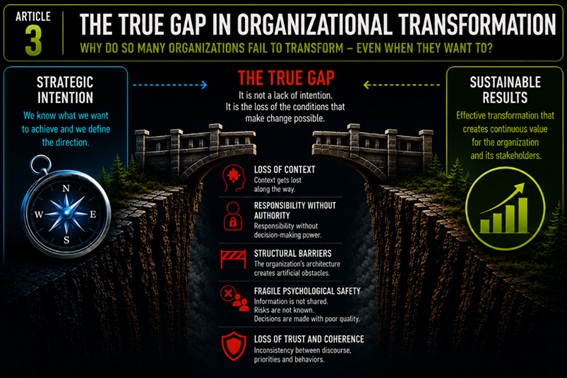
The first obstacle identified by the report concerns the progressive loss of context.
Organizations invest significant time defining strategy.
They clarify objectives.
They define priorities.
They produce plans.
They communicate intentions.
However, as those decisions cascade through the organization, part of their meaning is gradually lost.
What began as a strategic intention gradually transforms into:
- Objectives;
- Metrics;
- Projects;
- Tasks;
- Instructions.
When it finally reaches the teams, what needs to be done often remains clear, but why it needs to be done is no longer evident.
This distinction is decisive.
Without understanding context, teams can execute.
However, they face far greater difficulty in adapting.
Adaptation requires understanding intention—not merely following instructions.
When context disappears, part of the capacity to make coherent decisions in the face of unexpected situations also disappears.
Strategy then ceases to guide work.
It merely describes it.
Responsibility without authority remains dependency
Another recurring obstacle relates to how decision-making power remains distributed in organizations.
In recent years, it has become common to speak of autonomous teams.
However, autonomy does not result simply from assigning responsibilities.
A team can be responsible for project outcomes and yet remain entirely dependent on successive authorizations to alter priorities, mobilize resources, resolve dependencies, or respond rapidly to new circumstances.
In these cases, the organization transfers responsibility.
However, it does not transfer effective decision-making capacity.
The consequence becomes predictable.
Teams remain waiting.
Decisions continue to ascend the hierarchy.
Priorities shift faster than the organization can respond.
Adaptation becomes slow not because teams are incapable, but because the decision architecture remains essentially unchanged.
Barriers created by the organization itself
The report also calls attention to a particularly relevant phenomenon.
Many organizations seek to become more adaptive while simultaneously maintaining structures designed to maximize stability, efficiency, and control.
This combination produces permanent tension.
- Speed is desired; multiple approval layers are maintained.
- Experimentation is desired; error-penalizing mechanisms are maintained.
- Cross-functional collaboration is desired; functional silos are maintained.
- Continuous adaptation is desired; processes designed for relatively stable environments are maintained.
There is no contradiction between people here.
There is a contradiction between objectives and organizational architecture.
Organizations begin demanding behaviors that their own structures continue to impede.
Psychological safety is also an operational issue
The report also addresses a topic that, for a long time, was treated primarily as a cultural issue:
Psychological safety.
Naturally, an important human dimension remains.
However, there is also an organizational dimension that is frequently undervalued.
Without psychological safety, information degrades.
Risks cease to be communicated in a timely manner.
Errors remain hidden.
Assumptions cease to be questioned.
Bad news ascends more slowly.
Decisions come to rely on an incomplete representation of reality.
From this perspective, psychological safety ceases to be merely a well-being factor.
It becomes an essential condition for the quality of organizational decision-making.
The greater the complexity, the greater the importance of this condition.
Because adaptive organizations depend on the continuous flow of credible information.
Without that flow, adaptive capacity is inevitably reduced.
Trust accelerates adaptation
There is another element running throughout the entire report:
Trust.
When trust exists:
- People share information.
- They question assumptions.
- They experiment with new approaches.
- They take responsibility.
- They learn faster.
When that trust does not exist, precisely the opposite happens.
- People avoid exposing problems.
- They protect themselves.
- They wait for instructions.
- They postpone decisions.
- They escalate situations they could resolve locally.
The organization slows down precisely when it needs speed the most.
Trust, therefore, ceases to be merely a characteristic of interpersonal relationships.
It comes to represent an invisible infrastructure of adaptive capacity.
The true problem is inconsistency
Observing these different obstacles, a common pattern emerges.
- None of them results from the absence of methodologies.
- None results from the nonexistence of processes.
- None stems from a lack of technology.
The common element is different:
The organization seeks to adapt without preserving the conditions necessary for that adaptation to occur.
- It wants speed; it maintains slow structures.
- It wants autonomy; it maintains centralized authority.
- It wants innovation; it maintains risk aversion.
- It wants learning; it maintains cultures where error continues to be penalized.
- It wants collaboration; it maintains local incentives.
Inconsistency thus becomes one of the greatest obstacles to organizational transformation.
Not because organizations do not know the path, but because they frequently remain organized according to assumptions incompatible with the outcomes they intend to achieve.
The true gap
Perhaps this is the main message of the report.
The true gap in organizational transformation does not separate strategy and execution.
Nor does it separate leadership and teams.
Much less technology and people.
The true gap separates what the organization intends to achieve from the conditions it preserves to make that intention possible.
This distinction profoundly alters how we interpret transformation.
Transforming ceases to mean merely altering structures, processes, or methodologies.
It comes to mean preserving a set of organizational conditions that make it possible to learn, decide, adapt, and create value continuously.
When those conditions do not exist, any transformation initiative will inevitably hit a limit.
- Regardless of the quality of the methodology used.
- Regardless of the competence of the teams.
- Regardless of the available technology.
A new perspective on transformation
Perhaps the greatest contribution of Closing the Change-Readiness Gap is precisely this:
To remind us that transforming an organization does not consist merely in defining a new direction.
It consists in ensuring that this direction can cascade throughout the entire organization without losing meaning, decision capacity, trust, and coherence.
True readiness for change does not depend solely on strategic intention.
It depends on the conditions that allow that intention to be transformed into action.
And that distinction profoundly alters how we understand Project Management itself.
Because projects are, increasingly, one of the primary mechanisms through which organizations materialize their strategy.
If these conditions are not preserved, projects will also inevitably encounter limits that no methodology will be able to resolve.
The problem, after all, does not consist merely in changing the organization.
The true challenge consists in preserving the conditions that allow that change to happen.
In the next article, I will analyze the implications of this evolution for the role of the Project Manager and discuss why this professional is assuming an increasingly important role as an integrator between strategy, execution, people, technology, and organizational transformation |
Posted on: August 16, 2026 04:49 AM
|
Permalink |
Comments (2)
|
If a woman has to choose between catching a fly ball and saving an infant's life, she will choose to save the infant's life without even considering if there is a man on base.
- Dave Barry
|




