
Constitutional Stewardship


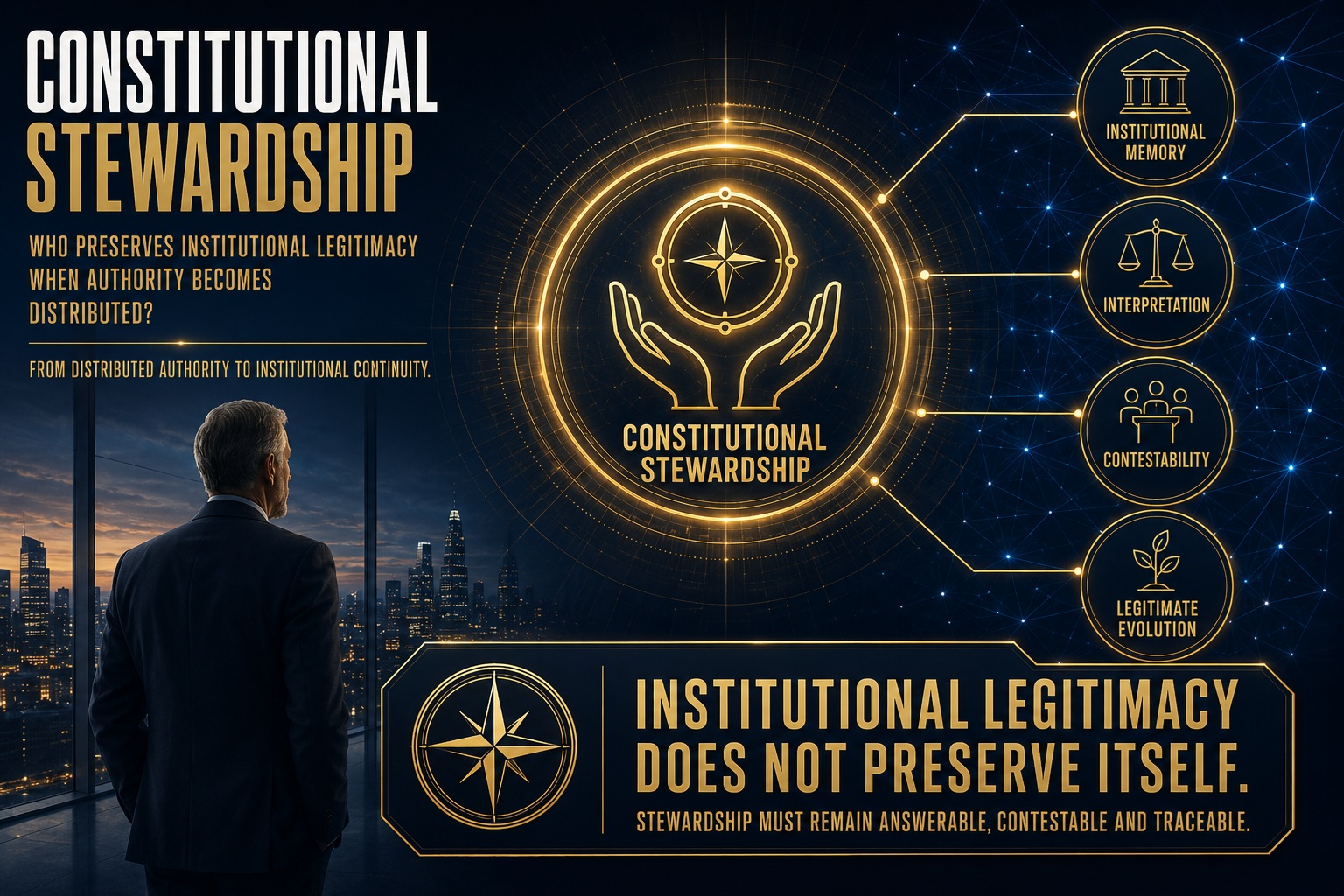 Who Preserves Institutional Legitimacy When Authority Becomes Distributed? Organizations do not preserve their legitimacy automatically. Policies may be documented. Governance structures may be established. Decision authorities may be clearly defined. Constitutional commitments may be formally articulated. None of these, however, is self-executing, self-interpreting or self-renewing. Organizations evolve. Markets change. Technologies mature. Leadership changes. Structures are redesigned. New computational capabilities emerge. Decision formation, recommendation and execution become increasingly distributed across people, teams and computational capabilities. The constitutional challenge therefore extends beyond defining which institutional commitments deserve deliberate preservation. It also requires preserving, interpreting and legitimately evolving those commitments as the organization itself changes. This is the challenge of Constitutional Stewardship. The previous article argued that constitutional organizations intentionally preserve, interpret and legitimately evolve institutional commitments that remain more stable than the ordinary decisions, practices and arrangements they govern. That naturally raises another question. Who preserves those commitments as authority itself becomes increasingly distributed? The answer cannot simply be "everyone." Shared responsibility becomes institutionally weak when it is not accompanied by identifiable authority, differentiated duties and answerability for preservation. Nor should institutional legitimacy depend exclusively on a single constitutional authority acting on behalf of the entire organization. A central body may perform an important stewardship role. But no individual, committee or office should become the exclusive source of constitutional meaning. Constitutional Stewardship therefore begins with a simple observation. Institutional legitimacy requires stewardship. It does not preserve itself. Many organizations possess governance. Fewer consciously develop stewardship. The distinction is fundamental. Governance structures, distributes and constrains authority. Stewardship preserves the institutional legitimacy through which that authority remains recognizable, contestable and worthy of trust. Governance asks: Who may decide, within which boundaries and under what forms of accountability? Stewardship asks: How does the organization preserve, interpret and legitimately evolve the institutional foundations through which that authority continues to deserve recognition? These are different questions. Both are necessary. Neither replaces the other. Governance structures how authority is exercised. Stewardship preserves the institutional conditions through which that exercise of authority remains legitimate across time. Distributed authority can expand organizational capability. Decisions can be made closer to operational reality. Relevant expertise can influence action more directly. Adaptation may become faster and more context-sensitive. Computational capabilities can support analysis, coordination and execution at increasing scale. Yet distribution also introduces an institutional risk. Authority is often easier to distribute than the institutional legitimacy required to sustain its exercise. Responsibility is easier to diffuse than answerability. Interpretation is easier to fragment than coherence is to preserve. Organizations may succeed in distributing decisions while weakening the institutional continuity that allows those decisions to remain collectively legitimate. This is where governance alone becomes insufficient. The organization also requires stewardship. Constitutional Stewardship should not be confused with ownership. Institutional commitments are not the property of any particular organizational actor. They express obligations that extend beyond the tenure, preferences and authority of those temporarily responsible for interpreting them. Stewardship is therefore not ownership or sovereign control. It is an institutionally authorized responsibility for preserving, interpreting and enabling the legitimate evolution of constitutional commitments. The distinction lies not in the absence of authority, but in its purpose. Ownership claims control. Stewardship exercises authority conditionally, on behalf of commitments that no steward may redefine unilaterally. Constitutional Stewardship may be distributed across multiple roles, bodies and relationships. But distribution must not become diffusion. The organization must remain able to identify who is responsible for preserving institutional memory. Who may interpret constitutional commitments. Who can contest those interpretations. Who can require reconsideration. Who may authorize legitimate revision. Authority may be distributed. Stewardship may be shared. Responsibility for preservation must nevertheless remain institutionally traceable. Distributed stewardship therefore requires answerability, countervailing authority and institutional traceability. Answerability ensures that those exercising stewardship can explain and justify how constitutional commitments have been interpreted, protected or revised. Countervailing authority prevents any individual or body from becoming the exclusive source of constitutional meaning. Institutional traceability allows the organization to reconstruct how commitments were interpreted, challenged and revised across time. These conditions prevent distributed stewardship from becoming anonymous, insulated or structurally unaccountable. Constitutional Stewardship also depends on several interdependent institutional capabilities. Institutional memory preserves the reasons, precedents and commitments required to connect past decisions with present interpretation. Institutional interpretation keeps constitutional commitments intelligible and relevant as organizational contexts evolve. Contestability preserves the organization's ability to challenge constitutional interpretations before and after they become embedded in institutional practice. Contestability must, however, be effective rather than merely formal. A constitutional commitment may remain formally open to revision while becoming practically immune to learning if those who surface materially relevant dissent, adverse evidence or alternative interpretations incur personal or professional cost. Constitutional Stewardship must therefore preserve legitimate channels through which such challenges can reach the competent authority, with protection against retaliation, appropriate confidentiality, traceability of how they are handled and an obligation to consider them. Protected dissent is necessary, but it is not self-authorizing. The ability to challenge a commitment does not confer authority to revise it. Revision must remain subject to bounded authority, proportionate deliberation and the legitimacy requirements appropriate to the institutional significance of the commitment. Protected dissent preserves the organization's capacity to recognize when revision may have become legitimate. It does not predetermine whether revision is justified. Coherence examines whether everyday decisions, practices and arrangements remain consistent with constitutional commitments. Legitimate evolution allows constitutional commitments to be revised through processes proportionate to their institutional significance and supported by broader deliberation, justification and authority than ordinary operational change. None of these capabilities exists independently. Together, they allow constitutional evolution without reducing institutional legitimacy to either rigidity or constant revision. Constitutional Stewardship must guard against both excessive rigidity and institutional drift. The less visible of these risks is often drift. Organizations rarely abandon their constitutional commitments through a single deliberate decision. More often, legitimacy weakens through the cumulative effects of successive operational adaptations. Exceptions become precedents. Temporary practices become permanent routines. Optimizations become institutional assumptions. Over time, organizations may discover that they have not consciously revised their constitutional commitments. They may continue to invoke those commitments while no longer preserving the conditions that give them practical meaning. Institutional erosion is rarely dramatic. It is usually incremental. This is precisely why stewardship cannot be understood as occasional constitutional review. It requires sustained institutional attention. Stewardship should not prevent organizational evolution. Its purpose is exactly the opposite. Organizations must remain capable of learning, adapting, innovating and transforming when their purpose and context require it. Constitutional Stewardship preserves the conditions through which that evolution can remain institutionally legitimate. Not every constitutional commitment should remain unchanged. Neither should every commitment evolve with equal ease. Stewardship therefore preserves neither rigidity nor permanent stability. It preserves institutional continuity through legitimately governed evolution. This distinction defines its constitutional role. As organizations increasingly integrate human judgment, computational capabilities and distributed authority, stewardship itself becomes an organizational capability. It is not necessarily a single role, office or governance body. Nor can it depend exclusively on individual leaders. Constitutional Stewardship is not defined by any single organizational form. It becomes organizationally real through identifiable arrangements, practices and relationships that preserve constitutional legitimacy across time. Those arrangements may include differentiated responsibilities, interpretive practices, institutional memory, channels of contestation, countervailing authority and legitimate processes of revision. Their form may vary. Their institutional function cannot disappear. Constitutional commitments cannot remain more stable than ordinary organizational change unless responsibility for their preservation remains identifiable, answerable, contestable and institutionally traceable. Constitutional Stewardship therefore does not determine who governs the organization. It determines how the legitimacy of governance is preserved when authority, interpretation and action become distributed. That legitimacy is not preserved by everyone in general. Nor is it preserved by one authority alone. It is preserved through identifiable stewardship arrangements whose responsibilities remain institutionally visible and whose exercise of authority remains open to justification, contestation and legitimate revision. Yet stewardship cannot depend on intention alone. Those entrusted with preserving constitutional legitimacy must themselves operate within boundaries that prevent interpretation from becoming discretion without limit, preservation from becoming rigidity and authority from becoming capture. This reveals a broader organizational principle. Freedom does not become sustainable through the absence of constraints. It becomes sustainable through constraints that preserve the conditions for legitimate action. That is the question explored in the next article: Constraint as a Strategic Capability: Why Freedom Requires Boundaries. |
Posted on: August 17, 2026 05:35 AM
| Permalink |
Comments (1)


