
M.O.R.E. Expands What Project Professionals Are Expected to Own. But Does Their Authority Expand with Their Accountability?


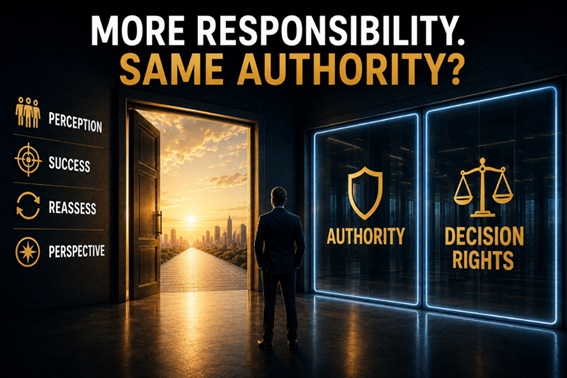 I recently completed PMI's M.O.R.E. Masterclass. Its central proposition deserves serious consideration. Project professionals should not define success narrowly through execution. They should Manage Perceptions, Own Success, Relentlessly Reassess and Expand Perspective. PMI's current research reframes project success beyond schedule, budget and scope toward a broader conception incorporating stakeholder value and desired outcomes. There is much to support in that direction. A project can deliver what was planned and still fail to create meaningful value. Assumptions can become invalid. Stakeholder expectations can change. Benefits may depend on adoption long after delivery. Organizational conditions can evolve while the project is underway. Project professionals should care about all of this. But taking M.O.R.E. seriously raises a question that deserves equal attention: If M.O.R.E. expands what project professionals are expected to own, does their authority expand with their accountability? The answer is more complex than it first appears. The Move Beyond Execution Did Not Begin with M.O.R.E. Historical continuity matters when evaluating claims of professional change. In 2013, Jack S. Duggal presented How to change the world?: The next generation of project managers at PMI Global Congress 2013, North America. It was not a PMI standard and should not be represented as an official institutional position. But it formed part of PMI's professional intellectual ecosystem. Read today, its argument is striking. Duggal directly addressed the "Ownership and Accountability of Benefits and Outcomes" and challenged the conventional separation between responsibility for project execution and responsibility for benefits and outcomes. His broader argument moved toward holistic and integrative project management, stakeholder adoption and experience, adaptation, and greater responsibility for overall project success. This is not merely evidence that isolated components of M.O.R.E. existed before M.O.R.E. It is evidence of something more significant. More than a decade earlier, an integrated professional proposition combining broader project success, outcome ownership, stakeholder experience, holistic thinking, adaptation and responsibility beyond delivery had already been articulated within PMI's professional intellectual ecosystem. And this was not an isolated formulation. In 2014, Duggal extended the argument in How to change the world with project management. He again questioned narrow responsibility for execution and delivery, explicitly addressed ownership and accountability for benefits and outcomes, and connected project management more closely with change, adoption, results and benefits realization. Taken together, the two papers establish a documented intellectual continuity: Execution and delivery → adoption and outcomes Deliverables → benefits and value Narrow project responsibility → broader ownership Control → sensing, adjustment and adaptation Project manager → more integrative change-oriented professional That does not establish that M.O.R.E. derives from Duggal's work. Temporal precedence is not intellectual derivation. But it changes the novelty question. If a substantially integrated proposition combining broader success, outcome ownership, stakeholder experience, holistic thinking and continuous adaptation was already articulated within PMI's intellectual ecosystem in 2013 and further developed in 2014, what is substantively new in M.O.R.E. beyond its empirical codification, behavioral translation and institutional amplification? That is a more demanding test than asking whether individual M.O.R.E. practices existed before. It asks whether the integration itself is new. The Historical Record Is Richer Than Execution Versus Value The issue extends beyond these two conference papers. PMI's Benefits Realization Management work subsequently emphasized strategic alignment, value creation, benefits ownership, defined roles and explicit accountability. PMI states that BRM requires effective cooperation, defined roles and responsibilities, ownership and accountability, and identifies the benefits owner as an important role in overseeing benefits realization. This matters because it challenges an overly simple historical narrative: Traditional project management → scope, schedule, cost and execution versus Contemporary project management → value, outcomes, stakeholders, adaptation and impact. PMI's own intellectual history is more sophisticated than that contrast suggests. Long before M.O.R.E., its ecosystem was already wrestling with value, benefits, strategic alignment, stakeholder experience, broader definitions of project success, adaptation and accountability for outcomes. M.O.R.E. therefore cannot reasonably be treated as the origin of project management's movement toward value. The more interesting question is what it does with that inheritance. The Other Side of the Historical Debate Expanding responsibility for outcomes has always created another problem. Projects do not produce value through the project professional alone. Benefits may depend on business owners. Adoption may depend on operations. Product value may depend on product decision-making. Strategic priorities and investment decisions may belong to executives or governance bodies. Resources may be controlled outside the project. PMI's own BRM work recognized precisely this distributed reality by emphasizing defined roles, cooperation, benefits ownership and accountability. This reveals a fundamental organizational distinction: Value may be collectively produced, but authority, decision rights and accountability remain distributed. A project professional may recognize that a business case is deteriorating while someone else retains authority to continue the investment. They may identify that expected benefits are at risk while operational functions control the conditions necessary to realize them. They may challenge a strategic assumption while executives retain authority over strategy. They may recommend stopping a project without possessing legitimate authority to terminate it. The professional can and should exercise agency in all these situations. But agency is not authority. Influence is not a decision right. And concern for an outcome is not necessarily accountability for producing it. This Makes "Own Success" Particularly Important PMI's 2024 Maximizing Project Success research makes one of its four implications explicit: Own project success: Be accountable for the project's value, not only its execution. The four implications were: Manage perceptions. Own project success. Reassess parameters. Expand perspective. They subsequently became recognizable as the architecture of M.O.R.E.: Manage Perceptions. Own Success. Relentlessly Reassess. Expand Perspective. The 2025 Step Up research reports that 69% of stakeholders and executives expect project professionals to take primary responsibility for the elements embodied by M.O.R.E. It also reports an increase in NPSS from 27 to 94 when project professionals consistently practice all four elements. PMI now explicitly calls on project professionals to take greater ownership and move beyond execution toward outcomes and value. That makes the meaning of ownership more than a semantic issue. It becomes a governance question. What Does It Mean to Own Success? At least three interpretations are possible. 1. Behavioral Ownership "Own Success" may mean that project professionals refuse to hide behind the formal boundaries of delivery. They seek evidence. Question assumptions. Understand value. Challenge decisions. Influence stakeholders. Recommend action. Escalate threats they cannot legitimately resolve themselves. This interpretation is highly defensible. It expands professional agency without necessarily redistributing formal accountability. But it creates a novelty problem. If this is what Own Success means, much of its intellectual substance has strong antecedents in established project-management knowledge, including the integrated professional propositions articulated by Duggal in 2013 and 2014. 2. Shared Accountability Perhaps success is jointly owned across project professionals, sponsors, business owners, benefits owners, product leaders, executives and operational functions. That too can be defensible. But shared accountability requires architecture. Who decides? Who recommends? Who approves? Who commits resources? Who can change success criteria? Who owns benefits after transition? Who can terminate the investment? Who remains answerable when stakeholders disagree about what constitutes value? Without differentiation, shared accountability can become diluted accountability. 3. Substantive Outcome Accountability The strongest interpretation would make the project professional meaningfully accountable for overall project success and value. That would represent a more consequential professional shift. But it immediately creates another question: Where is the corresponding expansion of authority and decision rights? Accountability cannot simply migrate while the organizational power required to influence the relevant outcomes remains elsewhere. The M.O.R.E. Ownership Trilemma This produces what I would call the M.O.R.E. Ownership Trilemma: If "Own Success" denotes substantive outcome accountability, it requires a corresponding architecture of authority and decision rights. If it denotes shared accountability, it requires explicit differentiation to prevent accountability dilution and role conflict. If it denotes proactive professional agency within existing governance boundaries, it remains governance-coherent, but its incremental contribution over established project-management knowledge becomes more modest. None of these interpretations makes M.O.R.E. irrelevant. But they represent materially different propositions. And distinguishing between them determines what M.O.R.E. is actually asking the profession to become. The Strongest Defense of M.O.R.E. A serious critique should confront the strongest defense available. Perhaps M.O.R.E. is simply not intended to be a governance architecture. The 2026 From Vision to Practice: A Playbook to Apply M.O.R.E. provides practitioner-oriented guidance for applying M.O.R.E. and presents the framework as a practical way of moving beyond task execution toward owning outcomes and delivering value. This supports a plausible interpretation: M.O.R.E. may be better understood as a behavioral layer operating within a richer project-management architecture, rather than as a replacement for that architecture. That is a legitimate design choice. A behavioral framework does not need to reproduce every distinction contained in governance, sponsorship, benefits management, product management, systems thinking or the PMBOK Guide. Indeed, simplification may be one of its strengths. Four memorable dimensions can translate a large and fragmented body of professional knowledge into behaviors that practitioners can more easily remember, discuss and apply. But accepting this defense does not end the analysis. It creates another test: Can a simplified behavioral layer be safely and correctly applied when its meaning depends on governance distinctions that the layer itself does not fully express? For an experienced practitioner, "Own Success" may naturally mean: Understand, challenge, influence, recommend and escalate, while respecting legitimate decision authority. A less experienced practitioner may interpret exactly the same language as: I am responsible for making this project successful. Those are not equivalent propositions. Cognitive compression creates accessibility. It can also remove distinctions. Responsibility, Agency and Accountability Are Not the Same Three concepts should therefore remain distinct. Epistemic responsibility is the duty to understand what is happening, seek evidence, question assumptions and recognize material consequences. Professional agency is the duty to act on that understanding through challenge, recommendation, influence, collaboration and escalation. Outcome accountability is answerability for results within an architecture of legitimate authority, decision rights and meaningful causal influence. A project professional can possess extensive epistemic responsibility and professional agency without controlling every condition necessary to produce the eventual outcome. That is not diminished leadership. It is coherent governance. Was the Research Designed to Confirm PMI's Strategy? There is another question that deserves scrutiny. PMI's strategic commitment to maximizing project success preceded the publication of the 2024 research, and the research subsequently generated the broader project-success definition and four behavioral implications that would develop into M.O.R.E. PMI itself described the 2024 initiative as part of its commitment to Maximizing Project Success. That chronology raises a legitimate question: Was the research architecture sufficiently independent to discover something materially inconsistent with the institutional strategy within which it was conceived? The strongest criticism would be that the research was simply designed to validate a predetermined institutional conclusion. The evidence examined does not justify that claim. That conclusion matters. The 2024 program involved approximately 10,000 project professionals and 150 in-depth interviews. PMI describes the research goal as developing a definition of project success, measuring project success rates globally and understanding which factors are predictive of success. The underlying research considered different formulations of project success and both execution-oriented and outcome-oriented dimensions. There was therefore genuine empirical room for findings less aligned with a simplistic outcomes-only narrative. The strongest allegation of a wholly predetermined study does not survive the evidence currently available. But a more sophisticated question does. Data-Level Independence Is Not Interpretive-Level Independence Empirical evidence can tell us that stakeholders value outcomes. It can show associations between particular behaviors and perceived project success. It can identify factors predictive of success. But none of those findings automatically establishes: Project professionals should be accountable for the project's value. That is also a normative proposition about professional responsibility and governance. There is an inferential bridge between: What constitutes or predicts project success and Who should be accountable for producing that success. That bridge deserves explicit justification. The same issue arises in the subsequent M.O.R.E. research. PMI reports a striking relationship between consistent application of the four M.O.R.E. elements and NPSS, rising from 27 to 94. The 2026 Playbook states that professionals who fully adopt M.O.R.E. see their NPSS more than triple. Elsewhere, PMI uses even stronger public-facing language. Its M.O.R.E. page says that when project professionals fully embrace the four practices, "project success nearly quadruples", while its December 2025 press release says that M.O.R.E. "more than triples success rates." This makes methodological precision essential. Association, prediction and causation are not interchangeable. Higher-performing organizational environments may simultaneously enable M.O.R.E.-consistent behavior and produce greater project success. Governance maturity may matter. Leadership quality may matter. Professional competence may matter. Project selection may matter. Organizational capability may matter. Other variables may influence both behavior and outcomes. The stronger the causal language becomes, the stronger the evidence required to sustain it. The Research Question Therefore Changes The relevant question is no longer: Was M.O.R.E. simply invented to prove PMI's strategy? The evidence currently available does not support that conclusion. A better question is: How independent was the interpretation and normative codification of the empirical findings from the institutional strategy within which the research was conceived? That is a much more demanding methodological question. It distinguishes data-level independence from interpretive-level independence. And it avoids both extremes. We should neither assume institutional manipulation without evidence nor assume that a large empirical study makes the transition from evidence to institutional prescription epistemically neutral. What, Then, Is Actually New in M.O.R.E.? This brings the novelty question back into focus. The core intellectual territory occupied by M.O.R.E. has substantial antecedents in earlier project-management knowledge. More importantly, Duggal 2013 and 2014 weaken even the stronger proposition that M.O.R.E.'s principal conceptual novelty lies simply in integrating those elements. An integrated professional vision had already been articulated around: Broader project success, Outcome ownership, Stakeholder experience and adoption, Holistic thinking, Adaptation, Benefits and value, Responsibility beyond delivery. M.O.R.E.'s contribution may therefore lie elsewhere. It may provide cognitive compression, organizing dispersed expectations into four memorable dimensions. It may provide behavioral translation, converting broad principles into practitioner-level practices. It may provide pedagogical integration, enabling these behaviors to be taught through cases, reflection and application. It may provide a common professional language capable of crossing predictive, adaptive and hybrid environments. It adds empirical codification, associating a defined behavioral architecture with PMI's contemporary measure of project success. And perhaps most importantly, it provides institutional amplification, making this conception of professional behavior central to PMI's contemporary vision of the profession. PMI describes M.O.R.E. as a call to action for the profession and directly connects it with the shift from project management success to project success. These are potentially meaningful contributions. But they are different from originating the underlying project-management knowledge. A framework can add substantial practical value without inventing its constituent ideas. The appropriate test is therefore not simply: Is M.O.R.E. new? It is: Does the particular M.O.R.E. architecture create explanatory power, predictive value, practical utility or professional capability beyond what existed in its constituent and integrated antecedents? That remains an empirical question. The Harder Question Is Organizational The central issue is therefore not whether project professionals should care about outcomes. They should. Nor should the profession retreat into narrow execution. The historical evidence makes clear that this debate was already moving beyond such boundaries many years ago. The harder question is: How far can professional responsibility expand before organizational authority must expand with it? Suppose a project professional discovers that the business case no longer holds. There is a duty to notice. A duty to investigate. A duty to evidence. A duty to challenge. A duty to recommend. And, where necessary, a duty to escalate. But authority to terminate the investment is a separate matter. The same distinction applies to strategic choices, product decisions, benefits realization, operational adoption and resource allocation. Expanded professional responsibility does not automatically confer expanded decision legitimacy. Toward Governable Professional Agency This suggests a principle that could complement M.O.R.E.: A project professional's accountability for outcomes should remain proportionate to the legitimate authority, decision rights, competence, causal influence and opportunity to act available to that professional. This principle does not reduce professional responsibility. It expands responsibility while preserving legitimate attribution. Project professionals should see more. Understand more. Question more. Reassess more. Challenge more. Influence more. Escalate when necessary. And care deeply about whether projects actually create value. But organizations must preserve clarity about who possesses authority to decide and who remains accountable for outcomes dependent on those decisions. Otherwise, expanded professional ownership risks transforming an organizational governance problem into an individual responsibility problem. Perhaps the Real Opportunity Is to Connect the Two M.O.R.E. asks an important question: What more should project professionals do to help projects succeed? Organizations need to answer its counterpart: What must governance, authority and decision rights enable so that project professionals can legitimately exercise that expanded agency? The two questions belong together. The future of project management should not be a return to execution. But neither should it become an expansion of accountability without boundaries. The objective should be governable professional agency. Expand professional agency as far as necessary to understand, challenge, influence and protect project value. Keep formal outcome accountability traceable to the legitimate authority, decision rights and causal influence through which that value can actually be produced. M.O.R.E. may therefore be most valuable not because project management has finally discovered value, nor because project professionals should simply become accountable for everything that determines success. Its stronger contribution may be its ability to make long-developing professional expectations more visible, memorable, actionable and institutionally salient. If so, the next step is not simply to ask project professionals to own more. It is to ensure that what they are expected to own, what they are empowered to decide, and what they can legitimately be held accountable for remain coherent. That is where M.O.R.E. meets governance. And that is where the more important conversation begins. References Duggal, J. S. (2013). How to change the world?: The next generation of project managers. Paper presented at PMI® Global Congress 2013, North America, New Orleans, LA. Project Management Institute. PMI official source, Duggal 2013 Duggal, J. S. (2014). How to change the world with project management. Paper presented at PMI® Global Congress 2014, EMEA, Dubai, United Arab Emirates. Project Management Institute. PMI official source, Duggal 2014 Project Management Institute. (2016). Establishing Benefits Ownership and Accountability. Benefits Realization Thought Leadership Series. PMI official source, Benefits Ownership and Accountability The Boston Consulting Group. (2016). Connecting Business Strategy and Project Management. Benefits Realization Thought Leadership Series, Project Management Institute. PMI official source, Connecting Business Strategy and Project Management Project Management Institute. (2024). Maximizing Project Success: What Is Project Success? PMI official source, Maximizing Project Success Project Management Institute. (2024). Project Management Institute Champions a New Era of "Project Success": Launches Groundbreaking Research to Drive Value and Recognition for the Profession. PMI official source, 2024 research announcement Project Management Institute. (2025). Step Up: Redefining the Path to Project Success with M.O.R.E. PMI official source, Step Up Walker, D. (2025). Step Up: A New Vision for Project Success. Project Management Institute. PMI official source, Step Up: A New Vision for Project Success Project Management Institute. (2025). New PMI Research Reveals Strategy-Execution Gap Is Undermining Transformation – And How to Close It. PMI official press release Project Management Institute. (2026). From Vision to Practice: A Playbook to Apply M.O.R.E. PMI official source, M.O.R.E. Playbook Project Management Institute. (2026). Delivering M.O.R.E. PMI official source, Delivering M.O.R.E. |
Posted on: August 20, 2026 12:50 PM
| Permalink |
Comments (4)


