
When Accountability Becomes Structurally Misaligned


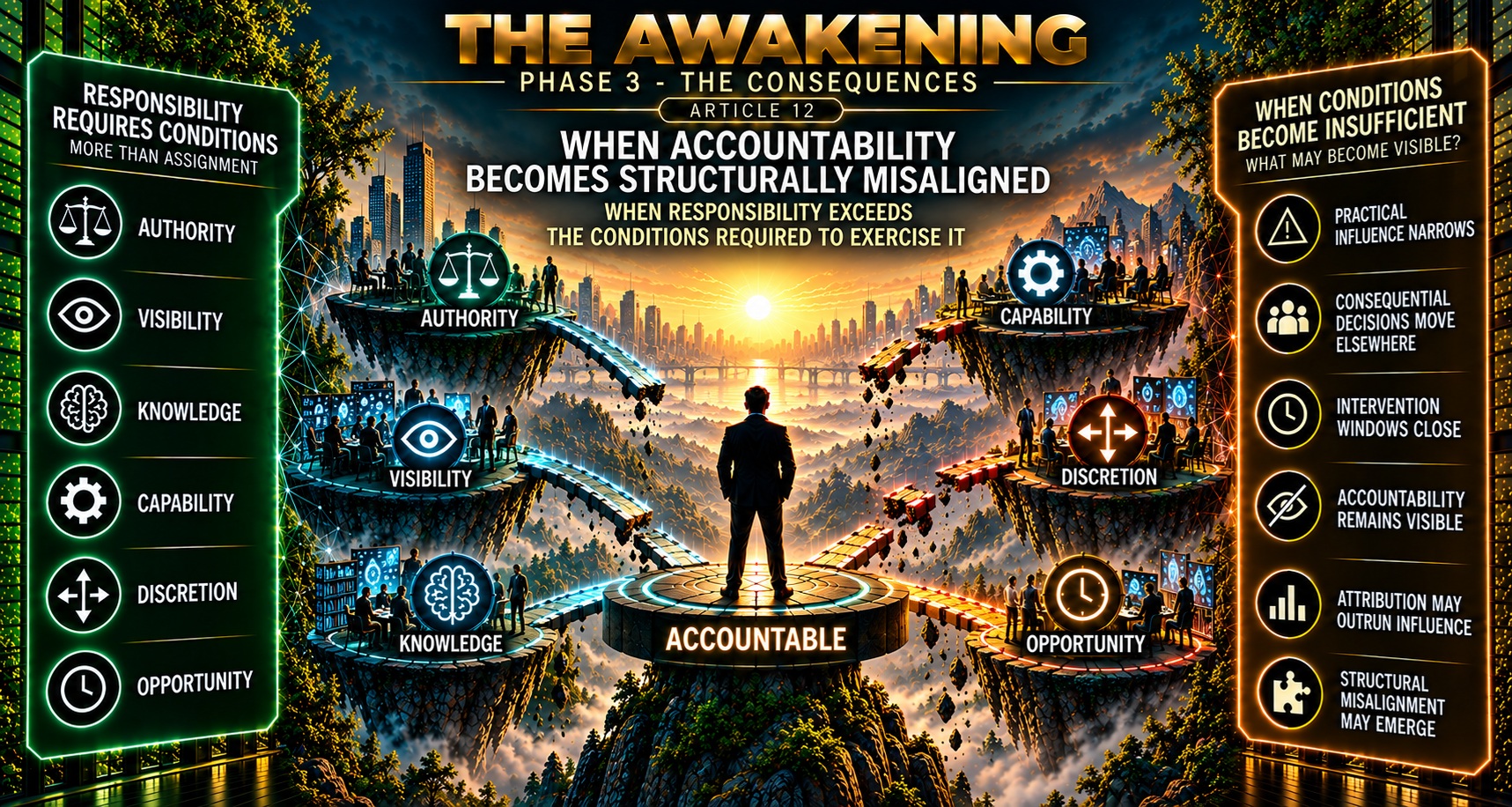 When Responsibility Exceeds the Conditions Required to Exercise It Someone is still accountable. The role has not disappeared. The responsibility has not been removed. The governance structure still identifies who owns the outcome. The escalation path still exists. And when something goes wrong, the organization may still know exactly whose name sits beside the responsibility. But that does not tell us whether that person still had the conditions required to exercise it. They may have lacked visibility into a consequential dependency. The knowledge required to understand the situation may have been distributed elsewhere. A decision may have been made beyond their authority. Their discretion may have narrowed. The opportunity to intervene may have arrived too late. Or they may have retained formal authority while losing the practical capacity to influence what happened. Nothing in the responsibility matrix necessarily changes when this occurs. The accountability remains visible. The conditions required to exercise it may not. That creates the central question of this article: What happens when formal responsibility remains in place while the conditions required to exercise it become insufficient? Accountability Can Remain After Its Conditions Have Changed Article 7 of THE AWAKENING asked whether accountability can remain legitimate when authority is distributed. That inquiry separated several relationships that organizations often compress into a single idea of responsibility. Responsibility is not authority. Authority is not knowledge. Knowledge is not capability. Capability is not discretion. Discretion is not causal influence. And formal accountability does not establish that the actor being held accountable possessed the conditions required to affect the relevant outcome. Article 7 treated this primarily as a problem of legitimacy and attribution. Article 12 asks a different question. What are the consequences when the architecture changes but accountability does not change with it? Consider a Project Manager who remains accountable for an outcome while consequential decisions increasingly occur within product teams, functional areas, governance bodies, suppliers, automated workflows or other organizational boundaries. That arrangement is not necessarily defective. Distributed authority may be entirely appropriate. Distributed knowledge may improve decision quality. Local discretion may increase responsiveness. Specialists may be better positioned to make particular decisions. Computational systems may recognize relationships that no individual could efficiently process. The problem does not arise simply because responsibility, knowledge and authority are distributed. It arises when formal responsibility remains attached to an actor while the conditions required to exercise that responsibility become insufficient for what the actor is still expected to influence. That is the possibility examined here. Responsibility Requires More Than Assignment Organizations are good at assigning responsibility. They create role descriptions. RACI matrices. Governance models. Delegations of authority. Approval thresholds. Escalation paths. Performance objectives. Contractual obligations. And named owners. These mechanisms matter. But assignment answers only one question: Who is expected to be responsible? It does not answer another: What must be true for that responsibility to be meaningfully exercised? At least several conditions may matter. Authority Can the actor legitimately make, authorize, challenge or escalate the decisions that materially affect the outcome? Visibility Can the actor see the information, dependencies, emerging conditions and consequences relevant to the responsibility? Knowledge Can the actor access or mobilize the knowledge required to interpret what is visible? Capability Does the actor have the practical capacity to understand, coordinate, decide or intervene as required? Discretion Is there meaningful room to act, or has the decision effectively been predetermined by rules, systems, commitments or decisions made elsewhere? Opportunity Can intervention occur while meaningful alternatives still exist? These conditions are not interchangeable. An actor may have authority without visibility. Visibility without knowledge. Knowledge without discretion. Discretion without capability. Capability without opportunity. Or formal responsibility without sufficient combinations of any of them. That matters because accountability can remain organizationally stable while its enabling conditions move. The Architecture Can Move While Accountability Stays Still Project systems rarely change all at once. Authority may gradually move closer to teams. Knowledge may become more specialized. Supplier ecosystems may expand. Governance may distribute decision rights. Automation may execute decisions previously made manually. AI may increasingly analyze, recommend, prioritize or trigger action. Product structures may change where decisions are made. Functional boundaries may determine which information is visible. None of these changes necessarily requires that formal accountability move at the same speed. The result can be subtle. The organization still knows who is accountable. But the system through which that person is expected to exercise responsibility may no longer be the system for which the accountability arrangement was originally designed. This creates a possible form of structural misalignment: The architecture of responsibility and the architecture of practical influence begin to diverge. That divergence does not automatically make accountability illegitimate. Nor does it prove that the accountable actor lacks agency. It creates a question that must be investigated: Has the actor retained sufficient authority, visibility, knowledge, capability, discretion and opportunity relative to the responsibility that remains assigned? Formal Authority May Not Be Effective Authority Formal authority matters. But its existence does not tell us whether it can still produce meaningful influence under the conditions in which it must be exercised. An escalation right that becomes usable only after a commitment is irreversible may preserve formal authority while providing little effective influence. An override right may matter little if the person expected to exercise it cannot recognize when intervention is required. This does not make formal authority meaningless. It means that formal authority and effective capacity to influence an outcome are not the same thing. Visibility Is Not the Same as Information Modern projects may produce enormous amounts of information. Dashboards. Reports. Risk registers. Logs. Metrics. Alerts. Forecasts. AI-generated summaries. Real-time operational data. That does not necessarily mean that the accountable actor has meaningful visibility. Visibility requires more than information being technically available. The relevant relationship must become recognizable. Its significance must be interpretable. And it must become visible while action remains possible. An actor can therefore be surrounded by information and still lack visibility into the consequence for which they will later be held accountable. This creates an important connection with integrative capacity. If consequential interdependencies are not recognized and connected across boundaries, an accountable actor may never receive the integrated understanding required to exercise responsibility effectively. But that connection must not be assumed in every case. The information may have been available and ignored. The actor may have misunderstood it. The signal may have been ambiguous. The risk may genuinely have been unknowable. Or the relevant uncertainty may have been irreducible. Lack of effective visibility is not automatically evidence of insufficient integrative capacity. Opportunity May Be the Condition We Notice Too Late Authority, knowledge and capability can all exist and still be insufficient if opportunity disappears. A decision may remain reversible today and become contractual tomorrow. A design choice may remain open until procurement commits. A stakeholder concern may remain manageable until public opposition hardens. A technical dependency may remain inexpensive to resolve until implementation begins. A governance intervention may remain useful until the decision path becomes locked. This makes time part of accountability architecture. The relevant question is not simply: Could the actor have intervened? It is: Could the actor have intervened while intervention could still materially change the outcome? That distinction matters. Because accountability assessed after the event can easily attribute responsibility using information and alternatives that were not available when action was still possible. The formal responsibility may be unchanged. The practical opportunity to exercise it may have disappeared much earlier. The Problem Is Not Always Too Little Authority There is an obvious response to accountability misalignment: Give accountable people more authority. Sometimes that may be appropriate. But it is not a general solution. More authority does not create knowledge. It does not guarantee visibility. It does not create capability. It does not recover a lost intervention window. It does not necessarily improve coordination across interdependent domains. And concentrating authority may create new information-processing constraints, slower decisions or weaker local responsiveness. The problem is therefore not: Accountability is concentrated, so authority should also be concentrated. Nor is it: Authority is distributed, so accountability should simply be distributed with it. The more demanding question is: What configuration of responsibility, authority, information, knowledge, capability, discretion and intervention opportunity is required for accountability to remain legitimate and practically exercisable under the actual conditions of the project system? That question cannot be answered through organizational symmetry alone. When Accountability Becomes Structurally Misaligned We can now state the hypothesis more precisely. A single instance of limited authority does not establish structural misalignment. Neither does one missed signal. One late escalation. One poor decision. One unclear role. Or one actor failing to use authority that was genuinely available. Persistence matters. But persistence alone would not make the misalignment structural. The mismatch would need to be recurring or embedded in the project configuration rather than merely episodic. The possibility examined here is that accountability becomes structurally misaligned when formal responsibility remains attached to an actor or role while the project configuration repeatedly or systematically fails to provide sufficient conditions for that responsibility to be exercised in relation to the outcomes for which accountability is retained. Temporary constraint may be normal. Incomplete information is unavoidable. Authority is always bounded. No actor can control every relevant cause. And accountability never requires omniscience. Structural misalignment would therefore need to describe something more systematic than the ordinary limits of responsible action. It would require a recurring or embedded mismatch between what the system expects an actor to answer for and the conditions the system makes available for influencing it. That is a hypothesis. It still has to earn the word structural. Accountability Misalignment May Remain Invisible The misalignment may be difficult to see precisely because the formal architecture remains intact. The responsibility matrix still looks coherent. The governance model still identifies an owner. Escalations still occur. Approvals still have signatures. Performance objectives still identify responsible individuals. The organization can therefore retain a clear appearance of accountability. But clarity of attribution is not the same as legitimacy of attribution. A name in a box tells us where responsibility was assigned. It does not tell us whether the conditions required to exercise that responsibility remained available. This creates a potentially important asymmetry: Accountability can remain highly visible while the erosion of its enabling conditions remains largely invisible. That possibility deserves particular attention in distributed project systems. Human Adaptation May Preserve the Alignment People may compensate when formal mechanisms do not provide every condition required for responsible action. Informal relationships may connect knowledge across functions. People may translate across boundaries. Experienced actors may recognize dependencies that formal mechanisms miss. And compensatory coordination may restore visibility or intervention capacity that the formal architecture does not provide reliably. That may represent resilience, architectural insufficiency, or both. Informal coordination is not necessarily evidence of structural weakness. It may itself be a legitimate part of the project's integrative architecture. The distinction matters. But the human burden, sustainability and learning consequences of such compensation require a separate inquiry later in this phase. AI Makes the Question More Difficult AI does not remove this problem. It can redistribute it. A computational system may detect a dependency before a human does. It may recommend an action. Prioritize an issue. Trigger a workflow. Reject a transaction. Optimize a schedule. Or execute within delegated boundaries. Formal accountability may nevertheless remain human. That arrangement may be entirely legitimate. But Article 10 established why human presence or approval alone cannot tell us whether meaningful human agency has been preserved. If the accountable human cannot understand the relevant context, recognize when intervention is required, access meaningful alternatives, or intervene before action becomes consequential, formal human accountability may remain while effective human influence has narrowed. The opposite is also possible. AI may increase visibility. Expand analytical capacity. Surface relationships earlier. Preserve intervention windows. And make accountability more exercisable rather than less. Technology therefore does not inherently create accountability misalignment. The question is whether the resulting human-organizational-computational configuration preserves the conditions required for legitimate and effective responsibility. Misalignment Does Not Eliminate Responsibility There is an important danger in this argument. If accountability requires authority, visibility, knowledge, capability, discretion and opportunity, almost anyone could defend failure by claiming that one of those conditions was incomplete. That would turn structural explanation into distributed impunity. That is not the argument. Actors can fail to exercise authority they genuinely possess. They can ignore available information. They can fail to seek relevant knowledge. They can avoid escalation. They can exercise poor judgment. They can fail to act while meaningful opportunity exists. And they can legitimately be held accountable for those failures. The existence of structural conditions does not remove individual agency. The relevant question is therefore not whether the actor faced constraints. Everyone does. It is whether the actor had sufficient conditions, relative to the responsibility assigned, to exercise meaningful influence over the outcome being attributed to them. Accountability requires attribution. Attribution requires examining both the architecture and the actor's conduct within it. Neither should substitute for the other. Alternative Explanations Must Survive Suppose an accountable actor repeatedly fails to influence outcomes. Is accountability structurally misaligned? Perhaps. But several alternatives remain. The role may simply have been poorly designed. Authority may have been available but unused. Objectives may have been unclear. Governance may have been weak. Information may have existed but not been examined. Political behavior may have obstructed action. The actor may have lacked capability that the role legitimately required. A supplier may have created an unforeseeable failure. The situation may have changed faster than any reasonable configuration could have responded. Or the outcome may have depended on uncertainty that no actor could meaningfully control. These alternatives matter. If accountability misalignment becomes the explanation whenever someone is responsible for an outcome they could not completely control, the concept explains almost every organizational responsibility. That would make it analytically useless. The hypothesis therefore needs a discriminating test: Was there a recurring or embedded mismatch between the responsibility retained and the conditions the project configuration could reasonably be expected to provide for exercising it, or did the actor fail to use conditions that were sufficiently available? Those are not the same problem. Accountability Is Not Control Accountability cannot require complete control. Projects are interdependent systems in which outcomes emerge from multiple actors, decisions, constraints, uncertainties and external conditions. No actor controls every causal contributor. The relevant question is therefore not whether the accountable actor controlled the outcome. It is whether the responsibility assigned was accompanied by sufficient legitimate influence, information and intervention capacity relative to what the actor was expected to answer for. That is more demanding than assigning ownership. But it is much less demanding than requiring control. What Would Make the Misalignment Structural? For the term structural misalignment to add explanatory value, several things should be observable. First, the mismatch should not be merely episodic. It should recur or be embedded in the project configuration. Second, the mismatch should concern conditions materially relevant to the assigned responsibility. Not every informational gap or authority boundary matters. Third, there should be a plausible mechanism connecting the configuration to the actor's reduced capacity to exercise responsibility. Fourth, the mismatch should remain distinguishable from individual failure, ordinary uncertainty, poor role design and other credible alternatives. Fifth, identifying the mismatch should explain something useful that a simpler statement such as “the person lacked authority” does not. Otherwise, there is no reason to introduce a stronger concept. The evidence must earn the adjective structural. What Article 12 Can and Cannot Conclude Several propositions can now be defended. 1. Formal responsibility does not establish that the conditions required to exercise it remain sufficient. 2. Those conditions can become differently distributed as project architecture changes. 3. Structural misalignment requires more than isolated constraint. It requires a recurring or embedded mismatch between assigned responsibility and the conditions required to exercise it. 4. Such a mismatch does not eliminate individual agency or legitimate accountability. 5. Neither distributed authority nor human or computational participation establishes accountability misalignment by itself. What cannot yet be concluded is that every persistent separation between responsibility and authority constitutes a distinct phenomenon of structural accountability misalignment. A stronger hypothesis is worth carrying forward: Accountability may become structurally misaligned when formal responsibility remains attached to an actor or role while the project configuration repeatedly or systematically fails to provide sufficient authority, visibility, knowledge, capability, discretion or opportunity for that responsibility to be meaningfully exercised in relation to the outcomes for which accountability is retained. That hypothesis has boundaries. It has alternative explanations. It preserves individual agency. And it can be rejected if the actor possessed sufficient conditions but failed to use them. That is enough for the investigation to continue. When Responsibility Stays but the System Moves Project systems can change while accountability arrangements remain comparatively stable. Authority can move. Knowledge can become more distributed. Decision rights can shift. Human and computational contributions can change. And the conditions through which responsibility is exercised can change with them. None of that eliminates accountability. Nor does it necessarily weaken it. Distributed systems may provide better conditions for responsible action. Technology may increase visibility and intervention capacity. Informal human adaptation may preserve connections that formal architecture cannot anticipate. But there may also be a point at which the organization continues to assign responsibility for outcomes while the conditions required to influence those outcomes become insufficient. When that happens, the problem is no longer simply: Who is accountable? The more demanding question becomes: Accountable with what authority, what visibility, what knowledge, what capability, what discretion, and while what meaningful opportunity to act still remains? Because responsibility can stay in exactly the same place while the system around it changes. And when the mismatch between responsibility and the conditions required to exercise it becomes recurring or embedded, accountability may become structurally misaligned. The next question is what happens when unresolved interdependencies and deferred trade-offs do not disappear, but accumulate over time. Article 13: The Cost of Deferred Integration. |
Posted on: September 28, 2026 10:20 AM
| Permalink |
Comments (1)
When Sponsorship Meets Ownership: Does PMI's Responsible Sponsorship Guide Close the Governance Gap?
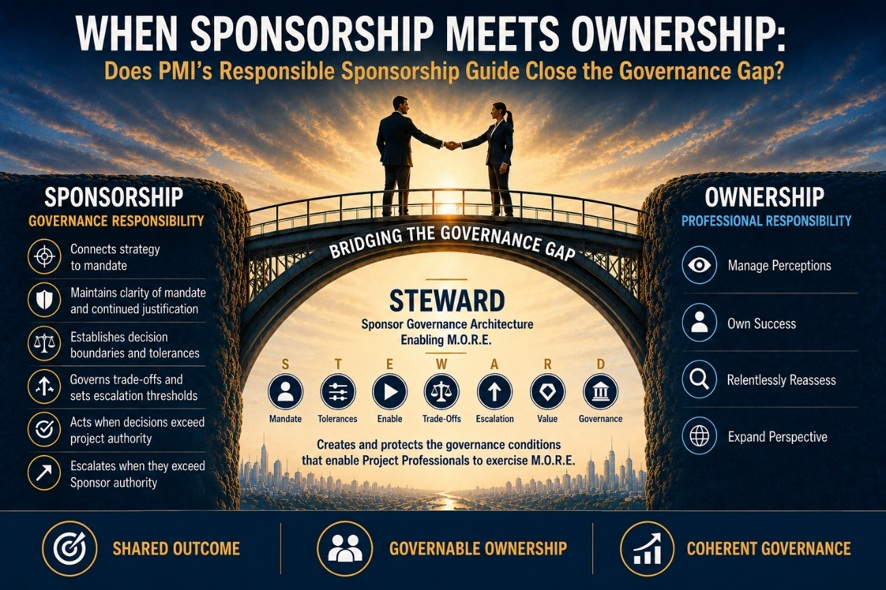 Project Professionals are increasingly expected to think beyond delivery. They are expected to understand strategic intent, question assumptions, reassess viability, influence stakeholders, anticipate consequences and remain focused on whether the project is actually creating value. PMI's M.O.R.E. framework captures this expectation through four practices: Manage Perceptions, Own Success, Relentlessly Reassess and Expand Perspective. Projects do not create value simply because deliverables are completed, schedules are maintained or budgets are controlled. Project outcomes emerge from a wider organizational system. But broader expectations of professional ownership create a governance question: If Project Professionals are expected to own more of project success, what authority must accompany that expectation? I explored that question in two previous articles. The first, M.O.R.E. Expands What Project Professionals Are Expected to Own. But Does Their Authority Expand with Their Accountability?, distinguished professional agency from formal authority and questioned how far responsibility for outcomes could expand while consequential decision rights remained elsewhere. The second, When Ownership Meets Governance: Designing Governable Professional Agency for Project Success, developed that argument further. It proposed that broader professional agency requires an organizational architecture connecting access to information, challenge, escalation, recommendation, decision, record and accountability. Since those articles were published, PMI's governance guidance has evolved. PMI has now published the GPM Guide to Responsible Project Sponsorship. The Guide does more than describe what effective Sponsors should do. It makes considerably more explicit the governance architecture surrounding project success. That creates a new question: Does PMI's Responsible Sponsorship Guide close the governance gap created by broader expectations of project-success ownership? Responsible Sponsorship Changes the Question One of the most important contributions of the new Guide is that it does not treat sponsorship merely as executive support. The Guide presents Responsible Sponsorship as a governance discipline. The Sponsor connects strategy to mandate, remains accountable for continued justification, establishes and maintains governance arrangements, defines decision tolerances and escalation thresholds, governs consequential trade-offs and intervenes when decisions exceed project authority. This matters because it shifts part of the discussion from individual professional behavior to organizational architecture. A capable Project Manager may recognize that a business case is deteriorating, identify a strategic inconsistency or conclude that a major trade-off threatens expected value. But recognizing a problem does not necessarily create authority to resolve it. The new Guide makes that distinction considerably clearer. Project Managers operate within an assigned mandate and agreed tolerances. Decisions beyond those boundaries move to the Sponsor and, where necessary, to the appropriate governing body. This provides something the language of professional ownership cannot provide on its own: An identifiable path to legitimate decision authority. That is a substantial development. The Emerging Division of Governance Responsibility The relationship between Project Professional and Sponsor becomes clearer when viewed through the decisions each is positioned to influence or make. The Project Professional remains close to the evolving reality of the initiative. They may reassess assumptions, identify dependencies, surface emerging risks, challenge interpretations, prepare decisions, recommend action, escalate matters beyond their authority and decide within the discretion legitimately assigned to them. The Sponsor occupies a different governance position. The Sponsor maintains clarity of the mandate and continued justification, establishes or preserves decision boundaries, governs consequential trade-offs and acts when decisions exceed project authority. Where the Sponsor's own authority is insufficient, the issue moves to the relevant governing body. This is not a hierarchy of professional importance. It is a distribution of governance functions. And that distribution matters because project outcomes are not produced by a single actor. Strategic choices may belong to executives. Investment decisions may belong to governance bodies. Resources may be controlled by functional organizations. Benefits may depend on business owners or operations. Adoption may depend on users and customers. Commercial outcomes may depend on suppliers and partners. Some project decisions may belong to the Project Manager within agreed boundaries. Others may belong to the Sponsor. Still others require portfolio, executive or governing-body authority. Project success is systemically produced while authority remains distributed. The clearer that distribution becomes, the more important it is to ask what ownership can legitimately mean. Responsible Sponsorship Strengthens the Architecture of Escalation This becomes particularly visible when project conditions change. Consider a Project Professional who concludes that assumptions supporting continued investment are no longer defensible. The professional may have a responsibility to identify the evidence, investigate its significance, challenge the assumptions, communicate the consequences and recommend action. But authority to continue, redirect, pause or terminate the investment may belong elsewhere. This distinction was central to my earlier argument about Governable Professional Agency. An escalation mechanism is meaningful only if authority exists at the other end. The new Responsible Sponsorship guidance strengthens that architecture by making escalation thresholds and authority transitions more explicit. When defined tolerances are exceeded, the matter moves beyond the Project Manager's authority to the Sponsor. Where the decision exceeds the Sponsor's authority, it moves again to the appropriate governing body. That is more than procedural escalation. It connects professional judgment with legitimate organizational authority. The Guide also gives continued justification a clear governance home. Authorization is not treated simply as a decision made at the beginning of a project. The underlying justification must remain defensible as circumstances evolve. This is particularly important for the meaning of Relentlessly Reassess. A Project Professional may reassess, conclude that the evidence has changed and recommend a different course of action. But reassessing justification and possessing legitimate authority to act on that reassessment are different organizational functions. Responsible Sponsorship helps make that boundary visible. STEWARD Makes the M.O.R.E. Relationship More Explicit The Guide goes further than simply clarifying Sponsor authority. Through its STEWARD model, it explicitly connects Responsible Sponsorship with M.O.R.E. That connection is important to the governance question. The Guide does not transfer responsibility for practicing M.O.R.E. from the Project or Program Manager to the Sponsor. Instead, it positions STEWARD as the Sponsor-side governance architecture that creates and protects the conditions within which Project and Program Managers can exercise M.O.R.E. The Guide also cites PMI research indicating that 69% of respondents, including 72% of Sponsors, place primary responsibility for practicing M.O.R.E. with the Project or Program Manager. This makes the emerging division of responsibility more explicit. Project Professionals are expected to exercise broader professional agency toward project success. Sponsors are expected to provide and exercise the governance needed to keep that agency connected to mandate, authority, escalation and continued justification. That is a significant answer to the governance problem raised in the earlier articles. It also provides a stronger test of what remains unresolved. If STEWARD supplies governance conditions for M.O.R.E. while M.O.R.E. remains primarily a Project or Program Manager responsibility, then the central question is no longer whether PMI recognizes the need to connect professional agency with governance. It clearly does. The sharper question is whether that connection also resolves what "Own Success" can coherently mean when consequential decision authority and causal influence remain distributed. So What Does "Own Success" Now Mean? This is where the new Guide creates its most interesting consequence. The clearer PMI becomes about who governs project success, the harder it becomes to treat "Own Success" as undifferentiated outcome accountability. If Sponsors remain accountable for continued justification, establish decision tolerances, govern consequential trade-offs, make decisions that exceed project authority and escalate matters that exceed their own authority, while other actors control resources, benefits, operations, strategic choices and organizational capabilities, then no Project Professional can coherently be assigned undifferentiated accountability for project success as a whole, irrespective of that distribution of authority and causal influence. This does not make "Own Success" wrong. It makes its meaning more important. There is a strong, governance-coherent interpretation of ownership. A Project Professional should not retreat behind the boundaries of task execution. Meaningful ownership requires seeking relevant evidence, understanding strategic intent, questioning assumptions, recognizing consequences beyond immediate delivery, challenging when evidence warrants it, recommending what professional judgment supports, escalating when authority lies elsewhere and acting decisively within legitimately assigned authority. That is meaningful ownership. But professional agency, decision authority and outcome accountability are not interchangeable. A professional may exercise extensive agency toward an outcome without possessing every decision right required to produce it. Likewise, limited authority does not remove responsibility for what the professional could reasonably have been expected to know, challenge, recommend, escalate or do. The appropriate objective is therefore not less ownership. It is differentiated ownership. Professional agency can be broad. Decision authority can remain distributed. Outcome accountability can exist, but it should remain proportionate to the actor's legitimate authority, decision rights, competence, causal influence, relevant knowledge and reasonable opportunity to act. Responsible Sponsorship provides a clearer governance architecture within which this interpretation of "Own Success" can be sustained. Has the Governance Gap Therefore Been Closed? Partly. The Guide makes Sponsor responsibilities for mandate clarity, decision boundaries, escalation, continued justification and consequential trade-offs considerably more explicit. Through STEWARD, it also explicitly connects those governance responsibilities with the conditions required for Project and Program Managers to practice M.O.R.E. Together, these address much of the authority architecture that broader professional ownership requires. But some questions remain. What Happens When Professional Judgment and Formal Authority Diverge? Suppose a Project Professional concludes, on defensible evidence, that a project should stop, challenges the underlying assumptions, escalates the issue and recommends termination. The legitimate authority decides to continue. The risk subsequently materializes. What happens to accountability? The professional remains responsible for the quality and timeliness of the analysis, the communication of uncertainty, the escalation and the actions taken within their authority. But the continuation decision was made by another actor. A governance architecture therefore needs to preserve the distinction between responsibility for professional judgment and accountability for a decision that another actor possessed the legitimate authority to make. Responsible Sponsorship makes the allocation of that authority clearer. But clarity about who decides does not, by itself, completely resolve how accountability should subsequently be attributed when professional advice and formal decision authority diverge. Decision Records Are Necessary, but Dissent Creates a Harder Case The new Guide also strengthens the importance of preserving decisions, assumptions and their rationale. That supports accountability. But a decision record and a record of dissent are not necessarily the same thing. When material disagreement exists, a mature governance system may need to reconstruct more than the final decision. What was known at the time? Which assumptions were challenged? What evidence supported the challenge? What recommendation was made? Who possessed the relevant authority? What decision was ultimately taken, and why? This is not an argument for defensive bureaucracy. It is an argument for accountability integrity. Without contemporaneous evidence, a systemically produced failure can later be compressed into a much simpler narrative around the actor most visibly associated with delivery. The Responsible Sponsorship Guide strengthens decision traceability. I do not find the Guide explicitly establishing how material professional dissent should be preserved when legitimate decision authority chooses a different course. Absence is not rejection. The Guide does not need to contain every possible governance mechanism. But the question remains relevant because broader expectations of professional ownership increase the importance of distinguishing who knew, who advised, who decided and who could legitimately act. Escalation Also Requires Governance Action Responsible Sponsorship clearly expects Sponsors to act when governance thresholds are reached. That is an important advance. But a narrower question remains. What happens when a material issue has been legitimately escalated and cannot be resolved within the Sponsor's own authority? A concern may be acknowledged and formally discussed while work, investment and exposure continue. Procedurally, escalation has occurred. Substantively, the consequential decision may still not have been made. Effective escalation therefore depends not only on identifying where authority resides, but also on whether the governance system can process a material issue within a decision window appropriate to its consequences. This leaves a further question: What obligation accompanies the receipt of a material escalation when a consequential decision is required? A governance architecture may therefore need more than an escalation pathway. It may also need an identifiable decision authority, an appropriate decision window and traceable accountability for whether the issue was considered and acted upon. Otherwise, procedural voice may exist without substantive governance effect. The Hardest Test May Come After the Professional Speaks There is another dimension that formal authority structures cannot resolve alone. Organizations often encourage professionals to challenge assumptions, speak up and act like owners. But those expectations become meaningful only when the organization can absorb inconvenient professional judgment. A Project Professional who genuinely Relentlessly Reassesses may discover that an important assumption no longer holds. Someone who genuinely Expands Perspective may identify consequences that powerful stakeholders would prefer not to confront. Someone who genuinely Owns Success may recommend stopping an initiative that senior leaders remain committed to continuing. At that point, the quality of governance is tested not by whether the organization encouraged the professional to speak, but by what it does after the professional speaks. Can evidence-based challenge be considered without being treated as disloyalty? Can an inconvenient recommendation reach the authority capable of acting on it? Can disagreement be preserved without distorting accountability? Can a legitimate authority reject professional advice while remaining accountable for the decision it was empowered to make? These questions extend beyond sponsorship competence. They concern the organization's capacity to make broader professional agency genuinely governable. Responsible Sponsorship and Governable Professional Agency Are Complementary Responsible Sponsorship and Governable Professional Agency should not be framed as competing architectures. They approach an overlapping governance problem from different positions. Responsible Sponsorship asks what Sponsors and governance systems must do to keep projects strategically justified, properly authorized and governable. Governable Professional Agency asks what organizational conditions are required when professionals are expected to exercise judgment, challenge assumptions, recommend action and protect value while consequential authority remains distributed. The overlap is substantial. Both depend on clear authority, meaningful escalation and decision traceability, and both reject the idea that professional capability can compensate for weak governance. STEWARD makes that complementarity more explicit by positioning Sponsor governance as an enabling condition for M.O.R.E., rather than as a substitute for the professional agency M.O.R.E. expects. The new Guide therefore closes part of the gap identified in my earlier articles. But it also helps reveal the remaining boundary more precisely. The issue is no longer simply whether Project Professionals have enough authority. The deeper issue is whether the relationship among professional agency, distributed decision authority and outcome accountability remains coherent as expectations of responsibility for project success expand. From "Own Success" to Governable Ownership Perhaps the most useful consequence of Responsible Sponsorship is not that it tells Project Professionals to own less. It is that it gives us a stronger basis for understanding what ownership should mean. "Own Success" can be read not as unlimited accountability for the total outcome, but as an obligation to exercise the fullest legitimate professional agency toward success while remaining accountable for one's decisions and actions within legitimate authority, and for outcomes to the extent justified by one's decision rights, meaningful causal influence and reasonable opportunity to act. At the same time, the organization must own its part. Sponsors must exercise the authority assigned to them. Governing bodies must make the decisions that belong to them. Business and operational owners must remain accountable for the conditions they control. And accountability must remain traceable to the actual distribution of knowledge, authority, decisions, actions, omissions and meaningful opportunities to act. That is not diluted ownership. It is governable ownership. Conclusion: The Gap Is Narrower, but the Question Is Sharper PMI's Responsible Sponsorship Guide materially advances the governance conversation. It makes explicit much of the authority architecture that broader expectations of project-success ownership require. Through STEWARD, it also explicitly connects Sponsor governance with the conditions under which Project and Program Managers are expected to practice M.O.R.E. The governance gap within PMI's current articulation of project-success ownership is therefore narrower than when the question was first posed. But closing part of that gap produces an important consequence. The clearer PMI becomes about who governs project success, the harder it becomes to treat "Own Success" as undifferentiated outcome accountability. Project Professionals can and should exercise broad agency toward success. Sponsors can and should exercise the governance authority entrusted to them. Other organizational actors remain responsible for decisions and conditions within their legitimate control. Project success remains systemically produced. The next step is therefore not to choose between professional ownership and organizational governance. It is to make them coherent. Responsible Sponsorship provides much of the governance architecture needed to do so. But the remaining test is whether organizations can preserve the connection between what professionals are expected to understand and challenge, what they are empowered to decide, what others legitimately decide instead, and what each actor can ultimately be held accountable for. That is where sponsorship meets ownership. And that is where "Own Success" becomes governable. |
Posted on: September 17, 2026 12:02 PM
| Permalink |
Comments (3)
Can Accountability Remain Legitimate When Authority Is Distributed?
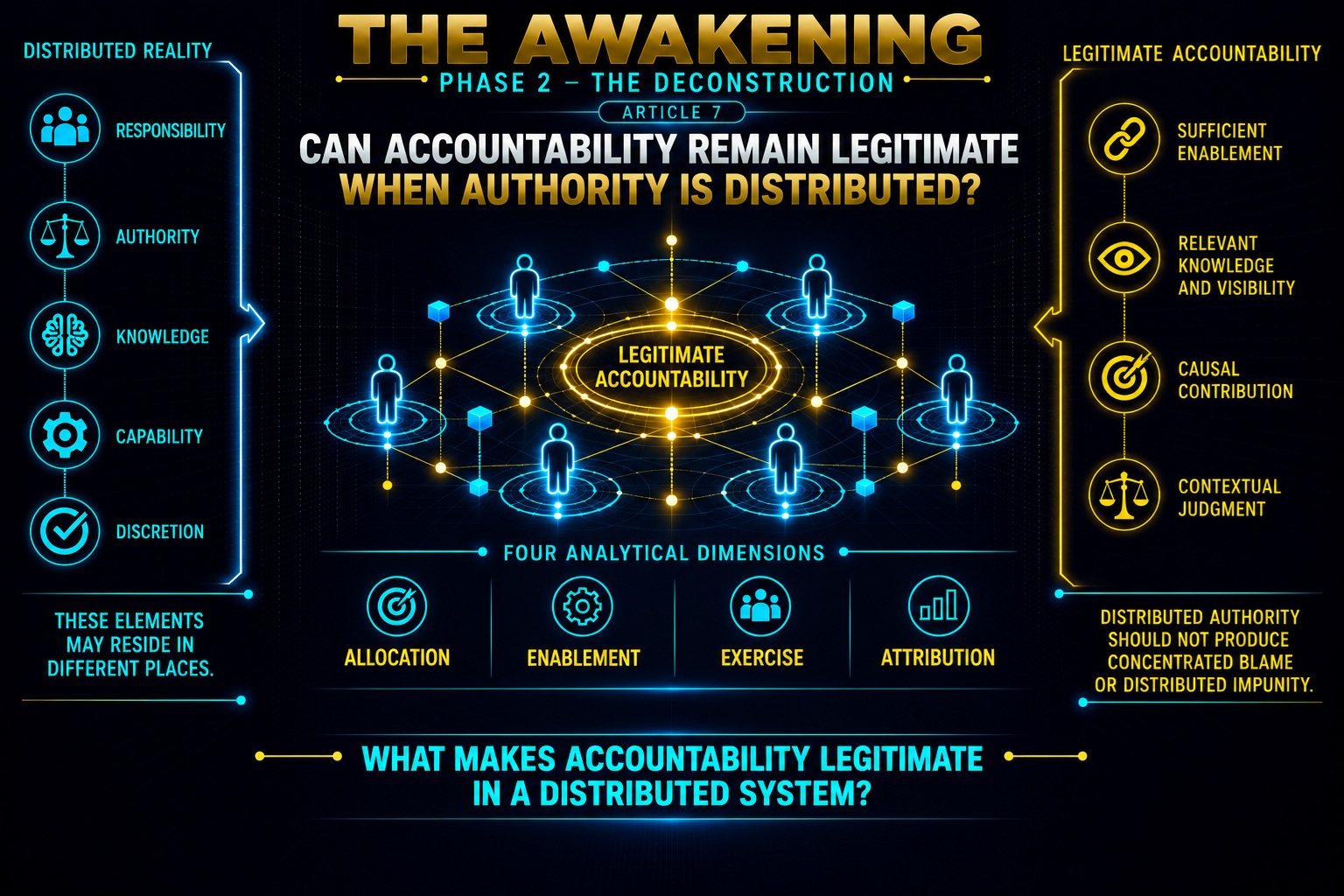 Rethinking Responsibility, Authority and Causal Capacity Accountability appears relatively straightforward when responsibility, authority and action seem to reside in the same place. Someone is responsible. That person has authority. They can act. Consequences follow. Accountability appears to have an obvious destination. But distributed project systems complicate that picture. Article 2 distinguished three dimensions of integrative responsibility: Allocation, Enablement and Exercise. Article 6 then separated the need for integration from the assumption that integration must reside in one designated role. That deconstruction reveals an immediate accountability problem. If responsibility can be distributed across several actors and mechanisms, accountability can no longer safely be inferred from role alone. Responsibility may sit with one actor while relevant authority resides elsewhere. Knowledge may be distributed across specialists, teams, suppliers, operational functions and governance bodies. Capability may depend on resources or expertise controlled by others. Discretion may be constrained by governance, contracts, organizational boundaries or prior commitments. And outcomes may emerge from interactions among decisions made legitimately by several actors rather than from the action of any single one. In such systems, identifying who was formally responsible may be relatively easy. Determining what they can legitimately be held accountable for is much harder. This raises the central question: Under what conditions can accountability remain legitimate when authority, knowledge, capability and discretion reside in different places? When responsibility and authority no longer coincide Accountability is often treated as if responsibility and sufficient authority should closely correspond. If someone is responsible for an outcome, we tend to expect that person to possess sufficient authority to influence it. If the expected outcome is not achieved, accountability for that outcome is often inferred. But distributed systems weaken that correspondence. A project leader may be responsible for project success while major resource, commercial or strategic decisions remain outside their authority. A Product Owner may control prioritization while operational, contractual or architectural consequences extend beyond the product boundary. A technical team may recognize a material dependency without having authority to resolve the trade-off it creates. A sponsor may possess substantial formal authority while depending on knowledge distributed across the system to understand when intervention is required. Responsibility, authority, knowledge, capability and discretion may therefore reside in different places. Once they do, formal responsibility alone becomes an insufficient basis for legitimate accountability. Responsibility is not authority The first distinction is fundamental: Responsibility ≠ Authority Responsibility concerns what an actor is legitimately expected to attend to, protect, decide, enable or accomplish. Authority concerns the legitimate right to make, influence or constrain particular decisions. The two may coincide. But they need not. Assigning responsibility does not create the authority required to exercise it. And possessing authority does not necessarily provide the knowledge, capability, visibility or discretion required to act effectively. This matters because accountability can become structurally distorted in both directions. An actor may be held accountable for consequences they lacked sufficient authority to influence. Or an actor with substantial authority may escape scrutiny because formal responsibility was assigned elsewhere. Neither outcome is satisfactory. Authority is not causal capacity A second distinction is equally important: Authority ≠ Causal Capacity Formal authority tells us something about what an actor is legitimately entitled to decide. It does not tell us everything about what that actor can actually cause, prevent or materially influence. Causal capacity may depend on several conditions. Relevant information may arrive too late. Resources may be controlled elsewhere. Technical possibilities may already have narrowed. Contractual commitments may constrain available choices. Intervention may require cooperation from other actors. Earlier decisions may have made some alternatives prohibitively expensive or practically irreversible. At the same time, actors without final decision authority may possess considerable causal capacity. They may determine which information becomes visible. Frame alternatives. Set technical parameters. Control resources. Configure systems. Shape recommendations. Establish operational constraints. Or make local decisions whose consequences propagate across organizational boundaries. Formal authority can therefore both overstate and understate actual causal contribution. If accountability is to remain legitimate, it cannot be inferred from authority alone. From integrative responsibility to legitimate accountability Article 2 distinguished Allocation, Enablement and Exercise as dimensions of integrative responsibility. Accountability introduces a further analytical question: Attribution. The resulting architecture contains four distinct dimensions. Allocation Who was legitimately responsible for what? Enablement Did the actor possess sufficient authority, knowledge, visibility, capability, discretion and opportunity to exercise that responsibility? Exercise Given those conditions, what did the actor actually do, or fail to do? Attribution Given the actor's causal capacity and actual action or inaction, what causal contribution can reasonably be attributed, and what accountability can legitimately follow from it? These dimensions should not be treated as a necessary linear sequence. They are analytical distinctions. But separating them matters. Responsibility may be appropriately allocated and inadequately enabled. It may be adequately enabled and not exercised. It may be exercised appropriately while the desired outcome still fails to materialize. And an undesirable outcome may occur without establishing that the responsible actor failed. Accountability therefore requires more than identifying who occupied the formally responsible role when the outcome occurred. Enablement is not optional Formal responsibility can support legitimate accountability only if the actor has sufficient conditions to exercise it. Authority matters. Relevant knowledge matters. Visibility matters. Capability matters. Discretion matters. Opportunity matters. An organization may formally allocate responsibility while retaining elsewhere the authority or capabilities necessary to discharge it. That is not sufficient for legitimate distributed accountability. It is a structural mismatch between responsibility and the conditions required to exercise it. But sufficient enablement creates another problem. What happens when the actor could act, yet responsibility was still not exercised? Capacity to act does not guarantee exercise Suppose an actor possesses substantial authority. The relevant information is available. The consequences are visible. The actor has sufficient knowledge and capability. There is still meaningful opportunity to intervene. Structurally, responsibility appears to be enabled. Yet intervention would require challenging a decision the actor previously supported. Or questioning a senior stakeholder. Or exposing a problem within their own function. Or delaying a strategically important commitment. Or confronting a powerful supplier. Or acknowledging that an earlier judgment was wrong. Or placing professional status, relationships or credibility at risk. The actor possesses capacity to act. But exercising that capacity carries a cost. This introduces an important distinction: Responsibility to act is not the same as Capacity to act is not the same as Cost of acting is not the same as Actual exercise and none of these, on its own, determines The legitimacy of holding someone accountable for not acting. These are different analytical objects. Exercise is not only structural Exercise cannot be reduced to the existence of a mechanism through which action is formally possible. Responsibility is exercised by people operating within organizational and relational systems. Formal authority may exist while incentives discourage its use. Escalation channels may exist while escalation is interpreted as failure. Information may be available while challenging its implications threatens established interests. Decision rights may be explicit while power asymmetries make their exercise difficult. An organization may formally encourage challenge while informally rewarding conformity. This does not mean that responsibility disappears. It means that: Exercise is not only structural. It is also behavioral and normative. But this qualification creates an obvious danger. If incentives, relationships, status, fear or political consequences affect the exercise of responsibility, almost any failure to act could potentially be explained by context. That would make accountability meaningless. The existence of a cost does not itself remove responsibility. Leadership can require challenging powerful interests. Governance can require questioning decisions that appear increasingly unsafe or incoherent. Ethical responsibility may require action precisely when silence is easier. The relevant question is therefore not: Was acting costly? It is: What was the nature and significance of that cost, how did organizational conditions shape it, what meaningful alternatives remained available, and what could reasonably be expected from the actor given the responsibility legitimately assigned to them? This prevents two opposite errors. Organizational conditions should not become an automatic excuse for individual inaction. But formal authority should not be treated as proof that responsibility was practically exercisable under all conditions. Non-action is not a simple binary Non-action should not be reduced to a binary distinction between: Unable and Unwilling. Between the two lies a more complex territory. Authority may be formally available but practically constrained. Knowledge may exist but remain fragmented. Materiality may be uncertain. Responsibilities may conflict. Escalation may threaten legitimate relationships or commitments. The consequences of acting and not acting may both be significant. And causal capacity may be partial rather than complete. Accountability must therefore examine the conditions of action rather than infer unwillingness from non-action. Individual and organizational responsibility This is why accountability must be considered at both individual and organizational levels. Organizations do not merely assign responsibility. They allocate authority, distribute knowledge, design decision rights and escalation mechanisms, establish incentives, and shape whether challenge is enabled or discouraged. Individual accountability should not automatically absorb failures materially shaped by organizational architecture. But the reverse is equally important. Organizational conditions cannot automatically absorb individual responsibility. An actor may possess sufficient authority, knowledge, capability, discretion and meaningful opportunity to act, face difficulties that are real but do not eliminate meaningful capacity to act, and nevertheless fail to exercise that responsibility. The analytical challenge is to distinguish these situations rather than collapse one into the other. Accountability requires causal discipline Distributed systems introduce another difficulty. Outcomes may have multiple contributors. A locally legitimate decision may create consequences elsewhere. Another actor may fail to surface those consequences. A governance body may see the issue but postpone intervention. A resource constraint may narrow the available response. A later decision may amplify the original effect. The final outcome may therefore be causally distributed. This does not mean that nobody can be held accountable. It means that accountability should not manufacture singular causality where singular causality did not exist. Different actors may legitimately be accountable for different contributions. One for a decision they had authority to make. Another for information they were responsible for surfacing. Another for a dependency they could reasonably have recognized. Another for an escalation they had sufficient grounds and opportunity to initiate. Another for a trade-off they legitimately accepted. And another for failing to exercise responsibility despite possessing sufficient conditions to do so. Distributed causal capacity may therefore require more precise accountability, not diluted accountability. From accountability to legitimate attribution The resulting shift is this. Accountability should not begin with: Who owns the outcome? It should begin with a more disciplined inquiry. What responsibility was legitimately allocated? Was that responsibility sufficiently enabled? How was it actually exercised? What causal contribution can reasonably be associated with the actor's action or inaction? And only then: What accountability can legitimately be attributed? This makes accountability more demanding. It also makes it more defensible. The architecture can therefore be summarized as: ALLOCATION What responsibility legitimately belonged to the actor? ↓ ENABLEMENT Did sufficient authority, knowledge, visibility, capability, discretion and opportunity exist? ↓ EXERCISE How was that responsibility actually exercised under the conditions affecting action? ↓ ATTRIBUTION Given the actor's causal capacity and actual action or inaction, what causal contribution can reasonably be attributed, and what accountability can legitimately follow from it? These relationships are analytical, not a necessary linear or causal sequence. And one dimension cannot simply be inferred from another. Formal responsibility does not prove enablement. Enablement does not prove exercise. Non-exercise does not prove unwillingness. Action does not prove causal responsibility for the outcome. And an adverse outcome does not retrospectively establish that an earlier decision or action was illegitimate. The accountability paradox of distributed systems Distributed systems create an apparent paradox. As authority, knowledge, capability and discretion become more distributed, attributing complex outcomes to a single actor merely because that actor occupies a formally accountable role becomes harder to defend. Yet the same distribution can make it easier for responsibility to disappear between actors. One response would be to reconcentrate authority and accountability. But that may sacrifice the distributed knowledge, responsiveness and local judgment that complex projects can require. The alternative cannot be accountability without authority. Nor can it be distributed responsibility without attribution. The challenge is to design accountability that follows the actual architecture of responsibility and causal capacity. That means preserving a demanding principle: Distributed authority should not produce either concentrated blame or distributed impunity. The Deconstruction Article 6 separated a necessary function from any assumed single role architecture. Article 7 now separates accountability from another familiar assumption: That formal responsibility, authority and accountability necessarily belong together. Sometimes they do. But distributed systems can separate them. And once responsibility, authority, knowledge, capability, discretion and causal contribution cease to coincide, legitimate accountability requires more than identifying who was formally responsible. It requires examining whether responsibility was appropriately allocated, sufficiently enabled and actually exercised, and what causal contribution can legitimately be attributed to action or inaction. Even sufficient formal authority and capacity may not settle the question. The practical exercise of responsibility can be affected by organizational, relational and personal conditions, including the consequences of acting. Those conditions matter. But they do not automatically excuse inaction. The difficult work lies in determining what could legitimately be expected of the actor under the conditions that actually existed. So perhaps the question is not simply: Who was accountable? It is: Under what conditions is holding someone accountable legitimate when responsibility, authority and causal capacity do not reside in the same place? That distinction may determine whether distributed accountability becomes more precise. Or merely more diffuse. |
Posted on: September 14, 2026 06:08 AM
| Permalink |
Comments (0)
When Transformation Is Not the Answer
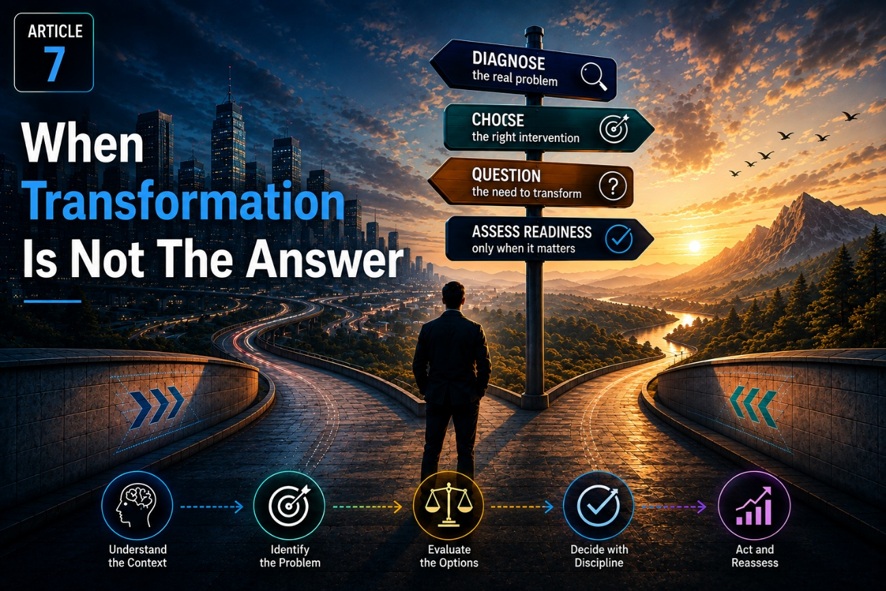 Why Adaptability Begins Before Change Over the previous articles in this series, I have explored a recurring idea. The new ways of working in projects are not simply about adopting new methodologies, introducing new technologies, or making teams more agile. They increasingly depend on the ability of organizations to adapt their structures, decision mechanisms, operating models, governance, and allocation of resources as the conditions around them change. But this raises an even more fundamental question. What if transformation itself is not the right response? A thoughtful comment from Aaron Porter on my previous article brought this question into sharp focus. He asked two deceptively simple questions: Is the organization solving the right problem? Is transformation the appropriate response? Those questions matter because much of the conversation about organizational transformation begins after a critical assumption has already been made: That transformation is necessary. From there, attention naturally turns to readiness, leadership, culture, capabilities, governance, technology, execution, and resistance to change. But an organization can be highly prepared to transform and still be preparing to execute the wrong intervention. That distinction changes where the conversation should begin. Before Readiness Comes Diagnosis When an organization underperforms, encounters disruption, or recognizes that existing ways of working are no longer producing the expected results, there is a natural pressure to act. Sometimes that pressure is justified. But recognizing that something is wrong is not the same as understanding what is wrong. A process may be poorly executed. A capability may remain appropriate but be insufficiently developed. An operating mechanism may work as designed but have become misaligned with a changed environment. A structure may have accumulated unnecessary complexity. A technology or capability may have become obsolete. Or assumptions that once justified existing arrangements may no longer hold. These are not necessarily the same problem. And they should not automatically produce the same response. Before asking how to transform, organizations therefore need to ask a more fundamental question: What problem are we actually trying to solve? Without that diagnosis, transformation can become a response in search of a problem. Transformation Is an Intervention Choice Aaron Porter made another important observation. Sometimes an organization does not need to transform. It may need to repair something that is not working as designed. It may need to optimize something that remains fundamentally sound. It may need to adapt to a changed external condition. It may need to simplify unnecessary complexity. It may need to replace an obsolete capability. It may need to stop doing something altogether. And sometimes it may indeed need a deeper transformation. This distinction matters because the language of transformation can unintentionally encourage organizations to treat scale of ambition as evidence of appropriateness. But an intervention is not better because it is more transformational. It is better when it is proportionate to the problem it is intended to address. A large intervention applied to a poorly diagnosed problem does not become more effective because it is ambitious. It may simply create more unnecessary change. Transformation Appropriateness Is Not Transformation Readiness This leads to a distinction that deserves greater attention. Transformation appropriateness and transformation readiness are not the same question. Transformation appropriateness asks: Is transformation the right response to the problem we have diagnosed? Transformation readiness asks: Do we have, or can we create, the conditions required for that transformation to work? The order matters. An organization may possess strong leadership commitment, adequate funding, capable teams, effective governance, appropriate technology, sufficient decision authority, and a high degree of readiness for change. None of those conditions demonstrates that transformation is the correct intervention. They demonstrate only that the organization may be capable of executing it. Execution capability cannot compensate for an incorrect diagnosis. Nor can readiness turn an inappropriate intervention into an appropriate one. The organization must first establish what kind of change, if any, the evidence actually justifies. Only then does readiness become the right question. Not Every Tension Is an Incoherence Aaron Porter's comment also raised an important challenge to the argument I developed in the previous article. I argued that transformation frequently encounters an Architectural Incoherence Gap between what the organization says it wants to achieve and the conditions it continues to preserve. Organizations may ask for speed while maintaining slow approval mechanisms. They may ask for autonomy while keeping decision authority centralized. They may ask for innovation while penalizing reasonable experimentation. They may ask for collaboration while rewarding local optimization. But there is an important qualification. Not every apparent contradiction is organizational incoherence. Organizations operate under multiple legitimate requirements that can pull in different directions. A bank may need greater experimentation while simultaneously requiring strong controls. A manufacturer may need local autonomy while preserving process standardization. An organization may need greater speed while maintaining governance mechanisms necessary to protect safety, regulatory compliance, financial integrity, or stakeholder interests. These are not necessarily design failures. They may be legitimate organizational tensions. The challenge is not to eliminate one side of every tension. It is to determine whether the organization has deliberately designed the conditions through which competing requirements can coexist. Where should autonomy apply? Where is standardization necessary? Which decisions can be decentralized, and which require independent oversight? Which risks can be accepted locally, and which must be escalated? What should remain stable while other parts of the organization adapt? Incoherence does not arise merely because legitimate requirements coexist. It arises when the organization's architecture persistently undermines, or makes materially more difficult, the reconciliation of the outcomes it expects the system to produce. That distinction matters. Adaptability Is Not Permanent Transformation There is a broader implication. Organizations are increasingly encouraged to become more adaptive. But adaptability can easily be misunderstood as an obligation to change continuously. It is not. As I argued earlier in this series, the most adaptive organizations are not necessarily those that change most frequently. They are those capable of distinguishing when stability continues to create value and when change becomes necessary. Sometimes the adaptive response is to transform. Sometimes it is to modify or strengthen a limited part of the system. Sometimes it is to remove something that no longer serves its purpose. And sometimes the most intelligent response is deliberately to preserve stability. The capacity to change is only one part of adaptability. The capacity not to change unnecessarily matters as well. The Cost of Solving the Wrong Problem Organizations rarely have unlimited transformation capacity. Every significant intervention consumes leadership attention, management capacity, financial resources, organizational energy, employee attention, trust, time, and opportunity. Transformation also introduces uncertainty into systems that often need to continue operating while they are being changed. Unnecessary transformation therefore has a cost even when it is competently executed. There is also a less visible cost. When organizations repeatedly launch transformations that fail to address the underlying problem, people learn from that experience. Future initiatives may encounter skepticism that is subsequently described as resistance to change. But what appears to be resistance may partly reflect organizational memory. People may have experienced previous programs that changed terminology, structures, roles, technologies, or reporting lines without resolving the conditions that originally created the problem. In such circumstances, the more useful question may not be: Why are people resisting transformation? It may be: What has the organization taught them to expect from transformation? Diagnosis therefore matters not only for selecting the right intervention. It also affects the credibility of future change. From Transformation Reflex to Intervention Discipline A more adaptive organization should therefore avoid two opposite errors. The first is structural inertia: continuing existing arrangements after the conditions that justified them have materially changed. The second is transformation reflex: assuming that significant problems necessarily require large-scale transformation. Both can disconnect organizational action from reality. A more disciplined sequence begins differently: What is happening? What evidence supports that diagnosis? Which assumptions have changed? What should remain stable, and what actually needs to change? What type and scale of intervention does the problem justify? Is transformation necessary? And only then: What must already be true for that transformation to work? This sequence changes transformation from an organizational aspiration into a decision that must itself be justified. Aaron Porter ended his comment with that final question: What must already be true for this transformation to work? I would retain it, but place another immediately before it: What must be true for transformation to be the right response in the first place? The first tests readiness. The second tests appropriateness. Both are necessary. Neither can substitute for the other. A Different Understanding of New Ways of Working This brings us back to the broader argument of this series. New ways of working are often associated with greater speed, agility, experimentation, technology, distributed decision-making, and continuous adaptation. All of these can matter. But perhaps organizational maturity is demonstrated not by the amount of change an organization can generate, but by the quality of the choices it makes about change. Can it distinguish symptoms from causes? Can it determine what should remain stable and what should change? Can it select an intervention proportionate to the problem? And can it reconsider those judgments when the evidence changes? If it can, adaptation becomes something more than responsiveness. It becomes disciplined organizational judgment. The next evolution in how organizations work may therefore not be about becoming better at transformation. It may be about becoming better at determining what should change, what should remain, and whether transformation is the right response at all. Because before an organization asks whether it is ready to transform, there is a more fundamental question it should be able to answer: Why transformation? |
Posted on: September 13, 2026 05:16 AM
| Permalink |
Comments (5)
PMBOK 8 Recognizes Integration. How Is Integrative Responsibility Allocated When Leadership Is Distributed?
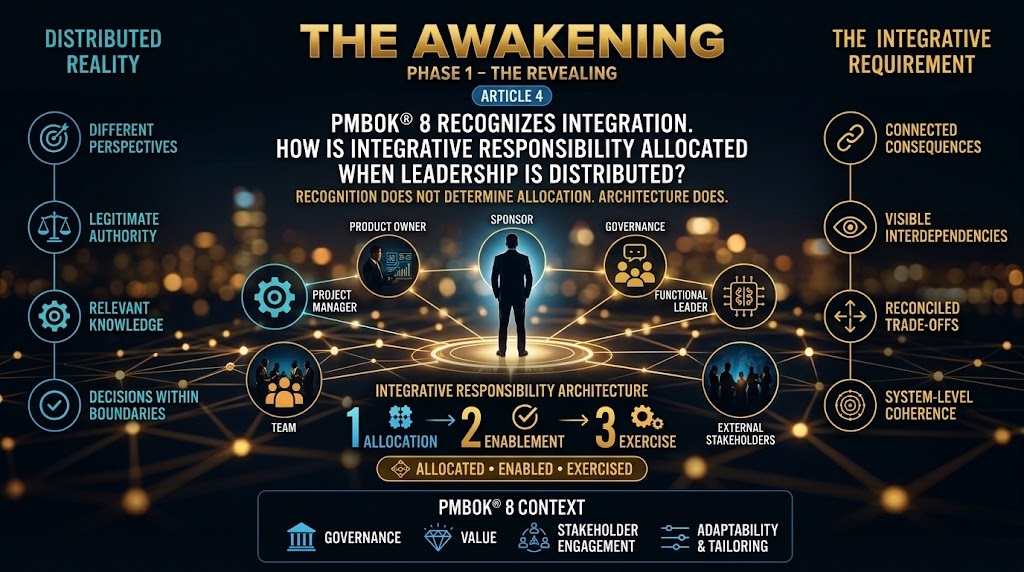 The first three reflections progressively narrowed the inquiry. Article 1 identified a structural shift: leadership, authority, knowledge and management responsibilities can be distributed across different configurations of the project system. Article 2 asked what happens to integration under those conditions and distinguished three dimensions of integrative responsibility: Allocation, enablement and exercise. Article 3 examined the same problem in adaptive environments, where strong local adaptive capacity can coexist with insufficient system-level integrative capacity. Now the argument must face a harder test. Not another conceptual extension. Not another hypothesis. The profession's own architecture. The PMBOK® Guide, Eighth Edition, clearly recognizes integration within a broader project-management architecture oriented toward value, governance, stakeholder engagement, adaptability and contextual tailoring. PMBOK 8 also connects integration-related work with planning, project execution, project knowledge, performance monitoring and change. So the question cannot be: Has PMI forgotten integration? It has not. Nor should the test be: Does PMBOK 8 prescribe one universal actor who must integrate everything? A framework deliberately designed to accommodate different contexts should not necessarily do so. The more demanding question is: When leadership, authority and management responsibilities are distributed, how does PMBOK 8 support the configuration of integrative responsibility, and how explicit must that configuration become for system-level coherence to be preserved? Recognizing integration is one question. Designing its responsibility architecture in a particular project is another. 1. The Strongest Case Against the Hypothesis Before looking for a gap, we should construct the strongest case that there may be none. PMBOK 8 is not indifferent to integration. Its architecture recognizes governance, value, stakeholder engagement, adaptability and contextual tailoring. It also connects integration-related work across planning, project execution, project knowledge, performance monitoring, change and governance rather than confining integration to a single isolated mechanism. That matters. It means that a claim such as: PMBOK distributes leadership but leaves integration behind Would be difficult to defend. PMBOK 8 clearly recognizes the need for integration and the risks that can arise when project decisions become fragmented. PMBOK 8 also accommodates different project and delivery configurations rather than assuming that every project must organize authority and responsibility identically. That too matters. Variation in how integration is organized is therefore not necessarily evidence of omission. It may be a legitimate consequence of contextual design. The serious inquiry begins after recognition. 2. Recognition Does Not Determine Allocation Article 2 distinguished three questions. Allocation Where does responsibility for recognizing and addressing material interdependencies reside? Enablement Do the responsible actors possess sufficient visibility, information, authority, knowledge, capability, discretion and opportunity to act? Exercise Through what interactions, decisions, escalation mechanisms and feedback structures is integration actually performed? The fact that PMBOK 8 recognizes integration does not mean that the three dimensions defined by this series must reside in the same actor in every project. That is not inherently a weakness. Different project configurations may legitimately produce different answers. A Project Manager may carry substantial integrative responsibility in one environment. A sponsor, product role, governance mechanism or team may carry part of it in another. A complex project may require several integrative mechanisms operating at different levels. The absence of a universal integrator therefore tells us very little. The relevant test is: Does the configured project make sufficiently explicit where integrative responsibility resides, whether it is adequately enabled, and how it will actually be exercised? That moves the analysis from prescription to architecture. 3. Tailoring Creates Freedom and Obligation Tailoring is central to this question. A context-sensitive project-management architecture allows the project-management approach, governance and processes to be adapted to the project environment, while the resulting organizational configuration can vary accordingly. That flexibility is valuable. But flexibility has a consequence. When a framework does not impose one universal configuration, the organization must ensure that the configuration it creates still preserves the functions required by the project. Integration is one of those functions. This leads to an important principle: Tailoring can change where and how integration occurs. It cannot remove the material interdependencies that require integration. The question is therefore not whether PMBOK 8 should prescribe one universal integration owner. It is whether the tailored project architecture makes the resulting integrative relationships sufficiently explicit. Who recognizes a material cross-boundary consequence? Who must surface it? Who has authority to address it? Who needs to participate when legitimate objectives conflict? What triggers escalation? Where does escalation go? Who can intervene while meaningful options remain? Who remains accountable for the resulting decision? For the purposes of this inquiry: Tailoring is not operationally sufficient unless material integrative relationships can be identified and acted upon within the selected configuration. This is not a new PMBOK requirement. It is the architectural test THE AWAKENING applies to the consequences of contextual tailoring. 4. Governance Can Carry Integration Without Being Identical to It Governance is central to this architecture. It can define decision rights, accountability, escalation, oversight, constraints and legitimate boundaries for action. It can also provide mechanisms through which material interdependencies are recognized and addressed. Governance may therefore carry substantial integrative responsibility. But governance and integration are not analytically identical. Governance structures legitimate organizational action. Integration concerns whether material interdependencies among differentiated decisions and actions are actually recognized, connected and reconciled across the project system. The distinction prevents two opposite errors. The first is to assume that integration requires a new role outside governance. It does not necessarily. The second is to assume that the existence of governance proves that every consequential interdependency already has an effective integrative path. It does not necessarily do that either. The real question is operational: Can the configured governance and management system recognize, surface and legitimately reconcile the interdependencies that matter while meaningful intervention remains possible? 5. Integrative Work Can Be Distributed Across the Architecture Taken together, PMBOK 8's tailorable and interconnected architecture is compatible with understanding integrative work as potentially distributed across multiple roles, mechanisms and decision levels. Integration may occur through governance. Through planning. Through stakeholder engagement. Through knowledge management. Through risk management. Through resource decisions. Through monitoring and change. Through decisions made at different levels of the project system. This need not represent fragmentation. It may represent a distributed architecture of integration. The relevant question then becomes: When integrative work is distributed across multiple mechanisms and actors, what makes those contributions function as a coherent integrative capability? A team may identify a dependency. A stakeholder may surface a new constraint. Resource management may expose a capability conflict. Risk processes may reveal broader exposure. Governance may confront a strategic trade-off. Change mechanisms may evaluate consequences. Each contribution can be valid. System-level integration depends on whether the relevant contributions connect where their combined consequences require reconciliation. The issue is therefore not simply whether integration-related activity exists. It is whether there is sufficient connectivity among the activities through which integration is being performed. 6. Allocation Does Not Guarantee Capacity Even explicit ownership is not enough. A Project Manager may formally carry an integrative responsibility but lack authority across a relevant boundary. A team may see a dependency but lack legitimate standing to resolve it. A governance body may possess authority but receive information too late. A sponsor may hold decision rights without sufficient operational context. An actor can therefore possess responsibility without possessing the conditions necessary to exercise it effectively. This distinction is fundamental. A framework can provide the elements from which integrative capacity can be constructed without guaranteeing that every tailored implementation will construct that capacity successfully. That is not a criticism unique to PMBOK. No general framework can guarantee the quality of every contextual implementation. But it identifies an important analytical boundary. We must distinguish: The architecture the standard makes possible, The configuration a particular project constructs, and The integrative capacity that configuration actually produces in practice. These are not equivalent. A weakness in implementation does not automatically demonstrate a weakness in the standard. Equally, the existence of a sound standard does not automatically demonstrate that integrative capacity exists in a particular project. 7. The Project Manager Has Not Disappeared From Integration Distributed project management should not be confused with the disappearance of the Project Manager's integrative function. In many project configurations, the Project Manager can remain a central integrative actor. The series therefore does not argue: The Project Manager no longer integrates. The more precise proposition is: The Project Manager cannot be assumed, solely by virtue of the role title, to contain every integrative responsibility required by every possible project configuration. Other actors can also carry relevant integrative responsibility. Teams may reconcile dependencies locally. Sponsors may resolve strategic trade-offs. Governance mechanisms may integrate across authority boundaries. Product roles may integrate value decisions. Operations may carry important integration responsibilities at transition and adoption boundaries. The architecture can vary. The professional objective should therefore not be to defend a monopoly of integration around one role. It should be to preserve integrative capacity across the configuration actually being used. 8. THE AWAKENING Architectural Explicitness Test The analysis now permits a practical test. Suppose the project is appropriately tailored. Roles exist. Governance exists. Teams understand their responsibilities. Adaptive practices operate. Integration-related activities occur. What would allow us to determine whether integrative responsibility itself is sufficiently explicit? For the purposes of THE AWAKENING, a project should be able to answer questions such as: What material interdependencies require active integration? Who is responsible for recognizing and surfacing them? Which can be reconciled locally? What conditions trigger escalation? Who has legitimate authority after escalation? What information must reach that actor or mechanism? Can intervention occur while meaningful alternatives remain available? Who remains accountable for the resulting decision? These answers do not necessarily require a new role. They do not necessarily require a new governance body. They may not require a new document. They require architectural clarity. If the project can answer them, integrative responsibility can be distributed and still remain explicit. If it cannot, the existence of integration-related practices alone may be insufficient to establish how coherence will be preserved when consequential interdependencies conflict. 9. What PMBOK 8 Already Provides The adversarial test changes the direction of the argument. PMBOK 8 already provides substantially more architectural support for integration than the original hypothesis assumed. It recognizes integration. It provides an interconnected project-management architecture. It incorporates governance and stakeholder engagement. It supports contextual adaptation and tailoring. It accommodates different project and delivery configurations. And it connects integration-related work with planning, project execution, project knowledge, performance monitoring and change. The implication is important. THE AWAKENING cannot legitimately argue that contemporary project management lacks an architecture for integration. That claim would go too far. Nor can it argue that integration has simply been abandoned as leadership becomes distributed. The evidence points elsewhere. PMBOK 8 itself recognizes a closely related risk. In self-governance models, distributed project-management responsibilities can create the potential for fragmented decision-making, with decision makers acting in conflicting ways and producing lack of direction or accountability. Its proposed response is also revealing: clear and measurable common objectives, leading indicators and effective feedback mechanisms that help self-managed teams make informed decisions and align their efforts toward shared goals. This does not establish THE AWAKENING's argument. But it demonstrates that the risk of fragmentation in distributed decision-making is already visible within the profession's architecture. The remaining question is how integrative capacity is made operational within a particular configuration. 10. What Remains Contextual What remains contextual is the concrete architecture through which integrative responsibility is instantiated in a particular project. PMBOK 8 provides a tailorable architecture within which what THE AWAKENING defines as integrative responsibility can be configured. The project must make the resulting configuration operational. The answer to: Who integrates this material interdependency, with what visibility, authority, capability and accountability, in this project? Can legitimately vary. That variability is not itself a flaw. It follows from contextual design. The vulnerability appears only when contextual flexibility is mistaken for self-executing clarity. Tailoring allows the architecture to vary. It does not remove the need for the architecture to be explicit enough to work. THE AWAKENING therefore proposes: Where leadership, authority and management responsibilities are distributed, the allocation, enablement and exercise of integrative responsibility must become sufficiently explicit within the project configuration itself. This is not a claim that PMBOK 8 is incomplete because it does not prescribe one universal integrator. It is a narrower proposition. A tailorable framework can preserve legitimate contextual freedom while leaving the organization applying it responsible for making consequential integrative relationships operationally clear. The Revealing The adversarial test has changed the original argument. PMBOK 8 is not evidence that integration has disappeared. It demonstrates that contemporary project management can support multiple legitimate configurations through which integration may occur. That flexibility is a strength. But flexibility creates a corresponding architectural responsibility: The more configurable the project-management system becomes, the less safely integrative responsibility can be inferred from role titles alone. The question is therefore no longer: Who does the profession say should integrate? It becomes: Has this project made sufficiently explicit how integrative responsibility is allocated, enabled and exercised across the configuration it has chosen? If the answer is yes, distributed leadership need not undermine coherence. If the answer is unclear, the problem is not necessarily the standard. It may lie in the architecture produced through its application. And there is an important signal that this question is becoming increasingly relevant. PMBOK 8 recognizes governance operating at organizational, portfolio, program and project levels. Recent PMI guidance on responsible sponsorship adds a related warning: deviations that appear reasonable individually can accumulate and move decision-making outside the governance structure. For this inquiry, that reinforces the importance of examining not only whether individual decisions are defensible, but whether their interactions remain visible and governable across the wider system. That takes us directly to the final reflection of Phase 1. When Locally Valid Decisions Become Globally Incoherent The Structural Risk of Distributed Integration The first four reflections have now established something more precise than the hypothesis with which the series began. Leadership can be distributed. Integrative responsibility can be distributed. Agility can increase the number of places from which adaptation emerges. PMBOK 8 can support multiple configurations through which these responsibilities are organized. The final question is therefore consequential: What happens when individually legitimate decisions remain valid within their respective boundaries, but their combined consequences cease to be sufficiently coherent at system level? That is where the structural risk becomes visible. Source Notes 1. PMBOK® Guide, Eighth Edition References in this article to project governance and integration, contextual tailoring, project functions and roles, distributed management and leadership, holistic and systems perspectives, interdependencies, and governance across organizational, portfolio, program, and project levels draw on The Standard for Project Management and A Guide to the Project Management Body of Knowledge, PMBOK® Guide, Eighth Edition, including the sections addressing the Governance Performance Domain, tailoring, functions associated with projects, project management roles, distributed management and leadership, and Adopt a Holistic View, Project Management Institute, 2025. 2. Self-Governance and Decision Coherence References to self-governance, distributed project management responsibilities, fragmented decision-making, common objectives, leading indicators, and feedback mechanisms draw specifically on A Guide to the Project Management Body of Knowledge, PMBOK® Guide, Eighth Edition, Sections 2.1.2, Project Governance Models, and 2.1.3, Metrics and Mechanisms for Effective Project Governance, Project Management Institute, 2025. 3. Responsible Sponsorship and Governance Drift The reference to individually reasonable deviations accumulating and progressively moving decision-making outside the governance structure draws on The PMI® GPM® Guide to Responsible Project Sponsorship, Version 1, particularly Section 5.10, Governance Drift, and the discussion accompanying Figure 12, Governance Drift Under Pressure, PMI GPM Sustainability JV, LLC, 2026. |
Posted on: September 04, 2026 11:41 AM
| Permalink |
Comments (0)


