


The Hidden Cost of Weak System-Level Integration
Agile approaches changed an important assumption about how projects can adapt.
Not every decision needs to travel upward.
Not every change should wait for central approval.
Not every problem is best understood far from the work.
Teams can exercise judgment.
Feedback can shorten the distance between evidence and response.
Decision-making can move closer to relevant knowledge.
Learning and adaptation can occur where the work is actually happening.
These are significant capabilities.
But the previous reflections exposed a condition that complicates the picture.
As leadership, authority and management responsibilities become more distributable, the interdependencies among the decisions they produce do not disappear.
And when those interdependencies are insufficiently recognized or reconciled, something subtle can happen.
Adaptive practices can remain active.
Teams can continue responding.
The project can continue moving.
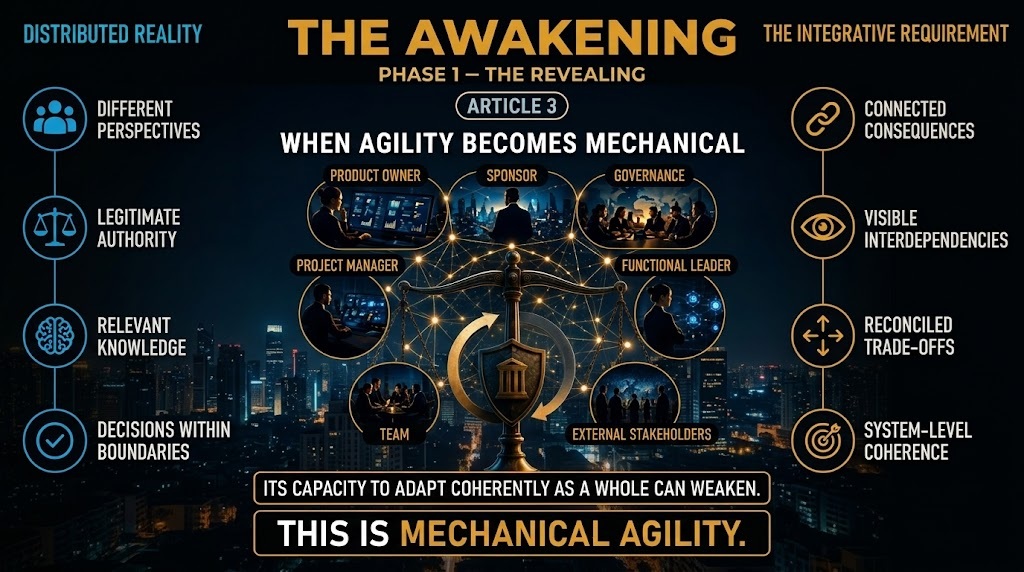
Yet its capacity to adapt coherently as a whole can weaken.
This is what I mean by mechanical agility.
Not failed agility.
Not false agility.
Not merely the mechanical performance of agile practices.
And not an argument against autonomy.
For the purposes of this inquiry:
Mechanical agility is a condition in which adaptive practices and local learning remain active, while the architecture becomes insufficient to connect and reconcile their material consequences across the wider system.
The question is therefore not simply whether teams are agile.
It is:
Can local adaptation remain systemically coherent when the decisions it produces are materially interdependent?
1. Agility Changed Where Adaptation Can Occur
Traditional project structures often concentrated substantial planning, coordination and decision authority within formal management arrangements.
Agile approaches challenged that concentration.
They enabled more sensing, judgment, learning and adaptation to occur closer to the work.
Teams inspect outcomes.
Customers and users provide feedback.
Priorities can change.
Solutions can evolve incrementally.
New information can influence subsequent decisions without waiting for an entire planning cycle to be completed.
This can reduce the distance between evidence and action.
But it also changes the architecture through which adaptation occurs.
When teams, product roles, managers and other actors can respond to different signals at different speeds, adaptation can emerge from several places across the project system.
That can be valuable.
But it raises another question:
What connects adaptations whose material consequences extend beyond the boundaries within which they were made?
2. Local Adaptation Is Not Sufficient for System Adaptation
A team can adapt effectively to what it sees.
That does not necessarily mean the wider project has adapted coherently.
A Product Owner may reprioritize work in response to customer evidence.
A technical team may change an architecture in response to performance data.
Another team may alter sequencing because of a dependency.
Operations may introduce a constraint based on serviceability.
A sponsor may protect a strategic milestone as conditions change.
Each response may be timely, rational and legitimate within its own context.
Yet their consequences can interact.
A locally beneficial change can alter another team's dependency.
A faster delivery choice can increase operational exposure.
A customer-driven priority can affect a contractual commitment.
A technical improvement can consume capability required elsewhere.
The distinction is therefore fundamental:
Local adaptation concerns the ability of a part of the system to respond to relevant change. System adaptation requires the consequences of those responses to remain sufficiently coherent across the interdependent whole.
Agile practices can substantially strengthen local adaptive capacity.
They do not, by themselves, remove the need to integrate consequences that cross local boundaries.
3. Autonomy Does Not Remove Interdependence
Autonomy is valuable partly because not every decision should require central intervention.
But autonomy does not make decisions independent.
A team may possess legitimate authority over how it performs its work while remaining dependent on shared architecture, funding, suppliers, platforms, regulatory requirements, other teams or downstream operations.
This creates an important distinction:
Decision autonomy concerns where legitimate decision authority resides.
System coherence concerns whether the consequences of different decisions remain compatible enough for the project to function as a whole.
These principles do not inherently conflict.
The difficulty arises when one is treated as sufficient for the other.
More local autonomy can improve responsiveness without resolving cross-boundary interdependencies.
More central control can make some dependencies easier to govern while weakening local judgment and responsiveness.
The architectural question is therefore not how to maximize autonomy or control.
It is:
Which decisions can remain local, and when do their consequences become sufficiently material and interdependent to require integration beyond the local boundary?
4. Fast Feedback Can Still Have a Narrow Boundary
Agility rightly emphasizes feedback.
Feedback allows assumptions to be tested.
It exposes differences between expected and actual outcomes.
It creates opportunities for learning and adjustment.
But the speed of a feedback loop does not determine the breadth of the system it represents.
A team can receive rapid usability feedback while remaining unaware of an operational consequence.
A product function can observe customer behaviour without seeing portfolio-level resource effects.
A technical team can detect performance degradation without understanding a contractual implication.
An AI-enabled system can identify a local pattern without representing every organizational constraint affected by the response.
The feedback itself may be excellent.
The limitation may be its scope.
A project cannot deliberately adapt to material consequences that remain outside the feedback structures through which those consequences can become visible.
Faster feedback is therefore valuable, but not always sufficient.
The architecture must also determine which consequences need to cross boundaries, who needs to see them and whether they become visible while meaningful intervention remains possible.
5. Iteration Creates Opportunities for Learning, Not Learning Itself
Iteration is another essential capability.
But iteration and learning are not equivalent.
A team can execute short cycles repeatedly while leaving important assumptions unchallenged.
Metrics can improve while the wrong objective is being optimized.
Retrospectives can identify local friction without revealing systemic causes.
Delivery can accelerate while strategic relevance weakens.
Iteration creates repeated opportunities for adjustment.
Learning requires something more.
Evidence must be connected to assumptions, decisions and consequences.
At system level, that becomes more difficult because evidence itself is distributed.
Different actors see different parts of reality.
Different metrics represent different objectives.
Different feedback loops operate at different speeds.
Some consequences emerge outside the team or only after the immediate delivery cycle.
This creates another important distinction:
Iteration creates opportunities for learning. Integration helps determine whether relevant learning can reach the interdependencies it needs to influence.
Without that connection, adaptation can remain locally intelligent while becoming systemically incomplete.
6. Motion Is Not Coherence
Mechanical agility may not look dysfunctional.
That is one reason it can be difficult to detect.
Work may continue flowing.
Iterations may continue.
Backlogs may be refined.
Throughput and cycle time may improve.
Teams may demonstrate progress.
Stakeholders may attend reviews.
The adaptive machinery appears active.
But activity is not coherence.
A project can become more efficient at producing outputs without becoming more capable of preserving coherence among the decisions, constraints and consequences that shape those outputs.
This is not a criticism of metrics.
Metrics make selected dimensions of reality visible.
The risk emerges when what is measurable locally becomes a proxy for what matters systemically.
A team metric can tell us whether work is moving.
It cannot, by itself, tell us whether the collection of decisions producing that movement remains coherent across the project system.
The more important question therefore becomes:
Are we merely increasing the speed of local response, or improving the capacity of the whole system to adapt to what it is learning?
Those are different achievements.
7. Mechanical Agility Is an Architectural Condition
Mechanical agility should not be understood as a criticism of teams.
Nor should it automatically be treated as poor implementation of an agile framework.
The condition can arise even when teams are capable, disciplined and genuinely adaptive within their legitimate boundaries.
Imagine a project in which:
- Teams possess meaningful autonomy,
- Feedback is frequent,
- Local decisions are timely,
- Iterations function,
- And learning occurs.
Interdependencies are not reconciled quickly enough.
Or the actors expected to integrate them lack sufficient visibility, authority, knowledge or opportunity to act.
The problem is not an absence of agility.
It is a separation between local adaptive capacity and system-level adaptive coherence.
Mechanical agility therefore describes what can happen when adaptive mechanisms remain operational while the integrative conditions required for coherent system-level adaptation become insufficient.
That makes it an architectural condition, not a methodology.
8. The Answer Is Not Less Autonomy
Recognizing this condition can lead to an attractive but simplistic conclusion:
reduce autonomy.
That does not necessarily follow.
Reducing autonomy can recreate bottlenecks.
It can move decisions away from relevant knowledge.
It can slow feedback.
It can weaken useful ownership.
And it can make adaptation depend on actors who are too distant from changing conditions.
The alternative is not to choose between autonomy and integration.
It is to design them as complementary capabilities.
Autonomy enables adaptation to occur where relevant knowledge and legitimate authority reside. Integration connects adaptations when their material consequences cross those boundaries.
Local actors can remain capable of responding where the consequences of their decisions remain appropriately local.
Integrative mechanisms can become more active when those consequences cross boundaries or create material system-level tensions.
The objective is therefore neither maximum autonomy nor maximum central control.
It is adaptive coherence.
9. From Team Agility to Adaptive Coherence
Team-level agility remains important.
But in an interdependent project system, it cannot be the only object of attention.
We also need to ask whether the wider system can:
- Sense material consequences across boundaries,
- Connect information generated in different places,
- Recognize when locally legitimate adaptations become mutually constraining,
- Surface significant trade-offs while meaningful options remain,
- Enable decisions at the level where those trade-offs can legitimately be resolved.
It is its systemic extension.
A project may therefore require both:
Local adaptive capacity, the ability of actors close to the work to sense, learn and respond,
and
System-level integrative capacity, the ability to recognize and reconcile the material interdependencies created by those responses.
Together, they can support what this series will call adaptive coherence.
For the purposes of this series, adaptive coherence refers to the capacity of an interdependent project system to adapt while keeping its differentiated responses sufficiently coherent as a whole.
Mechanical agility describes the condition in which local adaptive capacity remains active while system-level integrative capacity becomes insufficient.
10. The Hidden Cost
When system-level integration is weak, the first visible consequence may not be project failure.
It may be drift.
Teams remain productive.
Local decisions remain defensible.
Delivery continues.
But interdependencies become harder to reconcile.
Trade-offs accumulate or are deferred.
Strategic intent can be interpreted differently across boundaries.
Risks can emerge through interactions rather than through any single decision.
And increasing effort may be required to reconcile consequences created by adaptations that were entirely reasonable when viewed locally.
This is the hidden cost of mechanical agility.
The danger is not that the project stops adapting.
It is that:
The project can continue adapting through its parts while progressively weakening its ability to adapt as a coherent whole.
That is different from rigidity.
A rigid system struggles to adapt.
A mechanically agile system may adapt repeatedly and still drift.
The Revealing
Agile approaches did not eliminate the need for integration.
Nor do the foundational Agile principles imply that they should.
They expanded where sensing, judgment, learning and adaptation could occur.
That can make project systems more responsive.
But as adaptation becomes more distributed, the architecture must also account for the material consequences created across those distributed responses.
The challenge is therefore not:
How do we make teams less autonomous?
Nor:
How do we restore centralized control?
It is:
How do we preserve local adaptive capacity while keeping materially interdependent adaptations sufficiently coherent at system level?
Because a project can have autonomous teams.
Fast feedback.
Short iterations.
Frequent learning.
Continuous delivery.
And still face a deeper structural problem:
Its parts may be adapting while the whole is losing adaptive coherence.
And that takes us to the next reflection.
PMBOK 8 Recognizes Integration.
How Is Integrative Responsibility Allocated When Leadership Is Distributed?
The first three reflections have progressively narrowed the question.
Leadership can be distributed.
Integrative responsibility can also be distributed.
Agility can increase the number of places from which adaptation emerges.
Now the argument must be tested against the profession's own architecture.
Not to ask whether PMBOK 8 recognizes integration.
It does.
But to ask something more precise:
When leadership, authority and management responsibilities are distributed, how explicitly does PMBOK 8 establish how integrative responsibility should be allocated and what conditions are required for it to be exercised across the project system?
Posted on: September 02, 2026 03:47 AM |
Permalink


