
When Ownership Meets Governance


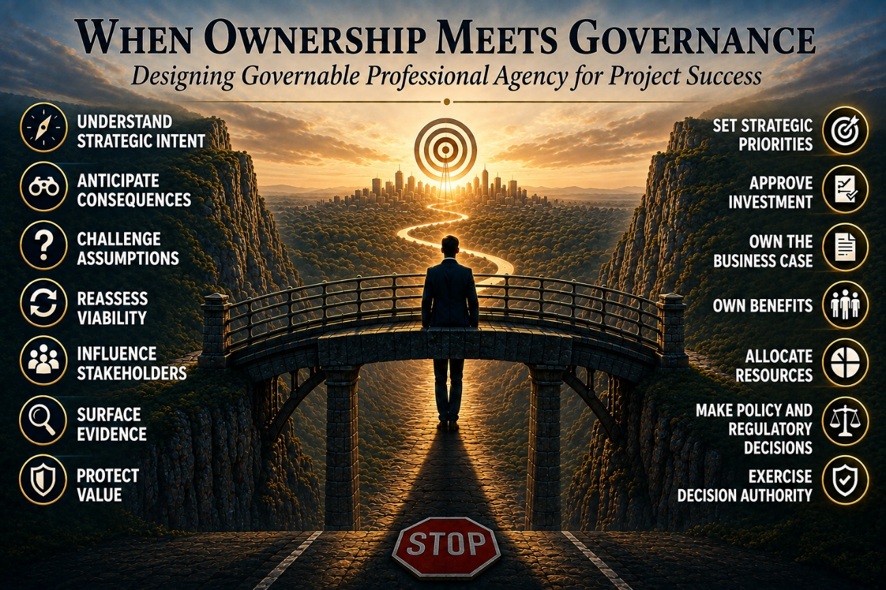 Designing Governable Professional Agency for Project Success Organizations increasingly expect Project Professionals to do more than deliver outputs. They are expected to understand strategic intent, anticipate consequences, challenge assumptions, reassess viability, influence stakeholders, surface uncomfortable evidence and remain focused on whether the project is actually creating value. That evolution is understandable. Projects do not succeed because schedules are maintained, reports are produced or deliverables are completed in isolation. Outcomes emerge from interactions among strategy, sponsorship, investment decisions, governance, organizational capabilities, operations, customers, suppliers, technology and the project itself. Project Professionals therefore need sufficient agency to operate within that wider system. But this creates a governance problem: What happens when professional agency expands faster than organizational authority? A Project Professional may identify that assumptions underlying the business case are no longer defensible. The professional may challenge them, escalate the evidence and recommend that the project be redirected, paused or terminated. Yet the authority to make that decision may remain with a Sponsor, steering committee, investment body, executive or another governance authority. If the recommendation is rejected and the project subsequently fails, who owns the outcome? The answer cannot be derived from the language of ownership alone. It requires an architecture of governance. The deeper question is: If Project Professionals are expected to exercise greater agency over success, what governance architecture must organizations provide so that challenge, escalation, recommendation and dissent can be exercised without converting distributed organizational failure into individualized professional accountability? This takes us beyond empowerment and into the architecture of Governable Professional Agency. 1. Project Outcomes Are Systemically Produced A first mistake is to treat project success as if it were produced by a single actor. A Project Professional may influence planning, integration, communication, risk responses, stakeholder engagement, delivery coordination and decision preparation. But other actors may control strategic priorities, investment approval, business-case ownership, benefit ownership, resource allocation, organizational capacity, product decisions, operational adoption, commercial commitments, supplier relationships, policy and regulatory decisions, and continuation or termination of investment. This is not a new governance problem. Earlier project-governance literature had already located important forms of authority and accountability outside the Project Manager. Material published through PMI in 2005, explicitly discussing the APM's 2004 Directing Change guidance, described project sponsorship as the critical link between senior executives and project management. Sponsors were associated with formal authority and decisions, ownership and maintenance of the business case, timely project closure, benefits accountability, and the use of independent advice in project appraisal. Later PMI-published research similarly emphasized that project success or failure is not entirely within the control of the Project Manager and project team, and situated sponsorship at the intersection between corporate governance and the governance of projects and programs. The contemporary issue is therefore not the discovery that project outcomes are distributed. It is what follows when professional expectations of agency expand within that already distributed governance architecture. Even an exceptionally capable Project Professional operates within a wider causal system. This distinction matters because: Influence over an outcome is not equivalent to control over all the conditions producing that outcome. Project success is often jointly produced. Authority is distributed. Knowledge is distributed. Causal influence is distributed. Accountability must therefore be designed with that distribution in mind. Otherwise, the organization risks converting a systemic outcome into an individualized judgment. 2. Greater Agency Does Not Automatically Create Greater Authority Organizations frequently encourage professionals to behave as owners. Take initiative. Challenge assumptions. Think strategically. Focus on outcomes. Speak up. Escalate early. Own success. These expectations can be valuable. But behavioral expectations do not, by themselves, alter organizational decision rights. A professional can be expected to think beyond the boundaries of the project without acquiring authority beyond those boundaries. Three concepts must therefore remain distinct. Professional Agency The legitimate capacity and expectation to interpret evidence, exercise judgment, challenge assumptions, influence decisions and act within one's professional remit. Decision Authority The legitimate organizational right to make a particular decision. Outcome Accountability The extent to which an actor may legitimately be held answerable for producing, protecting or failing to produce an outcome. These concepts interact, but they are not interchangeable. Agency is not authority. Influence is not a decision right. A recommendation is not a decision. Responsibility for exercising professional judgment does not automatically create accountability for every outcome that follows. This is where governance becomes essential. 3. From Empowerment to Governable Professional Agency Empowerment is often discussed as if it were primarily cultural. Organizations encourage people to speak up, take initiative and behave with greater ownership. But empowerment without institutional architecture can become rhetorical. A more useful question is: Empowered to do what? The relevant governance questions are concrete. What information can the professional access? What assumptions can be challenged? What matters can be escalated? What recommendations can be formally submitted? Who must consider them? Who decides? Within what timeframe? How are material decisions recorded? What happens to accountability when professional advice is rejected? These questions lead to a more precise concept. Governable Professional Agency Professional agency is governable when the organization provides sufficient access to relevant information, legitimate rights to challenge and escalate, explicit authority boundaries, traceable decision pathways and accountability proportionate to the actor's actual authority, decision rights, discretion, causal influence, access to relevant knowledge, and reasonable opportunity or duty to act. This does not require giving Project Professionals unlimited authority. It requires making the relationship among agency, authority and accountability explicit and governable. 4. The Five Rights of Governable Professional Agency If organizations genuinely expect Project Professionals to exercise broader agency over success, five corresponding governance rights become particularly important. These are proposed here as an analytical architecture, not as universal legal entitlements, nor as a claim that every organization must implement them identically. 4.1 The Right to Know Professional judgment depends on access to relevant evidence. A Project Professional cannot meaningfully reassess viability while being denied material information about the assumptions on which viability depends. Depending on context, relevant information may include business-case assumptions, strategic objectives, benefits expectations, major dependencies, financial constraints, risk exposure, supplier performance, organizational readiness and material changes affecting continued justification. The principle is not unrestricted access. It is: Decision-relevant access proportionate to the responsibility being assigned. An organization cannot reasonably demand informed ownership while structurally withholding information necessary for informed judgment. 4.2 The Right to Challenge Information alone is insufficient. Professionals must be able to question assumptions, commitments, forecasts and decisions when evidence provides legitimate grounds for doing so. This may include unrealistic targets, obsolete assumptions, unsubstantiated benefit expectations, unmanageable dependencies, continued viability, risk acceptance or strategic premises that no longer correspond to reality. Challenge is not necessarily insubordination. Within a properly governed system, evidence-based challenge can be one mechanism through which the organization protects decision quality. A system that asks professionals to exercise judgment but rewards only agreement does not create meaningful agency. It creates compliance. 4.3 The Right to Escalate Some issues cannot be resolved within the professional's authority. They must move to the actor or body possessing the relevant decision right. The distinction itself has clear antecedents. PMI-published guidance on project sponsorship has described the Sponsor as an escalation point for decisions and issues beyond the Project Manager's authority and associated sponsorship with go/no-go decisions. But an escalation mechanism is meaningful only if it leads somewhere. An organization may formally permit escalation while providing no corresponding obligation for anyone to consider the issue or make a decision. The professional raises the issue. The issue is acknowledged. No decision is made. Funding continues. Delivery continues. The underlying exposure remains. Procedurally, escalation occurred. Substantively, governance may not have. Therefore: An escalation right without a corresponding obligation to consider and, where a decision is required, decide may provide procedural voice without substantive governance effect. Effective escalation requires an identifiable decision authority, an appropriate decision window and a mechanism for preserving the resulting decision path. 4.4 The Right to Recommend Project Professionals must be able to translate professional judgment into explicit recommendations. Depending on circumstances, those recommendations might include continuing, modifying, rebaselining, redirecting, pausing or terminating an initiative. But the distinction remains fundamental: The right to recommend is not the right to decide. The professional remains responsible for the quality, integrity and timeliness of the recommendation. The legitimate decision authority remains responsible for the decision it is empowered to make. Governance becomes distorted when those two forms of responsibility are retrospectively collapsed. 4.5 The Right to Recorded Dissent This may be the most consequential of the five. Suppose a Project Professional concludes, on defensible evidence, that a project should no longer continue. The recommendation is formally presented. The legitimate authority decides otherwise. The concerns later materialize and the project fails. What does the organizational record show? A mature governance system should be capable of establishing what was known, when it became known, what assumptions were challenged, what was recommended, on what evidence, who possessed the relevant decision authority, what decision was made and why. This is not an argument for defensive bureaucracy. It is an argument for accountability integrity. Without contemporaneous decision evidence, organizations risk reconstructing failure retrospectively around the most visible delivery actor rather than around the actual distribution of knowledge, authority and decisions that produced the outcome. 5. Rights Require Corresponding Organizational Obligations Governable Professional Agency cannot rest on professional rights alone. It requires reciprocal organizational obligations. The organization must provide access where informed judgment requires access, a legitimate forum where evidence-based challenge can be considered, an identifiable escalation path where authority lies elsewhere, clarity over who possesses the relevant decision right, and sufficient traceability where material recommendations or decisions may subsequently affect accountability. The architecture can therefore be expressed as: Access → Challenge → Escalation → Recommendation → Decision → Record → Accountability This is not merely a communication process. It is an authority and accountability architecture. 6. The Termination Test One question can expose much of this architecture: Can a Project Professional legitimately recommend that the organization stop the project? Not rhetorically. Operationally. The importance of project termination is itself well established historically. The 2005 governance paper published through PMI noted the tendency for projects to continue after circumstances suggested they should close and argued that Sponsors should reconsider whether continuation remained justified. The Termination Test proposed here is different. It does not ask merely whether projects are terminated appropriately. It tests the governance pathway through which professional judgment encounters formal authority. Suppose evidence indicates that continued investment may no longer be justified. Can the professional obtain the information necessary to test that conclusion? Can the underlying assumptions be challenged? Can the issue be escalated beyond the immediate reporting relationship? Can termination be formally recommended? Who possesses stop authority? Is the appropriate authority required to consider the recommendation? Is there an appropriate decision window? Is the decision and its rationale traceable? Can the professional raise the issue without inappropriate retaliation? If the recommendation is rejected, does responsibility for the continuation decision remain with the authority that made it? And if the project later fails, can the organization accurately reconstruct the decision path? If several of these conditions are absent, the organization may be asking for outcome ownership without providing the governance architecture necessary to exercise that ownership meaningfully. 7. The Empowerment Reality Test The Termination Test exposes an extreme case. A broader question applies to everyday governance. Empowerment Reality Test When an organization claims to empower Project Professionals, which decisions can they make, which decisions can they formally challenge, which can they escalate, which can they only recommend, and which remain explicitly outside their authority? A Project Professional may, for example, have authority to modify sequencing but not scope, allocate resources within an agreed envelope but not increase investment, recommend changes in benefits expectations but not redefine strategic objectives, or escalate viability concerns without possessing authority to terminate funding. None of these limitations is inherently problematic. The problem arises when: Accountability ignores them. Empowerment becomes meaningful when the boundaries of discretion are sufficiently clear for both action and accountability. 8. The Capacity to Absorb Dissent Is a Governance Capability Organizations often celebrate candor in principle while making dissent costly in practice. This matters particularly in projects because projects accumulate commitment. Money has been invested. Executives may have sponsored the initiative. Targets may have been announced. Contracts may have been signed. Teams have mobilized. Reputations may become attached to continuation. Under these conditions, evidence that challenges the prevailing narrative can become organizationally uncomfortable. Yet this may be precisely when professional agency matters most. A Project Professional who identifies material evidence against continued viability may have a professional responsibility to make that evidence visible. The organization must therefore distinguish between unsupported resistance and evidence-based dissent. A governance system that demands ownership of success while penalizing legitimate evidence-based dissent creates an internally contradictory professional expectation. It asks the professional to help protect the outcome while discouraging behavior that may be necessary to protect it. 9. Rejected Advice Changes the Accountability Question When a professional recommendation is rejected, the professional's responsibility does not disappear. The professional may remain accountable for whether relevant evidence was identified, whether the analysis was competent, whether material uncertainty was communicated, whether escalation occurred appropriately, whether recommendations were timely and whether actions within the professional's authority were properly executed. But another actor or governance body may remain accountable for the decision that it possessed the authority to make. This produces an important principle: Accountability should be traceable to the actual architecture of decisions, responsibilities, relevant omissions and opportunities to act, not merely to the visibility of the actors closest to delivery. That does not mean every failure can be allocated neatly to one person. Many project outcomes are genuinely systemic. Nor is the objective to find a different individual to blame. The objective is to preserve the distinction between contribution to an outcome and legitimate accountability for decisions, actions and relevant omissions within one's responsibility and authority. 10. Retrospective Concentration of Accountability Project failure creates hindsight risk. Once the outcome is known, earlier uncertainty can appear smaller than it actually was. Warnings may look more obvious, alternative decisions more inevitable, and distributed choices more easily compressed into a simplified narrative. The Project Professional may also be one of the most visible continuous actors associated with the initiative. A systemically produced outcome can therefore be retrospectively narrated as the success or failure of one professional. Decision traceability is an important safeguard against this distortion. Its purpose is not to eliminate accountability. It is to make accountability more faithful to the actual distribution of knowledge, authority, responsibilities, decisions and actions at the time they occurred. 11. PMOs, Sponsors and Governance Bodies Governable Professional Agency is not created by Project Professionals alone. Sponsors, PMOs, steering bodies, portfolio authorities and other governance actors may all contribute, depending on the organizational model. Historical and contemporary project-governance literature already assigns consequential responsibilities to actors beyond the Project Manager. The important question is therefore not whether such actors exist, but whether their respective roles form a coherent architecture through which expanded professional agency can operate. Their precise responsibilities should not be assumed to be identical across organizations. What matters is that the governance system collectively provides the necessary functions: clarity of authority, access to decision-relevant information, legitimate escalation pathways, timely consideration of material issues, traceable decisions and accountability aligned with actual decision rights. A Sponsor with decision authority must be able to exercise it. A governance body must be capable of doing more than receiving information if consequential decisions fall within its remit. A PMO, where its mandate includes governance support, can help make authority boundaries, escalation paths and unresolved decisions visible. The allocation may vary. The architectural requirement does not. 12. From Heroic Ownership to Governable Agency There is an attractive simplicity in telling professionals: Own success. It encourages initiative. It discourages narrow role interpretation. It reminds professionals that completing deliverables is not the same as creating value. Those are useful effects. But organizations should resist converting that behavioral aspiration into an undifferentiated theory of organizational accountability. The alternative is not weaker professional agency. It is: Stronger agency embedded in stronger governance. Project Professionals should be expected to exercise judgment, challenge when evidence warrants it, escalate when necessary, recommend what the evidence supports, make material realities visible and act decisively within the authority they legitimately possess. Organizations must reciprocate by making the corresponding governance architecture real. That is not protection from responsibility. It is what makes responsibility governable and accountability legitimate. Conclusion: The Organization Must Also Own Its Part The debate about project success often asks whether Project Professionals are prepared to assume greater ownership. That question is incomplete. Organizations must also ask whether their governance systems are prepared for professionals who genuinely exercise it. A professional who reassesses viability may reach an inconvenient conclusion. A professional who expands perspective may expose consequences outside the project's immediate boundaries. A professional who manages perceptions responsibly may refuse to make an unhealthy project appear healthy. A professional who takes success seriously may recommend stopping work that powerful stakeholders want to continue. The real test of empowerment therefore comes after the professional speaks. The real test of empowerment is not whether professionals are encouraged to speak. It is what the organization is required to do when they do. Greater professional agency requires more than greater expectations. It requires governance capable of receiving challenge, processing dissent, locating authority, making decisions and preserving accountability boundaries. Organizations should not ask Project Professionals to own what they were never empowered to decide. Nor should professionals use limited authority to escape responsibility for what they could reasonably be expected to know, challenge, escalate, recommend or do. The objective is neither unlimited professional autonomy nor diluted accountability. It is coherence. What professionals are expected to know, what they are entitled to challenge, what they can recommend, what they are empowered to decide, and what they can legitimately be held accountable for must remain organizationally coherent. That is the foundation of Governable Professional Agency. And it may be one of the governance conditions required to make contemporary expectations of greater ownership of project success both meaningful and legitimate. References Hopkinson, M. (2005). Guidance for the Governance of Project Management. Paper presented at PMI® Global Congress 2005, EMEA, Edinburgh, Scotland. Newtown Square, PA: Project Management Institute. The paper explicitly discusses the Association for Project Management's 2004 Directing Change: A Guide to Governance of Project Management. Guidance for the Governance of Project Management, PMI Crawford, L., Cooke-Davies, T., Hobbs, J. B., Labuschagne, L., Remington, K., & Chen, P. (2008). Governance and Support in the Sponsoring of Projects and Programs. Project Management Journal, 39(3), S43-S55. Governance and Support in the Sponsoring of Projects and Programs, PMI Schibi, O., & Lee, C. (2015). Project Sponsorship: Senior Management's Role in the Successful Outcome of Projects. Paper presented at PMI® Global Congress 2015, EMEA, London, England. Newtown Square, PA: Project Management Institute. Project Sponsorship: Senior Management's Role in the Successful Outcome of Projects, PMI |
Posted on: August 25, 2026 07:41 AM
| Permalink |
Comments (5)


