
When Project Leadership Becomes Distributed


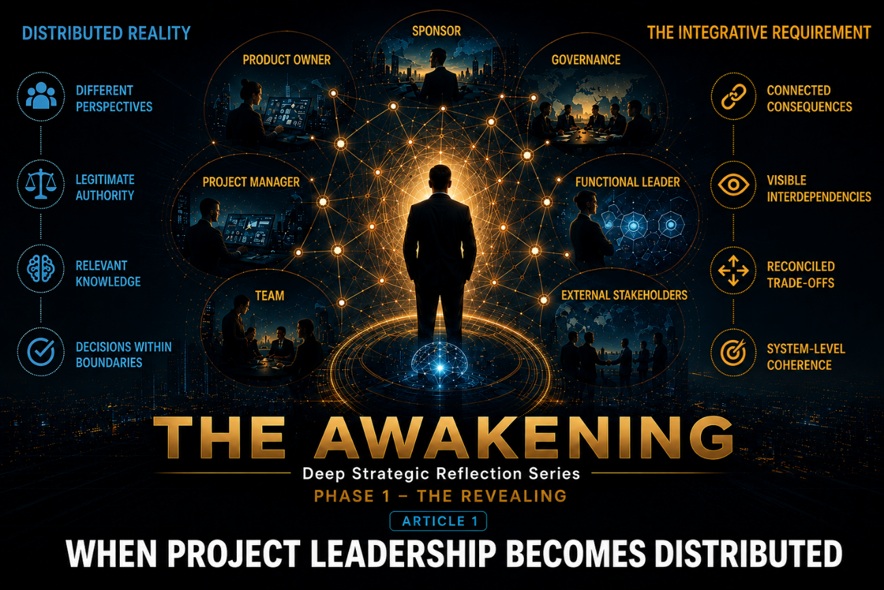 The Structural Shift Reshaping Project Management Something important is changing in project management. Not because projects no longer need leadership. Not because the Project Manager is disappearing. And not because one methodology has replaced another. The change is more structural. Leadership, management responsibilities and decision authority no longer need to converge in a single role. A sponsor may shape strategic direction. A Product Owner may determine value priorities. A Project Manager may integrate work across domains. Teams may make decisions close to execution. Functional leaders may control critical capabilities. Governance bodies may establish decision boundaries and escalation paths. Customers, partners and suppliers may influence choices that materially affect outcomes. And AI increasingly augments how information is interpreted, alternatives are generated and decisions are prepared. None of this means that leadership has disappeared. It points to something different: Project leadership is becoming increasingly distributable. And that changes how we need to understand the architecture of the project. 1. From a Role-Centered View to a Distributed System Project leadership has often been represented through a role-centered model. At its center sits the Project Manager, surrounded by plans, resources, stakeholders, risks, decisions and delivery responsibilities. Reality has always been more complex than that representation. Sponsors govern. Functional managers control resources. Customers shape requirements. Teams contribute expertise and judgment. Senior leaders make decisions beyond the authority of the Project Manager. Even in role-centered configurations, project leadership need not be exercised by one person alone. But the Project Manager has often provided a visible point around which much of the project could be understood and organized. That representation is becoming less sufficient for understanding how many contemporary projects are actually led. Project environments combine predictive, adaptive and hybrid approaches. Work crosses organizational boundaries. Product and project structures coexist. Teams operate with different degrees of autonomy. Governance can be centralized, decentralized or hybrid. Decision authority may vary according to the nature and consequences of the decision. The result is not necessarily less leadership. It is a different topology of leadership. Leadership may emerge from several places. Authority may reside elsewhere. Relevant knowledge may be distributed even more widely. And management responsibilities may be configured differently according to context. The relevant question is therefore no longer simply: Who is the Project Manager? It is: How is the project actually being led? 2. Distribution Is Not Disappearance This distinction matters. When responsibilities associated with one role are exercised by several actors, it is tempting to conclude that the role has been hollowed out. That conclusion moves too quickly. A function can be redistributed without disappearing. Authority can become differentiated without becoming absent. Leadership can become shared without becoming weaker. Autonomy can increase without eliminating accountability. And integration can be achieved through different organizational configurations. The structural shift is therefore better understood as a change in allocation. Who has authority over what? Where does the relevant knowledge reside? Who can make which decisions? Who can commit resources? Who interprets strategic intent when conditions change? Who can see consequences beyond a local boundary? Those questions need not produce the same answer. This is why distributed does not fully describe the phenomenon. The deeper change is that leadership, authority and management responsibilities are becoming increasingly distributable. They can be configured differently according to the project, governance model, delivery approach, organizational structure and nature of the work. That flexibility can be a strength. But it also changes the conditions under which the project must remain coherent as a system. 3. Distribution Can Be Rational There are good reasons not to concentrate every decision and responsibility in one role. Relevant knowledge is often distributed and locally situated. Specialists may understand technical realities that others cannot fully see. Teams close to the work can often respond more quickly to changing conditions. Product decisions may require authority different from delivery decisions. Strategic choices and operational choices may legitimately belong at different levels. And some decisions benefit from being made closer to the knowledge required to make them. Distribution can therefore improve responsiveness. It can support autonomy. It can reduce unnecessary decision bottlenecks. It can enable specialization. And, in appropriate contexts, it can increase adaptability. The question is not whether this evolution should simply be reversed. The question is what this evolution requires from the architecture around it. 4. Leadership, Authority, Knowledge and Responsibility Are Different Distributed project environments make distinctions visible that role descriptions can easily obscure. Leadership is not authority. A person may influence direction without possessing formal decision rights. Authority is not knowledge. Someone may legitimately make a decision without possessing all the information relevant to its consequences. Knowledge is not responsibility. The person who understands a consequence may not own the decision or action associated with it. Responsibility is not capability. Someone may be assigned responsibility for an outcome without controlling all the conditions required to achieve it. Responsibility is not accountability. Responsibility for performing work and accountability for consequences do not necessarily reside in exactly the same place. And management responsibility is not necessarily system-level visibility. An actor can manage a legitimate part of the project exceptionally well while seeing only part of the whole. These dimensions can therefore be allocated differently across the same project system. We may encounter distributed leadership with concentrated authority. Distributed decision rights with concentrated accountability. Distributed knowledge with centralized decision authority. Or hybrid configurations combining several of these patterns. That is not inherently a defect. It is an architectural condition that needs to be understood. 5. Expanding the Unit of Analysis If leadership can be exercised across several actors, analysing the Project Manager alone becomes insufficient for understanding how the project is actually led. A fuller unit of analysis is therefore the project system, not the Project Manager in isolation. Consider a difficult trade-off. The sponsor may understand strategic importance. The team may understand technical feasibility. The Product Owner may understand customer value. The Project Manager may understand dependencies, commitments and delivery consequences. Finance may understand economic exposure. Operations may understand what the organization can absorb after delivery. A supplier may control a critical external dependency. An AI-supported system may identify patterns or alternatives that none of these actors detected independently. Where can leadership emerge? Potentially across several of these actors. Where does authority reside? Not necessarily in the same places. Where does accountability reside? Again, it may differ. A contemporary project can therefore be understood as a network of differentiated but interdependent capacities. Understanding how it is led requires analysing not only the actors themselves, but also the relationships between them. 6. Interdependence Is the Hidden Variable Distribution becomes architecturally significant because project decisions are rarely independent. A team can make a technically sound decision that changes cost exposure. A Product Owner can make a rational prioritization decision that affects a regulatory commitment. A sponsor can protect strategic value while creating delivery consequences elsewhere. A functional manager can optimize scarce resources while weakening another critical dependency. Each decision may be legitimate within its own frame. Tension can emerge in the relationships between those frames. This is why the central issue created by distribution is not simply: Who has authority? It is also: How are interdependent decisions kept coherent when the authority to make them resides in different places? Different project configurations may answer that question differently. What matters at this stage is more fundamental: Distributing authority does not eliminate the interdependencies among the decisions being distributed. The more distributable leadership, authority and management responsibilities become, the more important it becomes to understand how those interdependencies are recognized and reconciled. 7. Recentralization Is Not the Automatic Answer Recognizing the difficulty of distributed interdependence can lead to an apparently simple response: return authority to a central Project Manager. That does not necessarily follow. Centralization can carry significant costs. It can distance decisions from relevant knowledge. It can create bottlenecks. It can weaken useful autonomy. It can concentrate cognitive load in people who cannot realistically understand every relevant element of a complex project. And it can create the appearance of control without the information required to exercise that control intelligently. Distribution, however, is not sufficient by itself either. Distributed authority can preserve proximity to knowledge and increase responsiveness while still leaving interdependent decisions insufficiently reconciled. Neither centralization nor distribution is sufficient as an organizing principle on its own. What matters is the architecture through which autonomy, authority and interdependence are structured. The challenge is therefore more demanding than choosing between centralized and distributed leadership. It is to preserve the benefits of distribution without losing the ability of the project to act as a coherent whole. That is not primarily a question of hierarchy. It is a question of architecture. 8. AI Adds Another Layer to Distribution AI adds another dimension to this transition. AI systems can augment analysis, identify patterns, synthesize large volumes of information and support forecasting, planning and risk identification. Increasingly agentic systems may also perform bounded actions within project workflows. But greater cognitive or execution capability does not automatically produce greater system-level coherence. An AI system can optimize against a bounded objective without representing every relevant organizational, strategic, regulatory or ethical constraint. It can improve the quality or speed of a local decision without resolving tensions between objectives elsewhere in the system. AI therefore does not remove the architectural question created by distribution. In AI-enabled project environments, integration increasingly extends beyond differentiated human roles and decisions. Technological capabilities can now shape analysis, recommendations and, increasingly, bounded actions within project workflows. The architectural question therefore expands: How should those technological capabilities coexist with human authority, responsibility and accountability while preserving coherence across the project system? 9. The Core Architectural Question This changes the question with which the profession should begin. Not: Is the Project Manager disappearing? Not: Should teams have more autonomy? Not: Does Agile weaken leadership? And not: Should leadership return to the center? Those questions begin with roles or methods. The more fundamental question begins with the system: When project leadership, management responsibilities and decision authority become increasingly distributable, what conditions allow the project to remain coherent as a whole? That question does not assume that distribution is a problem. It does not assume that integration has been forgotten. And it does not assume that a new role is required. It asks us to examine the architecture through which differentiated but interdependent actors continue to produce coherent collective action. That is a different conversation about the future of project management. 10. The Revealing What appears to be changing is not the disappearance of leadership. Nor is it necessarily the disappearance of the Project Manager. It is the way leadership, authority, knowledge and management responsibilities can be configured across the project system. That shift asks us to move beyond leadership understood primarily through roles and examine leadership through a system of differentiated responsibilities, authority, knowledge and interdependence. If that is the emerging condition, the challenge ahead is not to decide who should regain control. It is to understand what must happen between the parts so that distribution does not become fragmentation. A project can distribute leadership. It can distribute authority. It can distribute decisions. It can distribute management responsibility. But it cannot distribute away the need for the whole to remain coherent. And that takes us to the next question: Who integrates what has been distributed? Next in THE AWAKENING: Article 2 - Who Integrates What Has Been Distributed? The Architecture of Integrative Responsibility |
Posted on: August 28, 2026 04:46 AM
| Permalink |
Comments (0)


