
The New Ways of Working in Projects


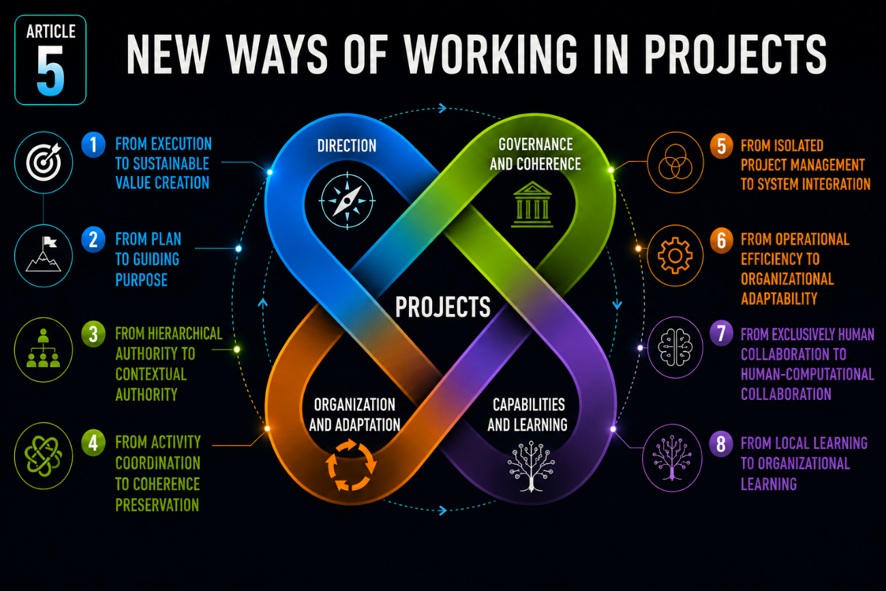 A New Architecture for Adaptive Organizations Throughout this series, I have sought to examine three recent documents that I consider particularly relevant to understanding the evolution of Project Management. The new Agile Practice Guide shows that the discipline has evolved far beyond the choice between predictive and agile approaches. The Manifesto for Enterprise Agility shows that adaptation no longer depends only on teams and increasingly involves the organization as a whole. The Closing the Change-Readiness Gap report shows that many transformations continue to fail not because methodologies are absent, but because the organizational conditions required to sustain change deteriorate during implementation. Across the previous four articles, I have sought to demonstrate that these documents, although addressing different topics, converge in the same direction. Taken together, they show that the evolution of Project Management does not result from replacing one methodology with another. It reflects a deeper transformation in how projects, organizations, people, and technologies interact to deliver change and create value in contexts characterized by increasing complexity, interdependence, and a continuing need for adaptation. This leads naturally to a broader question. What, then, characterizes the new ways of working in projects? In my view, the answer does not lie in a specific methodology or in the adoption of a new set of practices. It lies in the evolution of the organizational logic within which projects operate. Projects are progressively understood not only as execution mechanisms, but as temporary organizations embedded within broader organizational systems, capable, depending on their nature and context, of contributing to the adaptation of the permanent organization and to its capacity to create value. This evolution can be understood through eight fundamental transitions. These transitions do not represent sequential stages, nor do they mean that the principles that established the discipline have lost their validity. They represent complementary shifts in emphasis that reflect the adaptation of Project Management to the challenges faced by organizations that are increasingly complex, interdependent, and knowledge-intensive. Together, they are organized into four interdependent domains:
1. From Execution to Sustainable Value Creation For decades, project success was predominantly assessed by the ability to deliver the defined scope, meet agreed deadlines, and control planned costs. These dimensions remain indispensable. Without execution discipline, consistent results are difficult to achieve. However, execution performance alone does not provide a sufficient basis for evaluating the broader outcomes and value associated with a project. A project can finish on time and within budget, deliver all specified requirements, and still fail to produce relevant benefits for customers, the organization, or society. It can also achieve its immediate objectives at the cost of degrading organizational capabilities, creating technical debt, reducing future flexibility, or increasing risks that only become visible after the initiative has closed. This requires us to distinguish between related but different dimensions. Execution performance tells us how the project was carried out against the applicable commitments and criteria. Outcomes tell us what that execution produced or made possible. Value requires us to go further and assess the relevance of those outcomes, for whom they are relevant, over what time horizon, and with what benefits, costs, risks, or consequences. Creating value therefore comes to mean contributing to relevant outcomes and conditions during and beyond the realization of the project. That value may take different forms:
What changes is the frame within which these capabilities are understood. They cease to be ends in themselves. They become instruments through which the purpose that justified the project can be realized and through which the project can contribute to the creation and protection of sustainable value. Broadening the focus from execution to value does not eliminate the assessment of project performance. It places it within a broader evaluation architecture. Execution performance, outcomes, and value should therefore be assessed as related but distinct dimensions. 2. From the Plan to Guiding Purpose Planning remains one of the most important capabilities in Project Management. Complex projects require clear objectives, explicit priorities, credible estimates, work sequencing, dependency management, and effective coordination mechanisms. The problem was never the existence of plans. The real challenge is recognizing that no plan can fully anticipate a context that is constantly changing. New opportunities emerge. Constraints change. Risks materialize in unexpected ways. Technologies evolve. Customer needs change. Assumptions that were initially valid cease to reflect reality. When this happens, simple fidelity to the plan can lead precisely to a departure from the strategic intent that justified the project. It is in this context that purpose assumes a guiding role. Purpose does not replace the plan. It gives the plan meaning. While the plan organizes the action initially envisaged, purpose provides the reference point needed to decide when that action should be maintained, adjusted, or substantially revised. However, a purpose formulated only in generic terms will rarely guide relevant decisions effectively. To fulfil that role, it needs to be translated into concrete elements that legitimize adaptation and guide team action. These elements include:
Adaptive projects do not plan less. They plan with the recognition that the path may evolve without necessarily changing the strategic direction. Purpose offers greater continuity than the plan because it provides the reference point through which the plan itself can be reinterpreted whenever reality requires it. Purpose may also evolve when the strategic context changes significantly. But such evolution should result from a conscious strategic decision, not from circumstantial adjustments in execution. This is one of the most significant changes in the new ways of working in projects. Planning is no longer understood as an attempt to predict the future exhaustively. It becomes a mechanism for coordination, learning, and adaptation, continuously guided by purpose and sustainable value creation. 3. From Hierarchical Authority to Contextual Authority Hierarchical structures continue to play an indispensable role in organizations. They establish responsibilities, allocate resources, define governance mechanisms, and ensure accountability for decisions with greater impact. However, the increasing complexity of projects has made it clear that not every decision can, or should, depend exclusively on formal authority. In environments characterized by high interdependence, rapid change, and increasing specialization, many decisions depend on proximity to the problem, the quality of available information, relevant expertise, and the ability to act at the right moment. Whenever authority remains excessively distant from operational reality, response times increase, hierarchical escalations multiply, relevant context is lost, and the capacity to adapt is reduced. The new ways of working in projects seek to respond to this challenge through a more contextual distribution of authority. This is not about replacing hierarchy or advocating universal models of self-management. It is about recognizing that different decisions require different combinations of formal authority, knowledge, responsibility, and capacity for intervention. In this context, I propose understanding contextual authority as: Authority legitimately assigned to those who have the appropriate combination of knowledge, capability, proximity to the problem, necessary discretion, and opportunity to decide or act, within the limits defined by organizational governance. This definition highlights a fundamental distinction. Proximity to the problem, by itself, does not legitimize a decision. Likewise, technical expertise alone is not sufficient. The legitimacy of authority depends on an appropriate combination of:
It complements it. Governance remains responsible for defining limits, allocating decision rights, and preserving accountability. Within that framework, certain decisions can move closer to those who are best positioned to make them. The objective is not merely to decide faster. It is to improve the quality and legitimacy of decisions, strengthen their capacity for effective implementation, and support the organization’s capacity to adapt. In the new ways of working in projects, authority is progressively understood not only as an attribute of hierarchical position. It is also understood through the legitimate distribution of decision rights and capacity for intervention according to context, while preserving governance, responsibility, and sustainable value creation. 4. From Operational Efficiency to Organizational Adaptability Efficiency remains an indispensable capability for any organization. Improving processes, reducing waste, using available resources effectively, and increasing productivity remain legitimate and necessary objectives. However, increasing market volatility, technological acceleration, and interdependence between organizations have shown that efficiency alone no longer guarantees sustainability. An organization can achieve very high levels of efficiency precisely because it has been optimized for a particular set of conditions. When those conditions change, that same optimization can become a constraint. Highly standardized processes may inhibit innovative responses. Overly rigid structures may delay critical decisions. Resources permanently operating at full capacity may reduce the ability to absorb unexpected disruption. Capabilities that were once distinctive may lose relevance in the face of new technologies, new business models, or changing customer expectations. It is in this context that adaptability assumes a strategic role. Adaptability does not mean improvisation. Nor does it mean continuously changing priorities or structures without criteria. It means preserving the capacity to reconfigure the organization when the conditions that supported the existing configuration no longer produce results that remain appropriate to the relevant conditions and objectives. That reconfiguration may involve:
It seeks to preserve the organization’s capacity to continue creating value when the context changes. This is precisely why efficiency and adaptability are not necessarily competing objectives. Efficiency improves the performance of the current configuration. Adaptability allows that configuration to be questioned and transformed when it no longer responds adequately to reality. The most adaptive organizations are not necessarily those that change most frequently. They are those that can distinguish when stability continues to create value and when change becomes necessary. This distinction represents an important evolution in how organizational performance is understood. For a long time, the main challenge was to optimize relatively stable systems. Today, the challenge also lies in preserving the capacity to transform them without compromising responsibility, coherence, learning, or strategic direction. In the new ways of working in projects, excellence no longer results only from operational efficiency. It results from the capacity to combine execution discipline with learning, experimentation, and adaptation. Efficiency enables the existing system to be executed better. Adaptability enables that system to be questioned and transformed when it no longer responds adequately to reality. 5. From Coordinating Activities to Preserving Coherence Coordination has always been one of the central responsibilities of Project Management. Planning activities, managing dependencies, synchronizing teams, and controlling interfaces remain indispensable capabilities for turning objectives into results. However, as projects have increasingly been carried out within more distributed organizations, more interdependent ecosystems, and contexts of continuous change, it has become clear that coordinating activities is no longer enough. It is possible to execute hundreds of tasks correctly and still progressively lose the connection between what the project is doing and what the organization is trying to achieve. When this happens, the problem is no longer one of coordination. It becomes a problem of coherence. Although these concepts are often used interchangeably, they address different challenges. Coordination seeks to ensure that people, teams, and activities work together in an integrated manner. Coherence seeks to ensure that those activities remain sufficiently compatible with the project’s purpose, the organization’s strategy, decision criteria, available capabilities, and the outcomes that justify the initiative. A project may demonstrate excellent operational coordination and, at the same time:
But it is no longer coherent. In the new ways of working in projects, preserving and reassessing coherence therefore becomes a permanent responsibility. This requires purpose, decisions, capabilities, incentives, governance, and execution to remain sufficiently compatible for adaptation to occur without fragmenting the system. It is important to emphasize that coherence does not mean uniformity. Adaptive organizations depend on diversity, experimentation, and learning. Different teams may adopt different solutions. Similar projects may follow different approaches. Changes in context may justify substantial shifts in direction. Coherence does not eliminate that diversity. It seeks to ensure that diversity remains understandable, justifiable, and compatible with the organization’s strategic objectives. A practice, structure, or capability that was previously coherent may cease to be so when the context changes. A change may therefore require abandoning practices, structures, or capabilities that were once considered exemplary. The problem does not lie in change itself. It lies in introducing changes that inadvertently destroy the conditions required to continue creating value. In the new ways of working in projects, coordination ceases to be the final objective. It becomes a necessary condition for preserving something more important. Coordination keeps the work connected. Coherence seeks to ensure that those connections remain guided by a legitimately applicable purpose and by value creation. 6. From Managing the Project in Isolation to Integrating with the System For a long time, projects were understood as relatively autonomous initiatives. They had their own objectives, dedicated resources, specific control mechanisms, and their own success criteria. That perspective remains useful for understanding the management of an individual initiative. But it has become insufficient to explain the reality of contemporary organizations. Today, few projects truly exist in isolation. Each initiative continuously interacts with products, operations, programs, portfolios, partners, suppliers, customers, technology platforms, regulatory requirements, and other changes taking place at the same time. It receives resources from the permanent organization. It competes for limited capabilities. It produces changes that will need to be absorbed by operations. The work carried out within the project may generate knowledge that is relevant to other initiatives. It produces impacts that frequently extend beyond the initially defined scope. As a result, the project can no longer be understood only as an independent unit of execution. It can also be understood as a temporary organization embedded within broader organizational systems. This change significantly alters the perspective of Project Management. The challenge is no longer only to optimize the performance of the individual initiative. It also involves understanding and managing the relationships that connect the project to the systems on which it depends and on which it has effects. That integration requires consideration of, among other things:
Some initiatives are predominantly technical, operational, or departmental, with relatively limited interaction with the broader organizational system. Others, by contrast, cross multiple functional areas, involve different organizations, transform critical processes, or contribute to changes in business models. The greater the interdependence, the greater the need to understand the project as an element of integration and not merely as an execution mechanism. This perspective does not change the temporary nature of projects. It changes how we understand their function. The project remains oriented toward producing a specific change. But that change is understood as part of a broader system of value creation. In the new ways of working in projects, managing an initiative effectively also means understanding the system that makes the initiative possible and that will need to integrate its results. In sufficiently interdependent contexts, the project can no longer be understood only as a unit of execution. It also becomes a mechanism of organizational integration. 7. From Exclusively Human Collaboration to Human-Computational Collaboration Artificial intelligence represents one of the most significant transformations currently taking place in organizations. Much of the discussion has focused on the automation of tasks traditionally performed by people. Planning. Risk analysis. Information processing. Document production. Monitoring. Forecasting. Decision support. However, the deeper impact of artificial intelligence may lie not in replacing activities, but in transforming the very nature of collaboration. For decades, project work was based almost exclusively on cooperation between people. Today, computational capabilities increasingly participate in the production of information, identification of patterns, exploration of scenarios, formulation of recommendations, and support for decision processes. Projects therefore cease to mobilize only human capabilities. They begin to integrate human and computational capabilities within the same work architecture. This evolution raises challenges that go far beyond technology. The question is no longer only what artificial intelligence can do. It also becomes necessary to determine:
On the contrary. It makes it even more important to preserve the conditions that legitimize that responsibility. Holding someone responsible for a decision requires that the person actually have the authority, knowledge, capability, discretion, access to relevant information, and a real opportunity to intervene. Whenever those conditions cease to exist, the organization risks assigning responsibility without preserving the conditions that make that attribution legitimate. The real challenge therefore ceases to be exclusively technological. It also becomes architectural. It consists of explicitly defining how work, decision-making, supervision, and responsibility are distributed between human and computational capabilities. Artificial intelligence may significantly expand the analytical capacity of organizations. But its value will also depend on the quality of the organizational architecture within which it is used. In the new ways of working in projects, technology ceases to function only as a support tool. Computational capabilities become part of the organization’s capability architecture and, when appropriately integrated, can expand analytical capacity and support, challenge, or complement human judgment, without eliminating the need for legitimately attributed responsibility. The future of Project Management will depend not only on the quantity or sophistication of artificial intelligence being used, but also on the quality of the organizational architecture that frames collaboration between human and computational capabilities. 8. From Local Learning to Organizational Learning Learning has always been part of Project Management. The work carried out in projects generates experience, tests assumptions, reveals limitations, and may produce new knowledge and opportunities for learning. For a long time, however, a significant part of that learning remained essentially local. Teams learned. Projects ended. People moved to new initiatives. Lessons were recorded. But a significant part of that knowledge never truly reached the organization. The problem does not lie only in whether learning exists. It also lies in the organization’s capacity to transform relevant experience into learning and to allow that learning to contribute to more enduring organizational capability. The new ways of working in projects recognize that the value of learning does not depend only on what each team discovers during execution. It also depends on the organization’s capacity to preserve, interpret, adapt, and reuse relevant knowledge in future contexts. This transformation requires far more than lessons-learned repositories. It requires an organizational architecture capable of transforming relevant experience into learning and allowing that learning to contribute to organizational capability. That architecture includes, among other elements:
Solutions that are effective in one project may prove unsuitable in another context. Organizational learning does not consist of automatically replicating what worked. It also consists of developing the capacity to distinguish between transferable principles and context-dependent practices. Each project may therefore represent more than an opportunity to deliver results. It may also contribute to the organization’s progressive development of its capacity to understand, decide, adapt, and create value. In the new ways of working in projects, learning ceases to be merely a possible consequence of execution. Organizational learning becomes a strategic dimension of the organization’s future capability. The legacy of a project lies not only in what it delivers. It also lies in what it enables the organization to understand, decide, and do better afterwards. An Integrated Architecture for the New Ways of Working in Projects The eight transitions presented throughout this article do not constitute independent changes, nor do they represent a mandatory evolutionary sequence. They describe different manifestations of the same organizational transformation. Together, they are organized into four interdependent domains that make it possible to understand the evolution of Project Management beyond the methodological dimension. The first domain, Direction, redefines what guides action. Execution remains indispensable, but it is understood as an instrument for creating value. The plan remains necessary, but it ceases to be the only reference point for decision-making. Purpose provides the stability needed to adapt the path without losing strategic direction. The second domain, Governance and Coherence, redefines how decisions are distributed and articulated. Authority moves closer to those who have legitimate conditions for deciding. Coherence seeks to ensure that those decisions remain sufficiently compatible with purpose, strategy, organizational capabilities, and intended outcomes. The third domain, Organization and Adaptation, broadens the unit of analysis of Project Management. Efficiency and adaptability are not necessarily competing objectives and can complement one another. At the same time, the project ceases to be seen only as a temporary initiative and is understood as a temporary organization embedded within broader organizational systems. The fourth domain, Capabilities and Learning, incorporates two decisive transformations. On the one hand, it recognizes that value creation may result from collaboration between human and computational capabilities. On the other, it recognizes that learning generated in project contexts may contribute to the development of the organization’s future capability when mechanisms exist to preserve, interpret, adapt, and reuse it. The relevance of this architecture does not lie in each of these dimensions in isolation. It lies in the way they reinforce one another. An organization will struggle to adapt if it preserves efficiency while ignoring learning. It will struggle to distribute authority sustainably without preserving coherence. It will not create value consistently if it loses the connection between purpose, decision-making, and execution. Nor will it fully benefit from artificial intelligence if it does not preserve the conditions that legitimize human responsibility. It is precisely this interdependence that characterizes the new ways of working in projects. They do not represent a new methodology. They represent a conceptual architecture for understanding how direction, governance, adaptation, capabilities, and learning interact to sustain the creation and protection of value in adaptive organizations. A Definition of the New Ways of Working in Projects Based on the analysis developed throughout this series, I propose the following definition: The new ways of working in projects represent an evolution of Project Management that extends execution management to include the creation and preservation of the conditions that enable projects, understood as temporary organizations, to respond and adapt to relevant changes within the context of the permanent organizations in which they are embedded, integrating value-oriented direction, contextual authority legitimized by governance, organizational coherence, systemic integration, human-computational collaboration, and organizational learning, in order to contribute to the creation and protection of sustainable value in contexts characterized by high complexity, interdependence, and change. From this perspective, sustainable value refers to the creation and protection of relevant benefits and other outcomes without unjustifiably degrading the conditions that enable the organization to continue learning, adapting, deciding responsibly, and creating and protecting value in the future. This definition does not replace the principles that have historically structured Project Management. Planning, and the management of scope, schedule, cost, quality, risk, resources, and stakeholders remain fundamental capabilities. What changes is the frame within which those capabilities are applied. The discipline progressively ceases to focus only on execution excellence. It also becomes concerned with preserving the organizational conditions that make that execution relevant in a context of continuous change. Conclusion This series began with an apparently simple question. Why is talking only about methodologies no longer sufficient to understand the evolution of Project Management? Across the first four articles, I sought to show that three recent documents point, from different perspectives, toward the same evolutionary direction. The new Agile Practice Guide broadens our understanding of adaptation and value creation. The Manifesto for Enterprise Agility shows that team agility depends on the adaptive capacity of the organization. The Closing the Change-Readiness Gap report shows that transformation can fail when the organizational conditions required to realize change cease to exist. In this fifth article, I have sought to take one further step. Rather than examining each of these contributions separately, I have proposed a conceptual synthesis that seeks to explain what they reveal when considered together. The new ways of working in projects do not represent a break with the discipline we know. They represent the continuation of its evolution. An evolution in which excellence is no longer measured only by the ability to execute projects efficiently, but also by the capacity to preserve direction, responsibility, coherence, adaptation, learning, and sustainable value creation. It is in this sense that I propose understanding the new ways of working in projects. Not as a new methodology. Nor as another management trend. But as a conceptual architecture that helps us interpret how projects, as temporary organizations, permanent organizations, people, and computational capabilities interact to transform strategic intent into outcomes and sustainable value. The evolution of Project Management goes beyond doing projects better. It also requires us to understand how projects can help organizations execute, decide, learn, adapt, and create value in a world of continuous transformation. |
Posted on: August 30, 2026 03:10 AM
| Permalink |
Comments (1)


