Support to Develop
by Luis Branco

This blog addresses management-related topics and has three areas of focus: 1. Technical skills; 2. Competencies in the field of interpersonal relations and communication (including personal organization and delegation, leadership, teamwork, conflict resolution, conducting meetings, and negotiation); and 3. Strategy (including diagnosis, strategic guidelines, and implementation).4.Technology
Recent Posts
Does Integration Need an Integrator?
Before We Rebuild, What Must We Take Apart?
When Locally Valid Decisions Become Globally Incoherent
When Yesterday’s Solutions Become Today’s Constraints
PMBOK 8 Recognizes Integration. How Is Integrative Responsibility Allocated When Leadership Is Distributed?
Categories
Agile,
Career Development,
Career Development,
Career Development,
Career Development,
Career Development,
Career Development,
Career Development,
Career Development,
Career Development,
Career Development,
Career Development,
Career Development,
Career Development,
Career Development,
Career Development,
Career Development,
Career Development,
Career Development,
Career Development,
Career Development,
Career Development,
Career Development,
Career Development,
Career Development,
Career Development,
Career Development,
Career Development,
Career Development,
Career Development,
Career Development,
Career Development,
Career Development,
Career Development,
Career Development,
Career Development,
Career Development,
Career Development,
Career Development,
Career Development,
Career Development,
Career Development,
Career Development,
Career Development,
Career Development,
Career Development,
Career Development,
Career Development,
Career Development,
Career Development,
Career Development,
Career Development,
Career Development,
Career Development,
Career Development,
Career Development,
Career Development,
Career Development,
Career Development,
Career Development,
Career Development,
Career Development,
Career Development,
Career Development,
Career Development,
Career Development,
Career Development,
Career Development,
Career Development,
Career Development,
Career Development,
Career Development,
Career Development,
Career Development,
Career Development,
Career Development,
Career Development,
Career Development,
Career Development,
Career Development,
Career Development,
Career Development,
Career Development,
Career Development,
Career Development,
Career Development,
Career Development,
Career Development,
Career Development,
Career Development,
Career Development,
Career Development,
Career Development,
Career Development,
Career Development,
Career Development,
Career Development,
Career Development,
Career Development,
Career Development,
Career Development,
Career Development,
Career Development,
Career Development,
Career Development,
Career Development,
Career Development,
Career Development,
Career Development,
Career Development,
Career Development,
Career Development,
Career Development,
Career Development,
Career Development,
Career Development,
Career Development,
Career Development,
Career Development,
Career Development,
Career Development,
Career Development,
Career Development,
Governance,
Governance,
Governance,
Governance,
Governance,
Governance,
In,
Integration Management,
Interpersonal Skills,
Interpersonal Skills,
Interpersonal Skills,
Interpersonal Skills,
Interpersonal Skills,
Interpersonal Skills,
Interpersonal Skills,
Interpersonal Skills,
Interpersonal Skills,
Interpersonal Skills,
Interpersonal Skills,
Interpersonal Skills,
Interpersonal Skills,
Interpersonal Skills,
Interpersonal Skills,
Interpersonal Skills,
Interpersonal Skills,
Interpersonal Skills,
Interpersonal Skills,
Interpersonal Skills,
Interpersonal Skills,
Interpersonal Skills,
Interpersonal Skills,
Interpersonal Skills,
Interpersonal Skills,
Interpersonal Skills,
Interpersonal Skills,
Interpersonal Skills,
Interpersonal Skills,
Interpersonal Skills,
Interpersonal Skills,
Interpersonal Skills,
Interpersonal Skills,
Interpersonal Skills,
Interpersonal Skills,
Interpersonal Skills,
Interpersonal Skills,
Interpersonal Skills,
Interpersonal Skills,
Interpersonal Skills,
Interpersonal Skills,
Interpersonal Skills,
Interpersonal Skills,
Interpersonal Skills,
Interpersonal Skills,
Interpersonal Skills,
Interpersonal Skills,
Interpersonal Skills,
Interpersonal Skills,
Interpersonal Skills,
Interpersonal Skills,
Interpersonal Skills,
Interpersonal Skills,
Interpersonal Skills,
Interpersonal Skills,
Interpersonal Skills,
Interpersonal Skills,
Interpersonal Skills,
Interpersonal Skills,
Interpersonal Skills,
Interpersonal Skills,
Interpersonal Skills,
Interpersonal Skills,
Interpersonal Skills,
Interpersonal Skills,
Interpersonal Skills,
Interpersonal Skills,
Interpersonal Skills,
Interpersonal Skills,
Interpersonal Skills,
Interpersonal Skills,
Interpersonal Skills,
Interpersonal Skills,
Interpersonal Skills,
Interpersonal Skills,
Interpersonal Skills,
Interpersonal Skills,
Interpersonal Skills,
Interpersonal Skills,
Interpersonal Skills,
Interpersonal Skills,
Interpersonal Skills,
Interpersonal Skills,
Interpersonal Skills,
Interpersonal Skills,
Interpersonal Skills,
Interpersonal Skills,
Interpersonal Skills,
Interpersonal Skills,
Interpersonal Skills,
Interpersonal Skills,
Interpersonal Skills,
Interpersonal Skills,
Interpersonal Skills,
Interpersonal Skills,
Interpersonal Skills,
Interpersonal Skills,
Interpersonal Skills,
Interpersonal Skills,
Interpersonal Skills,
Interpersonal Skills,
Interpersonal Skills,
Interpersonal Skills,
Interpersonal Skills,
Interpersonal Skills,
Interpersonal Skills,
Interpersonal Skills,
Interpersonal Skills,
Interpersonal Skills,
Interpersonal Skills,
Interpersonal Skills,
Interpersonal Skills,
Interpersonal Skills,
Interpersonal Skills,
Interpersonal Skills,
Interpersonal Skills,
Interpersonal Skills,
Interpersonal Skills,
Interpersonal Skills,
Interpersonal Skills,
Interpersonal Skills,
Interpersonal Skills,
le,
lea,
Leadership,
Leadership,
Leadership,
Leadership,
Leadership,
Leadership,
Leadership,
Leadership,
Leadership,
Leadership,
Leadership,
Leadership,
Leadership,
Leadership,
Leadership,
Leadership,
Leadership,
Leadership,
Leadership,
Leadership,
Leadership,
Leadership,
Leadership,
Leadership,
Leadership,
Leadership,
Leadership,
Leadership,
Leadership,
Leadership,
Leadership,
Leadership,
Leadership,
Leadership,
Leadership,
Leadership,
Leadership,
Leadership,
Leadership,
Leadership,
Leadership,
Leadership,
Leadership,
Leadership,
Leadership,
Leadership,
Leadership,
Leadership,
Leadership,
Leadership,
Leadership,
Leadership,
Leadership,
Leadership,
Leadership,
Leadership,
Leadership,
Leadership,
Leadership,
Leadership,
Leadership,
Leadership,
Leadership,
Leadership,
Leadership,
Leadership,
Leadership,
Leadership,
Leadership,
Leadership,
Leadership,
Leadership,
Leadership,
Leadership,
Leadership,
Leadership,
Leadership,
Leadership,
Leadership,
Leadership,
Leadership,
Leadership,
Leadership,
Leadership,
Leadership,
Leadership,
Leadership,
Leadership,
Leadership,
Leadership,
Leadership,
Leadership,
Leadership,
Leadership,
Leadership,
Leadership,
Leadership,
Leadership,
Leadership,
Leadership,
Leadership,
Leadership,
Leadership,
Leadership,
Leadership,
Leadership,
Leadership,
Leadership,
Leadership,
Leadership,
Leadership,
Leadership,
Leadership,
Leadership,
Leadership,
Leadership,
Leadership,
Leadership,
Leadership,
Leadership,
Leadership,
Leadership,
Leadership,
or,
Organizational Project Management,
Program,
Program Management,
Strategy,
Strategy,
Strategy,
Strategy,
Strategy,
Strategy,
Strategy,
Strategy,
Strategy,
Strategy,
Strategy,
Strategy,
Strategy,
Strategy,
Strategy,
Strategy,
Strategy,
Strategy,
Strategy,
Strategy,
Strategy,
Strategy,
Strategy,
Strategy,
Strategy,
Strategy,
Strategy,
Strategy,
Strategy,
Strategy,
Strategy,
Strategy,
Strategy,
Strategy,
Strategy,
Strategy,
Strategy,
Strategy,
Strategy,
Strategy,
Strategy,
Strategy,
Strategy,
Strategy,
Strategy,
Strategy,
Strategy,
Strategy,
Strategy,
Strategy,
Strategy,
Strategy,
Strategy,
Strategy,
Strategy,
Strategy,
Strategy,
Strategy,
Strategy,
Strategy,
Strategy,
Strategy,
Strategy,
Strategy,
Strategy,
Strategy,
Strategy,
Strategy,
Strategy,
Strategy,
Strategy,
Strategy,
Strategy,
Strategy,
Strategy,
Strategy,
Strategy,
Strategy,
Strategy,
Strategy,
Strategy,
Strategy,
Strategy,
Strategy,
Strategy,
Strategy,
Strategy,
Strategy,
Strategy,
Strategy,
Strategy,
Strategy,
Strategy,
Strategy,
Strategy,
Strategy,
Strategy,
Strategy,
Strategy,
Strategy,
Strategy,
Strategy,
Strategy,
Strategy,
Strategy,
Strategy,
Strategy,
Strategy,
Strategy,
Strategy,
Strategy,
Strategy,
Strategy,
Strategy,
Strategy,
Strategy,
Strategy,
Strategy,
Strategy,
Strategy,
Strategy,
Strategy,
Strategy,
Sustainability,
Talent Management,
Talent Management,
Talent Management,
Talent Management,
Talent Management,
Talent Management,
Talent Management,
Talent Management,
Talent Management,
Talent Management,
Talent Management,
Talent Management,
Talent Management,
Talent Management,
Talent Management,
Talent Management,
Talent Management,
Talent Management,
Talent Management,
Talent Management,
Talent Management,
Talent Management,
Talent Management,
Talent Management,
Talent Management,
Talent Management,
Talent Management,
Talent Management,
Talent Management,
Talent Management,
Talent Management,
Talent Management,
Talent Management,
Talent Management,
Talent Management,
Talent Management,
Talent Management,
Talent Management,
Talent Management,
Talent Management,
Talent Management,
Talent Management,
Talent Management,
Talent Management,
Talent Management,
Talent Management,
Talent Management,
Talent Management,
Talent Management,
Talent Management,
Talent Management,
Talent Management,
Talent Management,
Talent Management,
Talent Management,
Talent Management,
Talent Management,
Talent Management,
Talent Management,
Talent Management,
Talent Management,
Talent Management,
Talent Management,
Talent Management,
Talent Management,
Talent Management,
Talent Management,
Talent Management,
Talent Management,
Talent Management,
Talent Management,
Talent Management,
Talent Management,
Talent Management,
Talent Management,
Talent Management,
Talent Management,
Talent Management,
Talent Management,
Talent Management,
Talent Management,
Talent Management,
Talent Management,
Talent Management,
Talent Management,
Talent Management,
Talent Management,
Talent Management,
Talent Management,
Talent Management,
Talent Management,
Talent Management,
Talent Management,
Talent Management,
Talent Management,
Talent Management,
Talent Management,
Talent Management,
Talent Management,
Talent Management,
Talent Management,
Talent Management,
Talent Management,
Talent Management,
Talent Management,
Talent Management,
Talent Management,
Talent Management,
Talent Management,
Talent Management,
Talent Management,
Talent Management,
Talent Management,
Talent Management,
Talent Management,
Talent Management,
Talent Management,
Talent Management,
Talent Management,
Talent Management,
Talent Management,
Talent Management
Date
| 
This is the second post in the series “The 11 Keys to Regenerative Leadership”
In regenerative leadership, decision-making is not a single act.
It’s a conscious, iterative, and relational process.
Effective decision-making goes beyond speed or assertiveness.
It generates clarity, collective commitment, and continuous learning.
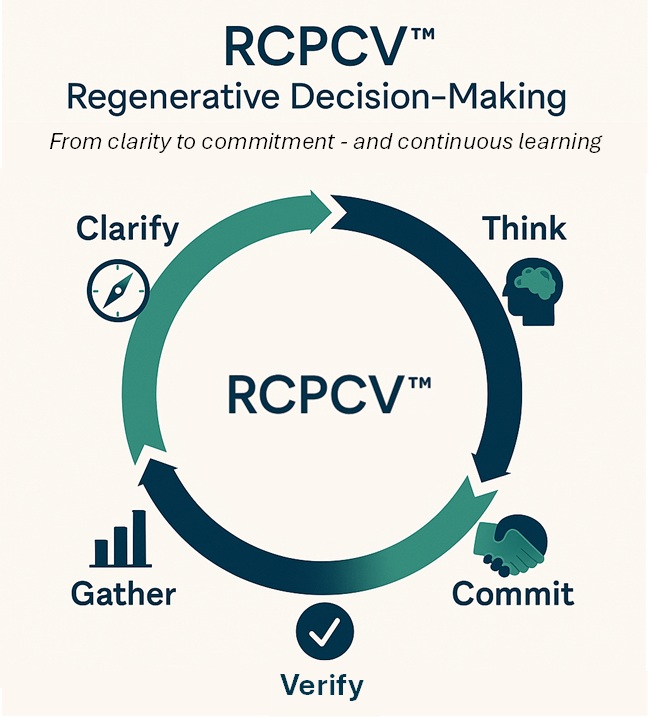
That’s why I developed the RCPCV™ model - a regenerative decision cycle built on five essential steps:
1. Gather the Facts — collect available data, signals, and context (acknowledging uncertainty)
2. Consult the People — engage those affected to listen and surface perspectives
3. Reflect and Analyze — make sense of complexity, test assumptions, and weigh options
4. Communicate the Decision — state the decision with clarity and purpose, explain its rationale, and ensure shared understanding across those impacted or involved in its execution
5. Verify and Follow Up — check outcomes, learn, and adapt
Practical example:
In complex or ambiguous environments, I often see leaders waiting for “complete certainty.”
The RCPCV™ model helps them move forward with sufficient clarity, avoiding paralysis.
Each decision becomes a learning opportunity, not just a destination.
To decide regeneratively is to choose with purpose - and to recognize that each decision also shapes our evolution.
What does your decision-making process look like in times of uncertainty?
Which of the 5 steps do you feel you most need — or most rely on?
Missed the first post in this series?
Read it here: 🔗 Post 1 — Introduction to the 11 Keys to Regenerative Leadership
|
Posted on: September 01, 2025 01:00 PM
|
Permalink |
Comments (6)
| 
This is the first post in the series “The 11 Keys to Regenerative Leadership”
In a world where everything changes rapidly, trust is no longer just “important.”
It has become vital.
But trust, from a regenerative perspective, is neither static nor guaranteed.
It is a living asset — something that must be cultivated, nurtured, and continuously renewed.
Regenerative leaders understand that trust does not stem from authority, but from consistency, listening, and presence.
And that organizational trust is not an abstract value — it’s an invisible infrastructure that sustains collaboration, accelerates decision-making, and makes teams more resilient.
Practical example:
In my work with hybrid teams and critical projects, I use the concept of Invisible Infrastructures of Trust — intentional practices that foster psychological safety, predictability, and alignment.
Things like:
- Keeping micro-agreements
- Making decisions transparent
- Listening with genuine curiosity
When trust is regenerated daily, it transforms what used to require control into something that flows with autonomy.
And in your experience: what practices help you regenerate trust in your context?
|
Posted on: August 29, 2025 11:43 AM
|
Permalink |
Comments (5)
| 
The world no longer needs leaders who are merely efficient.
It needs leaders who regenerate trust, impact, and the future.
After more than 40 years in management, leadership, and organizational transformation, I’ve come to realize that traditional leadership practices are no longer enough.
The future calls for something deeper: Regenerative Leadership.
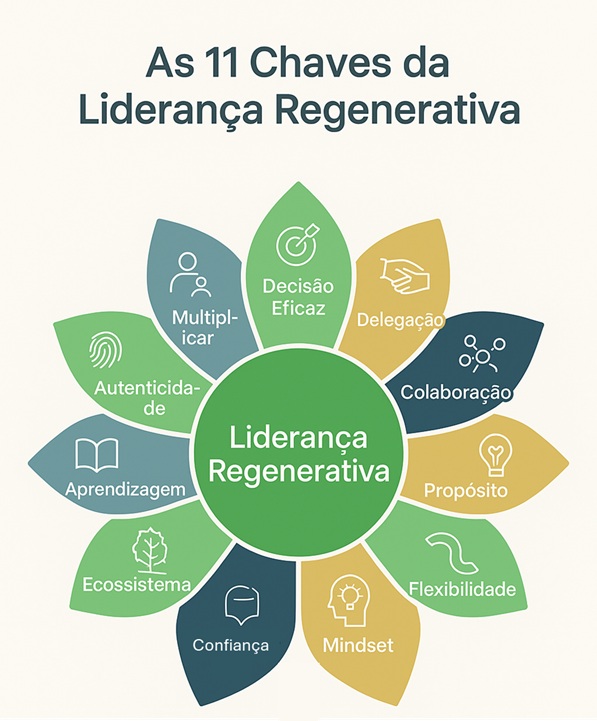
That’s why I’ve developed an integrated model built around 11 keys that reflect what a regenerative leader practices every day:
- Builds trust that continually renews
- Makes decisions as learning cycles
- Delegates as a form of legacy
- Multiplies leadership
- Aligns teams, organizations, and ecosystems around a greater purpose
This is the series I’m launching here on ProjectManagement:
“The 11 Keys to Regenerative Leadership”
In each post, I’ll explore one key, sharing reflections, frameworks, and practical examples.
The goal is not to create yet another theoretical model.
It’s to offer a practical compass for leaders who want to go beyond managing — and start regenerating.
Follow the series, share your thoughts, join the conversation.
The leadership of the future is a living dialogue.
|
Posted on: August 28, 2025 10:44 AM
|
Permalink |
Comments (7)
| 
How to transform task delegation into a strategy for leader development, cultural strengthening, and organizational sustainability.
Introduction
Earlier this year, I published the article, Mastering Delegation: The Key to High-Performance Teams and Sustainable Success where I presented an operational guide to delegating with clarity and effectiveness. We explored the practical steps — from defining what to delegate to monitoring results — focusing on increasing productivity and reducing leader overload.
But delegation goes far beyond efficiency. When seen only as a tool to “free up time” or “hand off tasks,” delegation loses its most transformative potential: developing leaders, strengthening cultures, and building resilient organizations. In a scenario where change is rapid, teams are more diverse, and structures are more distributed, delegating with purpose has become a central strategic competency. It is what differentiates leaders who merely manage teams from those who build high-performance ecosystems and organizational sustainability.
This approach echoes the central principle of the Toyota Model of “developing leaders who develop leaders,” where delegation is seen as a pillar for building organizational capacity. According to McKinsey’s The State of Organizations (2023), 20–30% of critical roles are not filled by the most suitable people — a gap that structured delegation can help close by developing internal talent for strategic roles.
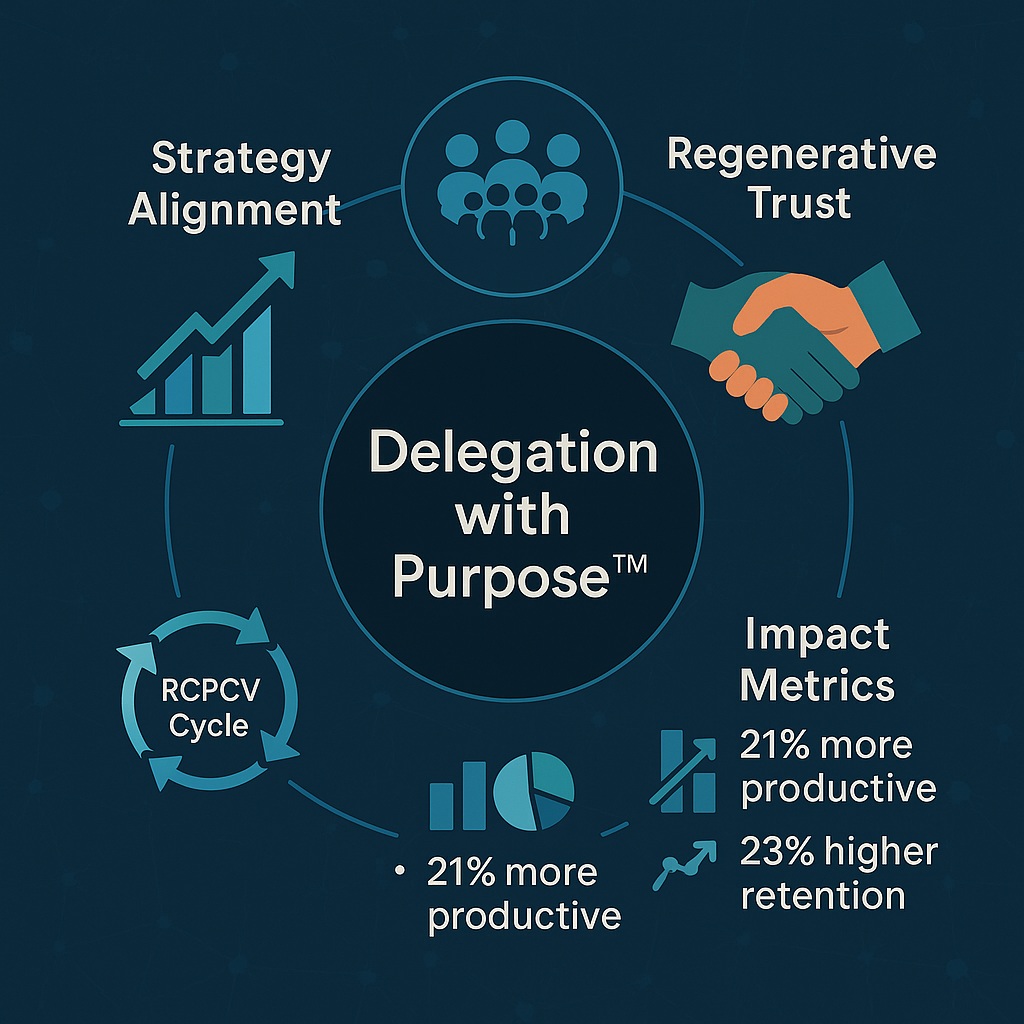
In this second part, we will explore the strategic and integrated version of Delegation with Purpose™, which combines:
- Stage 0 – Intention and Context to link each delegation to organizational objectives and individual development.
- Regenerative Trust as the foundation for creating sustained autonomy.
- RCPCV™ as a micro-cycle to structure and monitor the transfer of responsibilities.
- Effectiveness metrics to measure real impact and promote continuous improvement.
The goal is clear: to transform delegation from a tactical practice into a lever for regenerative leadership — capable of creating leaders at all levels and sustaining long-term success. Recent studies, such as Gallup’s State of the Global Workplace (2024), show that highly engaged teams — driven by effective delegation — are 21% more productive, highlighting its impact on overall performance.
Stage 0 – Intention and Context
Before deciding what to delegate, it is essential to answer a simple yet powerful question:
“Why am I delegating this task?”
Many leaders start delegating reactively — to relieve overload, meet deadlines, or “offload” operational work. While understandable, these motivations limit the true potential of delegation. Delegation with Purpose™ starts with strategic clarity and deliberate intent, ensuring that each transferred responsibility:
- Directly supports organizational objectives – The task must contribute to strategic priorities, not simply “fill time” or temporarily relieve the leader.
- Develops the employee’s capability – Delegation should be an investment in the person’s growth, expanding skills and confidence.
- Strengthens organizational culture – By involving different hierarchical levels in meaningful responsibilities, trust, collaboration, and belonging are reinforced.
Cultural Note: Perceptions of delegation vary according to cultural context. In cultures with higher power distance, delegation may be interpreted as “abandoning” the subordinate; in more horizontal cultures, it may be seen as a vote of confidence. Adjusting communication and support avoids misunderstandings. Deloitte’s Human Capital Trends (2025) indicates that collaborative cultures, strengthened by practices such as delegation, promote higher talent retention, with evidence suggesting significant impacts.
In the AI era, this stage gains relevance: delegating routine tasks to automation tools can free humans for innovation. PwC (2024) suggests that companies using AI for task automation see efficiency gains of up to 30%.
The Delegation Impact Map
A tool to quickly assess the strategic relevance of each task before delegating it:
|
Question
|
Application Example
|
Expected Impact
|
|
What is the impact of this task on strategy?
|
Preparing a report that supports investment decisions.
|
Contributes to growth goals, with the potential to increase decision-making speed by 20%, according to a McKinsey study on hybrid teams.
|
|
What skills will be developed?
|
Data analysis, executive communication.
|
Develops critical skills; Gallup reports that engaged teams grow retention by 23%.
|
|
How does it contribute to team culture?
|
Promotes information sharing and collaborative decision-making.
|
Strengthens resilience; Deloitte notes that collaborative cultures significantly promote retention.
|
Mapping these answers prevents “automatic” delegation and ensures the process is guided by long-term results.
Delegation as a Regenerative Leadership Tool
Delegating is not just transferring responsibilities — it is transferring trust, autonomy, and growth opportunities. In a regenerative leadership context, delegation becomes a lever to:
- Create new leaders – Challenge and empower people to make decisions and lead projects.
- Strengthen organizational resilience – Distribute skills and knowledge so operations do not depend on a few key individuals.
- Encourage innovation and autonomy – Free up leader time for strategic thinking while the team takes a more active role in execution.
As discussed in Regeneration Journal (2025), regenerative leadership focuses on restoring organizational ecosystems, with evidence showing positive impacts on productivity. In the AI era, delegating to intelligent agents strengthens resilience, with Deloitte (2025) highlighting notable improvements in adaptability to change.
The Role of Regenerative Trust
For delegation to succeed, more than technical competence is needed. It is necessary to create an environment where:
- Trust is reciprocal – The leader believes in the collaborator’s ability, and the collaborator feels they can act without excessive fear of mistakes.
- Psychological safety is strong – As Amy Edmondson argues, people need to feel safe to take risks and share ideas.
- Mistakes are treated as learning opportunities – Not as failures to be punished.
Stephen M.R. Covey, in the concept of Smart Trust, reinforces that intelligent trust is not the absence of control but rather the balance between autonomy and verification — precisely the logic that sustains Delegation with Purpose™. Gallup’s State of the Global Workplace (2024) reveals that low trust costs the global economy US$8.9 trillion, or 9% of GDP, underscoring the need for regenerative practices.
Integrating RCPCV™ into Delegation
RCPCV™ – Effective Decision-Making is an authorial model that structures decision-making with clarity and trust. Applied to delegation, it works as a micro-cycle:
- Recolher (Gather) – Obtain all relevant information: context, objectives, constraints, stakeholders.
- Consultar (Consult) – Exchange perceptions and align expectations with the collaborator before formalizing delegation.
- Pensar (Think) – Define, together, the action plan and success metrics.
- Comunicar (Communicate) – Formalize responsibility, deadlines, resources, and checkpoints.
- Verificar (Verify) – Monitor execution, provide support when necessary, and adjust based on results.
Practical Example: In a technology company, a product director delegated to a team manager the responsibility for a new feature line. By applying RCPCV™, they ensured vision alignment (Gather), clear priorities (Consult), defined milestones (Think), formal assignment (Communicate), and biweekly reviews (Verify). The result: a 20% increase in development speed, maintained quality, and a collaborator better prepared to lead strategic projects — aligned with McKinsey’s findings on hybrid teams, which see similar productivity gains.
Trust and Psychological Safety: The Foundation of Delegation with Purpose™
Regenerative trust is the radar for measuring and evolving the delegation environment. Metrics such as retention rate (increased by 23% with effective delegation, per Gallup) and engagement (31% in the U.S. in 2024) help track impacts. Include regular assessments to adjust, fostering a culture where delegation multiplies capabilities.
Conclusion – Delegating to Multiply, Not to Replace
Delegating with Purpose™ does not replace the leader — it multiplies their impact, creating regenerative organizations. Linking back to the previous article, this strategic approach elevates tactical execution into long-term sustainability. As the World Economic Forum (2025, New type of leadership key to future of global value chains) shows, regenerative leadership is essential for global value chains, significantly promoting resilience. Apply RCPCV™ to your next task and see the difference — test it for one week for initial results.
References
- Edmondson, A. (2019). The Fearless Organization. Wiley.
- Covey, S. M. R. (2012). Smart Trust. Free Press.
- Hersey, P., & Blanchard, K. H. (1988). Management of Organizational Behavior: Utilizing Human Resources. Prentice Hall.
- Liker, J. K. (2004). The Toyota Way. McGraw-Hill.
- McKinsey & Company. (2023). The State of Organizations.
- Gallup. (2024). State of the Global Workplace.
- Deloitte. (2025). Human Capital Trends.
- PwC. (2024). AI in Business Operations: Efficiency Gains.
- Regeneration Journal. (2025). Regenerative Leadership: What the World Needs Now.
- World Economic Forum. (2025). New type of leadership key to future of global value chains.
|
Posted on: August 23, 2025 09:32 AM
|
Permalink |
Comments (6)
| 
Introduction
Conflicts are part of the nature of human relationships, especially in organizational settings where diverse interests, perspectives, and pressures coexist.
However, it is not conflict itself that undermines results—but how it is handled.
A reactive, ego-driven approach can escalate tensions and compromise collaboration.
On the other hand, a structured and collaborative approach can transform conflict into an opportunity for alignment, innovation, and stronger relationships.
This article presents an original conflict resolution model, grounded in international best practices and direct experience in team and leadership environments.
The model proposes three simple yet profound steps, focusing on constructive confrontation, open dialogue, and the co-creation of solutions.
Infographic
The figure below provides an overview of the proposed model for constructive conflict resolution, structured in three complementary steps:

Model Foundations
This model incorporates key principles of Design Thinking, such as empathy with all parties, collaborative problem definition, creative idea generation, and implementation with openness to continuous learning.
Although designed for conflict management, the model reflects the iterative, human-centered, and solution-oriented logic of Design Thinking.
It is also influenced by recognized approaches in conflict resolution literature, such as the collaborative negotiation principles of Fisher, Ury, and Patton (Getting to Yes), the Thomas-Kilmann Conflict Mode Instrument (TKI), and transformative mediation practices.
These approaches promote a win-win posture based on mutual understanding, active listening, and the pursuit of sustainable solutions.
The model is presented as a structured and applicable synthesis for diverse contexts, aiming to facilitate functional resolution while preserving the dignity of those involved and promoting co-created value.
It has been successfully applied in different organizations and team settings, leading to visible improvements in collaboration, tension reduction, and collective effectiveness.
Case Study – Conflict Between Project Leaders
To illustrate the model, we present the fictional case of an organization where two project managers, Ana and Ricardo, entered into conflict over prioritizing shared resources between their teams.
Ana led a long-term strategic project, while Ricardo was under pressure to deliver immediate results.
The tension escalated to the point where both teams stopped collaborating effectively, affecting overall performance.
The 3-Step Collaborative Confrontation Model
Step 1 – Define the Problem
Acknowledge the Conflict
Recognize and name the tension or disagreement.
Avoid ignoring or minimizing the situation.
Agree that the situation needs to be resolved
All parties must agree that the issue deserves constructive attention and shared effort.
Establish Common Ground or Shared Objectives
Identify shared goals, values, or interests that can serve as a foundation for collaboration.
Effective communication is required
Ensure that communication is empathetic, clear, and focused on mutual understanding.
Separate Problems from People
Avoid personal attacks or assumptions about intent.
Focus on functions rather than ego and personality
Address behaviors, facts, and roles—without conflating them with individual identities.
Applying to the case: Ana and Ricardo participated in a facilitated session where they recognized the conflict wasn’t personal but stemmed from a lack of alignment on organizational priorities.
As common ground, they identified the shared goal of preserving the organization’s reputation and supporting the well-being of their teams.
Step 2 – Explore and Evaluate Alternatives
Explore Alternatives
Encourage open brainstorming without immediate judgment.
Welcome different perspectives, even those that initially seem impractical.
Research and define possible solutions – Divergence
Foster creative thinking and generate multiple options to expand the field of possibilities.
Evaluate Alternatives
Move to a critical assessment of proposals based on objective and shared criteria.
An analytical approach is required – Win-Win Strategy
Each alternative should be evaluated for feasibility, fairness, sustainability, and alignment with shared interests.
Applying to the case: Three main alternatives were proposed: (1) splitting resources by shifts, (2) redefining both project timelines based on the global portfolio, and (3) temporarily reallocating resources from a lower-priority team.
Option 2 was considered the most balanced and feasible.
Step 3 – Select the Best Alternative
Select and Implement the Alternative
Choose the most suitable solution based on shared criteria.
Define a clear and feasible implementation plan.
Achieve consensus on the chosen solution – Convergence
Ensure that all parties support the chosen alternative and are committed to putting it into action.
Applying to the case: Ana and Ricardo agreed to adjust their project schedules, with mediation from the Project Management Office.
Their teams resumed collaboration, and the conflict gave way to a new process of regular alignment between the managers.
Model Advantages
- Focus on relationships: Promotes active listening, mutual respect, and recognition.
- Sustainable solutions: Builds agreements based on real interests, not forced concessions.
- Skills development: Encourages empathy, critical thinking, and shared responsibility.
- Adaptability: Applicable in teams, interdepartmental settings, and institutional contexts.
- Strengthens a collaborative culture: Fosters emotional and relational maturity in the workplace.
Limitations and Considerations
- Not all contexts allow for collaboration: In environments with extreme power asymmetry or no psychological safety, the model may require adjustments.
- Requires time and emotional availability: May not be feasible in high-pressure or urgent situations.
- Assumes good faith: Works best when there is genuine intent to resolve—not manipulate—the conflict.
- Facilitator may be needed in complex cases: Deep conflicts may require the presence of a neutral mediator or external facilitator.
- Conflicts rooted in core values: When personal values or beliefs are involved, complementary approaches may be necessary (e.g., deep listening, coaching, or systemic interventions). Contextual sensitivity and emotional maturity are essential.
Practical Applications
This model can be used in:
- Team meetings to address misunderstandings or deadlocks
- Mediation between departments or external partners
- Coaching or mentoring focused on improving relationships
- Collective decision-making in contexts of divergence
- Leadership training programs to strengthen conflict resolution competencies
Conclusion
The connection to Design Thinking principles is clear in the model’s human-centered approach and emphasis on empathy, collaboration, and constructive iteration.
This reinforces its practical and adaptive nature, making it useful not only as a resolution tool but also as a platform for shared learning and growth.
Well-managed conflicts can become catalysts for innovation, alignment, and stronger relationships.
The 3-Step Collaborative Confrontation Model offers a practical, human, and effective way to transform disagreements into shared solutions.
By adopting this model, individuals and teams don’t just solve problems—they cultivate healthier and more resilient cultures.
This is an invitation to transformation: to face conflict with courage and empathy, recognizing that at the heart of every disagreement may lie the opportunity for shared evolution.
References
- Fisher, R., Ury, W., & Patton, B. (2011). Getting to Yes: Negotiating Agreement Without Giving In. Penguin Books.
- Thomas, K. W., & Kilmann, R. H. (1974). Thomas-Kilmann Conflict Mode Instrument. CPP, Inc.
- Bush, R. A. B., & Folger, J. P. (2005). The Promise of Mediation: The Transformative Approach to Conflict. Jossey-Bass.
- Covey, S. R. (2004). The 7 Habits of Highly Effective People. Free Press.
- Goleman, D. (1998). Working with Emotional Intelligence. Bantam Books.
- Lencioni, P. (2002). The Five Dysfunctions of a Team. Jossey-Bass.
- Brown, T. (2009). Change by Design: How Design Thinking Creates New Alternatives for Business and Society. Harvard Business Press.
|
Posted on: August 08, 2025 02:03 PM
|
Permalink |
Comments (3)
|
"To you I'm an atheist; to God, I'm the Loyal Opposition."
- Woody Allen
|




