Before We Rebuild, What Must We Take Apart?
From the Support to Develop Blog
by Luis Branco

This blog addresses management-related topics and has three areas of focus: 1. Technical skills; 2. Competencies in the field of interpersonal relations and communication (including personal organization and delegation, leadership, teamwork, conflict resolution, conducting meetings, and negotiation); and 3. Strategy (including diagnosis, strategic guidelines, and implementation).4.Technology
Recent Posts
Delegation with Purpose: Building Autonomy and Developing Capability
RCPCV™: A Method for Decision-Making and Continuous Improvement
The Same Change Can Succeed and Fail at the Same Time
What Must Exist Even When No Single Role Owns the Whole?
PHASE 4 – THE EMERGENCE
Categories
Agile,
Career Development,
Career Development,
Career Development,
Career Development,
Career Development,
Career Development,
Career Development,
Career Development,
Career Development,
Career Development,
Career Development,
Career Development,
Career Development,
Career Development,
Career Development,
Career Development,
Career Development,
Career Development,
Career Development,
Career Development,
Career Development,
Career Development,
Career Development,
Career Development,
Career Development,
Career Development,
Career Development,
Career Development,
Career Development,
Career Development,
Career Development,
Career Development,
Career Development,
Career Development,
Career Development,
Career Development,
Career Development,
Career Development,
Career Development,
Career Development,
Career Development,
Career Development,
Career Development,
Career Development,
Career Development,
Career Development,
Career Development,
Career Development,
Career Development,
Career Development,
Career Development,
Career Development,
Career Development,
Career Development,
Career Development,
Career Development,
Career Development,
Career Development,
Career Development,
Career Development,
Career Development,
Career Development,
Career Development,
Career Development,
Career Development,
Career Development,
Career Development,
Career Development,
Career Development,
Career Development,
Career Development,
Career Development,
Career Development,
Career Development,
Career Development,
Career Development,
Career Development,
Career Development,
Career Development,
Career Development,
Career Development,
Career Development,
Career Development,
Career Development,
Career Development,
Career Development,
Career Development,
Career Development,
Career Development,
Career Development,
Career Development,
Career Development,
Career Development,
Career Development,
Career Development,
Career Development,
Career Development,
Career Development,
Career Development,
Career Development,
Career Development,
Career Development,
Career Development,
Career Development,
Career Development,
Career Development,
Career Development,
Career Development,
Career Development,
Career Development,
Career Development,
Career Development,
Career Development,
Career Development,
Career Development,
Career Development,
Career Development,
Career Development,
Career Development,
Career Development,
Career Development,
Career Development,
Education,
Governance,
Governance,
Governance,
Governance,
Governance,
Governance,
Governance,
Governance,
Governance,
Governance,
Governance,
Governance,
Governance,
Governance,
Governance,
Governance,
Governance,
Governance,
Governance,
Governance,
Governance,
Governance,
In,
Integration Management,
Interpersonal Skills,
Interpersonal Skills,
Interpersonal Skills,
Interpersonal Skills,
Interpersonal Skills,
Interpersonal Skills,
Interpersonal Skills,
Interpersonal Skills,
Interpersonal Skills,
Interpersonal Skills,
Interpersonal Skills,
Interpersonal Skills,
Interpersonal Skills,
Interpersonal Skills,
Interpersonal Skills,
Interpersonal Skills,
Interpersonal Skills,
Interpersonal Skills,
Interpersonal Skills,
Interpersonal Skills,
Interpersonal Skills,
Interpersonal Skills,
Interpersonal Skills,
Interpersonal Skills,
Interpersonal Skills,
Interpersonal Skills,
Interpersonal Skills,
Interpersonal Skills,
Interpersonal Skills,
Interpersonal Skills,
Interpersonal Skills,
Interpersonal Skills,
Interpersonal Skills,
Interpersonal Skills,
Interpersonal Skills,
Interpersonal Skills,
Interpersonal Skills,
Interpersonal Skills,
Interpersonal Skills,
Interpersonal Skills,
Interpersonal Skills,
Interpersonal Skills,
Interpersonal Skills,
Interpersonal Skills,
Interpersonal Skills,
Interpersonal Skills,
Interpersonal Skills,
Interpersonal Skills,
Interpersonal Skills,
Interpersonal Skills,
Interpersonal Skills,
Interpersonal Skills,
Interpersonal Skills,
Interpersonal Skills,
Interpersonal Skills,
Interpersonal Skills,
Interpersonal Skills,
Interpersonal Skills,
Interpersonal Skills,
Interpersonal Skills,
Interpersonal Skills,
Interpersonal Skills,
Interpersonal Skills,
Interpersonal Skills,
Interpersonal Skills,
Interpersonal Skills,
Interpersonal Skills,
Interpersonal Skills,
Interpersonal Skills,
Interpersonal Skills,
Interpersonal Skills,
Interpersonal Skills,
Interpersonal Skills,
Interpersonal Skills,
Interpersonal Skills,
Interpersonal Skills,
Interpersonal Skills,
Interpersonal Skills,
Interpersonal Skills,
Interpersonal Skills,
Interpersonal Skills,
Interpersonal Skills,
Interpersonal Skills,
Interpersonal Skills,
Interpersonal Skills,
Interpersonal Skills,
Interpersonal Skills,
Interpersonal Skills,
Interpersonal Skills,
Interpersonal Skills,
Interpersonal Skills,
Interpersonal Skills,
Interpersonal Skills,
Interpersonal Skills,
Interpersonal Skills,
Interpersonal Skills,
Interpersonal Skills,
Interpersonal Skills,
Interpersonal Skills,
Interpersonal Skills,
Interpersonal Skills,
Interpersonal Skills,
Interpersonal Skills,
Interpersonal Skills,
Interpersonal Skills,
Interpersonal Skills,
Interpersonal Skills,
Interpersonal Skills,
Interpersonal Skills,
Interpersonal Skills,
Interpersonal Skills,
Interpersonal Skills,
Interpersonal Skills,
Interpersonal Skills,
Interpersonal Skills,
Interpersonal Skills,
Interpersonal Skills,
Interpersonal Skills,
Interpersonal Skills,
Interpersonal Skills,
Interpersonal Skills,
Interpersonal Skills,
Knowledge Management,
le,
lea,
Leadership,
Leadership,
Leadership,
Leadership,
Leadership,
Leadership,
Leadership,
Leadership,
Leadership,
Leadership,
Leadership,
Leadership,
Leadership,
Leadership,
Leadership,
Leadership,
Leadership,
Leadership,
Leadership,
Leadership,
Leadership,
Leadership,
Leadership,
Leadership,
Leadership,
Leadership,
Leadership,
Leadership,
Leadership,
Leadership,
Leadership,
Leadership,
Leadership,
Leadership,
Leadership,
Leadership,
Leadership,
Leadership,
Leadership,
Leadership,
Leadership,
Leadership,
Leadership,
Leadership,
Leadership,
Leadership,
Leadership,
Leadership,
Leadership,
Leadership,
Leadership,
Leadership,
Leadership,
Leadership,
Leadership,
Leadership,
Leadership,
Leadership,
Leadership,
Leadership,
Leadership,
Leadership,
Leadership,
Leadership,
Leadership,
Leadership,
Leadership,
Leadership,
Leadership,
Leadership,
Leadership,
Leadership,
Leadership,
Leadership,
Leadership,
Leadership,
Leadership,
Leadership,
Leadership,
Leadership,
Leadership,
Leadership,
Leadership,
Leadership,
Leadership,
Leadership,
Leadership,
Leadership,
Leadership,
Leadership,
Leadership,
Leadership,
Leadership,
Leadership,
Leadership,
Leadership,
Leadership,
Leadership,
Leadership,
Leadership,
Leadership,
Leadership,
Leadership,
Leadership,
Leadership,
Leadership,
Leadership,
Leadership,
Leadership,
Leadership,
Leadership,
Leadership,
Leadership,
Leadership,
Leadership,
Leadership,
Leadership,
Leadership,
Leadership,
Leadership,
Leadership,
Leadership,
Leadership,
or,
Organizational Project Management,
Portfolio Management,
Program,
Program Management,
Strategy,
Strategy,
Strategy,
Strategy,
Strategy,
Strategy,
Strategy,
Strategy,
Strategy,
Strategy,
Strategy,
Strategy,
Strategy,
Strategy,
Strategy,
Strategy,
Strategy,
Strategy,
Strategy,
Strategy,
Strategy,
Strategy,
Strategy,
Strategy,
Strategy,
Strategy,
Strategy,
Strategy,
Strategy,
Strategy,
Strategy,
Strategy,
Strategy,
Strategy,
Strategy,
Strategy,
Strategy,
Strategy,
Strategy,
Strategy,
Strategy,
Strategy,
Strategy,
Strategy,
Strategy,
Strategy,
Strategy,
Strategy,
Strategy,
Strategy,
Strategy,
Strategy,
Strategy,
Strategy,
Strategy,
Strategy,
Strategy,
Strategy,
Strategy,
Strategy,
Strategy,
Strategy,
Strategy,
Strategy,
Strategy,
Strategy,
Strategy,
Strategy,
Strategy,
Strategy,
Strategy,
Strategy,
Strategy,
Strategy,
Strategy,
Strategy,
Strategy,
Strategy,
Strategy,
Strategy,
Strategy,
Strategy,
Strategy,
Strategy,
Strategy,
Strategy,
Strategy,
Strategy,
Strategy,
Strategy,
Strategy,
Strategy,
Strategy,
Strategy,
Strategy,
Strategy,
Strategy,
Strategy,
Strategy,
Strategy,
Strategy,
Strategy,
Strategy,
Strategy,
Strategy,
Strategy,
Strategy,
Strategy,
Strategy,
Strategy,
Strategy,
Strategy,
Strategy,
Strategy,
Strategy,
Strategy,
Strategy,
Strategy,
Strategy,
Strategy,
Strategy,
Strategy,
Strategy,
Sustainability,
Talent Management,
Talent Management,
Talent Management,
Talent Management,
Talent Management,
Talent Management,
Talent Management,
Talent Management,
Talent Management,
Talent Management,
Talent Management,
Talent Management,
Talent Management,
Talent Management,
Talent Management,
Talent Management,
Talent Management,
Talent Management,
Talent Management,
Talent Management,
Talent Management,
Talent Management,
Talent Management,
Talent Management,
Talent Management,
Talent Management,
Talent Management,
Talent Management,
Talent Management,
Talent Management,
Talent Management,
Talent Management,
Talent Management,
Talent Management,
Talent Management,
Talent Management,
Talent Management,
Talent Management,
Talent Management,
Talent Management,
Talent Management,
Talent Management,
Talent Management,
Talent Management,
Talent Management,
Talent Management,
Talent Management,
Talent Management,
Talent Management,
Talent Management,
Talent Management,
Talent Management,
Talent Management,
Talent Management,
Talent Management,
Talent Management,
Talent Management,
Talent Management,
Talent Management,
Talent Management,
Talent Management,
Talent Management,
Talent Management,
Talent Management,
Talent Management,
Talent Management,
Talent Management,
Talent Management,
Talent Management,
Talent Management,
Talent Management,
Talent Management,
Talent Management,
Talent Management,
Talent Management,
Talent Management,
Talent Management,
Talent Management,
Talent Management,
Talent Management,
Talent Management,
Talent Management,
Talent Management,
Talent Management,
Talent Management,
Talent Management,
Talent Management,
Talent Management,
Talent Management,
Talent Management,
Talent Management,
Talent Management,
Talent Management,
Talent Management,
Talent Management,
Talent Management,
Talent Management,
Talent Management,
Talent Management,
Talent Management,
Talent Management,
Talent Management,
Talent Management,
Talent Management,
Talent Management,
Talent Management,
Talent Management,
Talent Management,
Talent Management,
Talent Management,
Talent Management,
Talent Management,
Talent Management,
Talent Management,
Talent Management,
Talent Management,
Talent Management,
Talent Management,
Talent Management,
Talent Management,
Talent Management,
Talent Management,
Talent Management
Date
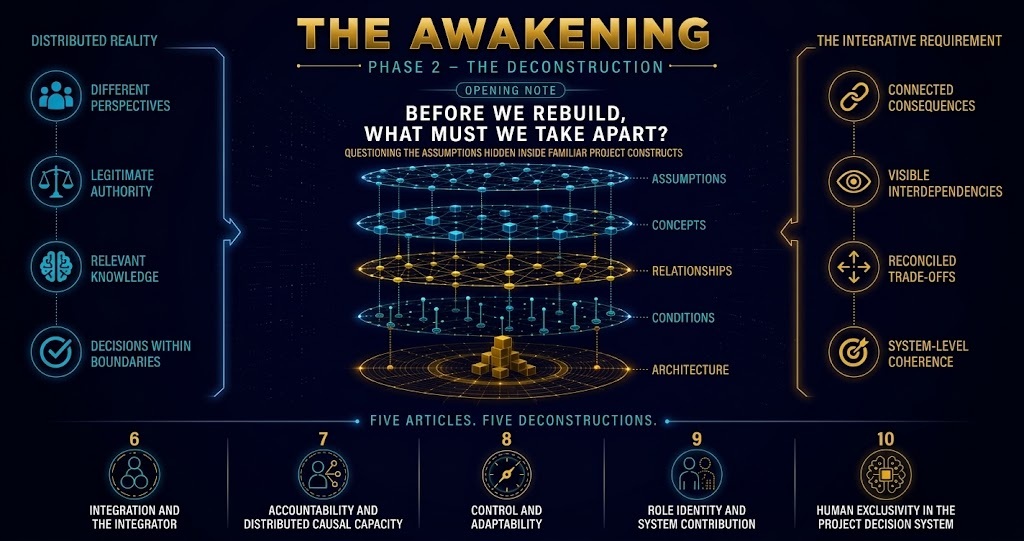 Questioning the assumptions hidden inside familiar project constructs
The first phase of THE AWAKENING began with a question.
What changes when project leadership becomes increasingly distributed?
Five reflections later, the answer became more precise.
Leadership has not disappeared.
Integration has not been forgotten.
Agility is not inherently the problem.
The Project Manager has not simply stopped integrating.
And distributed leadership does not, by itself, create an integration gap.
What has changed is the architecture within which these functions are exercised.
Leadership, authority, knowledge, adaptation and management responsibilities can increasingly reside in different places.
Responsibility for integrative work can also be distributed.
But the interdependencies among those distributions do not disappear.
Phase 1 therefore ended with a more precise conclusion:
The challenge is not that leadership has disappeared. Nor that integration has been forgotten. It is that as leadership, authority and management responsibilities become increasingly distributable, the architecture of integration must remain sufficiently explicit and capable relative to the material interdependencies created by that distribution. Otherwise, locally legitimate decisions can become globally incoherent.That was
The Revealing.
But revealing the problem is not the same as understanding the assumptions through which we interpret it.
That is where Phase 2 begins.
From Revealing to DeconstructingProject management has developed around concepts that are both useful and familiar.
Leadership.
Authority.
Responsibility.
Accountability.
Control.
Autonomy.
Governance.
Coordination.
Integration.
Alignment.
Roles.
These concepts help us organize action.
But familiarity can also make relationships between them appear necessary before that necessity has been tested.
If there is integration, we may look for an integrator.
If someone is accountable, we may assume that person must also possess authority.
If control decreases, we may assume autonomy increases.
If information is visible, we may assume that what matters will be recognized.
If responsibilities are clearly allocated, we may assume consequential relationships among them will also be recognized.
If everyone is aligned, we may assume the system will remain coherent.
If governance exists, we may assume integration follows.
None of these relationships should be rejected in advance.
But neither should they be accepted merely because they are familiar.
Phase 2 will test them.Deconstruction Is Not RejectionThe purpose of deconstruction is not to declare established project structures obsolete.
Nor is it to replace Project Managers, governance, accountability, control or established management practices with a new vocabulary.
It is something more disciplined.
To separate what has been treated as inseparable, so that we can test what is essential, what is contingent, and what actually follows under different organizational conditions.That distinction matters.
An integrator may be highly valuable.
The question is whether integration inherently requires one.
Control may preserve coherence.
The question is which forms of control do so, under what conditions, and when they begin to constrain useful adaptation.
Accountability is often associated with authority and causal capacity.
The question is whether accountability can remain legitimate when the conditions required to influence outcomes reside in different places or become materially constrained.
Roles can concentrate functions, capabilities and professional identity.
The question is whether those functions necessarily depend on the role boundaries through which they have traditionally been organized.
Project decision systems have historically been designed around human analysis, judgment, authority and accountability.
The question is which of those relationships remain necessary when AI becomes capable of analysis, recommendation and bounded action.
Deconstruction therefore begins neither with acceptance nor rejection.
It begins with a more demanding question:
What exactly must be true for the relationship we have assumed to hold?The Unit of Analysis Must Also Be QuestionedPhase 1 already exposed one reason this matters.
A project can contain competent people, legitimate authority, clear responsibilities, sound decisions, effective teams and appropriate governance mechanisms, yet still produce consequences that cannot be adequately understood by examining any one decision in isolation.
Decisions interact.
Responsibilities intersect.
Authority boundaries meet.
Consequences can propagate across boundaries.
And some risks become visible only at the level of those relationships.
Deconstruction therefore cannot focus only on roles.
It must also examine the relationships among:
Functions, actors, decisions, authority, information, incentives, boundaries, interdependencies and consequences.The question is no longer simply:
Who does what?
It also becomes:
Which relationships, if any, must exist among differentiated responsibilities for the system to remain governable and sufficiently coherent?Phase 1 Had Already Begun the DeconstructionSome of this work has already started.
Phase 1 separated integration from governance, coordination and alignment.
It also distinguished local validity from systemic coherence.
These were not semantic exercises.
They changed what we learned to look for.
A governance structure can establish legitimate authority, decision rights, accountability and oversight without ensuring that every material interdependency is recognized and reconciled.
Activities can be coordinated while consequential trade-offs remain unresolved.
People can remain aligned around strategic intent while changing conditions create new incompatibilities.
And decisions can be rational, evidence-informed, legitimately authorized and defensible within their own contexts while their combined consequences become systemically incoherent.
The implication is important.
Concepts that interact should not automatically be treated as equivalent, and functions that have historically resided together should not automatically be assumed to be inseparable.Phase 2 makes that principle explicit.
What Happens When the Conditions Separate?Consider a familiar expectation.
Someone is responsible for integration.
But what if that person can see a material interdependency and lacks the legitimate authority to address it?
What if they possess authority but lack relevant knowledge?
What if they possess authority and knowledge but become involved only after meaningful alternatives have disappeared?
What if the formal conditions to act exist, but exercising responsibility requires challenging a previous decision, established position or material interest?
These are not necessarily the same problem.
Nor should they automatically receive the same explanation.
Treating them as one can hide the architecture through which responsibility, authority, knowledge, capability, discretion and opportunity to act are actually connected.
Phase 2 will therefore repeatedly separate constructs that are often compressed together.
Not to fragment understanding.
But to make their relationships more precise.
The Method of Phase 2Each reflection will begin with a relationship that appears intuitively plausible.
Then it will subject that relationship to adversarial testing.
What happens if one element exists without the other?
Under which conditions does the relationship hold?
Under which conditions does it fail?
What mechanism actually connects the two?
At what level of analysis does that mechanism operate?
Who or what must possess the relevant capacity?
What evidence would allow us to distinguish a necessary relationship from one that is merely conventional?
And, importantly:
What would falsify the proposition?The objective is not to protect the argument developed in Phase 1.
It is to expose it to stronger tests.
If a proposition survives, it should survive because meaningful alternatives and counterconditions were seriously examined.
If it does not, THE AWAKENING should change with the evidence.
A defined sequence of inquiry does not predetermine its conclusions.What Phase 2 Will DeconstructFive questions will structure this phase.
Integration and the IntegratorDoes system-level integration inherently require a designated integrator, or can integrative capacity be produced through alternative architectures?
Accountability and Distributed Causal CapacityUnder what conditions can accountability remain legitimate when authority, knowledge, capability and discretion reside in different places?
Control and AdaptabilityWhich forms of control remain necessary for coherence, and under what conditions do they begin to weaken useful autonomy and adaptation?
Role Identity and System ContributionShould professional identity continue to be organized primarily around the Project Manager role, or around the contributions and capabilities required by the project system?
Human Exclusivity in the Project Decision SystemWhich assumptions about human execution, authority, agency and accountability remain valid when AI becomes capable of analysis, recommendation and bounded action?
These questions structure the inquiry. They do not prescribe its answers.Some inherited relationships may survive scrutiny.
Some may need to be qualified.
Some may prove contingent on particular organizational conditions.
And some apparent dichotomies may become less useful once the underlying architecture is examined more closely.
That uncertainty is not a weakness of the inquiry.
It is the reason for conducting it.
Before We RebuildThere is a temptation, once a structural problem becomes visible, to design the solution immediately.
A new role.
A new governance mechanism.
A new accountability model.
A new framework.
A new layer of control.
But premature reconstruction carries its own risk.
We may try to solve the problem using assumptions that have not themselves been tested.
So Phase 2 will resist that temptation.
Before asking what the future architecture of project leadership should become, we need to establish which parts of our inherited conceptual architecture are genuinely necessary, which are contingent, and which relationships survive adversarial testing.
Only then does reconstruction become meaningful.
Phase 1 revealed an architectural problem.
Phase 2 will question the assumptions through which that problem is normally understood.
And it begins with perhaps the most obvious assumption of all.
Integration matters.
Phase 1 gave us strong reasons to retain that conclusion.
But another proposition does not automatically follow from it:
That integration requires an integrator.So the first question of
THE DECONSTRUCTION is deceptively simple:
Does Integration Need an Integrator?That is where Phase 2 begins
Posted on: September 09, 2026 04:53 AM |
Permalink
Comments (11)
Please login or join to subscribe to this item

Antonio Avalos Oropeza
Industrial Engineer | Operational Excellence & Quality Professional| The Organizational Artery
Mexicali Baja California, Mexico
Excellent progression, Luis. The distinction between locally valid decisions and system-level coherence is especially important.
In practice, the governance question may not be only whether authority and accountability are properly assigned, but whether the organization can trace how one decision changes the conditions under which other decisions remain valid.
That shifts the unit of analysis from the individual decision to the network of dependencies, consequences, and feedback loops surrounding it.
As AI begins to take on bounded analysis and action, that architecture becomes even more critical. Visibility without relational traceability can still leave an organization locally rational but globally incoherent.
Would you consider dynamic interdependency traceability part of governance’s integrative capacity, or a distinct organizational capability?

Luis Branco
CEO| Business Insight, Consultores de Gestão, Ldª
Carcavelos, Lisboa, Portugal
Abolfazl Yousefi Darestani
Thank you.
I appreciate you taking the time to read it.
Luis Branco
CEO| Business Insight, Consultores de Gestão, Ldª
Carcavelos, Lisboa, Portugal
Antonio Avalos Oropeza
Thank you.
I think the distinction you introduce between visibility and relational traceability is important.
I would hesitate to place dynamic interdependency traceability inside governance itself.
Governance can establish decision rights, accountability and escalation mechanisms, but that does not necessarily mean the system can trace how one decision changes the conditions under which others remain valid.
I would see traceability, at least provisionally, as something that can support integrative capacity rather than as integration itself.
A system may trace a consequential relationship without recognizing its material significance, reconciling the resulting trade-off, or having legitimate authority to act on it.
AI makes that distinction even more important.
It may expand our capacity to detect and trace relationships across decisions, while leaving the questions of interpretation, integration and legitimate intervention unresolved.
So I would keep the concepts separate for now: traceability can support integrative capacity, but it should not yet be treated as equivalent to either integration or governance.
Antonio Avalos Oropeza
Industrial Engineer | Operational Excellence & Quality Professional| The Organizational Artery
Mexicali Baja California, Mexico
Thank you for the distinction. I agree that Integration, Traceability, and Governance operate at different layers. My interest is in how the threshold at which those layers interact is governed. Without mechanisms that define that threshold, the discussion remains closer to classification than to decision governance.
Luis Branco
CEO| Business Insight, Consultores de Gestão, Ldª
Carcavelos, Lisboa, Portugal
Antonio, I think that is an important distinction.
Separating the concepts is necessary, but it is not sufficient for decision governance.
I would add one qualification to “the threshold.”
I am not sure we should assume there is a single threshold.
A change in an interdependency might warrant attention without yet warranting escalation, and escalation without necessarily warranting intervention.
Different consequences may also require different forms of authority and judgment.
So I think your question takes the inquiry exactly where it needs to go: not only whether consequential relationships can be traced, but how the system determines when a change becomes material enough to require a governed response, and who has legitimate authority to make that determination.
At this stage of THE AWAKENING, I think that question should remain open to testing rather than be resolved by specifying a governance mechanism in advance.
Antonio Avalos Oropeza
Industrial Engineer | Operational Excellence & Quality Professional| The Organizational Artery
Mexicali Baja California, Mexico
Luis Branco, Your distinction between attention, escalation, and intervention made me reconsider the assumption that governance should operate through a single threshold. I am starting to see it more as a variable response to changing business conditions.
The working hypothesis I am exploring is that functions should remain integrated around the same core business objective, but not become dependent on one another or merge their decision logic. Their relative weight can shift as materiality, risk, and contribution to that shared objective change. In other words, a system may legitimately deform toward Safety, Operations, Finance, Quality, or another function when conditions require it. That deformation is not necessarily instability; it may actually be the expected behavior of an adaptive organization.
The more interesting question, then, is what constitutes rupture. My current view is that rupture occurs not when the organizational configuration changes, but when that change causes the system to lose coherence with the core objective, traceability of why the shift occurred, or the ability to absorb the impact without fragmenting. In that sense, I would define stability less as equilibrium and more as the capacity to absorb and redistribute impact without losing continuity.
This also changes how I look at authority. I do not think functional leaders should simply receive isolated departmental objectives and optimize them independently. The core business objective should first be interpreted cross-functionally; only then should functional contribution, risk exposure, and decision space be derived. That could allow authority to remain human and legitimate, while the range of acceptable decisions is already bounded by systemic conditions rather than individual preference.
AI becomes interesting here because it could help detect changing conditions, evaluate materiality, identify affected relationships, and recommend when a governance response may be required—without automatically becoming the authority that decides.
I am still pressure-testing this and would rather not prescribe the mechanism before trying to break it. But your multiple-threshold point helped me see that attention, escalation, and intervention may be better understood as different degrees of organizational deformation rather than a single governance switch. I would be very interested in where you think this logic fails.
Luis Branco
CEO| Business Insight, Consultores de Gestão, Ldª
Carcavelos, Lisboa, Portugal
Antonio, before I challenge the logic further, I would like to clarify one point in your hypothesis.
When you say that functions should remain integrated around the “same core business objective,” what exactly do you mean by “core business objective” in this context?
I think that clarification matters before I try to pressure-test the rest of the hypothesis.
Antonio Avalos Oropeza
Industrial Engineer | Operational Excellence & Quality Professional| The Organizational Artery
Mexicali Baja California, Mexico
Luis, by “core business objective” I do not mean a departmental target, a single KPI, or necessarily a fixed strategic statement.
I mean the highest-order outcome that the organization must preserve while conditions and functional priorities change — the common reference against which competing contributions, risks, and decisions can be interpreted.
For example, Operations may prioritize continuity, Quality conformance, Finance economic viability, and Safety acceptable exposure. Those objectives remain legitimate, but none of them becomes the organizational objective in isolation. Their relative importance can change depending on the situation, while the organization remains oriented toward the same higher-order outcome.
So the “core” is not intended to eliminate functional tension. It provides the reference that makes that tension governable.
I would also distinguish it from something permanently static. If the environment changes enough to require the core objective itself to be reconsidered, that would represent a different level of organizational change than the functional deformation I was describing.
With that definition, I would be very interested in where you think the hypothesis begins to fail.
Luis Branco
CEO| Business Insight, Consultores de Gestão, Ldª
Carcavelos, Lisboa, Portugal
Antonio, with your clarification of the higher-order outcome, that part of the hypothesis is much clearer to me.
I would now pressure-test what you mean by “deformation,” because I think there are two interpretations worth separating.
If deformation means a change in the underlying organizational architecture, I am not sure that a shift in functional weight necessarily implies deformation. Safety, Finance, Quality or Operations may become more consequential under particular conditions while roles, decision rights and governance arrangements remain unchanged.
Even escalation may simply activate a response already designed into the architecture. In that case, the system is not necessarily deforming; the architecture may simply be operating as intended.
If, however, deformation refers more broadly to how the system operates within an unchanged architecture as conditions change, I think the proposition becomes stronger.
Functional contributions may acquire different relative weight, and particular decision paths may be activated, without requiring the underlying architecture itself to change.
But that interpretation creates another question.
Are attention, escalation and intervention really different degrees of the same deformation?
Attention can change without authority changing; escalation can activate an existing decision path; and intervention can be local and reversible.
They may therefore be different governance responses rather than different intensities of one underlying phenomenon.
So I would not yet challenge the broader idea that an adaptive organization can redistribute functional weight while preserving coherence.
The point I would try to break is more specific: what exactly is changing when the organization “deforms,” and are the different responses you describe manifestations of the same variable or distinct mechanisms that should remain analytically separate?
Antonio Avalos Oropeza
Industrial Engineer | Operational Excellence & Quality Professional| The Organizational Artery
Mexicali Baja California, Mexico
Luis, I think your distinction exposes an ambiguity in my use of “deformation.”
I was not intending deformation to mean that the underlying organizational architecture necessarily changes. What I was trying to describe is a change in the operating configuration of the system within that architecture: the relative weight of functional contributions, the decision paths that become active, and the distribution of attention may shift as conditions change, while roles, decision rights, and the governance structure itself can remain intact.
In that sense, “adaptive reconfiguration” may be a more precise term than deformation.
I also think your second distinction is important. Attention, escalation, and intervention should probably not be treated as different intensities of the same phenomenon. They can remain analytically separate governance responses to an underlying change in system conditions.
That would suggest separating at least three things: the change in conditions, the resulting redistribution of functional relevance, and the governance response triggered by that redistribution.
The architecture may therefore remain stable while the operating configuration changes. A more consequential question may be when that reconfiguration can no longer be absorbed within the existing architecture without losing coherence with the higher-order outcome.
That boundary, rather than the reconfiguration itself, may be where what I previously called “rupture” begins.
I think this distinction makes the hypothesis cleaner. I would be interested in whether you see a failure point in that separation as well.
Please Login/Register to leave a comment.
|
A conference is a gathering of important people who singly can do nothing, but together can decide that nothing can be done.
- Fred Allen
|




