
When Locally Valid Decisions Become Globally Incoherent
Categories:
In,
Governance,
Program,
or,
Integration Management,
Leadership,
Program Management,
Organizational Project Management,
Strategy
Categories: In, Governance, Program, or, Integration Management, Leadership, Program Management, Organizational Project Management, Strategy


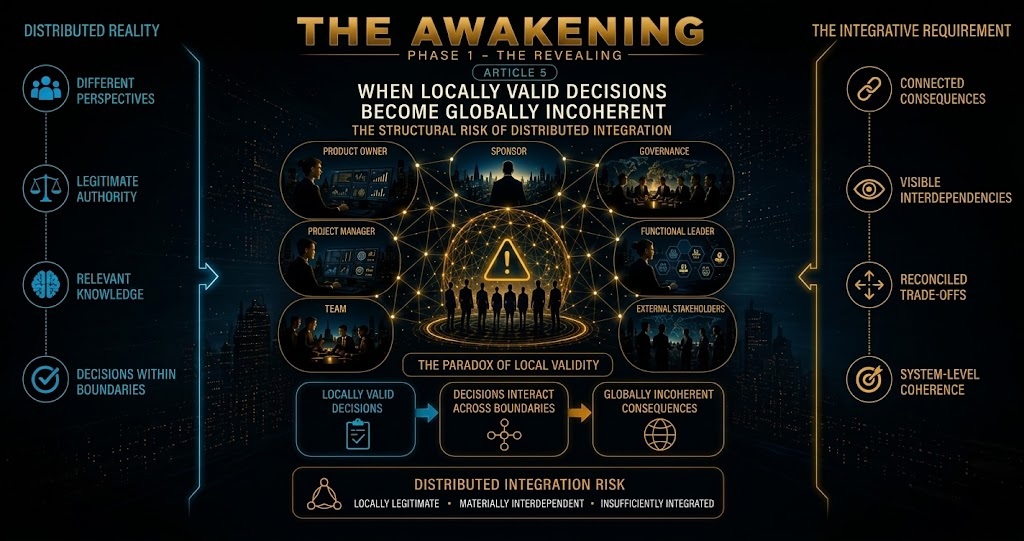 The Structural Risk of Distributed Integration The first four reflections progressively changed the question. We began by asking what changes when project leadership becomes distributed. We then examined how integrative responsibility can itself be allocated across different actors and mechanisms. We explored what happens when local adaptive capacity remains strong while system-level integrative capacity becomes insufficient. And we tested the argument against PMBOK 8, reaching a more precise conclusion. The profession has not forgotten integration. Distributed leadership does not necessarily create an integration gap. And no universal integrator is required for every project. The critical issue lies elsewhere: Whether the project configuration makes the allocation, enablement and exercise of integrative responsibility sufficiently explicit for the material interdependencies it contains. Now we reach the consequence. A project can contain competent people. Legitimate authority. Clear responsibilities. Sound decisions. Effective teams. Appropriate governance mechanisms. And still produce consequences that cannot be adequately explained by examining any one decision in isolation. This is the structural risk examined in this final reflection. The problem is not necessarily that someone made the wrong decision. It is that: Decisions can remain locally valid while their combined consequences become globally incoherent. 1. The Paradox of Local Validity Imagine a project in which several actors make decisions within legitimate boundaries. A Product Owner reprioritizes work because customer evidence has changed. A technical team modifies the solution to protect reliability. A functional manager reallocates scarce expertise to another critical initiative. A supplier changes sequencing within agreed contractual constraints. A sponsor protects a strategic milestone. Operations rejects a transition condition it considers unsustainable. Each decision may be rational. Each may fall within legitimate authority. Each may be supported by relevant evidence. Each may be defensible within its own context. Yet their consequences interact. The reprioritization changes dependencies. The technical decision increases demand for scarce expertise. The resource reallocation affects another component. The supplier's sequencing reduces recovery options. The protected milestone compresses the remaining intervention window. The operational constraint removes an implementation alternative. Eventually, the project may confront a condition that no individual actor explicitly chose. This is the paradox: Local validity does not guarantee systemic compatibility. A decision can remain defensible within its own boundary while contributing, through interaction with other decisions, to a configuration the project would not deliberately have chosen. 2. Expanding the Unit of Analysis Project analysis often begins by examining identifiable elements. Who made the decision? Which process failed? Which risk was missed? Which requirement changed? Which team underperformed? These questions remain necessary. But they may become insufficient when consequences emerge through interactions among decisions that are individually defensible. The analytical lens must therefore expand. From individual decisions to the pattern of decisions and their interactions. From individual actors to the relationships among actors, authority boundaries and consequences. From isolated errors to interaction effects. This does not remove individual accountability. Nor does it make responsibility diffuse by definition. It means that some outcomes cannot be adequately explained by evaluating each contributing decision independently. The project must also examine how those decisions interacted. When consequences emerge through interaction, the quality of the whole cannot be inferred solely from the quality of its parts. 3. Legitimacy and Coherence Are Different Tests A locally valid decision may satisfy several conditions. The actor possesses legitimate authority. The applicable process has been followed. Relevant evidence supports the decision. The choice is reasonable within the actor's mandate and available discretion. Here, legitimacy refers specifically to organizational decision legitimacy within the applicable authority architecture. System-level coherence asks a different question: Can this decision coexist with other legitimate decisions while keeping their combined consequences sufficiently coherent with the objectives, constraints and commitments that matter to the project as a whole? The two tests are related. But they are not equivalent. Legitimacy concerns whether a decision can properly be made within a given authority architecture. Coherence concerns whether its consequences remain sufficiently compatible with the interdependent system in which that decision operates. A governance architecture can therefore authorize legitimate decisions while still requiring mechanisms through which their material interdependencies are reconciled. This does not automatically mean that governance has failed. But if consequential cross-boundary interactions remain repeatedly invisible or unresolved, the adequacy of the governance and integration architecture itself may need to be questioned. 4. Local Decisions Create Cross-Boundary Consequences Differentiated responsibilities are necessary in complex projects. Product leadership attends to value. Technical leadership attends to feasibility, integrity and performance. Finance attends to economic constraints. Risk functions attend to exposure. Operations attends to serviceability and continuity. Sponsors attend to strategic purpose and organizational commitment. Teams attend to delivery within their legitimate domains. These differentiated perspectives make complexity manageable. But they also create different decision frames. What is rational within one frame can create consequences outside it. A technically optimal solution can increase operational cost. A financially rational resource decision can weaken delivery elsewhere. A customer-driven priority can affect a contractual commitment. A protected strategic milestone can reduce flexibility for technical risk treatment. None of this makes local optimization or locally rational decision-making undesirable. It makes their cross-boundary consequences architecturally significant. A project becomes vulnerable when: The authority to decide and optimize locally is clearer than the responsibility and capacity to integrate the material consequences of those choices. This is where distribution can become a systemic risk. 5. The Integrative Problem May Exist Between Decisions Suppose several decisions survive individual review. Decision A is justified. Decision B is justified. Decision C is justified. Decision D is justified. Yet their combination produces a result the project would not have selected deliberately. The problem may not reside entirely within any individual decision. It may reside in the relationships among them. In an unrecognized dependency. A signal that arrived too late. An escalation that did not occur. An assumption visible to one actor but not another. Two legitimate commitments that became mutually constraining. A trade-off that remained implicit until meaningful alternatives disappeared. Distributed project systems therefore require more than good local decisions. They require the capacity to detect when the interaction among acceptable decisions is creating an unacceptable system configuration. The integrative problem can reside not in the validity of individual decisions, but in the relationships among their consequences. Organizations are usually effective at assigning ownership to identifiable objects: Roles, Tasks, Risks, Deliverables, Decisions. The relationships among decisions can be less visibly owned. That is precisely where integrative responsibility becomes consequential. 6. Incoherence Can Accumulate Before It Becomes Visible System-level incoherence does not necessarily appear when the first contributing decision is made. Decision A may appear entirely successful. Decision B may create no immediate conflict. Decision C may still fit the current plan. Only later may their cumulative interaction become material. By then, earlier commitments may have narrowed the available alternatives. This introduces a temporal dimension into the problem. Integration is not only about whether a project can eventually recognize a conflict. Timing also matters. A material interdependency that becomes visible only after meaningful alternatives have disappeared is materially different from one recognized while intervention remains possible. System-level incoherence can accumulate before any individual decision appears clearly defective. The consequences of delayed recognition, and the conditions under which intervention windows are lost, require separate examination. For now, the important point is narrower: interaction effects may become visible later than the decisions that created them. 7. Risk Can Arise Through Interaction The same logic applies to risk. A project may contain no single decision that appears to create unacceptable exposure. Yet risk can arise through combinations of decisions, dependencies and their consequences. A schedule decision reduces contingency. A resource decision removes specialist capacity. A technical decision increases dependence on that capacity. A commercial commitment limits flexibility. A governance decision protects a milestone. Considered separately, none may exceed an established threshold. Together, they may create an exposure that no isolated element fully represents. Some project risks can arise from interactions among decisions, dependencies and their consequences rather than from any isolated element alone. This matters because an interaction-generated exposure may not belong naturally to one local risk boundary. Each actor may see a valid fragment of the causal structure. Integrative visibility is required to connect those fragments. This establishes the possibility of interaction-generated risk without yet determining its wider consequences for value, strategic viability or project outcomes. 8. Accountability Does Not Disappear With Distribution Interaction effects create another danger. If no single decision caused the outcome, perhaps no one can meaningfully be accountable. That conclusion does not follow. Complexity does not eliminate accountability. Nor does distribution make accountability inherently illegitimate. Actors can remain accountable for decisions and responsibilities within the authority and conditions legitimately assigned to them. But interaction effects raise a further architectural question: How can accountability remain legitimate and operationally coherent when authority, knowledge, capability, discretion and integrative responsibility do not reside in the same place? That question should not be answered by assuming that accountability must return to one role. Nor should it be answered by allowing accountability to become diffuse. It requires a separate examination of the relationship between accountability and the conditions actors can actually influence. That examination belongs to the next phase. 9. The Structural Risk We can now define the risk more precisely. It does not arise simply because leadership is distributed. Nor because autonomy exists. Nor because several actors possess decision authority. Nor because integrative responsibility itself is distributed. It arises when the architecture available to integrate materially interdependent decisions becomes insufficient relative to the interdependencies the project must manage. For the purposes of THE AWAKENING: Distributed Integration Risk refers to the possibility that materially interdependent decisions, actions or adaptations remain legitimate within their respective boundaries while their combined consequences become insufficiently visible, connected or reconciled to preserve system-level coherence. This is an operational construct proposed by the series and retained provisionally for further testing. It does not imply that distributed integration is inherently riskier than centralized integration. Centralized architectures have different vulnerabilities, including bottlenecks, distance from relevant knowledge and concentration of cognitive load. The narrower proposition is: As authority and responsibility become more distributable, integrative capacity must remain commensurate with the material interdependencies that the resulting configuration must manage. That is the structural requirement. 10. The Revealing Is Complete We can now return to the question that opened Phase 1. What changes when project leadership becomes distributed? The answer is considerably more precise than the hypothesis with which THE AWAKENING began. Leadership has not disappeared. Integration has not been forgotten. Agility is not inherently the problem. PMBOK 8 does not leave the profession without an architecture for integration. And the Project Manager has not simply stopped integrating. The deeper issue is configurational. As leadership, authority, knowledge, adaptation and management responsibilities become more distributable, coherence cannot safely be inferred from the quality of individual roles and decisions alone. The project must also preserve sufficient capacity to connect their material consequences. This allows us to return to the Phase 1 Exit Proposition. Its original formulation served as the hypothesis to be tested. The five articles and their adversarial audits allow us to state it more precisely. Phase 1 Exit Proposition - Final The challenge is not that leadership has disappeared. Nor that integration has been forgotten. It is that as leadership, authority and management responsibilities become increasingly distributable, the architecture of integration must remain sufficiently explicit and capable relative to the material interdependencies that the resulting configuration must manage. Otherwise, locally legitimate decisions can become globally incoherent. This is not a call for one universal integrator. It does not imply maximum centralization. It does not require reducing autonomy. And it does not require replacing the architectures already available to the profession. It means that: The allocation, enablement and exercise of integrative responsibility must be sufficiently explicit, and effective integrative capacity sufficiently strong, for the material interdependencies of the project configuration being used. That is what Phase 1 has revealed. Phase 1 Conclusion The five reflections now form a single argument. Article 1 established the phenomenon. Leadership, authority and management responsibilities can become increasingly distributable. Article 2 identified the architectural question. Integrative responsibility must be allocated, enabled and exercised, and its distribution is not equivalent to integrative capacity. Article 3 tested the problem in adaptive environments. Local adaptive capacity can remain active while system-level integrative capacity becomes insufficient, producing what the series defined as mechanical agility. Article 4 tested the argument against the profession. PMBOK 8 recognizes integration and provides a tailorable architecture within which integrative responsibility can be configured. The unresolved question lies in the explicitness and effectiveness of the configuration produced in practice. Article 5 identified the consequence. Locally valid decisions can interact in ways that become globally incoherent when the architecture is insufficient to recognize and reconcile their material interdependencies. We therefore reach the end of THE REVEALING not with a predetermined solution, but with a problem that has survived increasingly demanding tests. That distinction matters. The next phase should not begin by announcing a new leadership archetype. It must first challenge the assumptions beneath the current architecture. Which forms of control remain necessary? Which have become bureaucratic residue? What should remain centralized? What can legitimately be distributed? When should integration be performed by a role, and when should it be designed into the system? Which assumptions about Project Managers, governance, autonomy, accountability and leadership still hold? And which no longer explain the environments we are trying to manage? That is where THE AWAKENING goes next. PHASE 2 - THE DECONSTRUCTION The Revealing asked: What is changing, and why does it matter? The Deconstruction must now ask: Which assumptions still deserve to survive once the architecture is examined without inherited role boundaries? Only then should we determine what comes next. |
Posted on: September 07, 2026 05:59 AM
| Permalink |
Comments (0)


