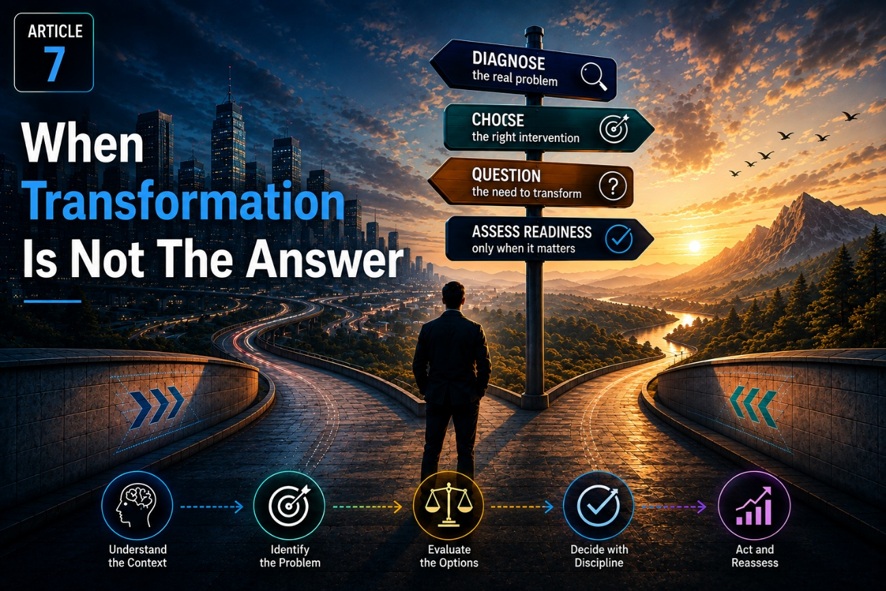
When Transformation Is Not the Answer
From the Support to Develop Blog
by Luis Branco

This blog addresses management-related topics and has three areas of focus: 1. Technical skills; 2. Competencies in the field of interpersonal relations and communication (including personal organization and delegation, leadership, teamwork, conflict resolution, conducting meetings, and negotiation); and 3. Strategy (including diagnosis, strategic guidelines, and implementation).4.Technology
Recent Posts
RCPCV™: A Method for Decision-Making and Continuous Improvement
The Same Change Can Succeed and Fail at the Same Time
What Must Exist Even When No Single Role Owns the Whole?
PHASE 4 – THE EMERGENCE
When Structural Drift Becomes Consequential
Categories
Agile,
Career Development,
Career Development,
Career Development,
Career Development,
Career Development,
Career Development,
Career Development,
Career Development,
Career Development,
Career Development,
Career Development,
Career Development,
Career Development,
Career Development,
Career Development,
Career Development,
Career Development,
Career Development,
Career Development,
Career Development,
Career Development,
Career Development,
Career Development,
Career Development,
Career Development,
Career Development,
Career Development,
Career Development,
Career Development,
Career Development,
Career Development,
Career Development,
Career Development,
Career Development,
Career Development,
Career Development,
Career Development,
Career Development,
Career Development,
Career Development,
Career Development,
Career Development,
Career Development,
Career Development,
Career Development,
Career Development,
Career Development,
Career Development,
Career Development,
Career Development,
Career Development,
Career Development,
Career Development,
Career Development,
Career Development,
Career Development,
Career Development,
Career Development,
Career Development,
Career Development,
Career Development,
Career Development,
Career Development,
Career Development,
Career Development,
Career Development,
Career Development,
Career Development,
Career Development,
Career Development,
Career Development,
Career Development,
Career Development,
Career Development,
Career Development,
Career Development,
Career Development,
Career Development,
Career Development,
Career Development,
Career Development,
Career Development,
Career Development,
Career Development,
Career Development,
Career Development,
Career Development,
Career Development,
Career Development,
Career Development,
Career Development,
Career Development,
Career Development,
Career Development,
Career Development,
Career Development,
Career Development,
Career Development,
Career Development,
Career Development,
Career Development,
Career Development,
Career Development,
Career Development,
Career Development,
Career Development,
Career Development,
Career Development,
Career Development,
Career Development,
Career Development,
Career Development,
Career Development,
Career Development,
Career Development,
Career Development,
Career Development,
Career Development,
Career Development,
Career Development,
Career Development,
Career Development,
Education,
Governance,
Governance,
Governance,
Governance,
Governance,
Governance,
Governance,
Governance,
Governance,
Governance,
Governance,
Governance,
Governance,
Governance,
Governance,
Governance,
Governance,
Governance,
Governance,
Governance,
Governance,
In,
Integration Management,
Interpersonal Skills,
Interpersonal Skills,
Interpersonal Skills,
Interpersonal Skills,
Interpersonal Skills,
Interpersonal Skills,
Interpersonal Skills,
Interpersonal Skills,
Interpersonal Skills,
Interpersonal Skills,
Interpersonal Skills,
Interpersonal Skills,
Interpersonal Skills,
Interpersonal Skills,
Interpersonal Skills,
Interpersonal Skills,
Interpersonal Skills,
Interpersonal Skills,
Interpersonal Skills,
Interpersonal Skills,
Interpersonal Skills,
Interpersonal Skills,
Interpersonal Skills,
Interpersonal Skills,
Interpersonal Skills,
Interpersonal Skills,
Interpersonal Skills,
Interpersonal Skills,
Interpersonal Skills,
Interpersonal Skills,
Interpersonal Skills,
Interpersonal Skills,
Interpersonal Skills,
Interpersonal Skills,
Interpersonal Skills,
Interpersonal Skills,
Interpersonal Skills,
Interpersonal Skills,
Interpersonal Skills,
Interpersonal Skills,
Interpersonal Skills,
Interpersonal Skills,
Interpersonal Skills,
Interpersonal Skills,
Interpersonal Skills,
Interpersonal Skills,
Interpersonal Skills,
Interpersonal Skills,
Interpersonal Skills,
Interpersonal Skills,
Interpersonal Skills,
Interpersonal Skills,
Interpersonal Skills,
Interpersonal Skills,
Interpersonal Skills,
Interpersonal Skills,
Interpersonal Skills,
Interpersonal Skills,
Interpersonal Skills,
Interpersonal Skills,
Interpersonal Skills,
Interpersonal Skills,
Interpersonal Skills,
Interpersonal Skills,
Interpersonal Skills,
Interpersonal Skills,
Interpersonal Skills,
Interpersonal Skills,
Interpersonal Skills,
Interpersonal Skills,
Interpersonal Skills,
Interpersonal Skills,
Interpersonal Skills,
Interpersonal Skills,
Interpersonal Skills,
Interpersonal Skills,
Interpersonal Skills,
Interpersonal Skills,
Interpersonal Skills,
Interpersonal Skills,
Interpersonal Skills,
Interpersonal Skills,
Interpersonal Skills,
Interpersonal Skills,
Interpersonal Skills,
Interpersonal Skills,
Interpersonal Skills,
Interpersonal Skills,
Interpersonal Skills,
Interpersonal Skills,
Interpersonal Skills,
Interpersonal Skills,
Interpersonal Skills,
Interpersonal Skills,
Interpersonal Skills,
Interpersonal Skills,
Interpersonal Skills,
Interpersonal Skills,
Interpersonal Skills,
Interpersonal Skills,
Interpersonal Skills,
Interpersonal Skills,
Interpersonal Skills,
Interpersonal Skills,
Interpersonal Skills,
Interpersonal Skills,
Interpersonal Skills,
Interpersonal Skills,
Interpersonal Skills,
Interpersonal Skills,
Interpersonal Skills,
Interpersonal Skills,
Interpersonal Skills,
Interpersonal Skills,
Interpersonal Skills,
Interpersonal Skills,
Interpersonal Skills,
Interpersonal Skills,
Interpersonal Skills,
Interpersonal Skills,
Interpersonal Skills,
Interpersonal Skills,
Knowledge Management,
le,
lea,
Leadership,
Leadership,
Leadership,
Leadership,
Leadership,
Leadership,
Leadership,
Leadership,
Leadership,
Leadership,
Leadership,
Leadership,
Leadership,
Leadership,
Leadership,
Leadership,
Leadership,
Leadership,
Leadership,
Leadership,
Leadership,
Leadership,
Leadership,
Leadership,
Leadership,
Leadership,
Leadership,
Leadership,
Leadership,
Leadership,
Leadership,
Leadership,
Leadership,
Leadership,
Leadership,
Leadership,
Leadership,
Leadership,
Leadership,
Leadership,
Leadership,
Leadership,
Leadership,
Leadership,
Leadership,
Leadership,
Leadership,
Leadership,
Leadership,
Leadership,
Leadership,
Leadership,
Leadership,
Leadership,
Leadership,
Leadership,
Leadership,
Leadership,
Leadership,
Leadership,
Leadership,
Leadership,
Leadership,
Leadership,
Leadership,
Leadership,
Leadership,
Leadership,
Leadership,
Leadership,
Leadership,
Leadership,
Leadership,
Leadership,
Leadership,
Leadership,
Leadership,
Leadership,
Leadership,
Leadership,
Leadership,
Leadership,
Leadership,
Leadership,
Leadership,
Leadership,
Leadership,
Leadership,
Leadership,
Leadership,
Leadership,
Leadership,
Leadership,
Leadership,
Leadership,
Leadership,
Leadership,
Leadership,
Leadership,
Leadership,
Leadership,
Leadership,
Leadership,
Leadership,
Leadership,
Leadership,
Leadership,
Leadership,
Leadership,
Leadership,
Leadership,
Leadership,
Leadership,
Leadership,
Leadership,
Leadership,
Leadership,
Leadership,
Leadership,
Leadership,
Leadership,
Leadership,
Leadership,
or,
Organizational Project Management,
Portfolio Management,
Program,
Program Management,
Strategy,
Strategy,
Strategy,
Strategy,
Strategy,
Strategy,
Strategy,
Strategy,
Strategy,
Strategy,
Strategy,
Strategy,
Strategy,
Strategy,
Strategy,
Strategy,
Strategy,
Strategy,
Strategy,
Strategy,
Strategy,
Strategy,
Strategy,
Strategy,
Strategy,
Strategy,
Strategy,
Strategy,
Strategy,
Strategy,
Strategy,
Strategy,
Strategy,
Strategy,
Strategy,
Strategy,
Strategy,
Strategy,
Strategy,
Strategy,
Strategy,
Strategy,
Strategy,
Strategy,
Strategy,
Strategy,
Strategy,
Strategy,
Strategy,
Strategy,
Strategy,
Strategy,
Strategy,
Strategy,
Strategy,
Strategy,
Strategy,
Strategy,
Strategy,
Strategy,
Strategy,
Strategy,
Strategy,
Strategy,
Strategy,
Strategy,
Strategy,
Strategy,
Strategy,
Strategy,
Strategy,
Strategy,
Strategy,
Strategy,
Strategy,
Strategy,
Strategy,
Strategy,
Strategy,
Strategy,
Strategy,
Strategy,
Strategy,
Strategy,
Strategy,
Strategy,
Strategy,
Strategy,
Strategy,
Strategy,
Strategy,
Strategy,
Strategy,
Strategy,
Strategy,
Strategy,
Strategy,
Strategy,
Strategy,
Strategy,
Strategy,
Strategy,
Strategy,
Strategy,
Strategy,
Strategy,
Strategy,
Strategy,
Strategy,
Strategy,
Strategy,
Strategy,
Strategy,
Strategy,
Strategy,
Strategy,
Strategy,
Strategy,
Strategy,
Strategy,
Strategy,
Strategy,
Strategy,
Sustainability,
Talent Management,
Talent Management,
Talent Management,
Talent Management,
Talent Management,
Talent Management,
Talent Management,
Talent Management,
Talent Management,
Talent Management,
Talent Management,
Talent Management,
Talent Management,
Talent Management,
Talent Management,
Talent Management,
Talent Management,
Talent Management,
Talent Management,
Talent Management,
Talent Management,
Talent Management,
Talent Management,
Talent Management,
Talent Management,
Talent Management,
Talent Management,
Talent Management,
Talent Management,
Talent Management,
Talent Management,
Talent Management,
Talent Management,
Talent Management,
Talent Management,
Talent Management,
Talent Management,
Talent Management,
Talent Management,
Talent Management,
Talent Management,
Talent Management,
Talent Management,
Talent Management,
Talent Management,
Talent Management,
Talent Management,
Talent Management,
Talent Management,
Talent Management,
Talent Management,
Talent Management,
Talent Management,
Talent Management,
Talent Management,
Talent Management,
Talent Management,
Talent Management,
Talent Management,
Talent Management,
Talent Management,
Talent Management,
Talent Management,
Talent Management,
Talent Management,
Talent Management,
Talent Management,
Talent Management,
Talent Management,
Talent Management,
Talent Management,
Talent Management,
Talent Management,
Talent Management,
Talent Management,
Talent Management,
Talent Management,
Talent Management,
Talent Management,
Talent Management,
Talent Management,
Talent Management,
Talent Management,
Talent Management,
Talent Management,
Talent Management,
Talent Management,
Talent Management,
Talent Management,
Talent Management,
Talent Management,
Talent Management,
Talent Management,
Talent Management,
Talent Management,
Talent Management,
Talent Management,
Talent Management,
Talent Management,
Talent Management,
Talent Management,
Talent Management,
Talent Management,
Talent Management,
Talent Management,
Talent Management,
Talent Management,
Talent Management,
Talent Management,
Talent Management,
Talent Management,
Talent Management,
Talent Management,
Talent Management,
Talent Management,
Talent Management,
Talent Management,
Talent Management,
Talent Management,
Talent Management,
Talent Management,
Talent Management,
Talent Management
Date
 Why Adaptability Begins Before Change
Over the previous articles in this series, I have explored a recurring idea.
The new ways of working in projects are not simply about adopting new methodologies, introducing new technologies, or making teams more agile.
They increasingly depend on the ability of organizations to adapt their structures, decision mechanisms, operating models, governance, and allocation of resources as the conditions around them change.
But this raises an even more fundamental question.
What if transformation itself is not the right response?A thoughtful comment from Aaron Porter on my previous article brought this question into sharp focus.
He asked two deceptively simple questions:
Is the organization solving the right problem?Is transformation the appropriate response?Those questions matter because much of the conversation about organizational transformation begins after a critical assumption has already been made:
That transformation is necessary.
From there, attention naturally turns to readiness, leadership, culture, capabilities, governance, technology, execution, and resistance to change.
But an organization can be highly prepared to transform and still be preparing to execute the wrong intervention.
That distinction changes where the conversation should begin.
Before Readiness Comes DiagnosisWhen an organization underperforms, encounters disruption, or recognizes that existing ways of working are no longer producing the expected results, there is a natural pressure to act.
Sometimes that pressure is justified.
But recognizing that something is wrong is not the same as understanding what is wrong.
A process may be poorly executed.
A capability may remain appropriate but be insufficiently developed.
An operating mechanism may work as designed but have become misaligned with a changed environment.
A structure may have accumulated unnecessary complexity.
A technology or capability may have become obsolete.
Or assumptions that once justified existing arrangements may no longer hold.
These are not necessarily the same problem.
And they should not automatically produce the same response.
Before asking how to transform, organizations therefore need to ask a more fundamental question:
What problem are we actually trying to solve?Without that diagnosis, transformation can become a response in search of a problem.
Transformation Is an Intervention ChoiceAaron Porter made another important observation.
Sometimes an organization does not need to transform.
It may need to repair something that is not working as designed.
It may need to optimize something that remains fundamentally sound.
It may need to adapt to a changed external condition.
It may need to simplify unnecessary complexity.
It may need to replace an obsolete capability.
It may need to stop doing something altogether.
And sometimes it may indeed need a deeper transformation.
This distinction matters because the language of transformation can unintentionally encourage organizations to treat scale of ambition as evidence of appropriateness.
But an intervention is not better because it is more transformational.
It is better when it is proportionate to the problem it is intended to address.A large intervention applied to a poorly diagnosed problem does not become more effective because it is ambitious.
It may simply create more unnecessary change.
Transformation Appropriateness Is Not Transformation ReadinessThis leads to a distinction that deserves greater attention.
Transformation appropriateness and
transformation readiness are not the same question.
Transformation appropriateness asks:
Is transformation the right response to the problem we have diagnosed?Transformation readiness asks:
Do we have, or can we create, the conditions required for that transformation to work?The order matters.
An organization may possess strong leadership commitment, adequate funding, capable teams, effective governance, appropriate technology, sufficient decision authority, and a high degree of readiness for change.
None of those conditions demonstrates that transformation is the correct intervention.
They demonstrate only that the organization may be capable of executing it.
Execution capability cannot compensate for an incorrect diagnosis.Nor can readiness turn an inappropriate intervention into an appropriate one.
The organization must first establish what kind of change, if any, the evidence actually justifies.
Only then does readiness become the right question.
Not Every Tension Is an IncoherenceAaron Porter's comment also raised an important challenge to the argument I developed in the previous article.
I argued that transformation frequently encounters an
Architectural Incoherence Gap between what the organization says it wants to achieve and the conditions it continues to preserve.
Organizations may ask for speed while maintaining slow approval mechanisms.
They may ask for autonomy while keeping decision authority centralized.
They may ask for innovation while penalizing reasonable experimentation.
They may ask for collaboration while rewarding local optimization.
But there is an important qualification.
Not every apparent contradiction is organizational incoherence.Organizations operate under multiple legitimate requirements that can pull in different directions.
A bank may need greater experimentation while simultaneously requiring strong controls.
A manufacturer may need local autonomy while preserving process standardization.
An organization may need greater speed while maintaining governance mechanisms necessary to protect safety, regulatory compliance, financial integrity, or stakeholder interests.
These are not necessarily design failures.
They may be legitimate organizational tensions.
The challenge is not to eliminate one side of every tension.
It is to determine whether the organization has deliberately designed the conditions through which competing requirements can coexist.
Where should autonomy apply?
Where is standardization necessary?
Which decisions can be decentralized, and which require independent oversight?
Which risks can be accepted locally, and which must be escalated?
What should remain stable while other parts of the organization adapt?
Incoherence does not arise merely because legitimate requirements coexist.
It arises when the organization's architecture persistently undermines, or makes materially more difficult, the reconciliation of the outcomes it expects the system to produce.That distinction matters.
Adaptability Is Not Permanent TransformationThere is a broader implication.
Organizations are increasingly encouraged to become more adaptive.
But adaptability can easily be misunderstood as an obligation to change continuously.
It is not.
As I argued earlier in this series, the most adaptive organizations are not necessarily those that change most frequently.
They are those capable of distinguishing when stability continues to create value and when change becomes necessary.
Sometimes the adaptive response is to transform.
Sometimes it is to modify or strengthen a limited part of the system.
Sometimes it is to remove something that no longer serves its purpose.
And sometimes the most intelligent response is deliberately to preserve stability.
The capacity to change is only one part of adaptability.The capacity
not to change unnecessarily matters as well.
The Cost of Solving the Wrong ProblemOrganizations rarely have unlimited transformation capacity.
Every significant intervention consumes leadership attention, management capacity, financial resources, organizational energy, employee attention, trust, time, and opportunity.
Transformation also introduces uncertainty into systems that often need to continue operating while they are being changed.
Unnecessary transformation therefore has a cost even when it is competently executed.
There is also a less visible cost.
When organizations repeatedly launch transformations that fail to address the underlying problem, people learn from that experience.
Future initiatives may encounter skepticism that is subsequently described as resistance to change.
But what appears to be resistance may partly reflect organizational memory.
People may have experienced previous programs that changed terminology, structures, roles, technologies, or reporting lines without resolving the conditions that originally created the problem.
In such circumstances, the more useful question may not be:
Why are people resisting transformation?It may be:
What has the organization taught them to expect from transformation?Diagnosis therefore matters not only for selecting the right intervention.
It also affects the credibility of future change.
From Transformation Reflex to Intervention DisciplineA more adaptive organization should therefore avoid two opposite errors.
The first is
structural inertia: continuing existing arrangements after the conditions that justified them have materially changed.
The second is
transformation reflex: assuming that significant problems necessarily require large-scale transformation.
Both can disconnect organizational action from reality.
A more disciplined sequence begins differently:
What is happening?What evidence supports that diagnosis?Which assumptions have changed?What should remain stable, and what actually needs to change?What type and scale of intervention does the problem justify?Is transformation necessary?And only then:
What must already be true for that transformation to work?This sequence changes transformation from an organizational aspiration into a decision that must itself be justified.
Aaron Porter ended his comment with that final question:
What must already be true for this transformation to work?I would retain it, but place another immediately before it:
What must be true for transformation to be the right response in the first place?The first tests readiness.
The second tests appropriateness.
Both are necessary.
Neither can substitute for the other.
A Different Understanding of New Ways of WorkingThis brings us back to the broader argument of this series.
New ways of working are often associated with greater speed, agility, experimentation, technology, distributed decision-making, and continuous adaptation.
All of these can matter.
But perhaps organizational maturity is demonstrated not by the amount of change an organization can generate, but by the quality of the choices it makes about change.
Can it distinguish symptoms from causes?
Can it determine what should remain stable and what should change?
Can it select an intervention proportionate to the problem?
And can it reconsider those judgments when the evidence changes?
If it can, adaptation becomes something more than responsiveness.
It becomes disciplined organizational judgment.The next evolution in how organizations work may therefore not be about becoming better at transformation.
It may be about becoming better at determining what should change, what should remain, and whether transformation is the right response at all.Because before an organization asks whether it is ready to transform, there is a more fundamental question it should be able to answer:
Why transformation?
Posted on: September 13, 2026 05:16 AM |
Permalink
Comments (5)
Please login or join to subscribe to this item

Antonio Avalos Oropeza
Industrial Engineer | Operational Excellence & Quality Professional| The Organizational Artery
Mexicali Baja California, Mexico
Luis, I think this article brings the discussion to a very important boundary.
I agree that diagnosis must precede intervention, and that transformation appropriateness and transformation readiness are fundamentally different questions. I also agree with your distinction that not every tension represents incoherence.
Where I think the next layer begins is here:
If legitimate tensions are expected, then organizational stability cannot mean preserving a fixed configuration.
A business is continuously exposed to changing demand, risk, technology, regulation, capacity, strategy, and external conditions. Under those circumstances, some degree of organizational deformation should not only be tolerated; it should be expected.
The question then becomes not whether the organization changes shape, but whether it can absorb and redistribute the impact without losing coherence with its core business objective.
That leads me to a working definition:
Stability is not equilibrium. Stability is the capacity of the system to absorb impact without losing continuity.
From that perspective, a temporary shift toward Safety, Operations, Finance, Quality, Supply, or another function is not necessarily dysfunction. It may simply represent the system responding correctly to a change in material conditions.
The real rupture occurs when that shift causes the organization to lose traceability, coherence, legitimate authority, or connection to the shared objective.
This also changes how I think about functional objectives. Rather than fragmenting the business objective into isolated departmental targets and later trying to “align” them, I think the core business objective should first be interpreted cross-functionally. Functional contribution, risk exposure, and decision space can then be derived from that shared interpretation.
In that architecture, functions remain integrated but not dependent. Their relative influence may change as conditions change, while the system preserves a common reference point.
Your distinction between attention, escalation, and intervention becomes especially interesting here. They may not represent three isolated governance events, but different degrees of governed organizational deformation.
AI could support this by detecting changing conditions, evaluating materiality, identifying affected relationships, and signaling when a governance response may be required. But detection should not automatically become authority.
So for me, the next question after “Why transformation?” becomes:
What must remain coherent while the organization adapts?
And perhaps the harder one:
How do we allow the organization to deform without allowing it to rupture?
That is the mechanism I am now trying to pressure-test.

Luis Branco
CEO| Business Insight, Consultores de Gestão, Ldª
Carcavelos, Lisboa, Portugal
Antonio, I think you are taking one of the questions in the article exactly where it needs to go. If adaptability requires distinguishing what should change from what should remain stable, then we also need to ask what stability actually means.
I find your distinction between stability and equilibrium particularly useful. From a systems perspective, stability does not require every state, priority or response to remain unchanged. But that makes “continuity” the next concept I would pressure-test: continuity of what? If significant elements of the system can legitimately vary, we still need to identify what must continue to be preserved for the organization to remain coherent.
That also makes your idea of deformation interesting. A temporary increase in the relative importance of Safety, Finance, Quality or Operations may not require transformation at all. It may simply reflect the system responding within the range of adaptation already enabled by its architecture. A change in system state is not necessarily a change in the architecture that makes those states possible.
This brings me back to the article’s underlying question: what actually needs to change? Perhaps we need to distinguish changes that occur within an existing architecture from changes to the architecture itself, without assuming in advance where adaptation ends and transformation begins.
Your point about functional objectives also resonates with me. A shared higher-order direction need not eliminate differentiated functional objectives or the legitimate tensions between them. But I would pressure-test “integrated but not dependent.” If the functions are materially interdependent, perhaps what needs to be preserved is not independence from one another, but functional differentiation without fragmentation.
And this is where I would reconnect with our earlier discussion. I am still not convinced that attention, escalation and intervention are necessarily different degrees of the same organizational deformation. Attention can change without authority changing; escalation can activate a decision path already provided by the architecture; and intervention can be local and reversible. They may therefore be distinct system responses rather than different intensities of one underlying phenomenon.
So I think your comment adds two powerful questions to the one in the article: what must continue to be preserved while the organization adapts, and what may legitimately vary without losing coherence?
Only after answering those would I try to locate the boundary you call rupture. Otherwise, we risk defining deformation and rupture before establishing what, in the system, is actually changing and what must endure.
Antonio Avalos Oropeza
Industrial Engineer | Operational Excellence & Quality Professional| The Organizational Artery
Mexicali Baja California, Mexico
Luis, I think your questions have helped me isolate the causal issue more clearly.
I no longer think the central question is whether the organization changes, or even how much it changes. The more precise question is whether the change being demanded of the system remains within the capacity of its existing architecture to absorb it while preserving the invariants required for coherence.
Under that formulation, changing conditions may alter the system state, redistribute functional relevance, and activate different governance responses without requiring any architectural change. If the existing architecture can accommodate those variations while preserving the higher-order direction, legitimate authority, relational coherence, and the ability to trace why consequential decisions remain valid, I would call that adaptation.
Transformation begins only when preserving those invariants requires the architecture itself to change — for example, its decision rights, relationships, escalation paths, or governing constraints.
Rupture would therefore not be caused by change itself. It would occur when the demands placed on the system exceed its capacity to adapt or transform coherently, such that one or more of those governing invariants can no longer be preserved.
That also clarifies the role of governance for me. Governance is not the change, nor the traceability of the change. It is the mechanism through which the organization determines whether a changing state remains legitimate within the existing architecture, requires architectural transformation, or is approaching a loss of coherence.
So perhaps the causal sequence is simpler than where we started:
conditions change → system state changes → governance evaluates materiality and legitimacy → the architecture either absorbs the change, is intentionally transformed, or coherence is lost.
That gives me a much cleaner boundary between adaptation, transformation, and rupture.
Your pressure-testing has been extremely useful because it moved the discussion away from terminology and toward the actual causal structure of the problem. I think that is a good point for me to stop adding concepts and start testing whether this separation holds in practice.
Luis Branco
CEO| Business Insight, Consultores de Gestão, Ldª
Carcavelos, Lisboa, Portugal
Antonio, I think that is a very good point at which to pause the conceptual development.
What I find particularly valuable is where the discussion has landed: changing conditions do not necessarily require architectural change, and adaptation should not be confused with transformation simply because the system is responding differently. The distinction becomes much clearer if adaptation can occur within the capacity of the existing architecture, while transformation becomes relevant when preserving what matters requires the architecture itself to change.
I also agree that the next useful test is practical rather than terminological: whether the distinctions between state change, adaptation, transformation, and loss of coherence actually hold when confronted with real organizational situations.
Thank you for being so open to the pressure-testing. I have enjoyed the progression of this discussion.
Antonio Avalos Oropeza
Industrial Engineer | Operational Excellence & Quality Professional| The Organizational Artery
Mexicali Baja California, Mexico
Luis, thank you. I agree — this is the right point to move from conceptual refinement to practical testing.
I also appreciate the way you challenged the distinctions without forcing premature conclusions. The discussion became much clearer by separating state change, adaptation, transformation, and loss of coherence.
The real test now is whether those boundaries remain observable and useful when applied to actual organizational situations.
I have genuinely enjoyed the progression of this discussion as well. Thank you for the rigor.
Please Login/Register to leave a comment.
|
"It takes a lot of courage to show your dreams to someone else."
- Erma Bombeck
|




