


Categories: Governance, Integration Management, Leadership, Organizational Project Management, Portfolio Management, Program Management, Strategy
Project Professionals are increasingly expected to think beyond delivery.
They are expected to understand strategic intent, question assumptions, reassess viability, influence stakeholders, anticipate consequences and remain focused on whether the project is actually creating value.
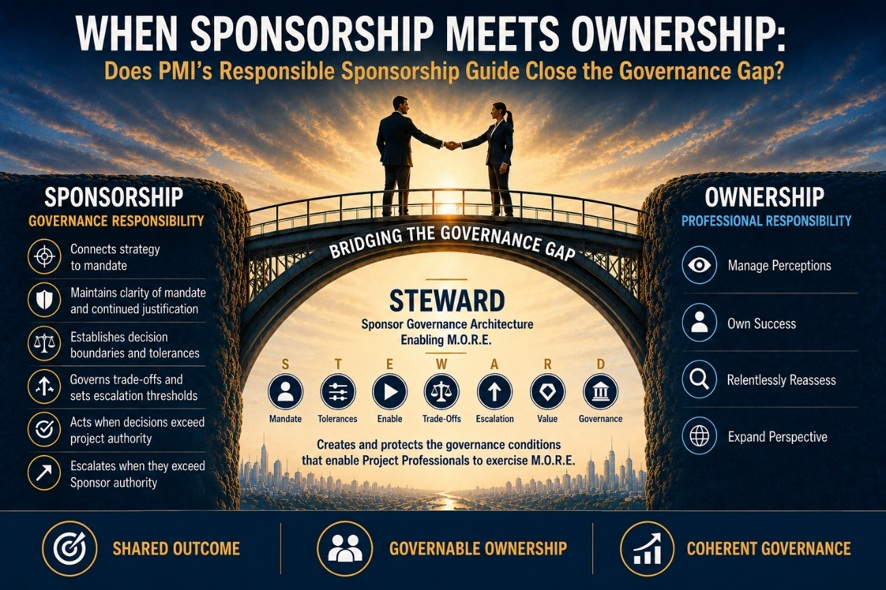
PMI's M.O.R.E. framework captures this expectation through four practices: Manage Perceptions, Own Success, Relentlessly Reassess and Expand Perspective.
Projects do not create value simply because deliverables are completed, schedules are maintained or budgets are controlled.
Project outcomes emerge from a wider organizational system.
But broader expectations of professional ownership create a governance question:
If Project Professionals are expected to own more of project success, what authority must accompany that expectation?
I explored that question in two previous articles.
The first, M.O.R.E. Expands What Project Professionals Are Expected to Own.
But Does Their Authority Expand with Their Accountability?, distinguished professional agency from formal authority and questioned how far responsibility for outcomes could expand while consequential decision rights remained elsewhere.
The second, When Ownership Meets Governance: Designing Governable Professional Agency for Project Success, developed that argument further.
It proposed that broader professional agency requires an organizational architecture connecting access to information, challenge, escalation, recommendation, decision, record and accountability.
Since those articles were published, PMI's governance guidance has evolved.
PMI has now published the GPM Guide to Responsible Project Sponsorship.
The Guide does more than describe what effective Sponsors should do.
It makes considerably more explicit the governance architecture surrounding project success.
That creates a new question:
Does PMI's Responsible Sponsorship Guide close the governance gap created by broader expectations of project-success ownership?
Responsible Sponsorship Changes the Question
One of the most important contributions of the new Guide is that it does not treat sponsorship merely as executive support.
The Guide presents Responsible Sponsorship as a governance discipline.
The Sponsor connects strategy to mandate, remains accountable for continued justification, establishes and maintains governance arrangements, defines decision tolerances and escalation thresholds, governs consequential trade-offs and intervenes when decisions exceed project authority.
This matters because it shifts part of the discussion from individual professional behavior to organizational architecture.
A capable Project Manager may recognize that a business case is deteriorating, identify a strategic inconsistency or conclude that a major trade-off threatens expected value.
But recognizing a problem does not necessarily create authority to resolve it.
The new Guide makes that distinction considerably clearer.
Project Managers operate within an assigned mandate and agreed tolerances. Decisions beyond those boundaries move to the Sponsor and, where necessary, to the appropriate governing body.
This provides something the language of professional ownership cannot provide on its own:
An identifiable path to legitimate decision authority.
That is a substantial development.
The Emerging Division of Governance Responsibility
The relationship between Project Professional and Sponsor becomes clearer when viewed through the decisions each is positioned to influence or make.
The Project Professional remains close to the evolving reality of the initiative.
They may reassess assumptions, identify dependencies, surface emerging risks, challenge interpretations, prepare decisions, recommend action, escalate matters beyond their authority and decide within the discretion legitimately assigned to them.
The Sponsor occupies a different governance position.
The Sponsor maintains clarity of the mandate and continued justification, establishes or preserves decision boundaries, governs consequential trade-offs and acts when decisions exceed project authority.
Where the Sponsor's own authority is insufficient, the issue moves to the relevant governing body.
This is not a hierarchy of professional importance.
It is a distribution of governance functions.
And that distribution matters because project outcomes are not produced by a single actor.
Strategic choices may belong to executives.
Investment decisions may belong to governance bodies.
Resources may be controlled by functional organizations.
Benefits may depend on business owners or operations.
Adoption may depend on users and customers.
Commercial outcomes may depend on suppliers and partners.
Some project decisions may belong to the Project Manager within agreed boundaries.
Others may belong to the Sponsor.
Still others require portfolio, executive or governing-body authority.
Project success is systemically produced while authority remains distributed.
The clearer that distribution becomes, the more important it is to ask what ownership can legitimately mean.
Responsible Sponsorship Strengthens the Architecture of Escalation
This becomes particularly visible when project conditions change.
Consider a Project Professional who concludes that assumptions supporting continued investment are no longer defensible.
The professional may have a responsibility to identify the evidence, investigate its significance, challenge the assumptions, communicate the consequences and recommend action.
But authority to continue, redirect, pause or terminate the investment may belong elsewhere.
This distinction was central to my earlier argument about Governable Professional Agency.
An escalation mechanism is meaningful only if authority exists at the other end.
The new Responsible Sponsorship guidance strengthens that architecture by making escalation thresholds and authority transitions more explicit.
When defined tolerances are exceeded, the matter moves beyond the Project Manager's authority to the Sponsor.
Where the decision exceeds the Sponsor's authority, it moves again to the appropriate governing body.
That is more than procedural escalation.
It connects professional judgment with legitimate organizational authority.
The Guide also gives continued justification a clear governance home.
Authorization is not treated simply as a decision made at the beginning of a project.
The underlying justification must remain defensible as circumstances evolve.
This is particularly important for the meaning of Relentlessly Reassess.
A Project Professional may reassess, conclude that the evidence has changed and recommend a different course of action.
But reassessing justification and possessing legitimate authority to act on that reassessment are different organizational functions.
Responsible Sponsorship helps make that boundary visible.
STEWARD Makes the M.O.R.E. Relationship More Explicit
The Guide goes further than simply clarifying Sponsor authority.
Through its STEWARD model, it explicitly connects Responsible Sponsorship with M.O.R.E.
That connection is important to the governance question.
The Guide does not transfer responsibility for practicing M.O.R.E. from the Project or Program Manager to the Sponsor. Instead, it positions STEWARD as the Sponsor-side governance architecture that creates and protects the conditions within which Project and Program Managers can exercise M.O.R.E.
The Guide also cites PMI research indicating that 69% of respondents, including 72% of Sponsors, place primary responsibility for practicing M.O.R.E. with the Project or Program Manager.
This makes the emerging division of responsibility more explicit.
Project Professionals are expected to exercise broader professional agency toward project success.
Sponsors are expected to provide and exercise the governance needed to keep that agency connected to mandate, authority, escalation and continued justification.
That is a significant answer to the governance problem raised in the earlier articles.
It also provides a stronger test of what remains unresolved.
If STEWARD supplies governance conditions for M.O.R.E. while M.O.R.E. remains primarily a Project or Program Manager responsibility, then the central question is no longer whether PMI recognizes the need to connect professional agency with governance.
It clearly does.
The sharper question is whether that connection also resolves what "Own Success" can coherently mean when consequential decision authority and causal influence remain distributed.
So What Does "Own Success" Now Mean?
This is where the new Guide creates its most interesting consequence.
The clearer PMI becomes about who governs project success, the harder it becomes to treat "Own Success" as undifferentiated outcome accountability.
If Sponsors remain accountable for continued justification, establish decision tolerances, govern consequential trade-offs, make decisions that exceed project authority and escalate matters that exceed their own authority, while other actors control resources, benefits, operations, strategic choices and organizational capabilities, then no Project Professional can coherently be assigned undifferentiated accountability for project success as a whole, irrespective of that distribution of authority and causal influence.
This does not make "Own Success" wrong.
It makes its meaning more important.
There is a strong, governance-coherent interpretation of ownership.
A Project Professional should not retreat behind the boundaries of task execution.
Meaningful ownership requires seeking relevant evidence, understanding strategic intent, questioning assumptions, recognizing consequences beyond immediate delivery, challenging when evidence warrants it, recommending what professional judgment supports, escalating when authority lies elsewhere and acting decisively within legitimately assigned authority.
That is meaningful ownership.
But professional agency, decision authority and outcome accountability are not interchangeable.
A professional may exercise extensive agency toward an outcome without possessing every decision right required to produce it.
Likewise, limited authority does not remove responsibility for what the professional could reasonably have been expected to know, challenge, recommend, escalate or do.
The appropriate objective is therefore not less ownership.
It is differentiated ownership.
Professional agency can be broad.
Decision authority can remain distributed.
Outcome accountability can exist, but it should remain proportionate to the actor's legitimate authority, decision rights, competence, causal influence, relevant knowledge and reasonable opportunity to act.
Responsible Sponsorship provides a clearer governance architecture within which this interpretation of "Own Success" can be sustained.
Has the Governance Gap Therefore Been Closed?
Partly.
The Guide makes Sponsor responsibilities for mandate clarity, decision boundaries, escalation, continued justification and consequential trade-offs considerably more explicit.
Through STEWARD, it also explicitly connects those governance responsibilities with the conditions required for Project and Program Managers to practice M.O.R.E.
Together, these address much of the authority architecture that broader professional ownership requires.
But some questions remain.
What Happens When Professional Judgment and Formal Authority Diverge?
Suppose a Project Professional concludes, on defensible evidence, that a project should stop, challenges the underlying assumptions, escalates the issue and recommends termination.
The legitimate authority decides to continue.
The risk subsequently materializes.
What happens to accountability?
The professional remains responsible for the quality and timeliness of the analysis, the communication of uncertainty, the escalation and the actions taken within their authority.
But the continuation decision was made by another actor.
A governance architecture therefore needs to preserve the distinction between responsibility for professional judgment and accountability for a decision that another actor possessed the legitimate authority to make.
Responsible Sponsorship makes the allocation of that authority clearer.
But clarity about who decides does not, by itself, completely resolve how accountability should subsequently be attributed when professional advice and formal decision authority diverge.
Decision Records Are Necessary, but Dissent Creates a Harder Case
The new Guide also strengthens the importance of preserving decisions, assumptions and their rationale.
That supports accountability.
But a decision record and a record of dissent are not necessarily the same thing.
When material disagreement exists, a mature governance system may need to reconstruct more than the final decision.
What was known at the time?
Which assumptions were challenged?
What evidence supported the challenge?
What recommendation was made?
Who possessed the relevant authority?
What decision was ultimately taken, and why?
This is not an argument for defensive bureaucracy.
It is an argument for accountability integrity.
Without contemporaneous evidence, a systemically produced failure can later be compressed into a much simpler narrative around the actor most visibly associated with delivery.
The Responsible Sponsorship Guide strengthens decision traceability.
I do not find the Guide explicitly establishing how material professional dissent should be preserved when legitimate decision authority chooses a different course.
Absence is not rejection.
The Guide does not need to contain every possible governance mechanism.
But the question remains relevant because broader expectations of professional ownership increase the importance of distinguishing who knew, who advised, who decided and who could legitimately act.
Escalation Also Requires Governance Action
Responsible Sponsorship clearly expects Sponsors to act when governance thresholds are reached.
That is an important advance.
But a narrower question remains.
What happens when a material issue has been legitimately escalated and cannot be resolved within the Sponsor's own authority?
A concern may be acknowledged and formally discussed while work, investment and exposure continue.
Procedurally, escalation has occurred.
Substantively, the consequential decision may still not have been made.
Effective escalation therefore depends not only on identifying where authority resides, but also on whether the governance system can process a material issue within a decision window appropriate to its consequences.
This leaves a further question:
What obligation accompanies the receipt of a material escalation when a consequential decision is required?
A governance architecture may therefore need more than an escalation pathway.
It may also need an identifiable decision authority, an appropriate decision window and traceable accountability for whether the issue was considered and acted upon.
Otherwise, procedural voice may exist without substantive governance effect.
The Hardest Test May Come After the Professional Speaks
There is another dimension that formal authority structures cannot resolve alone.
Organizations often encourage professionals to challenge assumptions, speak up and act like owners.
But those expectations become meaningful only when the organization can absorb inconvenient professional judgment.
A Project Professional who genuinely Relentlessly Reassesses may discover that an important assumption no longer holds.
Someone who genuinely Expands Perspective may identify consequences that powerful stakeholders would prefer not to confront.
Someone who genuinely Owns Success may recommend stopping an initiative that senior leaders remain committed to continuing.
At that point, the quality of governance is tested not by whether the organization encouraged the professional to speak, but by what it does after the professional speaks.
Can evidence-based challenge be considered without being treated as disloyalty?
Can an inconvenient recommendation reach the authority capable of acting on it?
Can disagreement be preserved without distorting accountability?
Can a legitimate authority reject professional advice while remaining accountable for the decision it was empowered to make?
These questions extend beyond sponsorship competence.
They concern the organization's capacity to make broader professional agency genuinely governable.
Responsible Sponsorship and Governable Professional Agency Are Complementary
Responsible Sponsorship and Governable Professional Agency should not be framed as competing architectures.
They approach an overlapping governance problem from different positions.
Responsible Sponsorship asks what Sponsors and governance systems must do to keep projects strategically justified, properly authorized and governable.
Governable Professional Agency asks what organizational conditions are required when professionals are expected to exercise judgment, challenge assumptions, recommend action and protect value while consequential authority remains distributed.
The overlap is substantial.
Both depend on clear authority, meaningful escalation and decision traceability, and both reject the idea that professional capability can compensate for weak governance.
STEWARD makes that complementarity more explicit by positioning Sponsor governance as an enabling condition for M.O.R.E., rather than as a substitute for the professional agency M.O.R.E. expects.
The new Guide therefore closes part of the gap identified in my earlier articles.
But it also helps reveal the remaining boundary more precisely.
The issue is no longer simply whether Project Professionals have enough authority.
The deeper issue is whether the relationship among professional agency, distributed decision authority and outcome accountability remains coherent as expectations of responsibility for project success expand.
From "Own Success" to Governable Ownership
Perhaps the most useful consequence of Responsible Sponsorship is not that it tells Project Professionals to own less.
It is that it gives us a stronger basis for understanding what ownership should mean.
"Own Success" can be read not as unlimited accountability for the total outcome, but as an obligation to exercise the fullest legitimate professional agency toward success while remaining accountable for one's decisions and actions within legitimate authority, and for outcomes to the extent justified by one's decision rights, meaningful causal influence and reasonable opportunity to act.
At the same time, the organization must own its part.
Sponsors must exercise the authority assigned to them.
Governing bodies must make the decisions that belong to them.
Business and operational owners must remain accountable for the conditions they control.
And accountability must remain traceable to the actual distribution of knowledge, authority, decisions, actions, omissions and meaningful opportunities to act.
That is not diluted ownership.
It is governable ownership.
Conclusion: The Gap Is Narrower, but the Question Is Sharper
PMI's Responsible Sponsorship Guide materially advances the governance conversation.
It makes explicit much of the authority architecture that broader expectations of project-success ownership require. Through STEWARD, it also explicitly connects Sponsor governance with the conditions under which Project and Program Managers are expected to practice M.O.R.E.
The governance gap within PMI's current articulation of project-success ownership is therefore narrower than when the question was first posed.
But closing part of that gap produces an important consequence.
The clearer PMI becomes about who governs project success, the harder it becomes to treat "Own Success" as undifferentiated outcome accountability.
Project Professionals can and should exercise broad agency toward success.
Sponsors can and should exercise the governance authority entrusted to them.
Other organizational actors remain responsible for decisions and conditions within their legitimate control.
Project success remains systemically produced.
The next step is therefore not to choose between professional ownership and organizational governance.
It is to make them coherent.
Responsible Sponsorship provides much of the governance architecture needed to do so.
But the remaining test is whether organizations can preserve the connection between what professionals are expected to understand and challenge, what they are empowered to decide, what others legitimately decide instead, and what each actor can ultimately be held accountable for.
That is where sponsorship meets ownership.
And that is where "Own Success" becomes governable.
Posted on: September 17, 2026 12:02 PM |
Permalink




