


Categories: Governance, Integration Management, Leadership, Organizational Project Management, Portfolio Management, Program Management, Strategy
Rethinking Responsibility, Authority and Causal Capacity
Accountability appears relatively straightforward when responsibility, authority and action seem to reside in the same place.
Someone is responsible.
That person has authority.
They can act.
Consequences follow.
Accountability appears to have an obvious destination.
But distributed project systems complicate that picture.
Article 2 distinguished three dimensions of integrative responsibility: Allocation, Enablement and Exercise.
Article 6 then separated the need for integration from the assumption that integration must reside in one designated role.
That deconstruction reveals an immediate accountability problem.
If responsibility can be distributed across several actors and mechanisms, accountability can no longer safely be inferred from role alone.
Responsibility may sit with one actor while relevant authority resides elsewhere.
Knowledge may be distributed across specialists, teams, suppliers, operational functions and governance bodies.
Capability may depend on resources or expertise controlled by others.
Discretion may be constrained by governance, contracts, organizational boundaries or prior commitments.
And outcomes may emerge from interactions among decisions made legitimately by several actors rather than from the action of any single one.
In such systems, identifying who was formally responsible may be relatively easy.
Determining what they can legitimately be held accountable for is much harder.
This raises the central question:
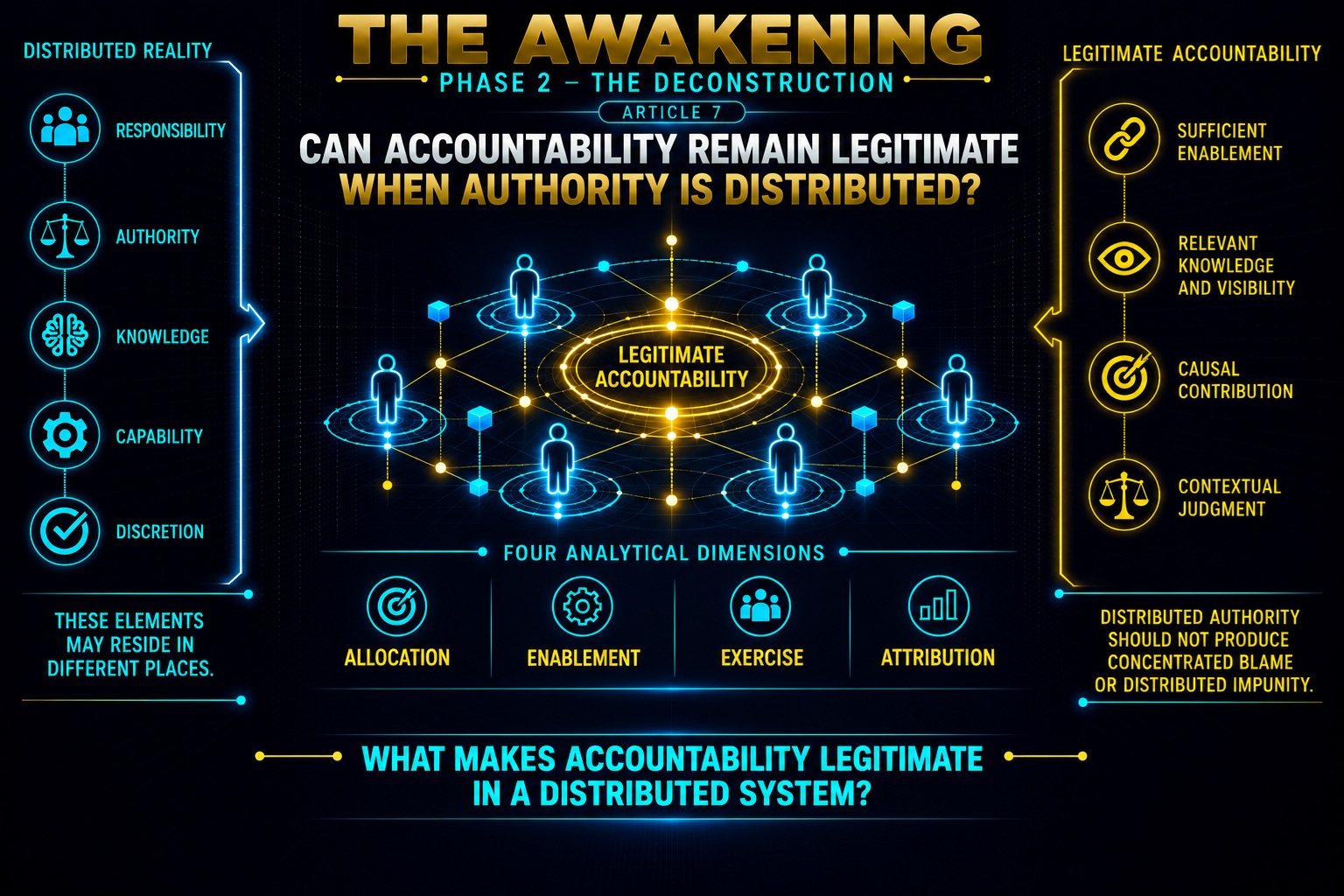
Under what conditions can accountability remain legitimate when authority, knowledge, capability and discretion reside in different places?
When responsibility and authority no longer coincide
Accountability is often treated as if responsibility and sufficient authority should closely correspond.
If someone is responsible for an outcome, we tend to expect that person to possess sufficient authority to influence it.
If the expected outcome is not achieved, accountability for that outcome is often inferred.
But distributed systems weaken that correspondence.
A project leader may be responsible for project success while major resource, commercial or strategic decisions remain outside their authority.
A Product Owner may control prioritization while operational, contractual or architectural consequences extend beyond the product boundary.
A technical team may recognize a material dependency without having authority to resolve the trade-off it creates.
A sponsor may possess substantial formal authority while depending on knowledge distributed across the system to understand when intervention is required.
Responsibility, authority, knowledge, capability and discretion may therefore reside in different places.
Once they do, formal responsibility alone becomes an insufficient basis for legitimate accountability.
Responsibility is not authority
The first distinction is fundamental:
Responsibility ≠ Authority
Responsibility concerns what an actor is legitimately expected to attend to, protect, decide, enable or accomplish.
Authority concerns the legitimate right to make, influence or constrain particular decisions.
The two may coincide.
But they need not.
Assigning responsibility does not create the authority required to exercise it.
And possessing authority does not necessarily provide the knowledge, capability, visibility or discretion required to act effectively.
This matters because accountability can become structurally distorted in both directions.
An actor may be held accountable for consequences they lacked sufficient authority to influence.
Or an actor with substantial authority may escape scrutiny because formal responsibility was assigned elsewhere.
Neither outcome is satisfactory.
Authority is not causal capacity
A second distinction is equally important:
Authority ≠ Causal Capacity
Formal authority tells us something about what an actor is legitimately entitled to decide.
It does not tell us everything about what that actor can actually cause, prevent or materially influence.
Causal capacity may depend on several conditions.
Relevant information may arrive too late.
Resources may be controlled elsewhere.
Technical possibilities may already have narrowed.
Contractual commitments may constrain available choices.
Intervention may require cooperation from other actors.
Earlier decisions may have made some alternatives prohibitively expensive or practically irreversible.
At the same time, actors without final decision authority may possess considerable causal capacity.
They may determine which information becomes visible.
Frame alternatives.
Set technical parameters.
Control resources.
Configure systems.
Shape recommendations.
Establish operational constraints.
Or make local decisions whose consequences propagate across organizational boundaries.
Formal authority can therefore both overstate and understate actual causal contribution.
If accountability is to remain legitimate, it cannot be inferred from authority alone.
From integrative responsibility to legitimate accountability
Article 2 distinguished Allocation, Enablement and Exercise as dimensions of integrative responsibility.
Accountability introduces a further analytical question:
Attribution.
The resulting architecture contains four distinct dimensions.
Allocation
Who was legitimately responsible for what?
Enablement
Did the actor possess sufficient authority, knowledge, visibility, capability, discretion and opportunity to exercise that responsibility?
Exercise
Given those conditions, what did the actor actually do, or fail to do?
Attribution
Given the actor's causal capacity and actual action or inaction, what causal contribution can reasonably be attributed, and what accountability can legitimately follow from it?
These dimensions should not be treated as a necessary linear sequence.
They are analytical distinctions.
But separating them matters.
Responsibility may be appropriately allocated and inadequately enabled.
It may be adequately enabled and not exercised.
It may be exercised appropriately while the desired outcome still fails to materialize.
And an undesirable outcome may occur without establishing that the responsible actor failed.
Accountability therefore requires more than identifying who occupied the formally responsible role when the outcome occurred.
Enablement is not optional
Formal responsibility can support legitimate accountability only if the actor has sufficient conditions to exercise it.
Authority matters.
Relevant knowledge matters.
Visibility matters.
Capability matters.
Discretion matters.
Opportunity matters.
An organization may formally allocate responsibility while retaining elsewhere the authority or capabilities necessary to discharge it.
That is not sufficient for legitimate distributed accountability.
It is a structural mismatch between responsibility and the conditions required to exercise it.
But sufficient enablement creates another problem.
What happens when the actor could act, yet responsibility was still not exercised?
Capacity to act does not guarantee exercise
Suppose an actor possesses substantial authority.
The relevant information is available.
The consequences are visible.
The actor has sufficient knowledge and capability.
There is still meaningful opportunity to intervene.
Structurally, responsibility appears to be enabled.
Yet intervention would require challenging a decision the actor previously supported.
Or questioning a senior stakeholder.
Or exposing a problem within their own function.
Or delaying a strategically important commitment.
Or confronting a powerful supplier.
Or acknowledging that an earlier judgment was wrong.
Or placing professional status, relationships or credibility at risk.
The actor possesses capacity to act.
But exercising that capacity carries a cost.
This introduces an important distinction:
Responsibility to act
is not the same as
Capacity to act
is not the same as
Cost of acting
is not the same as
Actual exercise
and none of these, on its own, determines
The legitimacy of holding someone accountable for not acting.
These are different analytical objects.
Exercise is not only structural
Exercise cannot be reduced to the existence of a mechanism through which action is formally possible.
Responsibility is exercised by people operating within organizational and relational systems.
Formal authority may exist while incentives discourage its use.
Escalation channels may exist while escalation is interpreted as failure.
Information may be available while challenging its implications threatens established interests.
Decision rights may be explicit while power asymmetries make their exercise difficult.
An organization may formally encourage challenge while informally rewarding conformity.
This does not mean that responsibility disappears.
It means that:
Exercise is not only structural. It is also behavioral and normative.
But this qualification creates an obvious danger.
If incentives, relationships, status, fear or political consequences affect the exercise of responsibility, almost any failure to act could potentially be explained by context.
That would make accountability meaningless.
The existence of a cost does not itself remove responsibility.
Leadership can require challenging powerful interests.
Governance can require questioning decisions that appear increasingly unsafe or incoherent.
Ethical responsibility may require action precisely when silence is easier.
The relevant question is therefore not:
Was acting costly?
It is:
What was the nature and significance of that cost, how did organizational conditions shape it, what meaningful alternatives remained available, and what could reasonably be expected from the actor given the responsibility legitimately assigned to them?
This prevents two opposite errors.
Organizational conditions should not become an automatic excuse for individual inaction.
But formal authority should not be treated as proof that responsibility was practically exercisable under all conditions.
Non-action is not a simple binary
Non-action should not be reduced to a binary distinction between:
Unable
and
Unwilling.
Between the two lies a more complex territory.
Authority may be formally available but practically constrained.
Knowledge may exist but remain fragmented.
Materiality may be uncertain.
Responsibilities may conflict.
Escalation may threaten legitimate relationships or commitments.
The consequences of acting and not acting may both be significant.
And causal capacity may be partial rather than complete.
Accountability must therefore examine the conditions of action rather than infer unwillingness from non-action.
Individual and organizational responsibility
This is why accountability must be considered at both individual and organizational levels.
Organizations do not merely assign responsibility.
They allocate authority, distribute knowledge, design decision rights and escalation mechanisms, establish incentives, and shape whether challenge is enabled or discouraged.
Individual accountability should not automatically absorb failures materially shaped by organizational architecture.
But the reverse is equally important.
Organizational conditions cannot automatically absorb individual responsibility.
An actor may possess sufficient authority, knowledge, capability, discretion and meaningful opportunity to act, face difficulties that are real but do not eliminate meaningful capacity to act, and nevertheless fail to exercise that responsibility.
The analytical challenge is to distinguish these situations rather than collapse one into the other.
Accountability requires causal discipline
Distributed systems introduce another difficulty.
Outcomes may have multiple contributors.
A locally legitimate decision may create consequences elsewhere.
Another actor may fail to surface those consequences.
A governance body may see the issue but postpone intervention.
A resource constraint may narrow the available response.
A later decision may amplify the original effect.
The final outcome may therefore be causally distributed.
This does not mean that nobody can be held accountable.
It means that accountability should not manufacture singular causality where singular causality did not exist.
Different actors may legitimately be accountable for different contributions.
One for a decision they had authority to make.
Another for information they were responsible for surfacing.
Another for a dependency they could reasonably have recognized.
Another for an escalation they had sufficient grounds and opportunity to initiate.
Another for a trade-off they legitimately accepted.
And another for failing to exercise responsibility despite possessing sufficient conditions to do so.
Distributed causal capacity may therefore require more precise accountability, not diluted accountability.
From accountability to legitimate attribution
The resulting shift is this.
Accountability should not begin with:
Who owns the outcome?
It should begin with a more disciplined inquiry.
What responsibility was legitimately allocated?
Was that responsibility sufficiently enabled?
How was it actually exercised?
What causal contribution can reasonably be associated with the actor's action or inaction?
And only then:
What accountability can legitimately be attributed?
This makes accountability more demanding.
It also makes it more defensible.
The architecture can therefore be summarized as:
ALLOCATION
What responsibility legitimately belonged to the actor?
↓
ENABLEMENT
Did sufficient authority, knowledge, visibility, capability, discretion and opportunity exist?
↓
EXERCISE
How was that responsibility actually exercised under the conditions affecting action?
↓
ATTRIBUTION
Given the actor's causal capacity and actual action or inaction, what causal contribution can reasonably be attributed, and what accountability can legitimately follow from it?
These relationships are analytical, not a necessary linear or causal sequence.
And one dimension cannot simply be inferred from another.
Formal responsibility does not prove enablement.
Enablement does not prove exercise.
Non-exercise does not prove unwillingness.
Action does not prove causal responsibility for the outcome.
And an adverse outcome does not retrospectively establish that an earlier decision or action was illegitimate.
The accountability paradox of distributed systems
Distributed systems create an apparent paradox.
As authority, knowledge, capability and discretion become more distributed, attributing complex outcomes to a single actor merely because that actor occupies a formally accountable role becomes harder to defend.
Yet the same distribution can make it easier for responsibility to disappear between actors.
One response would be to reconcentrate authority and accountability.
But that may sacrifice the distributed knowledge, responsiveness and local judgment that complex projects can require.
The alternative cannot be accountability without authority.
Nor can it be distributed responsibility without attribution.
The challenge is to design accountability that follows the actual architecture of responsibility and causal capacity.
That means preserving a demanding principle:
Distributed authority should not produce either concentrated blame or distributed impunity.
The Deconstruction
Article 6 separated a necessary function from any assumed single role architecture.
Article 7 now separates accountability from another familiar assumption:
That formal responsibility, authority and accountability necessarily belong together.
Sometimes they do.
But distributed systems can separate them.
And once responsibility, authority, knowledge, capability, discretion and causal contribution cease to coincide, legitimate accountability requires more than identifying who was formally responsible.
It requires examining whether responsibility was appropriately allocated, sufficiently enabled and actually exercised, and what causal contribution can legitimately be attributed to action or inaction.
Even sufficient formal authority and capacity may not settle the question.
The practical exercise of responsibility can be affected by organizational, relational and personal conditions, including the consequences of acting.
Those conditions matter.
But they do not automatically excuse inaction.
The difficult work lies in determining what could legitimately be expected of the actor under the conditions that actually existed.
So perhaps the question is not simply:
Who was accountable?
It is:
Under what conditions is holding someone accountable legitimate when responsibility, authority and causal capacity do not reside in the same place?
That distinction may determine whether distributed accountability becomes more precise.
Or merely more diffuse.
Posted on: September 14, 2026 06:08 AM |
Permalink


