
When Does Control Preserve Coherence, and When Does It Constrain Adaptability?


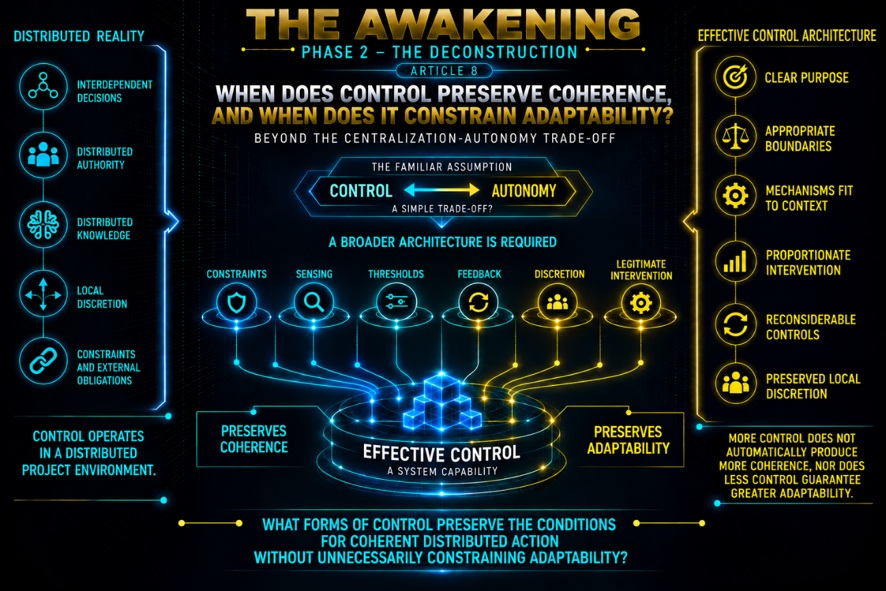 Beyond the Centralization-Autonomy Trade-off Article 6 challenged one familiar assumption. If integration is necessary, someone must necessarily be the integrator. The analysis showed that this does not automatically follow. Integration may be necessary as a system capability under conditions of material interdependence, while the architecture through which that capability is produced can vary. It may be concentrated. Distributed. Or hybrid. Article 7 challenged another familiar assumption. If someone is accountable, we often expect responsibility, authority and sufficient causal capacity to substantially coincide. Again, the relationship proved more conditional. Distributed systems can separate responsibility, authority, knowledge, capability, discretion and causal contribution. Legitimate accountability therefore requires more than identifying who formally owns an outcome. Both deconstructions lead toward another familiar relationship. If distributed action is to remain systemically coherent, some form of control appears necessary. That seems difficult to dispute. Projects operate within constraints. Decision boundaries matter. Commitments must be protected. Risks must be governed. Resources are finite. Safety, regulatory, contractual, ethical and fiduciary obligations may establish limits that cannot legitimately be traded away locally. And some decisions create consequences that extend beyond the authority of those making them. Control therefore matters. But another proposition does not automatically follow: That more control produces more coherence, or that less control produces more adaptability. That is the third deconstruction. 1. Control Is Not the Opposite of Adaptability Control and adaptability are often placed on opposite sides of an intuitive continuum. More control. Less autonomy. Less control. More autonomy. But this reasoning usually contains two assumptions at once. First, that more control necessarily reduces useful autonomy. Second, that more autonomy necessarily improves adaptability. Neither relationship should be taken for granted. Autonomy and adaptability are not equivalent. Autonomy concerns the discretion available to actors within legitimate boundaries. Adaptability concerns the capacity to respond appropriately as conditions change. Greater discretion may support adaptation. It may also produce fragmentation, unmanaged exposure or conflicting local responses. Conversely, some forms of control may constrain discretion while preserving the conditions within which adaptation remains safe and coherent. A safety constraint can protect non-negotiable boundaries while leaving teams free to adapt within them. A financial tolerance can limit exposure without prescribing how value must be delivered. A technical standard can enable distributed work by stabilizing critical interfaces. An escalation threshold can preserve local autonomy precisely because most decisions remain local until a defined condition is crossed. Other forms of control can have the opposite effect. An approval mechanism intended to preserve coherence can delay decisions until useful options disappear. A reporting requirement intended to improve visibility can produce information without improving recognition of what matters. A centralized decision authority can become a bottleneck when relevant knowledge is distributed elsewhere. Control can therefore constrain adaptability. But it can also enable it. The relevant question is not: Control or autonomy? It is: What forms of control preserve the conditions for coherent distributed action without unnecessarily constraining the capacity to adapt? 2. Why Control Exists Before challenging control, we should make the strongest case for it. Projects create interdependence. A local choice can affect cost, schedule, safety, compliance, technical integrity, operational viability, stakeholder commitments or the options available elsewhere in the system. Some consequences can safely remain local. Others cannot. Control can establish legitimate boundaries for discretion. It can protect interests that should not be traded away locally. It can ensure that significant decisions receive appropriate review. It can create traceability. It can prevent actors from externalizing material consequences onto others. It can define tolerances within which local adaptation remains legitimate. And it can ensure that decisions exceeding those tolerances reach an authority capable of addressing them. Control therefore performs more than a restrictive function. It can help make distributed action governable. Control can preserve coherence by shaping how decisions whose consequences cannot safely or legitimately remain local are bounded, surfaced, reviewed or escalated. This is why the issue is not whether projects need control. They do. The harder questions are: What kind? For what purpose? At what level? Through what mechanism? With what degree of discretion? And under which conditions? 3. Not All Control Is the Same The word control hides important architectural differences. A control may prescribe or prohibit an action. Define a boundary. Set a tolerance. Require evidence. Establish a standard. Trigger review. Require consultation. Preserve reversibility. Monitor consequences. Or specify an outcome while leaving the means open. These mechanisms do not have equivalent effects on autonomy. Consider two financial architectures. In the first, every material expenditure requires central approval. In the second, actors may make expenditure decisions independently within explicit financial limits, with wider review required only when defined exposure thresholds are crossed. Both architectures contain control. But they distribute discretion differently. The same applies to technical decisions. A central authority may approve every architectural change. Alternatively, teams may adapt locally within explicit interface constraints, with cross-boundary review required only when a change affects shared dependencies or protected conditions. Again, both architectures contain control. The difference is not control versus no control. It is how control and discretion are configured. This suggests an important distinction: The existence of control does not determine the degree of useful autonomy. Its design does. 4. Control Can Enable Autonomy This becomes clearer when decision boundaries are uncertain. Imagine a team that does not know which decisions it can make independently, which risks it may accept or when escalation becomes necessary. Formal control may appear low. But meaningful autonomy may also be low. Actors can hesitate. Seek unnecessary approval. Escalate defensively. Avoid legitimate decisions. Or exercise discretion inconsistently. Now consider a different configuration. Decision rights are explicit. Non-negotiable constraints are limited and justified. Tolerance levels are understood. Escalation conditions are known. And within those boundaries, actors possess meaningful discretion. Control has not disappeared. But autonomy has become more exercisable. A boundary does not necessarily reduce meaningful discretion. It can define where that discretion is legitimate. Useful autonomy may depend not on the absence of control, but on sufficient clarity about where control ends. The question is therefore no longer how much control should be removed to create autonomy. It becomes: Which controls make distributed discretion safer, clearer and more governable, and which unnecessarily constrain it? 5. When Control Begins to Constrain Adaptability A control can remain legitimate in purpose while becoming problematic in operation. The interest it protects may still matter. The risk may remain real. But the mechanism may impose costs that become increasingly disproportionate to the coherence, protection or governability it provides. Several patterns may indicate this possibility. Decisions repeatedly wait for authorities that add little relevant knowledge or protection. Local adaptations require approval even when their consequences can safely and legitimately remain within local boundaries. Escalations become routine rather than exceptional. Actors develop workarounds because formal mechanisms cannot respond at the speed the work requires. Decision authority remains centralized even though the knowledge necessary to decide has become highly distributed. Controls designed for exceptional exposure become standard requirements for ordinary decisions. Or compliance costs increase while the exposure being controlled remains stable or declines. None of these conditions proves that a control should be removed. Delay may be justified. Redundancy may protect against severe consequences. Central authority may remain necessary where decisions are highly consequential, irreversible or subject to non-delegable obligations. The existence of friction does not establish that a control is excessive. The relevant test is whether the friction remains proportionate to what the control legitimately protects. A control begins to constrain useful adaptability when the restrictions it imposes become insufficiently proportionate to the risks, exposures or legitimate interests at stake, including those arising from material interdependence. But even that test is incomplete. Because a control cannot be evaluated only by observing what happens while it exists. 6. The Counterfactual Matters Suppose an approval takes three days. The delay appears inefficient. Removing the approval might allow the decision to be made in three hours. Is the control therefore excessive? Not necessarily. What does the approval prevent? What information does it introduce? Which interests does it protect? What dependencies does it reveal? What legitimate authority does it bring into the decision? What exposure would change without it? And could another mechanism provide equivalent or better protection at lower systemic cost? A control cannot be evaluated only by the cost of complying with it. Nor can it be justified indefinitely merely by pointing to the risk it was originally created to address. Evaluating both the control and its alternatives requires counterfactual reasoning. What does the control enable, prevent or protect, and what changes if it is retained, weakened, redesigned, replaced or removed? This matters because adaptability is not equivalent to speed. A system that changes quickly while repeatedly creating unmanaged consequences is not necessarily adaptive. Nor is coherence equivalent to stability. A system that preserves every existing constraint while becoming unable to respond to changed conditions is not necessarily coherent. The relevant comparison is therefore between alternative architectures, not simply between control and its absence. 7. The Threshold Problem Distributed authority creates a particularly difficult question. When should a local issue remain local? And when does it become sufficiently consequential to justify wider intervention? If every deviation triggers system-level review, distributed authority becomes largely nominal. Actors may formally possess discretion while meaningful decisions continue to migrate upward. Adaptability weakens. But the opposite configuration is also problematic. If an issue remains local after its consequences have exceeded the conditions within which local discretion remains legitimate, intervention may arrive only after commitments have accumulated, dependencies have propagated or meaningful alternatives have narrowed. Control then arrives too late. This makes the threshold for intervention central to control architecture. A technical variation may remain local until it changes a shared interface. A schedule adjustment may remain local until it threatens a contractual commitment. A resource decision may remain within functional authority until it changes the viability of another critical commitment. A product decision may remain within product authority until its consequences materially alter operational, regulatory or financial conditions. Other issues may justify wider intervention without first becoming cross-boundary. A safety threshold may be crossed. A regulatory condition may no longer be satisfied. A fiduciary limit may be exceeded. A protected right or ethical constraint may become materially implicated. The relevant test is therefore broader than interdependence alone. The system must determine when a consequence, exposure or protected interest has become significant enough to warrant wider attention, and when it has become significant enough to justify wider authority or intervention. If the intervention threshold is set too low, control may unnecessarily constrain autonomy. If it is set too high, intervention may come too late to preserve coherence or protect the interest at stake. There is unlikely to be one universal quantitative rule. Context matters. Reversibility matters. Velocity matters. Risk matters. Interdependence matters. The distribution of knowledge and authority matters. The nature of the protected interest matters. And timing matters. The same consequence recognized early may be manageable through local adaptation. Recognized later, it may require wider intervention. So control architecture must answer not only: What requires intervention? But also: When does intervention become justified, and how will the system know? 8. Visibility Is Not Yet Intervention That question introduces another distinction. A consequence may exist without being visible. It may be visible without receiving sufficient attention. It may receive attention without being recognized as materially significant. Its significance may be recognized locally without being connected to relevant consequences elsewhere. And the resulting issue may be recognized without anyone possessing legitimate capacity to act. These distinctions matter. But they should not yet be converted into a necessary linear architecture. Human attention is not the only mechanism through which significant patterns can be detected. Automated monitoring can surface deviations. Predefined thresholds can trigger escalation. Information systems can connect signals across boundaries. AI may increasingly identify patterns that no individual actor was actively attending to. Governance mechanisms can require review without relying on spontaneous human recognition. So the proposition remains open: Information can be available without being integrated. Visibility can exist without sufficient attention. Attention can exist without recognition of systemic significance. And recognition can exist without legitimate capacity to act. These relationships require further testing. For the present deconstruction, their relevance is narrower. A control architecture cannot preserve coherence merely by making information available. It requires some viable mechanism through which materially significant consequences, exposures or protected interests can receive appropriate consideration and, where justified, legitimate intervention. At the same time, not every visible issue should trigger wider control. Otherwise, an architecture may turn visibility into automatic escalation and thereby erode local discretion. This creates a difficult design question: How can a project remain sensitive to material consequences without converting every local signal into system-level intervention? 9. Beyond Centralization Once control is separated from centralization, the design space becomes wider. Coherence may sometimes require centralized approval. But control can also operate through decision boundaries and standards, tolerances and thresholds, monitoring and feedback, review and escalation, or reversible experimentation. Some mechanisms constrain action before it occurs. Others detect consequences after action. Some prevent. Some guide. Some surface. Some escalate. Some preserve options. Some support accountability without requiring prior approval. The appropriate architecture depends on what must be governed. A highly irreversible decision with broad consequences may justify stronger ex ante control. A reversible local experiment within contained boundaries may justify broad discretion combined with rapid feedback. A decision whose consequences are difficult to detect may require stronger monitoring. A decision whose consequences become rapidly irreversible may require earlier intervention thresholds. This suggests that the centralization-autonomy continuum is too narrow. The more useful design question is: What combination of constraints, discretion, sensing, feedback and escalation is proportionate to the consequences, exposures and legitimate interests the system must govern? 10. Control Architecture Must Also Be Adaptable There is another assumption hidden inside the discussion. We often ask whether actors should adapt within a control architecture. But what about the control architecture itself? A control designed for one configuration of risk, knowledge, technology, interdependence or organizational capability may become less appropriate as those conditions change. That does not make the original control wrong. Nor does change automatically justify its removal. The protected interest may remain entirely legitimate. The relevant question is whether the mechanism remains proportionate to the conditions it now governs. A system capable of adapting its work while treating its controls as permanently fixed may eventually constrain the very adaptability those controls were intended to make governable. The control architecture therefore requires mechanisms for review and reconsideration. Not continuous redesign. Not permanent instability. Not a presumption in favor of less control. But the capacity to examine whether the relationship among purpose, risk, mechanism, discretion and consequence remains defensible as conditions materially change. Control that cannot itself be reconsidered may preserve arrangements designed for yesterday's coherence at the expense of tomorrow's adaptability. 11. Perhaps the Trade-off Is Wrong The familiar framing asks: How much control? How much autonomy? As if one must necessarily be purchased by sacrificing the other. But the analysis suggests that the relevant variables do not sit neatly on one line. Control. Autonomy. Coherence. Adaptability. They interact. But they are not equivalent. More control does not necessarily produce more coherence. Less control does not necessarily produce more adaptability. More autonomy does not necessarily produce better adaptation. And: Coherence does not necessarily require centralization. Poorly designed control can reduce autonomy without producing coherence. Poorly bounded autonomy can increase discretion without producing adaptability. Centralization can sometimes improve protection or consistency while degrading responsiveness and local knowledge. Distribution can improve responsiveness while weakening the capacity to recognize and govern consequences that exceed local boundaries. The real design problem is therefore relational. Which constraints preserve necessary coherence or legitimate protection? Which forms of discretion enable useful adaptation? What makes wider intervention materially justified? And can intervention occur while meaningful alternatives still exist? 12. Control as a System Capability Article 6 moved integration from assumed role ownership toward system capability. A similar distinction becomes useful here. Control should not be reduced to an approval hierarchy or centralized authority. At system level, effective control concerns the capacity to keep consequential action within legitimate boundaries and respond appropriately when those boundaries, assumptions or conditions are materially challenged. That capacity may be produced through multiple mechanisms. Some centralized. Some distributed. Some preventive. Some adaptive. Some human. Some increasingly computational. The architecture should therefore be evaluated functionally. Can it protect legitimate interests and limit unacceptable exposures? Can it preserve coherence where consequences become materially interdependent? Can it preserve legitimate local discretion? Can it detect and respond when relevant boundaries are crossed? And can its own mechanisms be reconsidered when the conditions that justified them materially change? If not, the system may possess controls without possessing effective control. That distinction matters. Controls are organizational mechanisms. Effective control is a system capability. The existence of the first does not prove the second. 13. When Does Control Preserve Coherence? We can now return to the central question. Which forms of control remain necessary for coherence, and under what conditions do they begin to weaken useful autonomy and adaptation? There is no universal threshold. Different project configurations create different patterns of interdependence, reversibility, uncertainty, risk, knowledge distribution, protected interests and consequences. But several conditions emerge from the analysis. Control is more defensible when it protects a legitimate interest or material exposure that cannot safely or legitimately remain within local discretion, and when intervention remains proportionate to the consequence being governed. That intervention should be informed by relevant knowledge and legitimate authority, occur while meaningful alternatives remain, avoid unnecessarily capturing decisions that can safely remain local, and remain open to reconsideration as governing conditions materially change. Conversely, control becomes increasingly difficult to defend when it captures decisions that can safely and legitimately remain within local discretion, centralizes authority without adding necessary knowledge or protection, repeatedly delays adaptation without preserving commensurate value, or continues to operate on assumptions that no longer adequately describe the conditions being governed. This does not produce a formula. It produces a more demanding test: Does this control protect a legitimate interest, limit a material exposure or preserve coherence in a way proportionate to the discretion and adaptive capacity it constrains? The Deconstruction The familiar opposition was: Control ↔ Autonomy More of one appeared to imply less of the other. The relationship does not survive intact. Control can constrain autonomy. It can also make autonomy exercisable. Autonomy can enable adaptation. It can also create consequences that exceed the conditions within which local discretion remains legitimate. Centralization can protect coherence. It can also create delay, information loss and dependency. Distribution can improve responsiveness. It can also weaken effective control when significant consequences or exposures are not recognized and governed in time. So the relevant question is not how to maximize autonomy. Nor how to minimize control. Nor even how to find a universal balance between them. It is: What architecture of constraints, discretion, sensing, thresholds, feedback and legitimate intervention can preserve coherence while allowing adaptation under the actual conditions of the project? That architecture will vary. But one proposition survives the deconstruction: Control is most defensible when it protects a legitimate interest or material exposure with intervention proportionate to the consequences at stake, while preserving discretion where action can safely and legitimately remain local. This is not a case for more control. Nor for less. It is a case for control whose form, location and intensity can be justified by what the project actually needs to protect and govern. And that leaves another assumption to examine. If functions such as integration, accountability and control should be configured around the capabilities, consequences and legitimate interests the project system must govern rather than inferred automatically from inherited organizational arrangements, what follows for the roles through which project management has traditionally organized those functions? Should we continue to begin with the role? Or should we begin with the contributions and capabilities the project system requires? That is where THE AWAKENING goes next. |
Posted on: September 16, 2026 06:53 AM
| Permalink |
Comments (0)


