Professionalism Under Pressure: Choosing Respect When Conflict Escalates
Categories:
Ethics as a competence,
Behavior,
courage honesty responsibility respect fairness,
code of ethics,
Ethical Leadership,
Decision-making,
Ethics Insight Team,
Ethics Bistro,
Business Ethics,
code of conduct,
Power Skills,
Decision-making,
Business Ethics,
Professionalization,
practitioner,
Ethical Dilemma,
respect,
Professional Responsibility,
Honesty,
Respect,
Responsibility,
Fairness,
Code of Ethics and Professional Conduct,
Human,
fairness,
communication,
honesty,
responsibility,
professonal conduct,
Conflict,
empathy,
EDMF,
Ethics in Communication,
Agile,
Decision Making,
Ethics,
Legal Project Management
Categories: Ethics as a competence, Behavior, courage honesty responsibility respect fairness, code of ethics, Ethical Leadership, Decision-making, Ethics Insight Team, Ethics Bistro, Business Ethics, code of conduct, Power Skills, Decision-making, Business Ethics, Professionalization, practitioner, Ethical Dilemma, respect, Professional Responsibility, Honesty, Respect, Responsibility, Fairness, Code of Ethics and Professional Conduct, Human, fairness, communication, honesty, responsibility, professonal conduct, Conflict, empathy, EDMF, Ethics in Communication, Agile, Decision Making, Ethics, Legal Project Management


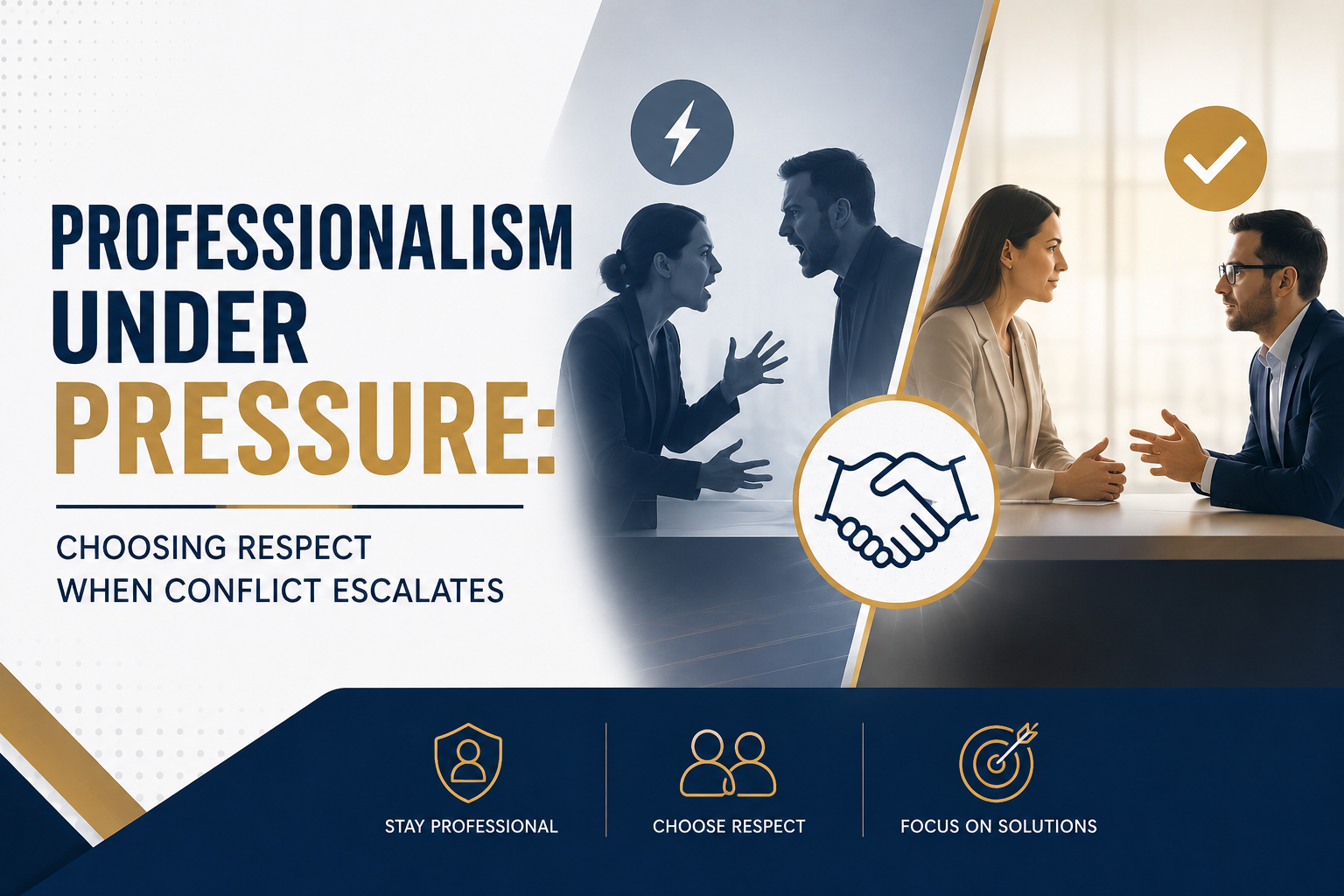 The message arrived at 11:47 p.m. It wasn't long. Just a few lines. But every sentence carried anger. A disagreement over a contract had been going on for weeks. There were questions about payment, responsibilities, and what each side believed had been promised. The conversation had already become uncomfortable. Now, the latest message crossed a different line. There were accusations. Personal insults. A veiled threat about “making sure people know” what had happened. And then came a remark about the other person's background. For a moment, the easiest response seemed obvious: Fight back. After all, they started it. But this is where professionalism is really tested not when everyone is calm and reasonable, but when someone gives us every reason to lose our composure. Conflict is part of professional life. Employment decisions can disappoint people. Contracts can fall apart. Candidates can feel unfairly treated. Managers can become frustrated. Clients and suppliers can disagree about commitments. Sometimes we are genuinely wronged. And sometimes we may be the ones who got something wrong. Either way, disagreement does not give us permission to abandon respect. The PMI Code of Ethics and Professional Conduct places Respect among its four core values. That sounds simple until we find ourselves staring at a message that feels deliberately insulting, threatening, or unfair. Respect is easy when it is reciprocated. It becomes meaningful when it isn't. The person receiving that late-night message eventually did something surprisingly difficult. They didn't respond. Not immediately. They saved the communication, stepped away from the computer, reviewed the facts, and went to bed. The next morning, they wrote back. The response acknowledged the disagreement. It clarified the contractual position. It proposed using the appropriate process to resolve the matter. There were no insults. No threats. No attempt to embarrass the other person. It wasn't weakness. It was professional self-control. Respect doesn't mean tolerating abuse. It doesn't mean remaining silent when discriminatory language is used. It doesn't mean accepting intimidation or allowing retaliation to go unchallenged. And it certainly doesn't mean avoiding difficult conversations. Sometimes respect means setting a boundary. Sometimes it means documenting what happened and involving Human Resources, legal counsel, procurement, recruitment leadership, or another appropriate authority. Sometimes it means saying: “I am willing to discuss the issue, but I will not continue the conversation in this manner.” That is respect too. Because respect isn't only about how we treat people when we agree with them. It is also about recognizing their dignity when we don't. And perhaps that's the uncomfortable part of professional ethics. We cannot control the tone of the message that arrives at 11:47 p.m. We cannot control whether someone tries to intimidate us, insults us, uses discriminatory language, or threatens retaliation. But we can control whether we respond in kind. We can choose to protect our boundaries without attacking someone else's dignity. We can choose accountability without humiliation. We can choose firmness without hostility. We can choose Respect. Not because the other person necessarily deserves our kindness in that moment, but because our professional values should not depend on someone else's behavior. The next time a difficult message lands in your inbox, ask yourself: When someone crosses the line with us, can we hold the line without crossing it ourselves? |
The Traps of a Conflict of Interest
Categories:
courage honesty responsibility respect fairness
Categories: courage honesty responsibility respect fairness
| Catherine lives in a small city, where everyone knows everyone, they are childhood friend, school mates, sports mates, colleagues who worked together at one point in time in their careers, neighbors, relatives, or connected with almost no degrees of separation! Simon, one of Catherine’s direct reports has been extremely busy; running an operational arm, establishing a new line of business, while at the same time driving the establishment of new service centers to expand the business and extend the reach to other geographical areas. Catherine could easily see that Simon needs support in establishing these new centers. The level of complexity and engagement with internal and external stakeholders require a dedicated Project Manager, rather than an Operational Manager whose time is split in between running the business and driving the establishment of new centers. Each center is a project on its own right that has a complex of level of consultation, communication, compliance, and a focus on driving a large number of interdependent activities and tasks. Catherine suggested that Simon creates the new project manager role and advertises it as soon as possible.
Photo by Gustavo Fring from Pexels The role drew a lot of interest, as it offers a sense of purpose - serving the community, a rich experience in driving a set of projects end to end, including engagement with a variety of stakeholders. The candidate list contained a large number of people, most of which would have crossed paths with both Catherine and Simon at one stage in their lives. However, the candidate’s name that raised red flags was Emma, a well-known close relative of Catherine. Catherine was planning to take part in the interview panel. However, seeing Emma’s name not only as an applicant, but also as a strong candidate, she opted out, demonstrating honesty and citing her conflict of interest. She asked Simon to formulate an interview panel. Simon, being aware of the situation, formulates the interview panel asking each to declare any conflicts of interest. The interviews proceed, with mixed feelings. Every member of the interview panel is aware of the relationship between Catherine and Emma. While each doesn’t have the conflict of interest that Catherine has, Catherine is ultimately their boss.
Image by Wokandapix from Pixabay The panel discussed openly how they do feel a little bit of pressure, as they understand the relationship between Catherine and Emma. They are also aware of how they are going to be judged by their recommendation. They also understand the need for the new role and how critical it is to select the most suitable candidate. Taking their responsibility seriously, they go about interviewing, giving each candidate their fair share of time, the opportunity to respond to interview questions as well as ask their own. Following a marathon of interviews, they pick the top two most suitable candidates to be lined up for a second interview. All agreed that while Emma was a good candidate, she is not one of the top two – as a matter of fact she comes third. The inner thoughts of the panel were:
The panel asks Simon as he conveys the shortlist to Catherine, to give Catherine the context and the reasoning that supports the top two shortlisted candidates. The panel members await the results of Simon’s conversation with Catherine. Their anxiety and worries turn into delight, they are relieved to hear that Catherine not only accepted their recommendation of the top two, but also was happy to offer the job to the top candidate waiving the need for second interview. How wonderful it is to see Catherine’s words reinforced by actions, distancing herself from the situation, declaring her conflict of interest and trusting her team’s judgement and recommendations! Reflecting on your own experience, if you were in Catherine’s shoes, what would you have done? |
.jpg)