Professionalism Under Pressure: Choosing Respect When Conflict Escalates
From the Ethics Bistro Blog
by Tara Leparulo,
Shenila Shahabuddin, Juan Posada Toro, Albert Agbemenu, Ming Yeung, Kannan Ganesan, Yannick Arekion, Witold Hendrysiak, Stelian ROMAN, Laszlo J. Kremmer MBA, CSPO®, CSM®, PMP®

We all tackle ethical dilemmas. Wrong decisions can break careers. Which are the key challenges faced? What are some likely solutions? Where can we find effective tools? Who can apply these and why? Dry, theoretical discussions don't help. Join us for lively, light conversations to learn, share and grow!
View Posts By:
Tara Leparulo
Shenila Shahabuddin
Juan Posada Toro
Albert Agbemenu
Ming Yeung
Kannan Ganesan
Yannick Arekion
Witold Hendrysiak
Stelian ROMAN
Laszlo J. Kremmer MBA, CSPO®, CSM®, PMP®
Past Contributors:
Dr. Deepa Bhide
Lily Murariu
Alankar Karpe
Bryan Shelby
Amany Nuseibeh
Mohamed Hassan
Fabio Rigamonti
Simona Bonghez
John Watson
Lissa Muncer
Valerie Denney
Majeed Hosseiney
Gretta Kelzi
Enrique Cappella
Rocio Briceno
Karthik Ramamurthy
Recent Posts
Professionalism Under Pressure: Choosing Respect When Conflict Escalates
The Credential Is a Promise: What Do Three Letters Really Say?
When the schedule slipped, so did accountability: Ethical reflections from an early ERP project - Part 2
When the schedule slipped, so did accountability: Ethical reflections from an early ERP project - Part 1
Do You Like to Pick and Choose Your Projects?
Categories
Aerospace and Defense,
Agile,
AI,
Ambassadors,
Artificial Intelligence,
Ask the Experts,
Behavior,
bottom line,
Business Acumen,
Business Ethics,
Business Ethics,
CEO,
CFO,
Change Management,
Chapters,
CIO,
code of conduct,
code of ethics,
Code of Ethics and Professional Conduct,
communication,
Conflict,
Construction,
courage honesty responsibility respect fairness,
Cultural Diversity,
Culture,
CxO,
Decision Making,
Decision-making,
Decision-making,
Digital Project Management,
Digital Transformation,
Diversity,
Do the right thing,
dugutalization project manager professionalism social media,
economy,
EDMF,
EMAG,
empathy,
Ethical Dilemma,
Ethical Leadership,
Ethics,
Ethics,
Ethics,
Ethics,
Ethics,
Ethics,
Ethics,
Ethics as a competence,
Ethics Bistro,
Ethics in Communication,
Ethics Insight Team,
Fairness,
fairness,
Governance,
Honesty,
honesty,
Human,
Information Technology,
Leadership,
Legal Project Management,
Legilsation,
Lessons Learned,
Negotiation,
Nexus,
Organizational Culture,
Organizational Project Management,
PMI Program Management,
PMI Talent Triangle,
PMIAA,
Portfolio Management,
Power Skills,
practitioner,
Product Management,
Professional Conduct,
professional conduct,
Professional Responsibility,
Professionalization,
professonal conduct,
Program Management,
Project,
Project Management,
project manager,
Regulatory,
research,
Respect,
respect,
Responsibility,
responsibility,
Risk Management,
Stakeholder Management,
Strategy,
Sustainability,
Team Assessment,
Teams,
Thought leadership,
tools,
Trust,
trust,
Values,
Values,
values,
Virtual Experience Series,
volunteers,
Ways of Working
Date
Categories:
Agile,
Behavior,
Business Ethics,
Business Ethics,
code of conduct,
code of ethics,
Code of Ethics and Professional Conduct,
communication,
Conflict,
courage honesty responsibility respect fairness,
Decision Making,
Decision-making,
Decision-making,
EDMF,
empathy,
Ethical Dilemma,
Ethical Leadership,
Ethics,
Ethics as a competence,
Ethics Bistro,
Ethics in Communication,
Ethics Insight Team,
Fairness,
fairness,
Honesty,
honesty,
Human,
Legal Project Management,
Power Skills,
practitioner,
Professional Responsibility,
Professionalization,
professonal conduct,
Respect,
respect,
Responsibility,
responsibility
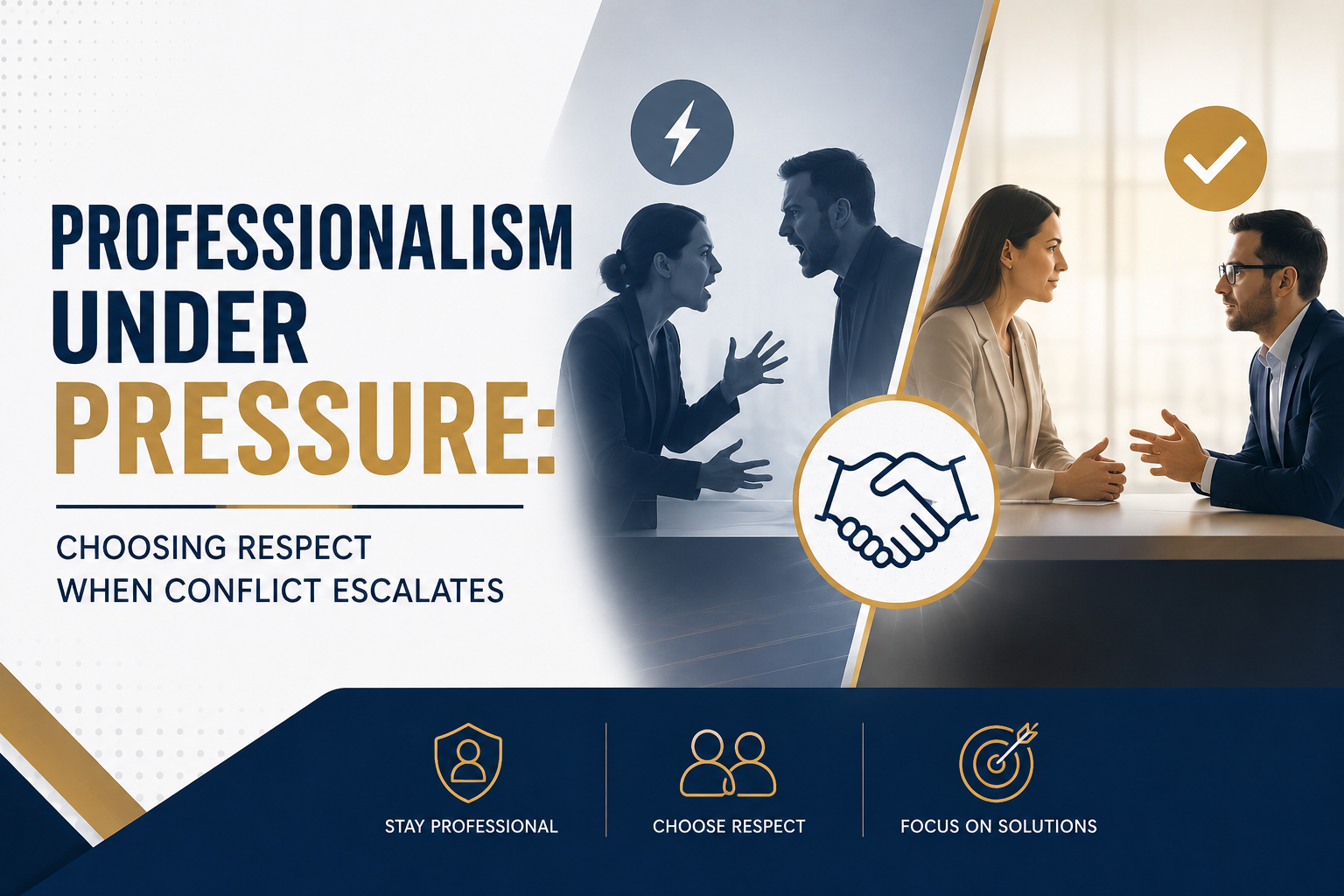
The message arrived at 11:47 p.m.
It wasn't long. Just a few lines. But every sentence carried anger.
A disagreement over a contract had been going on for weeks. There were questions about payment, responsibilities, and what each side believed had been promised. The conversation had already become uncomfortable.
Now, the latest message crossed a different line.
There were accusations. Personal insults. A veiled threat about “making sure people know” what had happened. And then came a remark about the other person's background. For a moment, the easiest response seemed obvious:
Fight back. After all, they started it.
But this is where professionalism is really tested not when everyone is calm and reasonable, but when someone gives us every reason to lose our composure. Conflict is part of professional life. Employment decisions can disappoint people. Contracts can fall apart. Candidates can feel unfairly treated. Managers can become frustrated. Clients and suppliers can disagree about commitments. Sometimes we are genuinely wronged. And sometimes we may be the ones who got something wrong. Either way, disagreement does not give us permission to abandon respect.
The PMI Code of Ethics and Professional Conduct places Respect among its four core values. That sounds simple until we find ourselves staring at a message that feels deliberately insulting, threatening, or unfair. Respect is easy when it is reciprocated. It becomes meaningful when it isn't. The person receiving that late-night message eventually did something surprisingly difficult.
They didn't respond. Not immediately.
They saved the communication, stepped away from the computer, reviewed the facts, and went to bed. The next morning, they wrote back.
The response acknowledged the disagreement. It clarified the contractual position. It proposed using the appropriate process to resolve the matter. There were no insults. No threats. No attempt to embarrass the other person. It wasn't weakness. It was professional self-control. Respect doesn't mean tolerating abuse. It doesn't mean remaining silent when discriminatory language is used. It doesn't mean accepting intimidation or allowing retaliation to go unchallenged. And it certainly doesn't mean avoiding difficult conversations.
Sometimes respect means setting a boundary. Sometimes it means documenting what happened and involving Human Resources, legal counsel, procurement, recruitment leadership, or another appropriate authority. Sometimes it means saying:
“I am willing to discuss the issue, but I will not continue the conversation in this manner.”
That is respect too.
Because respect isn't only about how we treat people when we agree with them. It is also about recognizing their dignity when we don't. And perhaps that's the uncomfortable part of professional ethics.
We cannot control the tone of the message that arrives at 11:47 p.m. We cannot control whether someone tries to intimidate us, insults us, uses discriminatory language, or threatens retaliation. But we can control whether we respond in kind. We can choose to protect our boundaries without attacking someone else's dignity. We can choose accountability without humiliation. We can choose firmness without hostility. We can choose Respect. Not because the other person necessarily deserves our kindness in that moment, but because our professional values should not depend on someone else's behavior. The next time a difficult message lands in your inbox, ask yourself:
When someone crosses the line with us, can we hold the line without crossing it ourselves?
Posted
by
Shenila Shahabuddin
on: August 29, 2026 03:36 PM |
Permalink
Comments (8)
Please login or join to subscribe to this item

Luis Branco
CEO| Business Insight, Consultores de Gestão, Ldª
Carcavelos, Lisboa, Portugal
Shenila, I agree that professionalism is tested most when respect is no longer reciprocal. I particularly like your distinction between maintaining respect and tolerating unacceptable conduct.
I would add one further boundary.
When behavior becomes materially threatening, discriminatory or retaliatory, the issue may no longer be primarily interpersonal.
Professionalism then requires more than self-control. It may require preserving evidence, setting explicit boundaries and involving the appropriate authority.
That distinction matters because respect for the person does not require neutrality toward the conduct.
Nor should remaining composed make misconduct less visible or less accountable.
Perhaps the deeper test is whether we can respond without retaliation while still making unacceptable behavior visible, addressable and governable through legitimate processes.
Holding the line, in that sense, means neither crossing it ourselves nor allowing respect to become a reason for leaving serious conduct unaddressed.
Thank you for adding this perspective. I completely agree that respect should never become a substitute for accountability. The distinction between respecting the person and addressing the conduct is especially important. We can remain composed and professional while still documenting what happened, establishing clear boundaries, and using legitimate processes to address serious behavior.
I particularly like your phrase “making unacceptable behavior visible, addressable and governable.” That captures the balance beautifully.
Professionalism isn't passive acceptance. Sometimes, holding the line means having the courage to escalate appropriately without becoming part of the problem ourselves.
Thank you for extending the conversation. This is exactly the kind of behavior that makes discussions around professional ethics valuable.

Ming Yeung
Professor (adjunct part time)| George Brown Polytechnic/Fanshawe College/Humber Polytechnic
Toronto, Ontario, Canada
Shenila, your piece makes it unmistakably clear that ethics is never theoretical when real conflict hits.
Your story of a late‑night, hostile message illustrates how professionalism is defined not by calm moments, but by the ones that tempt us to abandon our values.
You advocate that respect is not passive but an active, disciplined choice. It means stepping back, documenting facts, setting boundaries, and refusing to mirror hostility. It means separating the person from the conduct, addressing wrongdoing without dehumanizing anyone involved.
Your message is powerful: respect matters most when it’s hardest. Ethical behavior is not about being agreeable; it’s about being accountable, composed, and principled even when provoked.
As project practitioners, we carry influence in every interaction, say, emails, meetings, negotiations, academic collaborations, and personal conversations.
Our tone can escalate conflict or defuse it; our choices can model dignity or undermine it.
Thank you Ming for this thoughtful reflection. I particularly agree that ethics is tested most when we are under pressure.
Respect doesn’t mean avoiding difficult conversations; it means addressing conduct firmly while preserving the dignity of the person involved. As project leaders, how we respond in difficult moments sets the standard for others.
Accountability and respect can and should coexist.
Shenila, thank you for this post. I like your advice to allow yourself time to calm down and focus on facts. You may draft the answer, but don't send it immediately; review it the next day to ensure it's professional, respectful, and fair.

Juan Posada Toro
Customer Success Manager| Rockwell Automation
Envigado, Antioquia, Colombia
Powerful blog Shenila and thanks for sharing.
Real professionalism is not tested when things are easy, it is tested when we have every reason to react badly... and choose not to.
How we respond says as much about us as the conflict itself.

Antonio Avalos Oropeza
Industrial Engineer | Operational Excellence & Quality Professional| The Organizational Artery
Mexicali Baja California, Mexico
Thank you for this thoughtful reflection. I also see an important connection between professionalism and procedural fairness.
Maintaining respect and composure is essential, particularly when conflict escalates. At the same time, evaluating a difficult interaction objectively may require looking beyond tone alone and considering context, evidence, proportionality, and the perspectives of all parties involved.
In that sense, respect and accountability can be strengthened by a process that remains fair, balanced, and consistent for everyone involved.
Perhaps this is another dimension of “holding the line”: preserving professional values while ensuring that the way conflict is assessed is as objective as the way we expect people to behave.
Please Login/Register to leave a comment.
|
One word sums up probably the responsibility of any vice president, and that one word is 'to be prepared'.
- Dan Quayle
|





