Project Management

Ethics Bistro

by , , , , , , , , ,
We all tackle ethical dilemmas. Wrong decisions can break careers. Which are the key challenges faced? What are some likely solutions? Where can we find effective tools? Who can apply these and why? Dry, theoretical discussions don't help. Join us for lively, light conversations to learn, share and grow!

About this Blog

RSS

View Posts By:

Tara Leparulo
Shenila Shahabuddin
Juan Posada Toro
Albert Agbemenu
Ming Yeung
Kannan Ganesan
Yannick Arekion
Witold Hendrysiak
Stelian ROMAN
Laszlo J. Kremmer MBA, CSPO®, CSM®, PMP®

Past Contributors:

Dr. Deepa Bhide
Lily Murariu
Alankar Karpe
Bryan Shelby
Amany Nuseibeh
Mohamed Hassan
Fabio Rigamonti
Simona Bonghez
John Watson
Lissa Muncer
Valerie Denney
Majeed Hosseiney
Gretta Kelzi
Enrique Cappella
Rocio Briceno
Karthik Ramamurthy

Recent Posts

When the schedule slipped, so did accountability: Ethical reflections from an early ERP project - Part 2

When the schedule slipped, so did accountability: Ethical reflections from an early ERP project - Part 1

Do You Like to Pick and Choose Your Projects?

Behind closed doors: When decisions feel already made

Looking for the most important information on pmi.org? Here are the key links.

Categories

Aerospace and Defense, Agile, AI, Ambassadors, Artificial Intelligence, Ask the Experts, Behavior, bottom line, Business Acumen, Business Ethics, Business Ethics, CEO, CFO, Change Management, Chapters, CIO, code of conduct, code of ethics, Code of Ethics and Professional Conduct, communication, Conflict, Construction, courage honesty responsibility respect fairness, Cultural Diversity, Culture, CxO, Decision Making, Decision-making, Decision-making, Digital Project Management, Digital Transformation, Diversity, Do the right thing, dugutalization project manager professionalism social media, economy, EDMF, EMAG, empathy, Ethical Dilemma, Ethical Leadership, Ethics, Ethics, Ethics, Ethics, Ethics, Ethics, Ethics, Ethics as a competence, Ethics Bistro, Ethics in Communication, Ethics Insight Team, Fairness, fairness, Governance, Honesty, honesty, Human, Information Technology, Leadership, Legal Project Management, Legilsation, Lessons Learned, Negotiation, Nexus, Organizational Culture, Organizational Project Management, PMI Program Management, PMI Talent Triangle, PMIAA, Portfolio Management, Power Skills, practitioner, Product Management, Professional Conduct, professional conduct, Professional Responsibility, Professionalization, professonal conduct, Program Management, Project, Project Management, project manager, Regulatory, research, Respect, respect, Responsibility, responsibility, Risk Management, Stakeholder Management, Strategy, Sustainability, Team Assessment, Teams, Thought leadership, tools, Trust, trust, Values, Values, values, Virtual Experience Series, volunteers, Ways of Working

Date

Navigating AI in Project Management: A Comparison with Racing Co-Pilots and Driverless Cars

linkedin twitter facebook Request to reuse this  

Artificial Intelligence (AI) is revolutionizing industries, and project management is no exception. With advanced tools supporting decision-making, risk mitigation, and efficiency, the project management landscape is increasingly intertwined with AI technologies. However, this evolution raises questions about human responsibility, autonomy, and ethics—questions like those faced in the realms of racing co-pilots and driverless cars. 
This blog explores the pros and cons of using AI in project management and compares these dynamics with racing environments and autonomous vehicle scenarios, focusing on the balance between human involvement and ethical considerations. 
Shape 
The Role of AI in Project Management 
AI-driven tools, such as virtual assistants and machine learning algorithms, are increasingly used to streamline project management processes. From schedule optimization and predictive analytics to stakeholder communication and resource allocation, AI empowers project managers to make well-informed and efficient decisions. 
The Racing Co-Pilot Analogy: Shared Responsibility, Enhanced Performance 
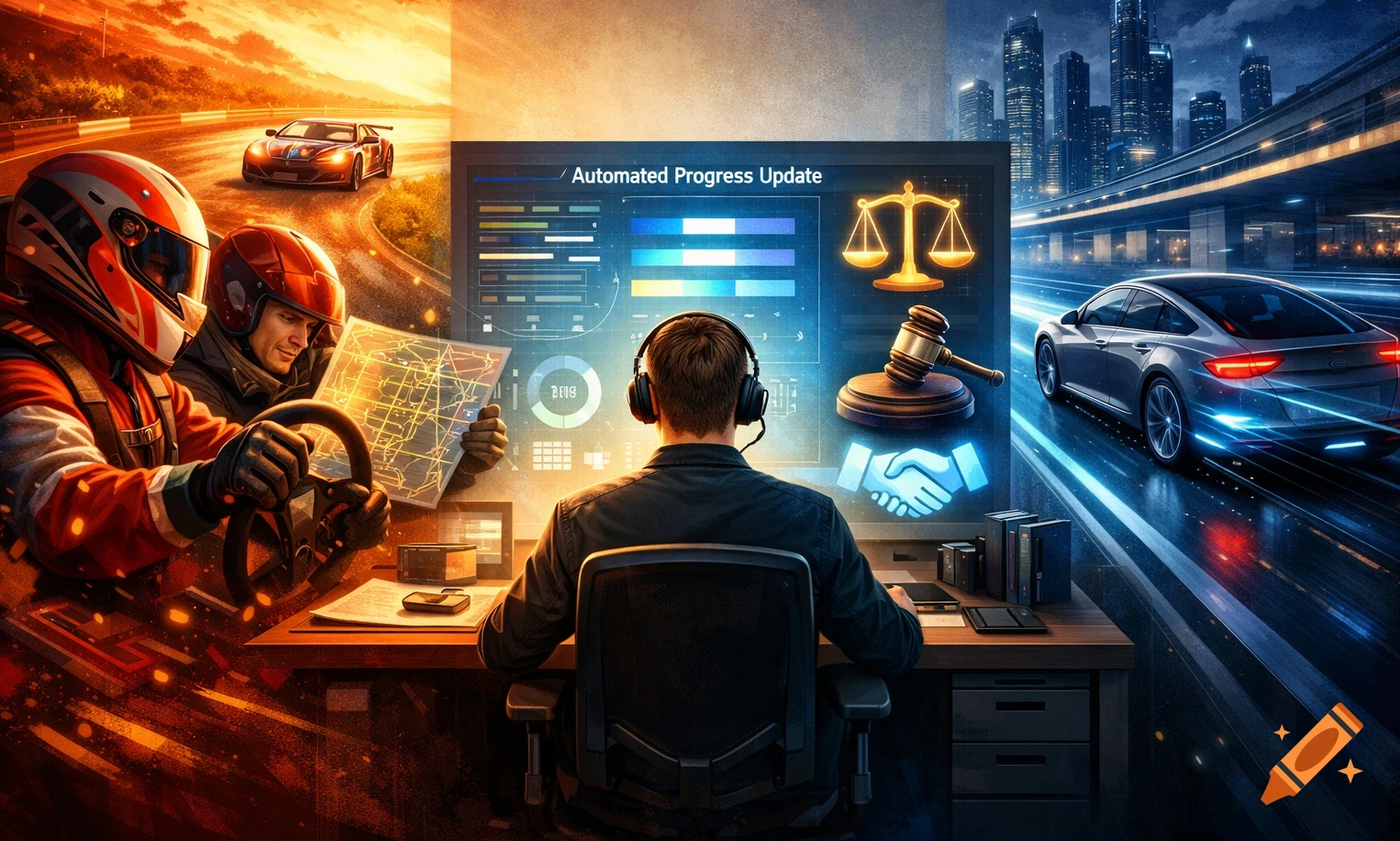
In professional racing environments, a co-pilot performs critical tasks: navigating the course, analysing conditions, and advising the driver. This relationship mirrors the human-machine collaboration often seen in project management. Here, AI acts as a "co-pilot," assisting project managers while leaving primary control in human hands. Let us examine this analogy: 
Pros of AI as a Co-Pilot in Project Management: 
  1. Enhanced Decision-Making: AI algorithms analyse massive datasets to predict outcomes and recommend actions, akin to a co-pilot guiding navigational decisions during a race. 
  2. Efficiency Gains: AI automates repetitive tasks and improves processes, freeing project managers to focus on strategy—like how co-pilots manage tactical information during high-speed races. 
  3. Risk Reduction: By identifying potential issues in advance, AI serves as an advisor, much like a racing co-pilot warning about challenging road conditions, enabling initiative-taking corrections. 
Cons of AI as a Co-Pilot: 
  1. Over-Reliance on AI: Just as a driver must remain vigilant and not entirely dependent on the co-pilot, project managers risk deferring critical decisions to AI tools, potentially leading to a lack of accountability. 
  2. Ethical Blind Spots: Racing ethics demand fair play and adherence to rules; similarly, ethical AI use in project management calls for attention to bias, transparency, and fairness. Overlooking these aspects can harm stakeholders or perpetuate inequitable practices. 
In this analogy, collaborative relationships thrive when the human retains ultimate responsibility while leveraging AI as a supporting entity. 
Shape 
The Driverless Car Comparison: Autonomous AI in Project Management 
Shifting perspective, consider driverless cars: vehicles fully controlled by AI, requiring minimal human intervention. Some envision project management systems that resemble a driverless car—autonomous AI overseeing the project's execution from start to finish. While promising, this model has risks and challenges to consider. 
Pros of Autonomous AI in Project Management: 
  1. Unparalleled Precision: Autonomous AI can minimize human errors, akin to driverless cars maintaining perfect lane control or braking at precisely calculated intervals. 
  2. Scalability: AI can manage complex, multi-layered projects beyond human capacity, like its role in optimizing traffic flows with autonomous vehicle networks. 
Cons of Autonomous AI: 
  1. Loss of Human Judgment: Driverless cars highlight the drawback of removing human intuition, empathy, and situational awareness—a challenge mirrored in project management where human leadership and creativity are essential. 
  2. Accountability Gaps: In a driverless car accident, responsibility is ambiguous. Similarly, with autonomous AI, project managers may struggle to allocate accountability for errors, raising ethical dilemmas. 
  3. Ethical Concerns: Driverless cars must navigate moral conflicts (e.g., protecting passengers versus pedestrians). In project management, fully autonomous systems must grapple with potentially biased decisions affecting stakeholders, raising questions of fairness and inclusivity. 
Shape 
Ethical Considerations: Responsibility and Integrity 
Both racing co-pilots and driverless cars illustrate contrasting extremes in human-machine collaboration. A key differentiator in these scenarios is ethical responsibility: 
  • In shared responsibility (co-pilot), humans are ethically required to oversee and correct AI outputs, ensuring alignment with organizational values and stakeholder trust. Like racing, project managers retain control while benefiting from AI's support. 
  • In autonomous systems (driverless cars), ethical concerns magnify as AI takes over critical decisions. Issues of fairness, inclusivity, and transparency emerge, demanding rigorous bias checks, accountability frameworks, and adherence to PMI’s Code of Ethics principles. 
Driving AI responsibly in projects calls for a careful balance. Project managers must evaluate how AI’s involvement impacts stakeholder trust, transparency, and ethical integrity. 
Shape 
Conclusion: The Road Ahead for AI in Project Management 
The racing co-pilot and driverless car analogies shed light on the pivotal balance required in leveraging AI for project management. While AI offers immense benefits—such as efficiency, precision, and scalability—it also raises concerns about accountability, ethical responsibility, and judgment. As the PMI Code of Ethics underscores values like fairness, honesty, and responsibility, project managers must ensure AI tools serve as partners rather than replacements, fostering trust and inclusivity. 
By choosing the right path—whether enhanced collaboration or selective autonomy—project managers can steer their projects responsibly toward success while maintaining the ethical values essential to effective leadership. 

Related discussion topic: Can project management run on AI autopilot?


https://tinyurl.com/mr497je7
Posted by Stelian ROMAN on: March 04, 2026 03:42 AM | Permalink | Comments (5)

Trust: The Cornerstone of Successful Project Management

linkedin twitter facebook Request to reuse this  


As an experienced project manager, Victor recently joined a new organization after a five-month break due to layoffs at his previous job. He was hired as a PMO Lead and was eager to make a positive impact on his new team. However, he quickly realized that the team seemed hesitant to trust him, due to his newness to the organization or the time it would take for him to fully engage with them.

Victor took various initiatives to engage with his team, scheduling regular cadence with them to get to know them better. However, he observed that the team was not seeking help when they needed it, and his peers were taking advantage of this situation. This lack of trust was affecting the progress of the team, the projects, and even the customers.

Victor felt conflicted because he wanted to help the team succeed in their projects, but he also wanted to earn their trust and inspire them as their leader. He did not want the team to be affected by negative energies resulting from the trust issues. However, he realized that he was not being honest with the responsibilities assigned to him by the management and was not justifying his role as PMO Lead.

According to the Project Management Institute's Code of Ethics and Professional Conduct, honesty is defined as understanding the truth and acting truthfully in communications and conduct. Victor realized that he was not being honest with himself or the organization, and this was causing him to feel like he was not fulfilling his responsibilities. He considered leaving the organization as he did not want to compromise on his integrity.

At the same time, Victor also realized that he may encounter similar situations in any new workplace, and his lack of confidence in himself may be due to the five-month break he had taken. He did not want to let his peers take advantage of this situation, and he wanted to find a solution that would align with his values and principles as a project manager.

After careful consideration, Victor decided to take the following steps:

  1. Communicate openly and transparently with his team: Victor scheduled a team meeting where he shared his observations and concerns with the team. He emphasized his commitment to their success and his willingness to support them in any way possible. He encouraged open and honest communication within the team and set up regular feedback sessions to address any issues or challenges.
  2. Build trust through actions: Victor understood that trust is earned over time through consistent actions. He made sure to follow through on his commitments, be transparent in his communication, and be approachable and supportive to his team. He also acknowledged and appreciated the contributions of his team members and recognized their efforts and achievements.
  3. Seek feedback and improve: Victor understood that self-reflection and continuous improvement are essential to becoming a better leader. He sought feedback from his team, peers, and mentors, and actively addressed any gaps or areas for improvement. He also invested time in building his confidence and skills through professional development opportunities.
  4. Stay true to his values and principles: Victor reminded himself of the importance of honesty, integrity, and professionalism as outlined in PMI's Code of Ethics and Professional Conduct. He made a conscious effort to align his actions with these values and principles and hold himself accountable for his responsibilities as a PMO Lead.

As time passed, Victor noticed a positive change in his team's attitude towards him. They started seeking his guidance and support, and the team's progress improved. Victor regained his confidence as a project manager and felt that he was justifying his role in the organization. He realized that by being honest with himself and others, and upholding his professional values, he could overcome the initial trust issues and create a positive work environment.

"What are your thoughts on how project managers can balance the need to be honest about their challenges while still fulfilling their responsibilities and justifying their role within an organization?"

Posted by Shenila Shahabuddin on: April 27, 2023 12:00 AM | Permalink | Comments (15)
ADVERTISEMENTS

"Among those whom I like or admire, I can find no common denominator; but among those whom I love, I can: All of them can make me laugh."

- W.H. Auden

ADVERTISEMENT

Sponsors