

Ethics in PMI Certification Part I – The Certification Process and the Code of Ethics


Introduction
Project Management Institute (PMI) certifications such as PMP® (Project Management Professional) are among the most respected credentials in the project management profession. Their value depends on trust; trust that certification holders have met rigorous eligibility requirements and earned their credentials through ethical conduct. However, the drive to obtain these credentials sometimes results in ethical challenges; whether intentional or not, ethical issues can lead to audits, application rejection, or even credential revocation. The Project Management Institute (PMI) Code of Ethics and Professional Conduct (CoEPC) is intended to guide the conduct of PMI members, certification holders, volunteers, and certification candidates throughout the credential lifecycle, including application, examination, certification maintenance, and professional practice. Some of the recurrent issues extracted from the ethics-related feedback received by the Ethics Advisory Team (EAT) are: Some cases stem from misunderstanding rather than intentional misconduct. However, inaccurate applications, unsupported claims, and examination violations can undermine the integrity, credibility, and fairness of the certification process. Left unchecked, these behaviours erode trust in PMI certifications and the profession as a whole. This post examines the alignment between some of the most prevalent ethics issues extracted by the members of the Ethics Advisory Team (EAT) from PMI feedback records and PMI’s Code of Ethics and Professional Conduct values of Responsibility, Respect, Fairness, and Honesty. Experience-Related ViolationsHonesty and Accurate Experience Reporting The PMI value of Honesty requires candidates to provide accurate and complete descriptions of their project management experience. Experience must be truthful, verifiable, and representative of actual project leadership responsibilities. When applicants fail to do so, they create a false representation of their qualifications. Fairness in Meeting Eligibility Requirements Certification eligibility standards exist to ensure all candidates are evaluated consistently. Candidates who embellish experience gain an advantage over honest candidates who invest the time and effort to meet PMI's requirements legitimately. This creates an uneven playing field and diminishes the value of the credential. Therefore, misrepresenting experience violates the PMI value of Fairness because it deprives other applicants of equal treatment under the certification process. Responsibility for Accurate Documentation Failure to properly document project leadership experience or to ensure information is accurate demonstrates a lack of professional accountability. Education and Training MisrepresentationHonest Reporting of Educational Qualifications PMI certifications require candidates to demonstrate specified levels of project management education and training. The PMI Code requires candidates to report educational qualifications accurately. Even if done unintentionally, the result may be certification based on inaccurate information. Because PMI relies heavily on candidate self-reporting, accurate disclosure is essential to maintaining trust in the certification process. Fair Competition Among Candidates Candidates who satisfy education requirements through legitimate coursework should not compete against individuals who inflate training records or count nonqualifying activities. Allowing unsupported educational claims would weaken standards and create unfair advantages. The value of Fairness requires all candidates to meet the same educational thresholds. Respect for Professional Standards Respect extends beyond interpersonal interactions. By honestly meeting education requirements, candidates demonstrate respect for: when they fulfill education requirements honestly. Attempting to bypass educational requirements demonstrates a lack of respect for the rigor and professional significance of PMI credentials. Examination Behaviour and Proctor-Terminated SessionsViolation of Responsibility The PMI Code requires certification candidates to comply with applicable rules and procedures. Leaving the testing area, ignoring instructions, or engaging in prohibited behaviours represents a failure to fulfill these responsibilities. Even when violations are unintentional, candidates remain accountable for understanding the rules governing certification examinations. Violation of Fairness Examination security exists to ensure every candidate competes under identical conditions. Even behaviour that merely creates the appearance of receiving outside assistance can call the fairness of the testing process into question. Consequently, behaviours that lead proctors to terminate sessions directly conflict with PMI's value of Fairness. Violation of Honesty Online certification examinations depend upon self-discipline and ethical conduct. Candidates are expected to honestly demonstrate their own knowledge and abilities. Attempting to circumvent testing rules, receive assistance, or compromise exam security is fundamentally inconsistent with the value of Honesty. Violation of Respect Testing conditions are established to protect all candidates. Failure to comply with proctor directions demonstrates a lack of respect for: Failed Audits and Certification RevocationsViolation of Honesty When auditors cannot verify submitted information, PMI's ability to rely on candidate honesty is compromised. Since certification decisions depend upon the integrity of application information, inaccurate or unverifiable claims undermine the ethical foundation of the program. Violation of Responsibility Candidates are responsible for maintaining records capable of supporting their claims. Failure to provide evidence during an audit may demonstrate inadequate professional responsibility, even when fraud is not present. Violation of Fairness Audits protect candidates who comply honestly with PMI requirements. Without audits, individuals who exaggerate education or experience could obtain certifications improperly. By identifying unsupported claims, audits uphold fairness for all credential holders. Violation of Respect Certification revocation occurs when PMI determines eligibility standards were not satisfied or when integrity concerns arise. Revocations help preserve respect for: Candidates who submit inaccurate applications ultimately devalue the achievement of individuals who earned certification through honest compliance. ConclusionPMI certifications derive their value not only from technical knowledge, but also from the ethical conduct of those who earn and maintain them.Every candidate plays a role in preserving the credibility of the PMI credentials by providing accurate information, following examination rules, maintaining supporting documentation, and acting in accordance with the PMI Code of Ethics and Professional Conduct. When certification holders uphold these standards, they strengthen trust in the profession and reinforce the value of PMI credentials worldwide. Viewed collectively, the education issues, experience misrepresentations, examination misconduct, and failed audits identified in the feedback data all threaten the credibility and integrity of PMI credentials. The audit process, examination security controls, and certification review mechanisms exist to protect the four foundational values of the PMI Code of Ethics and Professional Conduct and preserve public trust in PMI-certified professionals. Additional Resources·https://www.pmi.org/-/media/pmi/documents/public/pdf/ethics/pmi-code-of-ethics.pdf ·https://www.projectmanagement.com/blogs/365304/Ethics-Bistro ·https://www.pmi.org/about/ethics/guidelines ·https://www.pmi.org/certifications
|
PMI’s Ethical Framework
IntroductionCentral to PMI’s mission is upholding the highest standards of ethical conduct and professionalism. To this end, PMI has established two critical bodies: the Ethics Review Committee (ERC) and the Ethics Advisory Team (EAT). Each team plays a vital role in sustaining PMI’s ethical framework, mandates, and responsibilities. This blog provides clarity on the structure, function, and distinctions between these two teams, aiming to provide project management professionals with a clear understanding of their importance in the PMI ecosystem. ERC and EAT place in PMIPMI is a membership-based organization. Members elect directors to the Board, reinforcing the organization’s accountability to its global membership. PMI’s governance structure is broadly divided between the Board of Directors and the CEO/Executive Leadership Team1 The Ethics Review Committee (ERC) is a PMI Board Reporting Committee that investigates and resolves ethics complaints under the PMI Code of Ethics and Professional Conduct. The Ethics Advisory Team (EAT) functions as a team of subject matter experts in the Code of Ethics and Professional Conduct within PMI's Legal Team. Both teams are comprised from PMI volunteers and supported by PMI staff. Collaboration and Boundaries Ethics Advisory Team (EAT)Purpose and MandateThe Ethics Advisory Team (EAT) is an advisory and educational initiative within PMI. The EAT provides guidance, interpretation, and support regarding ethical dilemmas, applying the PMI Code of Ethics. EAT promotes awareness, understanding, and application of PMI's Code of Ethics and Professional Conduct. Its focus is prevention, education, and guidance. Members of the EAT are PMI volunteers selected for their expertise in ethics, experience in project management, and ability to provide clear, unbiased advice. EAT provides the "educate and advise" function. In change management and process improvement terms, the ERC aligns with the Awareness, Desire, Knowledge, and Ability stages of Prosci’s ADKAR framework and the Define, Measure, Analyse, and Improve phases of Lean Six Sigma’s DMAIC process. Key Responsibilities·Guidance: Providing advice on ethical dilemmas to members, chapters, and stakeholders.·Education: Developing and delivering training, webinars, and resources related to the PMI Code of Ethics. ·Interpretation: Clarifying elements of the code and addressing ambiguities. ·Support: Assisting individuals and organizations in embedding ethical practices in their operations. ·Thought Leadership: Contributing to the evolution of PMI’s ethical standards. Key activitiesEducating PMI members, certification holders, candidates, and volunteers on the Code of Ethics and Professional Conduct.
Process Overview1. Members or stakeholders submit questions or scenarios.2. The EAT reviews and deliberates on the issue. 3. Guidance is provided, typically in the form of written opinions, presentations, or resource materials. 4. The team may use anonymized real-world examples to educate the broader PMI community. Ethics Review Committee (ERC)Purpose and MandateThe Ethics Review Committee (ERC) is a formal ethics enforcement body within PMI tasked with investigating and resolving allegations of violation of the PMI Code of Ethics and Professional Conduct. The ERC is responsible for investigating complaints, conducting thorough reviews, and making decisions based on its findings. ERC members must maintain strict confidentiality throughout the process and avoid conflicts of interest. Impartiality is paramount to ensure fairness for all parties involved. The ERC is composed of experienced PMI volunteers who possess deep knowledge of the code and investigative procedures. Members are selected based on their ethical track record, professional integrity, and commitment to PMI’s values. Role in the Ethics Framework ERC plays the investigator and enforcer role. In organisation change management terms, its role aligns with the Reinforcement phase of Prosci’s ADKAR framework. From a process improvement perspective, it corresponds to the Control phase of Lean Six Sigma’s DMAIC process. By investigating alleged violations and enforcing appropriate outcomes, the ERC helps close the loop between developing the Code and ensuring its consistent implementation. Key Responsibilities·Case Intake: Receives and reviews submitted allegations of ethical violations.·Investigation: Investigates by reviewing submitted evidence, soliciting the relevant parties for additional information and gathering supporting documentation. ·Deliberation: Reviews and determines whether the available evidence supports finding that the PMI Code of Ethics and Professional Conduct has been violated ·Enforce: Take disciplinary actions, which may include reprimand either public or private, suspension of, or revocation of PMI credentials and/or membership ·Reporting: Documents findings and communicates outcomes to relevant stakeholders. Key Differences Between the ERC and EATNature of Work
|
Professionalism Under Pressure: Choosing Respect When Conflict Escalates
Categories:
Ethics as a competence,
Behavior,
courage honesty responsibility respect fairness,
code of ethics,
Ethical Leadership,
Decision-making,
Ethics Insight Team,
Ethics Bistro,
Business Ethics,
code of conduct,
Power Skills,
Decision-making,
Business Ethics,
Professionalization,
practitioner,
Ethical Dilemma,
respect,
Professional Responsibility,
Honesty,
Respect,
Responsibility,
Fairness,
Code of Ethics and Professional Conduct,
Human,
fairness,
communication,
honesty,
responsibility,
professonal conduct,
Conflict,
empathy,
EDMF,
Ethics in Communication,
Agile,
Decision Making,
Ethics,
Legal Project Management
Categories: Ethics as a competence, Behavior, courage honesty responsibility respect fairness, code of ethics, Ethical Leadership, Decision-making, Ethics Insight Team, Ethics Bistro, Business Ethics, code of conduct, Power Skills, Decision-making, Business Ethics, Professionalization, practitioner, Ethical Dilemma, respect, Professional Responsibility, Honesty, Respect, Responsibility, Fairness, Code of Ethics and Professional Conduct, Human, fairness, communication, honesty, responsibility, professonal conduct, Conflict, empathy, EDMF, Ethics in Communication, Agile, Decision Making, Ethics, Legal Project Management
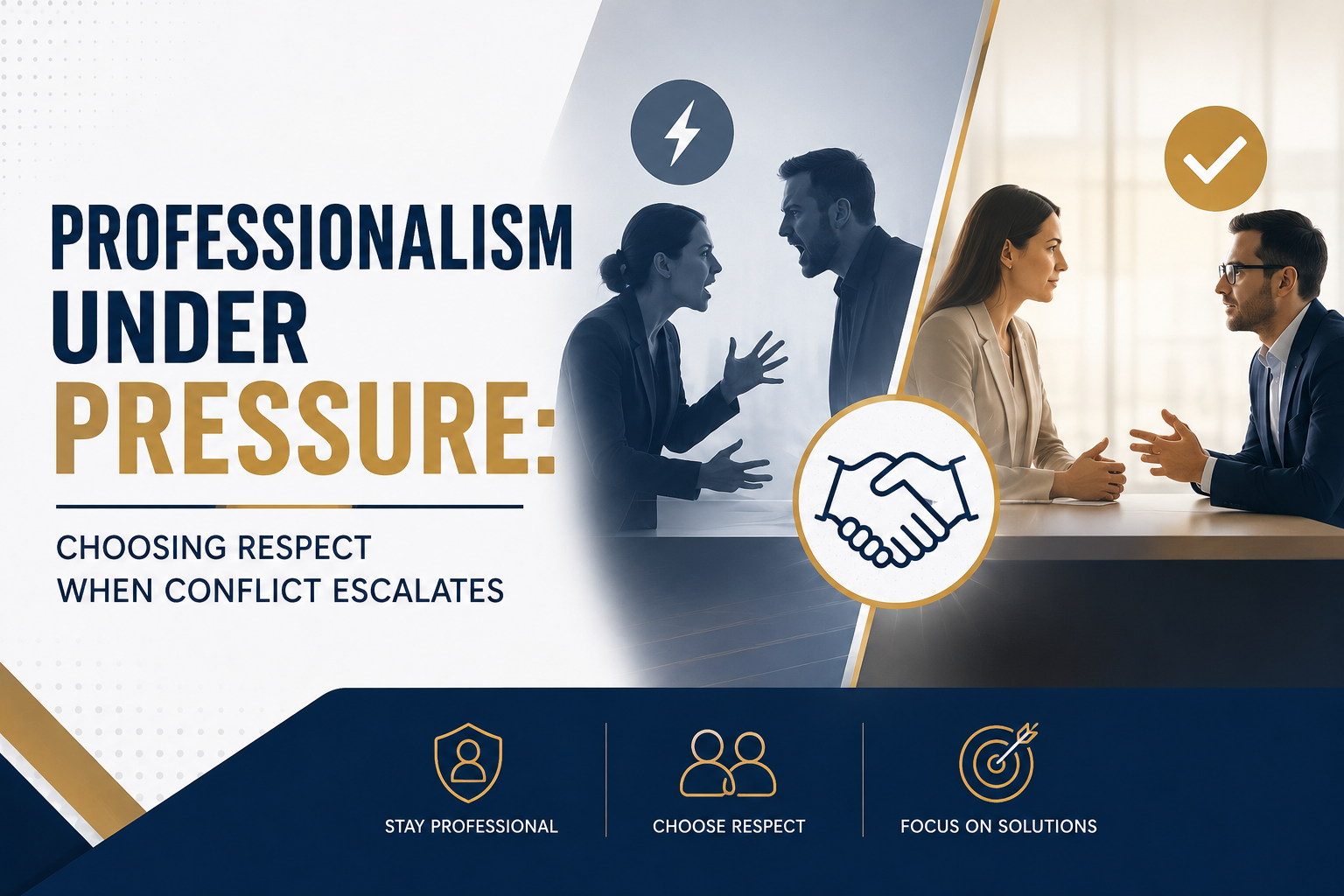 The message arrived at 11:47 p.m. It wasn't long. Just a few lines. But every sentence carried anger. A disagreement over a contract had been going on for weeks. There were questions about payment, responsibilities, and what each side believed had been promised. The conversation had already become uncomfortable. Now, the latest message crossed a different line. There were accusations. Personal insults. A veiled threat about “making sure people know” what had happened. And then came a remark about the other person's background. For a moment, the easiest response seemed obvious: Fight back. After all, they started it. But this is where professionalism is really tested not when everyone is calm and reasonable, but when someone gives us every reason to lose our composure. Conflict is part of professional life. Employment decisions can disappoint people. Contracts can fall apart. Candidates can feel unfairly treated. Managers can become frustrated. Clients and suppliers can disagree about commitments. Sometimes we are genuinely wronged. And sometimes we may be the ones who got something wrong. Either way, disagreement does not give us permission to abandon respect. The PMI Code of Ethics and Professional Conduct places Respect among its four core values. That sounds simple until we find ourselves staring at a message that feels deliberately insulting, threatening, or unfair. Respect is easy when it is reciprocated. It becomes meaningful when it isn't. The person receiving that late-night message eventually did something surprisingly difficult. They didn't respond. Not immediately. They saved the communication, stepped away from the computer, reviewed the facts, and went to bed. The next morning, they wrote back. The response acknowledged the disagreement. It clarified the contractual position. It proposed using the appropriate process to resolve the matter. There were no insults. No threats. No attempt to embarrass the other person. It wasn't weakness. It was professional self-control. Respect doesn't mean tolerating abuse. It doesn't mean remaining silent when discriminatory language is used. It doesn't mean accepting intimidation or allowing retaliation to go unchallenged. And it certainly doesn't mean avoiding difficult conversations. Sometimes respect means setting a boundary. Sometimes it means documenting what happened and involving Human Resources, legal counsel, procurement, recruitment leadership, or another appropriate authority. Sometimes it means saying: “I am willing to discuss the issue, but I will not continue the conversation in this manner.” That is respect too. Because respect isn't only about how we treat people when we agree with them. It is also about recognizing their dignity when we don't. And perhaps that's the uncomfortable part of professional ethics. We cannot control the tone of the message that arrives at 11:47 p.m. We cannot control whether someone tries to intimidate us, insults us, uses discriminatory language, or threatens retaliation. But we can control whether we respond in kind. We can choose to protect our boundaries without attacking someone else's dignity. We can choose accountability without humiliation. We can choose firmness without hostility. We can choose Respect. Not because the other person necessarily deserves our kindness in that moment, but because our professional values should not depend on someone else's behavior. The next time a difficult message lands in your inbox, ask yourself: When someone crosses the line with us, can we hold the line without crossing it ourselves? |
Do You Like to Pick and Choose Your Projects?
Do You Like to Pick and Choose Your Projects?What the PMI Code of Ethics Says May Surprise YouAs a Project Manager, you know the feeling. A new project lands in your lap which is either a cutting-edge AI technology implementation, a shiny digital transformation or something that will look brilliant on your CV and that you know you can deliver. You're energised. You're in. Then there's the other kind. The project that is deep in the red, the one nobody else wanted, the rescue mission with a sponsor who is already frustrated, a team that is burnt out, and a timeline that was never realistic to begin with. Suddenly your diary looks very full. We have all been there and tempted to lean toward the good ones and push back on the hard ones. It's human nature. But before you do, let's talk about what the PMI Code of Ethics and Professional Conduct actually says because most practitioners have never taken notice to that relevant section. 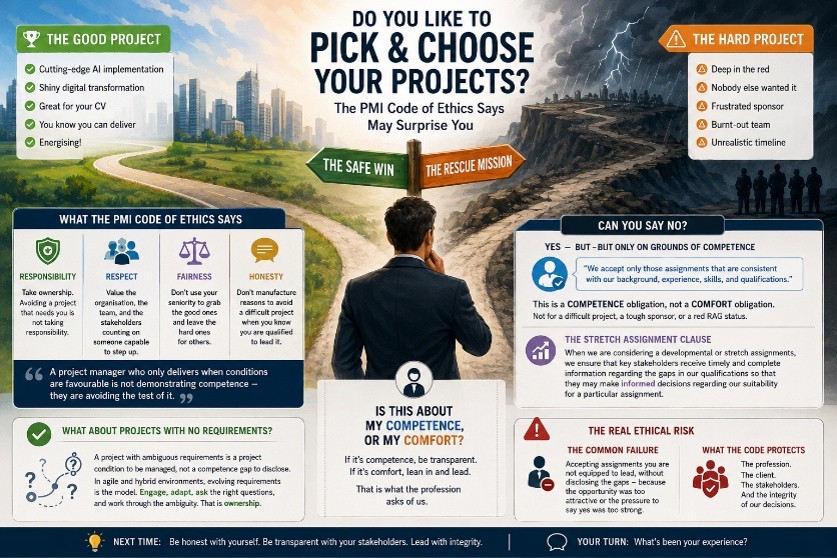 So if you had to choose between the good project and the hard one, which one should you take? The answer that the Code points to is the one that we are qualified for which may be the hard one. And here's why. The Code of Ethics does not give you the right to cherry-pick assignments based on what looks good for your career or what feels manageable for your stress levels. Think about what the four pillars actually demand in this situation. Responsibility means taking ownership including the decision to avoid a project that genuinely needs you. Respect means valuing the organisation, the team stuck on that struggling project, and the stakeholders counting on someone capable to step up. Fairness means not using your seniority or positioning to grab the good ones and leave the hard ones for others. Honesty means not manufacturing reasons to avoid a difficult project when you know full well you are qualified and competent to lead it. The uncomfortable truth that the Code asks us to sit with is this: “a project manager who only delivers when conditions are favourable is not demonstrating competence they are avoiding the test of it”. But there is a provision that lets you say no but it's not what you think. Now here is where it gets interesting, because the Code does provide a legitimate basis to decline an assignment. It sits in the Responsibility chapter of the updated 2025 PMI Code of Ethics and Professional Conduct (version 8, effective November 2025), in Section 2.2.3 it reads: "We accept only those assignments that are consistent with our background, experience, skills, and qualifications." Most practitioners who know this line assume it covers situations like the ones above the difficult project, the unwanted rescue, the high-pressure delivery. It doesn't. This is a competence obligation, not a comfort obligation. The Code is protecting the profession and the client from a Project Manager who takes on work they are genuinely not equipped to lead. Taking on a highly specialised regulatory compliance program, a complex sovereign cloud migration, or a safety-critical infrastructure project when that domain expertise is genuinely beyond their capability without telling anyone is an ethical problem the Code is addressing. Not a project with a difficult sponsor or a red RAG status. Also the clause most practitioners have never read that makes this provision even richer is the commentary that follows it, which the vast majority of PMPs have never encountered: "When we are considering a developmental or stretch assignments, we ensure that key stakeholders receive timely and complete information regarding the gaps in our qualifications so that they may make informed decisions regarding our suitability for a particular assignment." This is the stretch assignment clause. The Code explicitly contemplates that you will sometimes be asked to lead work at the edge of your capability and the ethical response is not automatic refusal. It is transparency. Be upfront about where the gaps are, what support you will need, and let your stakeholders make an informed call. That is Honesty and Responsibility working exactly as the Code intends. What about the project with no requirements? This is where even experienced practitioners get caught out, and it comes up regularly during the PMP training exam simulators for good reason. If you are assigned a project with poorly defined or missing requirements, is that grounds to refuse the project? The answer is No. A project with ambiguous requirements is a project condition to be managed, not a competence gap to disclose. So next time you feel the pull toward the safe win, or the resistance to the rescue project, ask yourself one honest question: Is this about my competence, or my comfort? If it is competence speak up, be transparent, and let your stakeholders decide with the full picture. If it is comfort take a breath, lean in, and lead. That is what the profession asks of us. Have you ever said no to a project that you were fully qualified to lead and if so, was it really about competence, or were you protecting yourself? Have you ever watched a colleague grab the good projects and leave the hard ones for others and said nothing? Now that you are aware of what the PMI Code of Ethics actually says does it change how you see those moments? Please share your thoughts below. More information please refer to the PMI Code of Ethics and Professional Conduct https://www.pmi.org/-/media/pmi/documents/public/pdf/ethics/pmi-code-of-ethics.pdf?rev=e7713058411741c78fe3c4f77040895c |
Navigating AI in Project Management: A Comparison with Racing Co-Pilots and Driverless Cars
Categories:
Ethics as a competence,
Values,
values,
Ethical Leadership,
Decision-making,
Ethics Insight Team,
Ethics Bistro,
trust,
Ways of Working,
Decision-making,
Values,
AI,
Do the right thing,
Ethical Dilemma,
respect,
Professional Conduct,
Honesty,
Respect,
Responsibility,
Trust,
honesty,
responsibility,
professonal conduct,
empathy,
professional conduct,
Ethics in Communication,
Leadership,
Decision Making,
Ethics
Categories: Ethics as a competence, Values, values, Ethical Leadership, Decision-making, Ethics Insight Team, Ethics Bistro, trust, Ways of Working, Decision-making, Values, AI, Do the right thing, Ethical Dilemma, respect, Professional Conduct, Honesty, Respect, Responsibility, Trust, honesty, responsibility, professonal conduct, empathy, professional conduct, Ethics in Communication, Leadership, Decision Making, Ethics
 Artificial Intelligence (AI) is revolutionizing industries, and project management is no exception. With advanced tools supporting decision-making, risk mitigation, and efficiency, the project management landscape is increasingly intertwined with AI technologies. However, this evolution raises questions about human responsibility, autonomy, and ethics—questions like those faced in the realms of racing co-pilots and driverless cars. This blog explores the pros and cons of using AI in project management and compares these dynamics with racing environments and autonomous vehicle scenarios, focusing on the balance between human involvement and ethical considerations.  The Role of AI in Project Management AI-driven tools, such as virtual assistants and machine learning algorithms, are increasingly used to streamline project management processes. From schedule optimization and predictive analytics to stakeholder communication and resource allocation, AI empowers project managers to make well-informed and efficient decisions. The Racing Co-Pilot Analogy: Shared Responsibility, Enhanced Performance In professional racing environments, a co-pilot performs critical tasks: navigating the course, analysing conditions, and advising the driver. This relationship mirrors the human-machine collaboration often seen in project management. Here, AI acts as a "co-pilot," assisting project managers while leaving primary control in human hands. Let us examine this analogy: Pros of AI as a Co-Pilot in Project Management:
The Driverless Car Comparison: Autonomous AI in Project Management Shifting perspective, consider driverless cars: vehicles fully controlled by AI, requiring minimal human intervention. Some envision project management systems that resemble a driverless car—autonomous AI overseeing the project's execution from start to finish. While promising, this model has risks and challenges to consider. Pros of Autonomous AI in Project Management:
Ethical Considerations: Responsibility and Integrity Both racing co-pilots and driverless cars illustrate contrasting extremes in human-machine collaboration. A key differentiator in these scenarios is ethical responsibility:
Conclusion: The Road Ahead for AI in Project Management The racing co-pilot and driverless car analogies shed light on the pivotal balance required in leveraging AI for project management. While AI offers immense benefits—such as efficiency, precision, and scalability—it also raises concerns about accountability, ethical responsibility, and judgment. As the PMI Code of Ethics underscores values like fairness, honesty, and responsibility, project managers must ensure AI tools serve as partners rather than replacements, fostering trust and inclusivity. By choosing the right path—whether enhanced collaboration or selective autonomy—project managers can steer their projects responsibly toward success while maintaining the ethical values essential to effective leadership. Related discussion topic: Can project management run on AI autopilot?https://tinyurl.com/mr497je7 |


