
Viewing Posts by Yannick Arekion
Do You Like to Pick and Choose Your Projects?


Do You Like to Pick and Choose Your Projects?What the PMI Code of Ethics Says May Surprise YouAs a Project Manager, you know the feeling. A new project lands in your lap which is either a cutting-edge AI technology implementation, a shiny digital transformation or something that will look brilliant on your CV and that you know you can deliver. You're energised. You're in. Then there's the other kind. The project that is deep in the red, the one nobody else wanted, the rescue mission with a sponsor who is already frustrated, a team that is burnt out, and a timeline that was never realistic to begin with. Suddenly your diary looks very full. We have all been there and tempted to lean toward the good ones and push back on the hard ones. It's human nature. But before you do, let's talk about what the PMI Code of Ethics and Professional Conduct actually says because most practitioners have never taken notice to that relevant section. 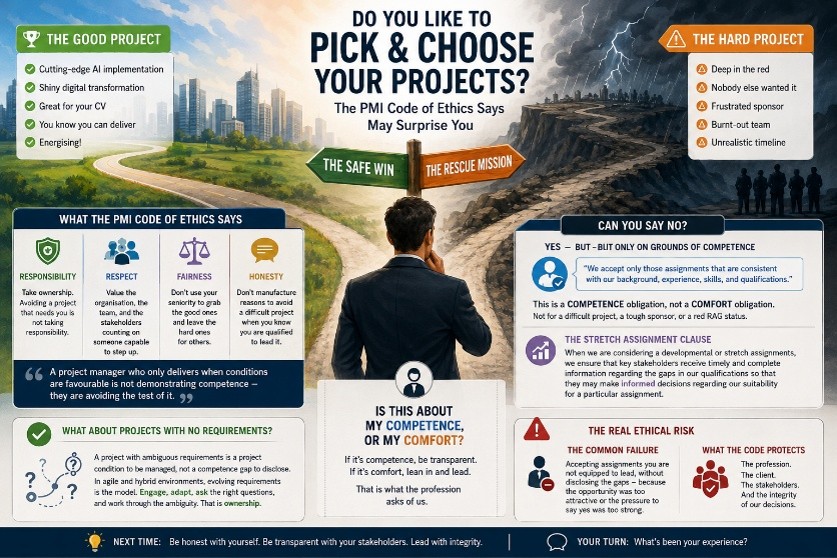 So if you had to choose between the good project and the hard one, which one should you take? The answer that the Code points to is the one that we are qualified for which may be the hard one. And here's why. The Code of Ethics does not give you the right to cherry-pick assignments based on what looks good for your career or what feels manageable for your stress levels. Think about what the four pillars actually demand in this situation. Responsibility means taking ownership including the decision to avoid a project that genuinely needs you. Respect means valuing the organisation, the team stuck on that struggling project, and the stakeholders counting on someone capable to step up. Fairness means not using your seniority or positioning to grab the good ones and leave the hard ones for others. Honesty means not manufacturing reasons to avoid a difficult project when you know full well you are qualified and competent to lead it. The uncomfortable truth that the Code asks us to sit with is this: “a project manager who only delivers when conditions are favourable is not demonstrating competence they are avoiding the test of it”. But there is a provision that lets you say no but it's not what you think. Now here is where it gets interesting, because the Code does provide a legitimate basis to decline an assignment. It sits in the Responsibility chapter of the updated 2025 PMI Code of Ethics and Professional Conduct (version 8, effective November 2025), in Section 2.2.3 it reads: "We accept only those assignments that are consistent with our background, experience, skills, and qualifications." Most practitioners who know this line assume it covers situations like the ones above the difficult project, the unwanted rescue, the high-pressure delivery. It doesn't. This is a competence obligation, not a comfort obligation. The Code is protecting the profession and the client from a Project Manager who takes on work they are genuinely not equipped to lead. Taking on a highly specialised regulatory compliance program, a complex sovereign cloud migration, or a safety-critical infrastructure project when that domain expertise is genuinely beyond their capability without telling anyone is an ethical problem the Code is addressing. Not a project with a difficult sponsor or a red RAG status. Also the clause most practitioners have never read that makes this provision even richer is the commentary that follows it, which the vast majority of PMPs have never encountered: "When we are considering a developmental or stretch assignments, we ensure that key stakeholders receive timely and complete information regarding the gaps in our qualifications so that they may make informed decisions regarding our suitability for a particular assignment." This is the stretch assignment clause. The Code explicitly contemplates that you will sometimes be asked to lead work at the edge of your capability and the ethical response is not automatic refusal. It is transparency. Be upfront about where the gaps are, what support you will need, and let your stakeholders make an informed call. That is Honesty and Responsibility working exactly as the Code intends. What about the project with no requirements? This is where even experienced practitioners get caught out, and it comes up regularly during the PMP training exam simulators for good reason. If you are assigned a project with poorly defined or missing requirements, is that grounds to refuse the project? The answer is No. A project with ambiguous requirements is a project condition to be managed, not a competence gap to disclose. So next time you feel the pull toward the safe win, or the resistance to the rescue project, ask yourself one honest question: Is this about my competence, or my comfort? If it is competence speak up, be transparent, and let your stakeholders decide with the full picture. If it is comfort take a breath, lean in, and lead. That is what the profession asks of us. Have you ever said no to a project that you were fully qualified to lead and if so, was it really about competence, or were you protecting yourself? Have you ever watched a colleague grab the good projects and leave the hard ones for others and said nothing? Now that you are aware of what the PMI Code of Ethics actually says does it change how you see those moments? Please share your thoughts below. More information please refer to the PMI Code of Ethics and Professional Conduct https://www.pmi.org/-/media/pmi/documents/public/pdf/ethics/pmi-code-of-ethics.pdf?rev=e7713058411741c78fe3c4f77040895c |
Conflict Resolution: Leading with Ethics to Prevent Fractures from Becoming Irreparable and Transform Them into Growth
| This past week, I caught up with several former colleagues and friends from different organisations. A recurring theme emerged in our conversations: many of them are grappling with significant challenges, with much of their time and energy consumed in trying to resolve conflicts within their teams. In several cases, these conflicts are escalating and beginning to get out of hand. By the end of the week, these discussions prompted me to pause and reflect, analysing not only what I had heard, but also how it connects with lessons I’ve learned through teaching, leadership, and practice.
Why Do We End Up in Conflict? Across these reflections, one root cause stood out: misaligned expectations. When expectations are not met, trust begins to erode. But why are expectations so often out of alignment? Each person brings their own interpretation of what success will look like working in this team driven mostly by their own sense of purpose. Over time, when those expectations are not met for a variety of reasons. Without the right guardrails in place, signs of disengagement or frustration go unnoticed until conflict surfaces. How individuals react is strongly influenced by their values and coping mechanisms. For organisations, this can result in good employees quietly leaving disruptive arguments within teams, or prolonged disputes that drain productivity and morale. Drawing from My Teaching Experience When teaching the PMI Agile Certified Practitioner (PMI-ACP®) course under Domain IV: Team Performance, one of the models I referenced often was Speed B. Leas’ Model of Conflict. It outlines five escalating levels of conflict from manageable problem solving to entrenched, intractable disputes. The lesson is simple but powerful: leaders must recognise and address conflict early. In agile environments, where transparency and collaboration are vital, even small misunderstandings can snowball into major disputes if left unchecked. Another useful framework is the Thomas-Kilmann Conflict Mode Instrument (TKI), which identifies five approaches: competing, collaborating, compromising, avoiding, and accommodating. Effective leaders learn to adapt their approach to context, while prioritising collaboration for long term trust and cohesion. Together, these frameworks reinforce a core truth: effective conflict resolution requires awareness, adaptability, and timing. Preventing Conflict Before It Escalates The best approach to conflict is prevention. From my reflections, several practices stand out as essential:
When these practices are embedded in the way we work, conflict shifts from being destructive to becoming a constructive part of problem solving. The Role of PMI Ethics Conflict also brings us back to values and ethics. How we respond under pressure whether we lash out, withdraw, resign quietly, or seek constructive dialogue is guided by both personal values and professional standards. The PMI Code of Ethics and Professional Conduct provide a compass for leaders and teams alike:
Applied consistently, these principles not only help to prevent conflict but also shape how teams respond when disagreements inevitably arise. When Conflict Becomes Beyond Repair Despite best efforts, some conflicts move beyond repair. This typically happens when:
At this stage, leadership often shifts from resolution to containment, restructuring, or separation, to protect the wider team and organisation. These conversations reinforced my belief that conflict is not a sign of failure it is an inevitable part of human interaction. When addressed constructively, it can become a powerful driver of learning, innovation, and stronger collaboration. The true test of leadership lies in how early we recognise conflict, how openly we create space for resolution, and how firmly we anchor our actions in ethical principles. By leading with responsibility, respect, fairness, and honesty, we can transform conflict into an opportunity for trust and growth ultimately strengthening the very foundations of collaboration and leadership. |

The Quiet Power of “Thank You” in Project Leadership
Categories:
Ethics
Categories: Ethics
| In this fast-paced world of project delivery, where deadlines, deliverables, and decisions often dominate the agenda, there is one leadership act that costs nothing, takes seconds, and yet carries immense value: saying thank you.
I have realized the quiet but transformative power of gratitude not just in life, but especially in leadership. Too often, we assume our appreciation is understood, that our team members know they are doing a good job, or that, after all, “it’s their job.” But assumptions, no matter how well-intentioned, can create a void of recognition, and over time, that void affects morale, trust, and motivation. There have been moments when a simple “thank you” directed at me shifted my perspective, softened my approach, or reminded me of the value I was bringing often in times when I needed it most. It did not change the task, but it changed how I felt about doing it. And that made a lot of difference. As leaders, we should not underestimate this. “Feeling gratitude and not expressing it is like wrapping a present and not giving it.” — William Arthur Ward Gratitude and the PMI Code of Ethics The PMI Code of Ethics and Professional Conduct encourages us to embody values like Respect, Fairness, Responsibility, and Honesty. Saying thank you directly reflects: Respect – acknowledging the dignity and contributions of every team member. Responsibility – creating a culture of recognition, not just accountability. Fairness – ensuring people feel seen and valued, not just managed. Expressing gratitude is not just a social nicety it is a leadership competency. It aligns with emotional intelligence, stakeholder engagement, and the human side of delivery that PMI now recognises as central to modern project management. Research backs this too. A Harvard Business School study showed that employees who feel appreciated are more productive, engaged, and loyal. The simple act of appreciation contributes to psychological safety a key enabler of high-performing teams. “The deepest principle in human nature is the craving to be appreciated.” William James, philosopher, and psychologist So, what can we do?
Gratitude builds connection, and connection builds trust. And where there is trust, there is progress. “People work for money but go the extra mile for recognition, praise, and rewards.” — Dale Carnegie So, here’s to remembering that while processes and plans keep projects on track, people move them forward. And sometimes, the most powerful tool in a project manager’s toolkit is simply saying: “Thank you.” It is a small act that reflects the very heart of the PMI Code of Ethics showing respect, fostering trust, and recognising the value every individual brings to the project. |

Why Every AI Project Now Needs an AI Management Plan?
| Sunday, 23rd of March 2025 – A recent segment on 60 Minutes Australia highlighted growing concerns around the ethical use of artificial intelligence (AI) in digital platforms. In the episode titled “Defiant: Former Executive Takes on Facebook” (Watch here), a former Facebook (Meta) executive raised questions about how AI systems influence content delivery and the potential consequences for individuals and society.
As AI becomes increasingly embedded in business solutions, it’s vital that organizations consider its ethical implications during project planning and delivery. To address this, the inclusion of an AI Management Plan in project management plan and governance should be adopted as best practice to ensure ethical alignment, regulatory compliance, and responsible innovation. AI systems are driven by algorithms and data both of which can reflect the limitations and biases of their sources. When ethical considerations are not built into the design and deployment of AI, the technology can inadvertently reinforce inequalities or deliver unintended outcomes. This risk is amplified in high-impact areas such as recruitment, finance, law enforcement, and content moderation. In recent years, several public examples have highlighted the complexities involved. For instance, facial recognition systems have led to wrongful arrests, particularly in the United States. One notable case involved Robert Williams ( https://www.abc.net.au/news/science/2023-11-01/ai-facial-recognition-robert-williams-crime-prison/103032148), who was wrongfully arrested in Detroit due to a false facial recognition match. In the hiring domain, Amazon discontinued an AI recruiting tool after it was found to show bias against female applicants (Reuters Article). These examples underline the importance of proactively managing AI-related risks within the project lifecycle. The broader public discussion around AI use highlighted by media programs and individual testimonies shows that innovation must be balanced with responsibility. AI has the potential to deliver significant benefits, but only when developed and deployed with care and Ethics at the forefront. This can be achieved by embedding an AI Management Plan into project delivery, then organizations can demonstrate a commitment to ethical practice and risk mitigation. This proactive approach not only ensures compliance but also enhances transparency and trust in the solutions being delivered. In an era where AI is rapidly evolving, taking a structured, ethical approach isn’t just good practice it’s becoming essential. Building trust in AI starts with responsible project delivery, and that starts with planning for ethics from day one. Question? What are your thoughts on including an AI Management Plan as part of project delivery? What key sections or considerations do you believe should be included to ensure ethical and responsible AI implementation? Follow our AI and Ethics articles below |

Fostering Agile Excellence: The Vital Role of Respect in Project Management
| PMI currently upholds a Code of Ethics and Professional Conduct grounded in four core values expected from every project professional and aspiring project professional. Over recent years, there has been a notable transition from the waterfall approach to Agile in project delivery. This article is the first of series of articles that will explore how embracing PMI values can enhance project managers “Power Skills”, ultimately boosting the certainty of project delivery in an agile environment. As a reference the PMI Code of Ethics and Professional Conduct values are Respect, Responsibility, Fairness and Honesty. In this article we will focus on the value of Respect. “Respect is our duty to show a high regard for ourselves, others, and the resources entrusted to us. Resources entrusted to us may include people, money, reputation, the safety of others, and natural or environmental resources. An environment of respect engenders trust, confidence, and performance excellence by fostering cooperation—an environment where diverse perspectives and views are encouraged and valued.” https://www.pmi.org/-/media/pmi/documents/public/pdf/ethics/code-values-card.pdf?rev=44578e34774241568ce0034489794fe4&sc_lang_temp=en PMI defines Power Skills as Human Skills such as “Communication, leadership, collaboration, empathy… these are some of the power skills that help to build strong teams and successful businesses” https://www.pmi.org/learning/publications/pm-network/digital-exclusives/power-skills-are-human-skills . Delving deeper into acquiring and mastering these skills reveals the importance of embracing the value of Respect. How does Respect relate to Agile? Let's examine the Agile Manifesto's values and principles. Values
Principles
What we observe is that only half of the values and principles are listed, and this half pertains to interactions and relationships among humans, including team members and stakeholders. Respect serves as the foundational ingredient necessary for effectively adhering to these principles and values. Without mutual respect, meaningful interactions and collaborations cannot occur. If individuals do not treat each other with respect, interactions and relationships will suffer. This lack of respect will weaken the relationship between the business and developers, hindering their ability to work and collaborate effectively. In Agile, constant information sharing is crucial for successful delivery. Respect ensures the effectiveness of ceremonies such as daily sprints and retrospectives. For instance, if respect is absent during retrospectives, the team's ability to reflect and improve on practices diminishes, leading to poor outcomes. We've all observed daily sprint meetings exceeding the prescribed 15 minutes due to team members discussing unrelated matters. Respecting team members' work-life balance is an example of fostering sustainable development pace. Respecting everyone's time during daily sprint meetings and adhering to prescribed guidelines fosters an environment conducive to sustainable development. Failure to do so disrupts team dynamics and impedes progress.
These examples underscore the importance of Respect as a core value for Project Professionals. It is a fundamental ingredient in acquiring and mastering Power Skills, particularly relevant in Agile environments where effective collaboration is paramount. I invite further discussion on this topic within the forum and encourage you to stay tuned for my next article.
|



