
Professionalism Under Pressure: Choosing Respect When Conflict Escalates
Categories:
Ethics as a competence,
Behavior,
courage honesty responsibility respect fairness,
code of ethics,
Ethical Leadership,
Decision-making,
Ethics Insight Team,
Ethics Bistro,
Business Ethics,
code of conduct,
Power Skills,
Decision-making,
Business Ethics,
Professionalization,
practitioner,
Ethical Dilemma,
respect,
Professional Responsibility,
Honesty,
Respect,
Responsibility,
Fairness,
Code of Ethics and Professional Conduct,
Human,
fairness,
communication,
honesty,
responsibility,
professonal conduct,
Conflict,
empathy,
EDMF,
Ethics in Communication,
Agile,
Decision Making,
Ethics,
Legal Project Management
Categories: Ethics as a competence, Behavior, courage honesty responsibility respect fairness, code of ethics, Ethical Leadership, Decision-making, Ethics Insight Team, Ethics Bistro, Business Ethics, code of conduct, Power Skills, Decision-making, Business Ethics, Professionalization, practitioner, Ethical Dilemma, respect, Professional Responsibility, Honesty, Respect, Responsibility, Fairness, Code of Ethics and Professional Conduct, Human, fairness, communication, honesty, responsibility, professonal conduct, Conflict, empathy, EDMF, Ethics in Communication, Agile, Decision Making, Ethics, Legal Project Management


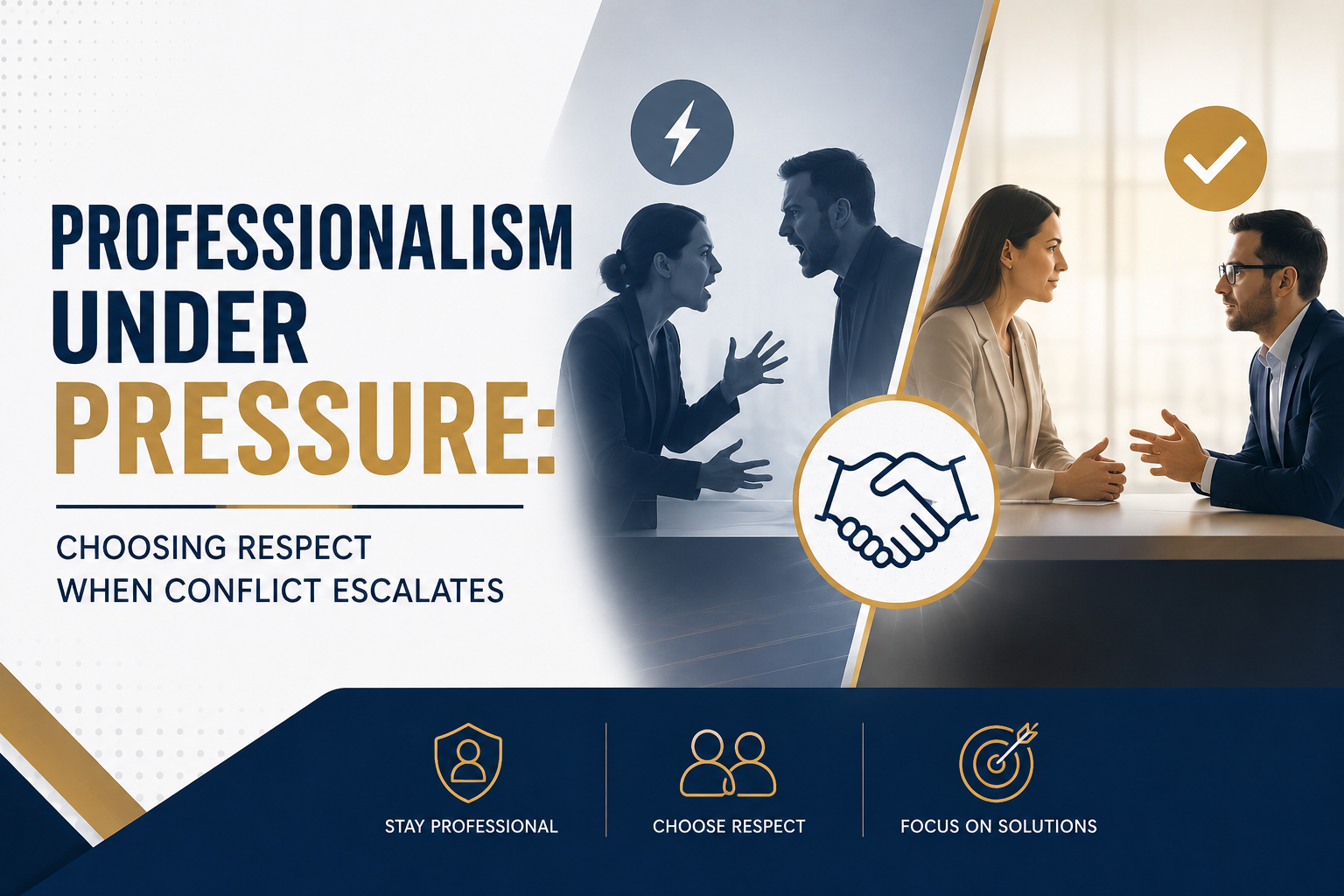 The message arrived at 11:47 p.m. It wasn't long. Just a few lines. But every sentence carried anger. A disagreement over a contract had been going on for weeks. There were questions about payment, responsibilities, and what each side believed had been promised. The conversation had already become uncomfortable. Now, the latest message crossed a different line. There were accusations. Personal insults. A veiled threat about “making sure people know” what had happened. And then came a remark about the other person's background. For a moment, the easiest response seemed obvious: Fight back. After all, they started it. But this is where professionalism is really tested not when everyone is calm and reasonable, but when someone gives us every reason to lose our composure. Conflict is part of professional life. Employment decisions can disappoint people. Contracts can fall apart. Candidates can feel unfairly treated. Managers can become frustrated. Clients and suppliers can disagree about commitments. Sometimes we are genuinely wronged. And sometimes we may be the ones who got something wrong. Either way, disagreement does not give us permission to abandon respect. The PMI Code of Ethics and Professional Conduct places Respect among its four core values. That sounds simple until we find ourselves staring at a message that feels deliberately insulting, threatening, or unfair. Respect is easy when it is reciprocated. It becomes meaningful when it isn't. The person receiving that late-night message eventually did something surprisingly difficult. They didn't respond. Not immediately. They saved the communication, stepped away from the computer, reviewed the facts, and went to bed. The next morning, they wrote back. The response acknowledged the disagreement. It clarified the contractual position. It proposed using the appropriate process to resolve the matter. There were no insults. No threats. No attempt to embarrass the other person. It wasn't weakness. It was professional self-control. Respect doesn't mean tolerating abuse. It doesn't mean remaining silent when discriminatory language is used. It doesn't mean accepting intimidation or allowing retaliation to go unchallenged. And it certainly doesn't mean avoiding difficult conversations. Sometimes respect means setting a boundary. Sometimes it means documenting what happened and involving Human Resources, legal counsel, procurement, recruitment leadership, or another appropriate authority. Sometimes it means saying: “I am willing to discuss the issue, but I will not continue the conversation in this manner.” That is respect too. Because respect isn't only about how we treat people when we agree with them. It is also about recognizing their dignity when we don't. And perhaps that's the uncomfortable part of professional ethics. We cannot control the tone of the message that arrives at 11:47 p.m. We cannot control whether someone tries to intimidate us, insults us, uses discriminatory language, or threatens retaliation. But we can control whether we respond in kind. We can choose to protect our boundaries without attacking someone else's dignity. We can choose accountability without humiliation. We can choose firmness without hostility. We can choose Respect. Not because the other person necessarily deserves our kindness in that moment, but because our professional values should not depend on someone else's behavior. The next time a difficult message lands in your inbox, ask yourself: When someone crosses the line with us, can we hold the line without crossing it ourselves? |
Ethics and Governance in Project Management: Small Sins Allowed and the Line of Impunity (Eduardo Victor Lopez and Alicia Medina) (Book Review: Reviewer - Lily Murariu, Canada, 2017)
| Ethics and Governance in Project Management: Small Sins Allowed and the Line of Impunity (Eduardo Victor Lopez and Alicia Medina) ” Ethics must be cardinal to the overall management of any project, instead of merely a peripheral subject”. In an era of tremendous growth of project management as an occupation, professional project managers, ready, well-equipped, and capable to deliver successful projects become more and more in demand and a highly-valued commodity. For the past few decades there were intense and continue need of continue development of this class of blue collars, for cultivating technical skills along with soft skills, and strong ethics knowledge. This journey supports one’s trip within the complex realm of ethical aspects, with consideration of ramifications that ethics creates for project success. Eduardo Victor Lopez and Alicia Medina brings their valuable work on ethics to the forefront and attention of project management. The book is an eulogy to the ethics culture in an organization, and to the relationship between ethics, ethical behaviours and governance. In the ““Ethics and Governance in Project Management” Small Sins Allowed and the Line of Impunity”, the authors engage the reader in a journey on new perspectives on ethics, using a breadth of resources, in a well-documented, and well-researched material. Lopez and Medina introduce the facets and complexities of ethics by building a parallel exercise with the Rubik Cube. Since its apparition, back in 1974, the Rubik Cube, identified as an eponymous cube, impacted art, design, science, engineering, math; it challenges humankind to explore the intricacies of this unique structure, the different perspectives and views it creates, while seeking innovative way for solving it. This context presents similarities to the project environment and the need for solving ethics problems. “We are of different opinion at different hours, but we always may be said to be at heart on the side of truth.” This parallel perspective invites the reader to consider out-of-the box, fresh perspectives for ethic situation, and the authors discuss the mindset needed for evaluation of business ethics and its influence, exploring three main key concepts: ethics, context, and governance. How important is ethics and governance in project management? “When an ethical component is included in the vision of a project … it can move stakeholders at large to support this visions for reasons beyond those arising only from a financial nexus. The ability to fulfil the project’s social purpose influences its success”. The research conducted by the authors fill the noticed gap, the connection and the dependency between strategy and ethics, as “Most of the publications related to strategic planning throughout 1980s, and early 1990, omitted any mention of ethical and moral trues…” strategy and ethics are considered separate and unrelated matters”. The novelty of the book is the unique ethical model and the two new ethical behaviours, interdependent to governance and its quality, and the context: Small Sins Allowed defined as “the mechanism that allow individuals to cheat on our own values “just by a bit”, concept defined as the updated socially accepted ethical standards, in the context of double standards, legality, and project culture, and, The Line of Impunity that impact at the individual level, creating a “detachment between business and ethics as many believe themselves as above the moral law”. The book’s style, content and format supports scholars and practitioners in nourishing their appetite for ethics knowledge, understanding of origins, linkages, and implications with other research areas. Readers will find the book immediately useful as the examples used are grounded in the reality, with immediate applicability to their day-to-day line of business. The case studies presented and the quizzes create smooth linkages between the topic and their relatedness to the reality. These tools give the book the taste of a well-defined ethics guide that can support equally a practitioner, a novice or a senior project manager. An excellent lecture, the book calls project managers to become aware of Small Sins Allowed and The Line of Impunity, build their own Rubik Cube, identify ethical attributes of their cube, and support the creation of an ethical culture embedded in the governance “that rewards ethical behaviour”. |


