

Purpose & Impact: Turning Purpose into Choices That Matter


 A project can meet its targets and leave others carrying costs its success measures never captured. Purpose becomes consequential when it shapes what we choose, whose interests we consider and which consequences we are prepared to accept. A statement of purpose can provide direction. Its credibility depends on how it influences decisions, particularly when resources are limited or an attractive opportunity conflicts with the organization’s stated values. In regenerative leadership, the immediate result matters alongside its consequences and the capability that remains. An intervention may improve performance while exhausting a team, creating a critical dependency or transferring difficulties to suppliers and communities. Three questions offer a practical entry point into Positive Impact by Design: Why are we doing this? Who benefits, and how? What do we leave behind? They help connect purpose with the examination of alternatives, consequences and future responsibilities. They do not guarantee positive impact. The effects of implementation need to be assessed, and that evidence must inform subsequent action. Why are we doing this? Purpose helps clarify the contribution an initiative is intended to make and why that contribution matters. It should influence the criteria used to compare alternatives, allocate resources and judge whether an opportunity deserves pursuit. This includes identifying what the organization is unwilling to compromise. A profitable proposal may still conflict with that purpose. Equally, invoking purpose does not establish that a proposal is viable or that its benefits justify its costs. The practical test is whether purpose informs the reasoning and the commitment. What receives priority? What safeguards are funded? What is retained, declined or redesigned? When circumstances change, the interpretation of purpose may need examination. Any revision should be explicit, justified and made by those with the appropriate authority, preserving applicable ethical commitments and safeguards. Who benefits, and how? The people who receive the benefits may differ from those who bear the effort, risk or loss. An efficiency gain can improve customer service while increasing pressure on a support team. A purchasing decision can reduce the buyer’s costs while imposing delivery requirements or financial exposure that a supplier cannot sustainably absorb. Examining impact requires asking who is affected, how their situation may change and whose perspective is missing from the initial assessment. Consultation helps reveal these consequences. It does not eliminate incompatible interests or create enough resources to satisfy every expectation. Where a choice imposes a disadvantage, the decision should make that consequence visible, explain the criteria used and identify proportionate measures to avoid, reduce or address the harm. Some consequences may justify rejecting the proposal. A shared purpose does not make every trade-off acceptable. What do we leave behind? A completed delivery, its use and its longer-term effects are different things. New equipment may be operational while the organization lacks the expertise or maintenance budget to sustain it. A process may work because one experienced person repeatedly intervenes. Those obligations and dependencies belong in the assessment of what the intervention leaves behind. Dependence on a specialist or partner can be appropriate. Its implications need to be understood, supported and reviewed. The same examination can reveal capabilities developed: knowledge others can use, people prepared to exercise judgment, more dependable relationships or processes that remain adaptable as conditions change. Can people understand the solution, support it and revise it? Who carries the ongoing responsibilities, and do they have the means to fulfil them? A legacy includes obligations as well as benefits. A practical example Consider a hypothetical manufacturer assessing investment in an automated production line. The initial comparison emphasizes throughput, operating costs and the expected payback period. One option offers the shortest payback but leaves unresolved whether existing staff can safely operate and maintain the equipment. Why? The organization clarifies that the investment is intended to improve product quality and production reliability as well as financial performance. Safe operation is a condition of approval, not a benefit that can be traded away for a faster return. Who benefits? Customers may receive more consistent products. Operators face changing responsibilities and possible displacement. Maintenance staff may inherit unfamiliar equipment, while suppliers may need to meet different requirements. Their input helps identify consequences missing from the initial comparison. What remains? The organization examines training, future roles, maintenance capacity and supplier dependence. It also asks how new employees will develop practical knowledge if automation removes tasks that previously provided that experience. The alternatives can then be redesigned or compared on a fuller basis. Phased implementation, different equipment specifications or additional investment in skills and support may be appropriate. If safe operation cannot be established, the option should not proceed in its current form. A longer payback may be justified by the capabilities and safeguards provided. That conclusion still requires explicit appraisal of costs, benefits, uncertainty and available alternatives. After implementation, verification should examine product quality, financial performance, workload, employment effects and the capability to operate and maintain the line. Unexpected consequences require attention even when the headline investment targets are met. Purpose shapes the assessment and the commitment. Evidence determines what can be concluded about the impact. Examine impact over time Different effects emerge at different speeds. A cost reduction may be visible before a loss of expertise or a maintenance dependency becomes apparent. Useful questions include:
Purpose becomes regenerative in practice when it guides responsible choices, its consequences are examined and addressed, and the intervention helps preserve, develop or restore the capacity to create value in the future. Which decision would change if your organization examined who benefits, who bears the consequences and what remains after delivery? |
Posted on: November 04, 2026 04:28 AM
| Permalink |
Comments (0)
Regenerative Trust: Building the Conditions for Responsible Action
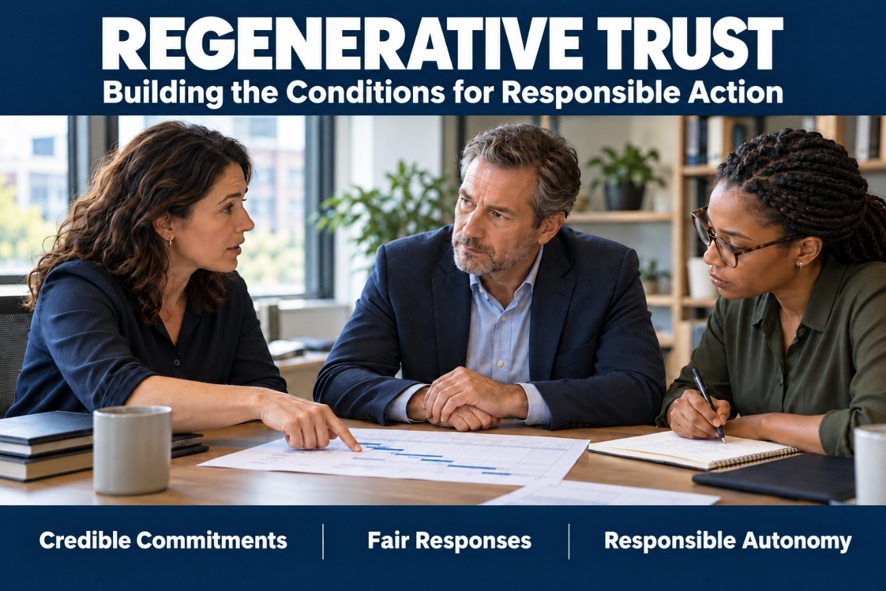 A leader says, “Tell me early if something is going wrong.” Someone does. What happens next gives the team evidence about whether that invitation can be trusted. The response may make the difficulty easier to address. It may also encourage people to wait until they have a complete answer, soften uncomfortable information or keep concerns to themselves. Trust is shaped by these experiences. People notice whether commitments are honoured, decisions are explained, support is available and concerns receive a fair response. In regenerative leadership, both the work accomplished and the capability that remains matter. Trust can support responsible action today while helping people develop the judgment and relationships needed for future work. Make commitments credible Trust involves a willingness to rely on others when their actions matter and cannot be fully controlled. It needs grounds: relevant competence, honest communication and commitments that hold up in practice. A promise of autonomy loses credibility when every unfamiliar choice triggers intervention. An invitation to collaborate becomes difficult to sustain when agreed resources repeatedly disappear without discussion. Credible commitments require clarity about responsibilities, decision authority, available support and limitations. People need to know what they can rely on and what remains uncertain. When circumstances change, timely renegotiation can preserve trust. That requires explaining what can no longer be delivered, recognizing the consequences and agreeing on a workable response. Leaving others to rely on a commitment that can no longer be met makes coordination harder. Respond fairly to difficulty Trust and psychological safety are related but distinct. Trust concerns willingness to rely on another party under uncertainty. Psychological safety concerns the perceived interpersonal consequences of speaking up, asking for help or admitting uncertainty. Neither removes the need for scrutiny or accountability. When something goes wrong, the response should examine what happened, what was known, which responsibilities were assigned and what conditions shaped the action. An unsuccessful experiment, an unclear instruction and a failure to follow an agreed safeguard require different investigations and potentially different responses. Fairness does not mean treating every situation alike. It means considering the evidence, hearing those involved and explaining the response. People also need to understand what happened to a concern they raised. Acknowledging it without follow-through can weaken the credibility of the next invitation to speak. Silence alone does not demonstrate trust. It may reflect confidence, but it may also reflect resignation or fear. Respect the judgment people are authorized to exercise One test of trust arises when someone makes a decision within their authority that differs from the leader’s preference. The leader still needs to examine material risks and fulfil their own responsibilities. A different approach is not, by itself, evidence that autonomy should be withdrawn. Where intervention is necessary, its purpose and scope should be clear. Resolving a resource constraint or helping someone examine an assumption need not transfer responsibility back to the leader. If risk requires a temporary change in authority, that change should be explained and reviewed. These responses help people understand whether the autonomy offered is dependable, including when the work becomes difficult. The aim is justified confidence in what people can do, together with recognition of when support is needed. A practical example Consider a hypothetical project team preparing a deliverable for a client. Before the scheduled review, a team member discovers that the specialist needed to validate the work has been reassigned to another priority. Without that validation, the team cannot responsibly confirm the agreed delivery date. The manager examines the evidence with the team and clarifies what it can resolve. Alternatives might include changing the sequence of work, securing another qualified specialist or negotiating the delivery commitment. The resource conflict is referred to the person authorized to decide. The original deadline may still prove unattainable. Raising the concern has not created additional capacity. For trust, the response matters: whether the decision is explained, the consequences are addressed and the support agreed is actually provided. The review should also examine when the reassignment became known and how future resource changes should be communicated. That gives the team evidence about the credibility of speaking early. If the revised arrangements make dependencies easier to recognize and give others a workable way to respond, the experience may also strengthen capability for subsequent assignments. Those effects need to be examined rather than assumed. Examine what trust makes possible More positive survey responses or fewer escalations do not, by themselves, establish stronger trust. Their meaning depends on what is happening in practice. Useful questions include:
Trust becomes regenerative when credible relationships support responsible action today and help develop the judgment, cooperation and capability needed for future work. When someone brings you difficult information, what does your response teach them about whether to do it again? |
Posted on: November 01, 2026 04:15 AM
| Permalink |
Comments (1)
Collaborative Culture: Turning Shared Understanding into Coordinated Action
 Everyone leaves the meeting convinced they have reached agreement. Days later, their actions reveal different interpretations of the same decision. The meeting is over. Coordinated action still needs to be built. Collaboration develops when people share knowledge, examine differences and fulfil commitments. These interactions shape expectations about whether it is worth raising a concern, whether it is safe to ask for help and whether agreements can be trusted. They become part of the culture when they are sustained over time and remain credible under pressure, through disagreement and changes in team membership. Reflection enables adjustment: repeating meetings does not guarantee better understanding or execution. In regenerative leadership, both the work accomplished and the capability that remains matter. Work can be completed successfully while leaving people exhausted or dependent on a few individuals to coordinate across teams. Collaborative Culture brings together three practices: welcoming perspectives, co-creating meaning and committing with clarity. They can be revisited whenever experience reveals a gap in understanding or coordination. Welcome Perspectives People see different parts of the work. Those preparing a deliverable may understand its technical constraints. Those receiving it may recognize operational consequences that escape the originating team. Welcoming perspectives means including the people relevant to understanding the situation and its effects, listening before attributing intentions, and distinguishing facts, interpretations, needs and proposals. Participation requires credible conditions. An invitation to speak loses value when uncomfortable information is ignored or penalized. Written contributions before a meeting and time for reflection can broaden participation. Contributions need to be taken seriously, and people need to understand how their input was followed up. Listening respectfully includes examining what is presented. Two people can speak sincerely while supporting contradictory interpretations. Understanding the evidence and assumptions behind them helps identify what needs confirmation. Co-create Meaning Words such as ready, urgent, quality and autonomy can conceal different expectations. Co-creating meaning involves clarifying the situation, connecting contributions and making criteria explicit. The interaction may reveal a dependency or produce an alternative that none of the participants initially proposed. Shared understanding does not require identical preferences. Two teams may understand each other and still need the same indivisible resource. Collaboration can clarify consequences, reveal alternatives and support negotiation. When disagreement persists, a decision by someone with the appropriate authority may be necessary. The understanding developed also needs to be tested against reality. A widely accepted interpretation can be wrong. Commit with Clarity Understanding translates into coordinated action through commitments that people have the means and support to fulfil. This requires clarity about the expected outcome, responsibilities, authority, resources, dependencies and deadlines. People also need to know how to raise difficulties and who can respond. Reaching agreement in a meeting does not resolve conflicting priorities or create additional time. Those making a commitment must be able to explain the constraints affecting their ability to fulfil it. The decision is communicated to those involved as a group, with clear reasoning, a connection to purpose and an explanation of its consequences, while respecting legitimate confidentiality requirements. That common understanding helps coordinate execution. Someone can retain a different preference and commit professionally to implementation. That commitment includes continuing to communicate new risks or information that may justify a review. An Example from Practice: Connecting Engineering Design and Installation In a situation I experienced, the engineering design team prepared the drawings and specifications that the installation team used on site. During execution, requests for clarification and changes arose, sometimes involving rework. The first team proposed more detailed documents. The second asked for faster responses. By examining specific situations together, they connected design assumptions with knowledge about access, tools, assembly sequences and installation conditions. Some of that knowledge was only being considered once work was already underway on site. The conversation helped clarify what it meant for a design to be ready for installation. A different proposal emerged: conduct a joint review of installation readiness before approving and issuing selected documents, while it was still possible to adjust the design and avoid late changes. Making a proposal of this kind workable requires agreement on who participates, what information they prepare, how much time they allocate and who can decide on the issues identified. Its evaluation should consider the difficulties identified in advance, subsequent rework and the coordination effort required. The experience illustrates how bringing relevant knowledge together early enough can reveal an alternative to the responses initially proposed. The implementation and effects of that alternative need to be monitored to determine what to retain, adjust or discontinue. Examine What Collaboration Leaves Behind More meetings, messages or participants do not, by themselves, demonstrate a stronger collaborative culture. Three dimensions deserve examination:
What does your team only discover during execution that a higher-quality conversation could have revealed earlier? |
Posted on: October 29, 2026 04:52 AM
| Permalink |
Comments (0)
Regenerative Learning: Turning Experience into Organizational Capability
 An organization can complete a project, document its lessons and encounter the same difficulty again. Experience contributes to organizational capability when learning becomes usable beyond the people who acquired it, supported by the conditions needed to act. Work creates opportunities to learn. It exposes assumptions, reveals dependencies and tests decisions against reality. Those opportunities do not automatically produce learning. A successful outcome may conceal a fragile process. A disappointing result may follow a reasonable decision. Understanding the experience requires examining what happened, under what conditions and with what consequences. Regenerative learning connects that examination to future work. It seeks to improve performance while preserving, developing or restoring the capability needed for subsequent challenges. This includes examining whether new ways of working strengthen people’s ability to respond and whether they can be sustained without creating excessive burdens or unrecognized dependencies elsewhere. Experience needs interpretation A lesson such as “involve operations earlier” may sound useful. Yet it leaves important questions unanswered. Earlier than what? Who needs to participate? What information should they examine? Which decision could their contribution change? A useful account explains the difficulty, the assumptions behind the original approach and the evidence supporting the conclusion. It preserves relevant context, identifies uncertainty and clarifies the conditions under which the lesson may apply. That gives others a basis for judging its relevance and adapting it to their circumstances. Documentation needs a path into practice Recording a lesson preserves an account of the experience. Making it usable requires people to find it, understand it and have an opportunity to apply it. That may involve conversation, practical demonstration, supervised practice or changes to how work is prepared. The appropriate means depends on the knowledge involved. A document can preserve a decision’s rationale; developing the skills to apply it may require practice and feedback. People also need authority, time and resources to act. A team may understand a problem and remain unable to change the conditions producing it. AI can help retrieve relevant records, identify connections and prepare comparisons. Its summaries require scrutiny: omitted context or overstated conclusions can turn a useful lesson into misleading guidance. People need sufficient understanding to question those summaries and assess their relevance. Two teams, a similar difficulty Consider a hypothetical engineering organization. During installation, Team A discovers that the equipment layout leaves insufficient access for maintenance. Correcting the layout requires design changes and delays completion. The team reviews the experience with operations and maintenance colleagues. Together, they examine why the access requirement was missed and record the affected interfaces, the assumptions made and the reasons for the changes. Months later, Team B begins a similar assignment. The report provides a starting point. A discussion with Team A makes the reasoning clearer, including what the first team would now examine before approving a layout. Team B identifies a different equipment arrangement, consults the relevant specialists and adapts the review questions. Its lead assigns responsibility and time for checking access before design approval. Subsequent checks examine whether the review exposed relevant constraints in time, whether corrections were implemented and what effort was required. The organization incorporates the useful questions into design preparation and assigns responsibility for keeping them current. Later applications may confirm their relevance, reveal limitations or identify additional dependencies. The revised process gives subsequent teams a starting point. Its value must be examined through their use of it and the effects that follow. Evaluate the capability that remains Meeting attendance, repository entries and lessons recorded describe parts of the learning process. They do not establish what people can now do. Evaluation needs to examine both the capability developed and the conditions for exercising it:
Evidence of learning therefore includes how people reason and act, the results they achieve and the support required. It also includes whether subsequent experience leads them to revise what they previously accepted. Regenerative learning connects experience to future work through knowledge people can question and use, capabilities they can exercise and conditions the organization sustains and renews. Which lesson has changed how another team works, and what evidence shows whether that change strengthened its capability? |
Posted on: October 25, 2026 06:18 AM
| Permalink |
Comments (0)
Delegation with Purpose: Building Autonomy and Developing Capability
 Delegating means assigning responsibility for a task or outcome, together with the authority to make decisions within agreed boundaries. Effective delegation requires the resources and support needed to fulfil that responsibility. When it also develops judgment and autonomy, it becomes an investment in the organization’s future. A leader may delegate a task while continuing to decide every detail. They may demand a result without providing resources. They may announce autonomy and intervene whenever someone chooses a different approach. In these situations, the work changes hands, but the ability to act remains limited. Delegation with Purpose connects the expected outcome with the development of the person taking responsibility. It seeks to create value today while leaving people better prepared for future challenges. Decide Before Delegating Delegation begins by understanding what should be assigned, why, and to whom. The RCPCV method structures this decision through five stages: Gather, Consult, Think, Communicate, and Verify. The acronym retains the initials of the original Portuguese terms. Consultation involves the person being considered for the responsibility and the other people affected. It helps identify availability, experience, dependencies, and support needs while keeping responsibility for the decision clear. Choosing someone requires considering competence, availability, and the support needed, alongside opportunities for development. Set Clear Conditions for Delegation Before the delegation decision is communicated, four aspects need to be clear:
The leader remains accountable for the conditions they are responsible for providing. The person taking on the work is accountable for exercising the responsibility and authority assigned to them. Assigning responsibility without authority or resources can leave someone accountable for an outcome they lack the means to deliver. Follow Through to Develop Autonomy Well-founded trust helps leaders give people space. Follow-through helps identify difficulties, support decisions, and learn from execution. The level of oversight should reflect the person’s experience, the complexity of the work, and the potential consequences. A new challenge may require demonstration, guidance, or more frequent reviews. Autonomy can grow as capability is demonstrated. Leaders need to respect decisions made within the agreed boundaries. A solution different from their own preference is not, by itself, a reason to withdraw autonomy. When difficulties arise, it is important to understand what happened before concluding that commitment or competence was lacking. Additional support, revised resources, or a temporary reduction in autonomy may be necessary, with clear explanations and continued review. A Practical Example Consider a hypothetical situation: a director intends to delegate the preparation of a client proposal to a less experienced manager. She consults him about availability, readiness, and support needs, while also hearing from the other people affected. After careful consideration, she clarifies the expected outcome, quality criteria, deadline, and resources. The manager can organize the work and coordinate internal contributions; final commercial approval remains with the authorized role. Before they proceed, she asks him to explain his understanding of the responsibility, what he can decide, and when he should seek support. They agree on a review before any external commitments are made. At the review, the proposal is incomplete. The director feels tempted to finish it herself but first seeks to understand the difficulty. The manager has identified a mismatch between the requested deadline and available capacity but has not yet worked out the alternatives. She helps him examine the assumptions and consequences. He develops the options, explains the reasoning behind his recommendation, and completes the proposal. Her support addresses the specific difficulty while preserving his responsibility and decision-making authority. Even if the client rejects the proposal, execution, judgment, and continuing support needs can still be assessed. Completing one proposal does not, by itself, demonstrate autonomy. That capability needs to be assessed as he takes on further responsibilities. Assess What Remains Delegation should be assessed through its outcome, execution, and the capability developed. Can the person take on similar responsibilities with less support? Do they recognize when they need help? Was the effort sustainable? In regenerative leadership, both the work accomplished and the capability that remains matter. Delegating with purpose means getting work done while developing other people’s ability to understand, decide, and act responsibly. In your next delegation, what outcome do you want to achieve, and what capability do you want to help develop? Reference: Stephen R. Covey, The 7 Habits of Highly Effective People, discussion of stewardship delegation and the Green and Clean example. |
Posted on: October 22, 2026 06:34 AM
| Permalink |
Comments (0)


