
When Integrative Capacity Falls Behind Interdependence


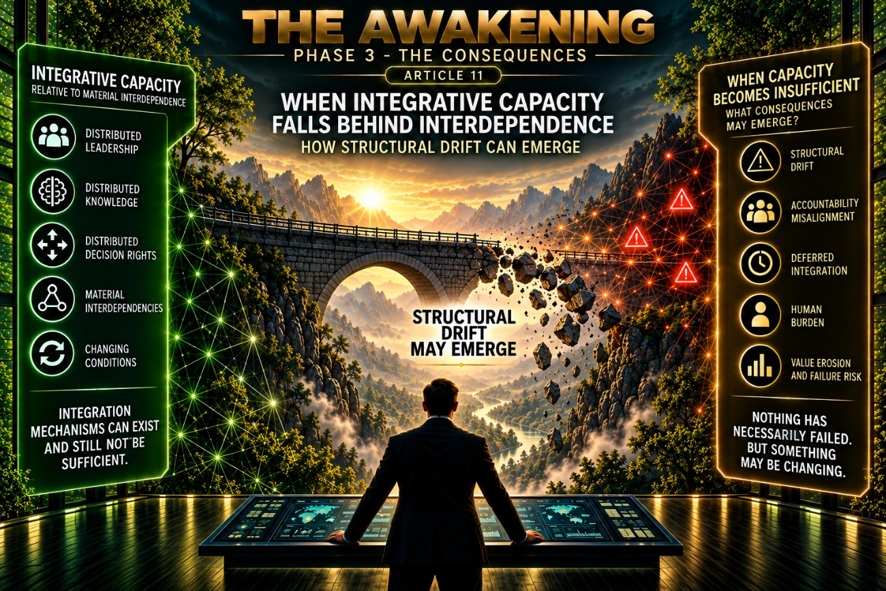 How Structural Drift Can Emerge A project can have integration and still not have enough. That possibility is easy to miss. The meetings still happen. Governance structures remain in place. Project Managers, product owners, functional leaders, specialists and teams continue to perform their roles. Dashboards continue to report. Information continues to move. Decisions continue to be made. Escalation paths still exist. Nothing necessarily looks structurally broken. And yet the project system may be becoming less capable of recognizing and reconciling the material interdependencies it must recognize and reconcile. A dependency is discovered later than it could have been. A technically sound decision changes an operational condition elsewhere. A trade-off is understood by several people, but not brought together soon enough for its combined significance to be recognized. An escalation occurs correctly, but after the most valuable alternatives have disappeared. A local decision remains legitimate within one boundary while creating consequences beyond it. Individually, none of these observations proves that the project lacks integration. That may be precisely the point. The more difficult problem may begin after integration mechanisms already exist. The question for this article is therefore not: Does the project have integration? It is: Can the project system recognize and reconcile its material interdependencies with sufficient quality, reliability and timeliness for the conditions it actually faces? And what happens when the answer begins to become no? Integration Is Not a Binary Condition Project organizations rarely choose between complete integration and complete fragmentation. Most operate somewhere between those extremes. They use plans, meetings, governance forums, cross-functional teams, digital platforms, reporting systems, escalation mechanisms, standards, routines, interfaces and informal relationships to connect work that has been distributed. Some rely more heavily on identifiable integrating roles. Others distribute integrative work across teams and functions. Many combine both. The existence of these mechanisms matters. But it does not establish that the system possesses sufficient effective integrative capacity. A meeting can exist without the relevant knowledge being present. Information can be available without its significance being recognized. A dependency can be visible without anyone connecting it to a decision being made elsewhere. A trade-off can be identified without sufficient authority to reconcile it. An escalation path can function exactly as designed and still operate too slowly for the decision window involved. A governance forum can receive an issue after earlier choices have already constrained the available alternatives. So the first distinction is fundamental: Formal presence of integrative mechanisms ≠ sufficient effective integrative capacity. This is not an argument against formal mechanisms. It is an argument against treating their existence as evidence that the integrative requirement has been satisfied. Capacity Relative to What? Calling integrative capacity “sufficient” immediately creates another question. Sufficient relative to what? Not every project presents the same integrative challenge. A small project with stable interfaces, limited uncertainty and a handful of tightly connected actors may integrate effectively through relatively simple mechanisms. A different project may distribute knowledge across multiple specialist domains, authority across organizational levels, delivery across suppliers, decisions across teams, and execution across technological and geographical boundaries. The second project does not necessarily require centralization. Nor does it necessarily require more meetings, more governance or more management. But it may create a different integrative demand. That term needs care. Here, integrative demand is analytical shorthand for the material interdependencies requiring recognition or reconciliation under the conditions the project system faces. It is not being proposed as a separate construct. Nor should it become a synonym for complexity. Not every additional stakeholder, dependency or decision automatically creates additional integrative demand. The relevant issue is narrower: What material interdependencies must the project system recognize and reconcile for consequential decisions and actions to remain sufficiently coherent? Three dimensions may matter. Volume How many material interdependencies require recognition or reconciliation? More actors do not necessarily mean more material interdependencies. But as consequential relationships multiply, the number of connections requiring attention may increase. Complexity How difficult are those interdependencies to understand and reconcile? A dependency may cross technical, commercial, regulatory, operational or stakeholder boundaries. Several individually understandable relationships may also interact in ways that make their combined consequences difficult to anticipate. Velocity How quickly do relevant interdependencies emerge, change, or require response? Here, velocity should not be treated as a settled variable. It may involve the rate at which consequential relationships change, the speed at which decisions are being made, or the time available before intervention becomes less effective. The distinction matters because a system capable of reconciling an issue in two weeks may be entirely adequate in one environment and functionally too slow in another. This suggests a working proposition: Integrative capacity should not be assessed only by whether a project configuration can recognize and reconcile material interdependencies, but by whether it can do so with sufficient quality, reliability and timeliness, at a proportionate coordination cost, relative to the volume, velocity and complexity of those interdependencies. The proposition is intentionally demanding. It also needs to survive challenge. More Integration Is Not Necessarily More Capacity One tempting response to rising integrative demand is simply to add integration. More meetings. More reporting. More reviews. More coordination roles. More escalation. More governance. But integrative mechanisms themselves consume attention, time and cognitive capacity. Coordination is not free. A project system could improve its ability to recognize interdependencies while simultaneously imposing such a coordination burden that decision speed, local responsiveness or productive work deteriorates. That means effective integrative capacity cannot be measured by the amount of coordination activity. Nor can the solution automatically be more integration. The relevant question is whether the configuration provides the required integration at a proportionate coordination cost. This also prevents an unwarranted conclusion: distributed systems create more interdependence, therefore centralized systems integrate better. Not necessarily. Centralization has its own information-processing limits. Distributed configurations may place knowledge closer to the point of action, allow specialists to interpret weak signals earlier, and enable local adaptation without waiting for central intervention. The issue is therefore not centralization versus distribution. It is whether the chosen configuration can meet the integrative demand it actually faces. The Middle Condition This brings us to the condition that matters most for this article. Imagine three simplified states. In the first, important interdependencies are not integrated because the necessary mechanisms are absent. That problem is relatively visible. In the second, integrative mechanisms exist and remain sufficiently capable for the demands placed on them. There may still be mistakes, delays and uncertainty, but the architecture is broadly able to recognize and reconcile material relationships when they matter. The third condition is harder to see. The mechanisms still exist. They may even be working as designed. But the relationship between integrative demand and effective integrative capacity has changed. Interfaces may have multiplied. Decision cycles may have accelerated. Authority and knowledge may have become more distributed. External conditions may be changing more rapidly. No single mechanism has necessarily failed. But the architecture that once integrated the project adequately may no longer do so with the same quality, reliability or timeliness. This is the condition Phase 3 needs to investigate. Not: Integration exists / integration does not exist. But: Integration exists / effective integrative capacity may no longer be sufficient. That condition is not, by itself, structural drift. It is the condition under which structural drift might emerge. From Insufficient Capacity to Structural Drift This distinction matters. If effective integrative capacity becomes insufficient relative to material interdependence, that establishes a potential condition. It does not yet establish the phenomenon that follows from it. The potential mechanism lies in what that insufficiency changes. Consequential relationships may begin to be recognized later. Trade-offs may be reconciled only after some options have disappeared. Connections may be recognized inconsistently across interfaces. Local decisions may remain individually defensible while their combined effects become progressively harder to anticipate or reconcile. Teams may increasingly compensate through informal conversations, personal networks, extra checking or manual coordination. Formal mechanisms may continue operating while more integrative work has to occur around them. If such patterns persist, the project system may begin to change in ways that are not captured by the continued formal presence of its mechanisms. That potential emergent change is what this article provisionally calls structural drift. The distinction can therefore be stated more precisely: Insufficient effective integrative capacity is the condition. Degraded recognition or reconciliation of material interdependencies provides a possible mechanism. Structural drift is the hypothesized emergent change in the project system as those effects accumulate or persist. But naming that change does not establish that a distinct phenomenon exists. The term must earn its place. For the purposes of this investigation, the hypothesis is therefore: Structural drift may emerge when persistent insufficiency in effective integrative capacity progressively alters how the project system connects, reconciles or compensates for material interdependencies, even while its formal integrative mechanisms remain in place. The important word is may. Several alternative explanations remain possible. The Alternative Explanations Matter Late recognition of dependencies does not necessarily indicate insufficient integrative capacity. Some dependencies may be inherently unknowable earlier. A technological uncertainty may only become visible through experimentation. A regulatory change may create a new relationship that did not previously exist. A stakeholder may alter a requirement. A supplier may behave unpredictably. A strategic decision may legitimately change the project environment. Similarly, repeated escalation does not necessarily indicate structural drift. It may show that governance is functioning properly. Additional coordination effort does not necessarily indicate architectural weakness. It may be the appropriate response to genuinely complex work. Local decisions producing system-level tensions do not necessarily indicate insufficient integration. Some trade-offs are irreducible. Coherence does not mean eliminating legitimate conflict. And slower decisions are not necessarily worse decisions. Additional time may improve judgment where consequences justify deliberation. These alternatives are not qualifications added to protect the hypothesis. They are part of the test. If structural drift cannot be distinguished from uncertainty, complexity, normal adaptation, poor execution, weak governance or ordinary coordination difficulty, then it adds little explanatory value. What Would Make Structural Drift Distinct? For structural drift to become a useful construct, at least four things would need to be demonstrated. First, there would need to be a recognizable change in fit between the material interdependencies the system must address and its effective integrative capacity. The problem could not simply be that the project was always poorly integrated. Second, there would need to be a plausible mechanism through which that mismatch changes the functioning of the project system. Possible signals might include later recognition of consequential relationships, increasing dependence on compensatory coordination, repeated reconciliation after decision windows have narrowed, or growing divergence between formally valid local decisions and their combined system effects. Third, the resulting pattern would need to be distinguishable from credible alternatives. Fourth, the concept would need to explain something useful that simpler concepts such as poor coordination, complexity, governance failure, information overload or normal adaptation do not already explain adequately. This last test is especially important. There is already substantial thinking about coordination, information processing, interdependence, organizational fit and adaptation. So the purpose is not to rename established phenomena. The question is narrower: Does persistent insufficiency in effective integrative capacity produce a distinguishable change in the project system that is not adequately explained by those existing concepts? If the answer is no, we should use the concepts that already exist. If the answer is yes, structural drift may earn a more specific role. Drift Does Not Mean Failure Even if structural drift exists, another distinction is necessary. Structural drift ≠ project failure. A project may continue delivering while integrative capacity is under pressure. People may compensate. Experienced individuals may bridge interfaces. Informal networks may carry information that formal processes miss. Teams may absorb additional cognitive and coordination work. Managers may intervene manually. Technology may identify patterns that human actors would otherwise miss. Temporary redundancy may create resilience. These mechanisms matter because they can prevent consequences from becoming visible in conventional performance indicators. A project can therefore remain apparently successful while the architecture supporting that performance changes underneath it. But the opposite interpretation is also possible. What looks like compensation may simply be effective adaptation. Informal coordination may not indicate architectural weakness at all. It may be part of the architecture. Additional human effort may be temporary and proportionate. A system that changes its coordination mechanisms as conditions change may be demonstrating resilience rather than drift. So we cannot infer structural drift merely because the formal architecture is no longer doing all the integrative work. The test is harder: Has the system adapted its integrative capacity to changing conditions, or is performance increasingly dependent on compensatory mechanisms because effective capacity has fallen behind? That distinction will matter again when Phase 3 reaches the human burden of integrative work. Technology Can Change Both Capacity and Demand AI and other computational systems add another complication. They may increase integrative capacity by detecting patterns, dependencies, anomalies and relationships across information that distributed human actors may not see. But they may also change integrative demand. Faster recommendations can accelerate decisions. Automated action can narrow intervention windows. Computational systems can introduce new dependencies among data, models, workflows, human oversight and decision authority. Technology therefore cannot simply be placed on one side of the relationship. It may expand capacity. It may expand demand. It may change the nature of both. Article 10 challenged the assumption that computational capability determines legitimate authority or accountability. Article 11 adds a narrower question: Does technological augmentation increase the system's effective ability to integrate material interdependencies faster than it changes the integrative demand the system must meet? The answer cannot be assumed. Quality, Reliability and Timeliness Three dimensions of effective capacity now deserve particular attention. Quality Does integration produce an adequate understanding of the material relationship and its consequences? Recognizing the wrong relationship, connecting incomplete information or reconciling a trade-off on a false assumption is not effective integration simply because integration occurred. Reliability Does the system perform the integrative function consistently enough? A project should not depend entirely on whether one unusually experienced individual happens to notice a relationship at the right moment. Reliability does not require perfect detection. It asks whether the configuration can perform sufficiently dependably under the conditions it faces. Timeliness Does integration occur while meaningful intervention remains possible? This may be the most consequential dimension. A dependency recognized after a decision is irreversible has still been recognized. A trade-off reconciled after contractual commitment has still been reconciled. An escalation made after the viable option set has narrowed may still follow the correct governance path. But in each case, the practical value of integration may have changed. Integration is therefore not only about whether consequential relationships are recognized and reconciled. It is also about when. The Coordination-Cost Constraint There is one final boundary. A project could attempt to make every decision visible to everyone. It could require every interface to be reviewed. Every dependency mapped. Every trade-off escalated. Every decision cross-checked. Every signal retained. That might increase some forms of integrative visibility. It could also make the project almost impossible to operate. So sufficient integrative capacity cannot mean maximal integration. The objective is not to eliminate every possibility of local incoherence. It is to provide enough capacity to recognize and reconcile material interdependencies with adequate quality, reliability and timeliness without imposing disproportionate coordination cost. That word, proportionate, is doing important work. Because a system that preserves coherence only by consuming unsustainable attention may not possess sufficient effective integrative capacity. It may simply be paying increasingly more to compensate for the architecture it has. What Article 11 Can and Cannot Conclude The analysis supports several distinctions more strongly than it supports a new construct. First: The existence of integrative mechanisms does not establish sufficient effective integrative capacity. Second: Integrative capacity is meaningful only relative to the material interdependencies the system must recognize and reconcile. Third: More coordination activity is not equivalent to greater effective integrative capacity. Fourth: Quality, reliability, timeliness and coordination cost matter alongside formal mechanism availability. Fifth: A mismatch between effective integrative capacity and material interdependence is not itself evidence of structural drift. Sixth: Neither insufficient integrative capacity nor structural drift, if it exists, establishes project failure. These propositions are defensible. A stronger claim is not yet. We do not yet have sufficient grounds to conclude that persistent insufficiency in effective integrative capacity produces a distinct phenomenon that should be called structural drift. What we have is a hypothesis worth carrying forward: Structural drift may emerge when persistent insufficiency in effective integrative capacity progressively changes how a project system connects, reconciles or compensates for material interdependencies, even while formal integrative mechanisms remain present. That hypothesis now has a specified antecedent condition. It has potential mechanisms. It has alternatives. It has boundaries. And it has conditions under which it should be rejected. That is enough for the investigation to continue. The More Difficult Question The easiest integration problems are often the visible ones. A missing governance mechanism can be created. An unclear interface can be clarified. An absent decision right can be assigned. A known dependency can be managed. The harder problem may be a project system in which all the expected mechanisms are still present, each appears individually legitimate, and yet their combined capacity is no longer sufficient for the relationships the system must address. Nothing has necessarily failed. But something may be changing. And if that change is real, its consequences may not appear first in schedule, cost or scope. They may appear in the relationship between responsibility and the conditions required to exercise it. That is where the next inquiry begins. Article 12: When Accountability Becomes Structurally Misaligned. |
Posted on: September 25, 2026 04:49 AM
| Permalink |
Comments (0)


