
PHASE 3 - THE CONSEQUENCES


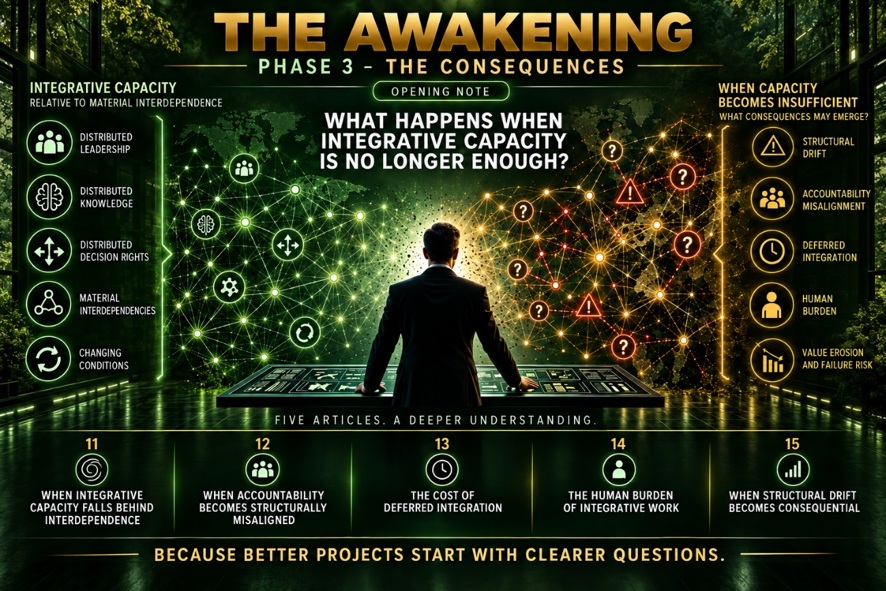 Opening Note What Happens When Integrative Capacity Is No Longer Enough? Phase 2 ended without prescribing a new project architecture. That was deliberate. Across five deconstructions, THE AWAKENING questioned relationships that project organizations can easily treat as if they were inseparable. Integration does not automatically imply one integrator. Accountability does not automatically imply coincident authority and causal capacity. Control does not automatically imply centralization. System contribution does not automatically imply role obsolescence. And historical human performance does not automatically establish human exclusivity. The purpose was not to prove that familiar roles, structures or practices should disappear. It was to separate what had been bundled together so that each relationship could be examined more carefully. That work changes what can legitimately be assumed. But it does not yet tell us what happens when the resulting project configuration encounters integrative demands it may no longer be able to meet. That is where Phase 3 begins. From Assumptions to Consequences A project system can distribute leadership and authority. It can locate knowledge across specialists, teams and organizational boundaries. It can allocate different decision rights to different actors. It can combine human and computational contributions. It can use governance mechanisms to establish boundaries, thresholds, escalation paths and intervention rights. And it can distribute integrative responsibility rather than concentrating it in one role. None of these characteristics necessarily creates a problem. Distribution is not fragmentation, and integration does not require every consequential relationship to be recognized by one person. But one requirement remains. The project system must somehow remain capable of recognizing and reconciling the material interdependencies that arise within and across the way its work, knowledge, authority and decisions are distributed. That requirement was already visible in Phase 1. Phase 2 challenged assumptions about where the functions required to satisfy it must reside. Phase 3 asks a different question: What happens when the system's effective integrative capacity becomes insufficient relative to the material interdependencies it must recognize and reconcile? The question is not whether integration exists. It is whether the integrative capacity of the project configuration remains sufficient for the conditions the system is actually facing. Integration Can Exist and Still Be Insufficient Organizations rarely operate with no integrative mechanisms at all. They have meetings. Governance bodies. Project Managers. Cross-functional teams. Dashboards. Escalation paths. Planning processes. Information systems. Reviews. Committees. Standards. And increasingly, computational systems capable of detecting relationships across large volumes of information. Their presence matters. But presence is not the same as capacity. A system may possess mechanisms intended to integrate work and still struggle to recognize consequential interdependencies early enough. It may recognize them but fail to connect the relevant knowledge. It may connect the knowledge but fail to reconcile competing implications. It may identify a trade-off but escalate it too slowly. It may escalate appropriately but only after meaningful alternatives have disappeared. Or it may achieve integration, but at a coordination cost that becomes increasingly difficult to sustain. This creates a distinction that will govern Phase 3: Formal presence of integrative mechanisms ≠ sufficient effective integrative capacity. A more demanding question is therefore required: Can the project system recognize and reconcile material interdependencies with sufficient quality, reliability and timeliness, at a proportionate coordination cost, relative to the volume, velocity and complexity of the interdependencies it faces? That proposition is not yet a conclusion. It is one of the propositions Phase 3 must test. Capacity Must Be Considered Relative to Demand Integrative capacity has little meaning in isolation. A configuration that works adequately under one set of conditions may become insufficient under another. A small project with limited interdependence may rely successfully on informal conversations among a few experienced people. The same mechanisms may become less reliable as the number of actors increases, decisions accelerate, authority becomes more distributed, specialized knowledge becomes more fragmented, organizational boundaries multiply, or contractual, regulatory and technological dependencies become more complex. AI-enabled systems may also increase the speed at which analysis, recommendation and action occur. What changes may be the relationship between what we might provisionally describe as integrative demand and the effective integrative capacity available to meet it. But that relationship should not be converted prematurely into a universal law. More interdependence does not necessarily produce failure. More complexity does not necessarily overwhelm integration. Distributed configurations may develop highly effective mechanisms for connecting partial knowledge and reconciling consequences. Technology may increase integrative capacity as well as integrative demand. Standardization may reduce the number of relationships requiring active reconciliation. Modularity may contain the propagation of consequences. Clear interfaces may reduce coordination requirements. And experienced actors may recognize patterns that formal mechanisms miss. Phase 3 must therefore examine not simply whether integrative demand increases, but whether, under particular conditions, effective integrative capacity becomes insufficient relative to it. Failure May Not Begin With Failure If integrative capacity becomes insufficient, the first visible consequence may not be project failure. The project may continue. Milestones may still be achieved. Governance meetings may still occur. Dashboards may remain green. Individual decisions may remain locally defensible. And each function may continue to perform competently within its own domain. Yet something may begin to change between those domains. A dependency is recognized later than it could have been. A trade-off is deferred. A decision remains locally rational while transferring consequences elsewhere. An escalation occurs after the range of viable alternatives has narrowed. Someone absorbs additional coordination work to compensate for a weak interface. Formal accountability remains attached to an actor whose practical capacity to influence the relevant outcome has diminished. None of these observations, individually, establishes a distinct phenomenon. Nor do they prove that insufficient integrative capacity caused what occurred. But they identify the territory Phase 3 must investigate. The possibility is that systemic difficulty may become visible through friction, delay, unresolved trade-offs, compensatory human effort, accountability tensions or narrowing option space before appearing as conventional project failure. Whether these effects form coherent causal patterns, under what conditions, and with what alternative explanations remains to be tested. The Causal Problem Phase 3 therefore carries a greater evidentiary burden than simply identifying interesting organizational symptoms. Suppose a project experiences repeated rework. Was integrative capacity insufficient? Perhaps. But requirements may have been unstable. Technical uncertainty may have been unavoidable. A supplier may have failed. Resources may have been inadequate. The strategy may have changed. Or the project may simply have encountered uncertainty that no plausible integrative configuration could have resolved earlier. Suppose accountability appears misaligned. That may result from insufficient conditions for exercising responsibility. But it may also result from poor role design, weak governance, unclear objectives, political behavior or individual failure to exercise authority that was genuinely available. Suppose people experience a high coordination burden. That may indicate architectural insufficiency. Or it may be an appropriate cost of managing genuinely complex work. Suppose value deteriorates. That does not establish that unresolved interdependencies caused the deterioration. Phase 3 therefore cannot proceed through association alone. For every proposed consequence, the inquiry must ask: What is the claimed consequence? Through what mechanism could insufficient integrative capacity produce it? Under what conditions should that mechanism operate? What evidence would distinguish the proposed mechanism from plausible alternatives? And what evidence would cause us to reject or materially revise the claim? Without those questions, insufficient integrative capacity could become an explanation for almost any project difficulty. If it explains everything, it explains very little. Five Lines of Inquiry The five articles in this phase form a sequence of inquiry, not a predetermined chain of causation. Article 11 When Integrative Capacity Falls Behind Interdependence How Structural Drift Can Emerge The first inquiry addresses the capacity problem itself. Can structural drift emerge when integrative mechanisms remain formally present but become insufficient relative to the volume, velocity or complexity of the material interdependencies they must recognize and reconcile? Article 12 When Accountability Becomes Structurally Misaligned When Responsibility Exceeds the Conditions Required to Exercise It The second inquiry turns to accountability. What happens when formal responsibility remains in place while authority, visibility, knowledge, capability, discretion or opportunity to act become insufficient? Article 13 The Cost of Deferred Integration How Unresolved Interdependencies Accumulate Over Time The third inquiry examines accumulation. Can unresolved dependencies, deferred trade-offs and lost intervention windows create persistent systemic burdens? And does the provisional idea of integration debt survive serious scrutiny? Article 14 The Human Burden of Integrative Work When People Compensate for Architectural Gaps The fourth inquiry turns to the people inside the system. What cognitive, relational and coordination burden emerges when people compensate manually for limitations in integrative architecture? Observed performance may conceal substantial compensatory human effort. But that effort may represent resilience, architectural insufficiency, or both. The distinction matters. Article 15 When Structural Drift Becomes Consequential From Accumulated Incoherence to Value Erosion and Failure Risk The final inquiry examines consequence at the level of value and project viability. Under what conditions does accumulated systemic incoherence begin to affect value, risk, strategic viability or project outcomes? These inquiries are connected. But their relationship must not be assumed to be linear. Insufficient integrative capacity does not necessarily produce structural drift. Structural drift does not necessarily produce accountability misalignment. Deferred integration does not necessarily become debt. Human compensatory effort may prevent rather than signal failure. And accumulated incoherence may sometimes remain tolerable, reversible or locally contained. Each relationship must survive separately. Consequences Are Not Yet Constructs Terms such as structural drift and integration debt may prove useful. But naming a possible phenomenon does not establish that it exists as a distinct construct. A useful construct must distinguish something sufficiently coherent from adjacent phenomena, have a defensible mechanism, clarify rather than relabel, and provide explanatory or practical value beyond simpler language. Phase 3 will therefore resist the temptation to convert every recurring observation into a new term. The evidence must earn the construct. The Unit of Analysis Remains the Project System Phase 2 broadened the unit of analysis beyond individual roles. Phase 3 must preserve that discipline. If integration becomes insufficient, the explanation cannot automatically be: The Project Manager failed to integrate. Nor: The team failed to collaborate. Nor: Governance failed. Nor: AI failed to detect the relationship. Any of those may be true in a particular case. But integrative capacity can be distributed across people, roles, governance mechanisms, information systems, routines, interfaces and computational participants. The relevant question is therefore systemic: What configuration of actors and mechanisms was expected to provide the required integrative capacity, what integrative demands did it actually face, and was its effective capacity sufficient to meet them? This does not dissolve individual responsibility. Phase 2 already established why systemic explanation should not become distributed impunity. It means only that causal attribution should follow the actual configuration rather than an inherited assumption about where integration ought to have occurred. What Phase 3 Must Establish Phase 3 begins with a hypothesis, not a verdict. The working possibility is that insufficient integrative capacity may become visible before conventional failure through structural friction, deferred trade-offs, accountability misalignment, compensatory human burden and narrowing option space. But that proposition must survive adversarial examination. Phase 3 must establish: Which consequences can defensibly be associated with insufficient integrative capacity, through what mechanisms, under what conditions, and with what alternative explanations. Some proposed relationships may survive. Others may require narrower boundary conditions, different explanations or abandonment. That would not weaken the investigation. It would be the investigation doing its job. THE CONSEQUENCES Phase 1 revealed a problem. Phase 2 took familiar assumptions apart. Phase 3 now asks what follows when the project system's capacity to integrate is no longer sufficient for the material interdependencies it must manage. Not whether integration exists. Not whether one role owns it. Not whether distributed systems are inherently better or worse. And not whether every project difficulty can be traced back to integration. The question is narrower and more demanding: When integrative capacity becomes insufficient relative to material interdependence, what consequences actually follow, through what mechanisms, and under what conditions? Before designing a new architecture, we need to understand the consequences that architecture would need to prevent, absorb or resolve. That is the work of THE CONSEQUENCES. And it begins with a deceptively simple problem: What happens when the project system still has integration, but no longer has enough? |
Posted on: September 23, 2026 05:16 AM
| Permalink |
Comments (0)


