
RCPCV™: A Method for Decision-Making and Continuous Improvement


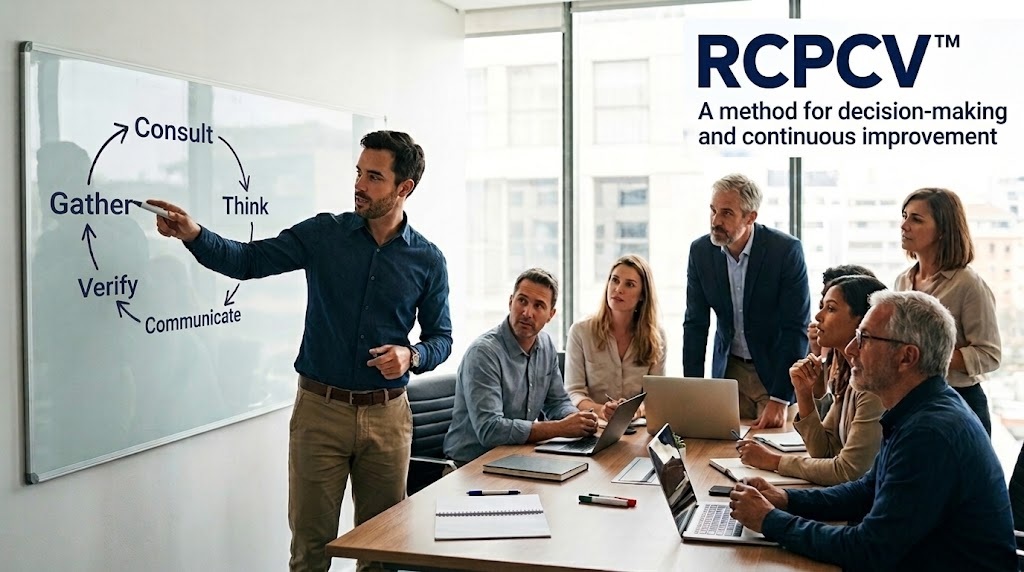 Gather, Consult, Think, Communicate, and Verify. Five stages in a continuous cycle connecting information, people, decisions, implementation, and learning. A decision begins before it is announced and continues to require attention after implementation has begun. Between understanding a situation and evaluating the results of a decision, there is an ongoing process of gathering information, consulting people, thinking carefully, communicating, and following up. In regenerative leadership, this process seeks to achieve results in the present while preserving or developing the capabilities, autonomy, and relationships the organization depends on to respond to future demands. I developed RCPCV™ to structure this work. The name comes from its five stages in Portuguese: Recolher, Consultar, Pensar, Comunicar e Verificar, meaning Gather, Consult, Think, Communicate, and Verify. The method organizes decision-making into five interconnected stages within a continuous improvement cycle. Consulting the people affected is always part of the process. The decision is made after weighing the information gathered and the contributions received. Communication explains and sells that decision. Verification monitors implementation, evaluates results, and informs learning and subsequent decisions. Time runs through the entire method. Latency is used here in an operational sense: the time between a need arising and the corresponding response, whether obtaining information, receiving a contribution, deciding, communicating, starting implementation, or responding to what verification reveals. It is important to examine both the time spent within each stage and the waiting time between stages. Examining latency involves distinguishing the time needed to carry out the work, avoidable waits, and the time needed to observe results. The aim is to carry out each part of the process in time to serve its purpose, with a depth of analysis appropriate to the importance, urgency, and consequences of the decision. 1. Gather the FactsThe first step is to understand the situation requiring a decision. What is happening, and what factors are contributing to the situation? What do we want to achieve? What resources do we have? What commitments have we made? What known constraints, dependencies, and consequences shape the choice? Gathering involves seeking relevant information and distinguishing what we know from what we estimate, interpret, or assume. An assumption may be supported by earlier data or may be a hypothesis that still needs to be verified. A predicted delay, for example, needs to be examined to understand its cause: does it arise from a technical dependency, a lack of capacity, or an estimate that has not yet been confirmed? Each explanation may point to a different decision. This stage prepares the consultation. An initial set of facts helps us ask better questions, identify the people affected, and recognize gaps and issues that still need clarification. Information also has a time dimension: when was it produced, when does it become available, and how long does it remain relevant to the situation? Gathering must take into account the time needed to obtain and validate data, as well as the consequences of information arriving late or already being out of date. Consider a hypothetical example that will run through all five stages: two projects each require the same specialist exclusively for the same week. The leader begins by gathering information about deadlines, activities, dependencies, viable alternatives, and the foreseeable consequences of allocating that resource. 2. Consult the People AffectedConsultation is always part of RCPCV™. People affected by the decision may bring practical knowledge that is not included in the initial reports, identify unforeseen risks and consequences, and explain how the situation is experienced by those who will have to implement the decision or bear its consequences. Consultation also brings clarification. It helps clarify facts, questions, perspectives, interests, and consequences. In the two-project example, consultation involves the specialist and the people affected by how the specialist’s time is allocated. It may reveal that one activity requires uninterrupted attention to maintain context, that another allows preparatory work, or that a change in priority will affect a third team’s commitments. These contributions may justify gathering further information. Gathering and consulting work together: what we hear helps us understand what we still need to investigate. Psychological safety provides an environment in which people can share information, disagree, raise questions, and flag risks. The leader is responsible for ensuring that no relevant person is excluded and that contributions are heard and examined seriously. Listening respectfully also involves understanding the facts, experiences, or assumptions underlying conflicting contributions. Organizing consultation includes establishing when contributions are needed, giving people the conditions they need to prepare them, and avoiding unnecessary waits for meetings or responses. Urgency requires organizing participation in time for it to inform the decision, while maintaining the inclusion of the people affected. Consultation does not dilute the decision-maker’s responsibility or automatically turn the decision into a vote. It helps clarify the situation and provide a sound basis for the choice. Responsibilities for the decision, implementation, and follow-up must remain distinct and clear. 3. Think Carefully and DecideAfter gathering information and consulting people, it is necessary to think carefully. This stage brings together the available information and the contributions received, examines differing perspectives and alternatives, assesses risks, and weighs the losses and gains associated with each option. The organization’s purpose and established limits guide the assessment of what is important to achieve and protect. Which alternative best addresses the situation? What benefits does it offer? What losses does it entail? Do we have the resources needed? What will happen if we postpone the decision? In the example, both teams may have legitimate needs. After listening and weighing the options, the leader may conclude that the specialist should give priority to the project with a dependency affecting a higher-priority organizational commitment. The specialist’s work on the other project is postponed. Consultation and careful consideration help the leader recognize that consequence and plan ways to mitigate it. Understanding both teams’ interests does not make a resource divisible when both need it during the same period. Thinking carefully also involves assessing whether the available information is sufficient to make a decision or whether a gap warrants further investigation. Contributions from the consultation help with this assessment. The decision-maker recognizes that relevant uncertainty may remain. Timing is part of the assessment: by when does the decision need to be made? What are the consequences of waiting? Could additional information change the choice in time to make a difference? Deciding when to act requires weighing the benefit of further analysis against the cost of delay. In close cases, when careful consideration identifies no relevant difference between two acceptable alternatives, the leader may use a random draw as a tie-breaking procedure. In that case, the well-considered decision is to accept either alternative and deliberately use that procedure to move the process forward. This stage ends with a well-considered decision, ready to be communicated and implemented. 4. Communicate the DecisionCommunicating means explaining and selling the decision that has already been made. Selling the decision means demonstrating its value and rationale. It involves making clear what was decided, why, and how the choice aligns with the organization’s purpose. It includes addressing objections, acknowledging the consequences for the people affected, and building acceptance and commitment to implementation. The credibility of this communication rests on the work carried out in the earlier stages. Communication should make clear how the contributions received during consultation were considered and which criteria informed the choice. In the example, the leader explains the priority assigned, the criteria considered, the impact on the second project, and the measures planned to mitigate the delay. The leader clarifies what each person is expected to do, with what resources, and within what timeframes. Consultation, fact-gathering, and careful consideration have already taken place. When communicating, the leader presents a decision that has been worked through to guide action. Instructions are communicated in a group setting to promote a shared understanding among all recipients and clarify each person’s responsibilities and the dependencies between their actions. No one who needs to receive the decision may be excluded. The leader must confirm that everyone understands what they are expected to do. A written record helps maintain clarity and confirm what has been established. A person may understand the decision and commit to implementing it even if their initial preference was different. Communication connects the considered choice with the commitment to put it into practice. It is important to track the interval between making the decision, communicating it, and ensuring that recipients are in a position to act. In the example, the teams and the specialist need to be informed of the priority in time to prepare the work and reorganize the commitments affected. 5. Verify Implementation and ResultsAfter communicating, the leader monitors implementation and its effects. Is the decision being implemented correctly and with commitment? Did implementation begin when it needed to? Are resources available and being used efficiently? Have obstacles or waits emerged that are blocking the work? Has the context changed? Are the results favorable to the organization? Implementation involves its own time requirements: mobilizing resources, starting activities, addressing dependencies, and resolving obstacles. These intervals need to be tracked, including when a difficulty is identified and how much time passes before a response. Verification requires distinguishing three dimensions:
Similarly, a favorable result does not, on its own, prove the quality of the decision or its implementation. It may have benefited from favorable circumstances that should be recognized. In the example, the leader checks whether the priority commitment was met, how much the second project was actually delayed, what additional costs arose, and whether the allocation overloaded the specialist. The leader compares these effects with what was considered when making the decision, including the results of the mitigation measures. The leader also examines whether information became available, consultation took place, and the decision was made and communicated in time, and whether any waits delayed the start or continuation of the work. Verification itself must take place at the appropriate time. It is necessary to distinguish the time an effect needs to become observable from the delay in detecting and assessing it. Verifying too late may prolong harm; drawing conclusions too early may mean judging an outcome as a failure before it has had time to emerge. This is the stage at which the need to adjust implementation or revise the decision itself is assessed. When that happens, the process returns to gathering information, consulting people, thinking carefully, and communicating. It is important to track the interval between recognizing that need and putting the response into practice. The possibility of revision does not remove the need for careful consideration beforehand: some consequences can be remedied, but others involve irreversible losses. Learning depends on examining experience and applying what is learned to subsequent decisions. In regenerative leadership, verification also includes examining the decision’s effects on people’s capabilities, mutual trust, and the conditions the organization depends on to continue creating value. Five Stages in a Continuous CycleRCPCV™ connects a decision with its implementation, the experience it produces, and what we learn from that experience: Gather → Consult → Think and decide → Communicate → Verify → a new cycle. Each stage serves a specific function within the method:
When verification leads to learning that is put into practice and to effective corrections, the cycle contributes to developing the organization’s capacity and preparing teams for subsequent challenges. Making a decision involves gathering the facts, consulting the people affected, thinking carefully, explaining and selling the choice, and following through on its implementation and results. Which stage deserves more attention in your organization’s decision-making? |
Posted on: October 18, 2026 06:51 AM
| Permalink |
Comments (0)


