


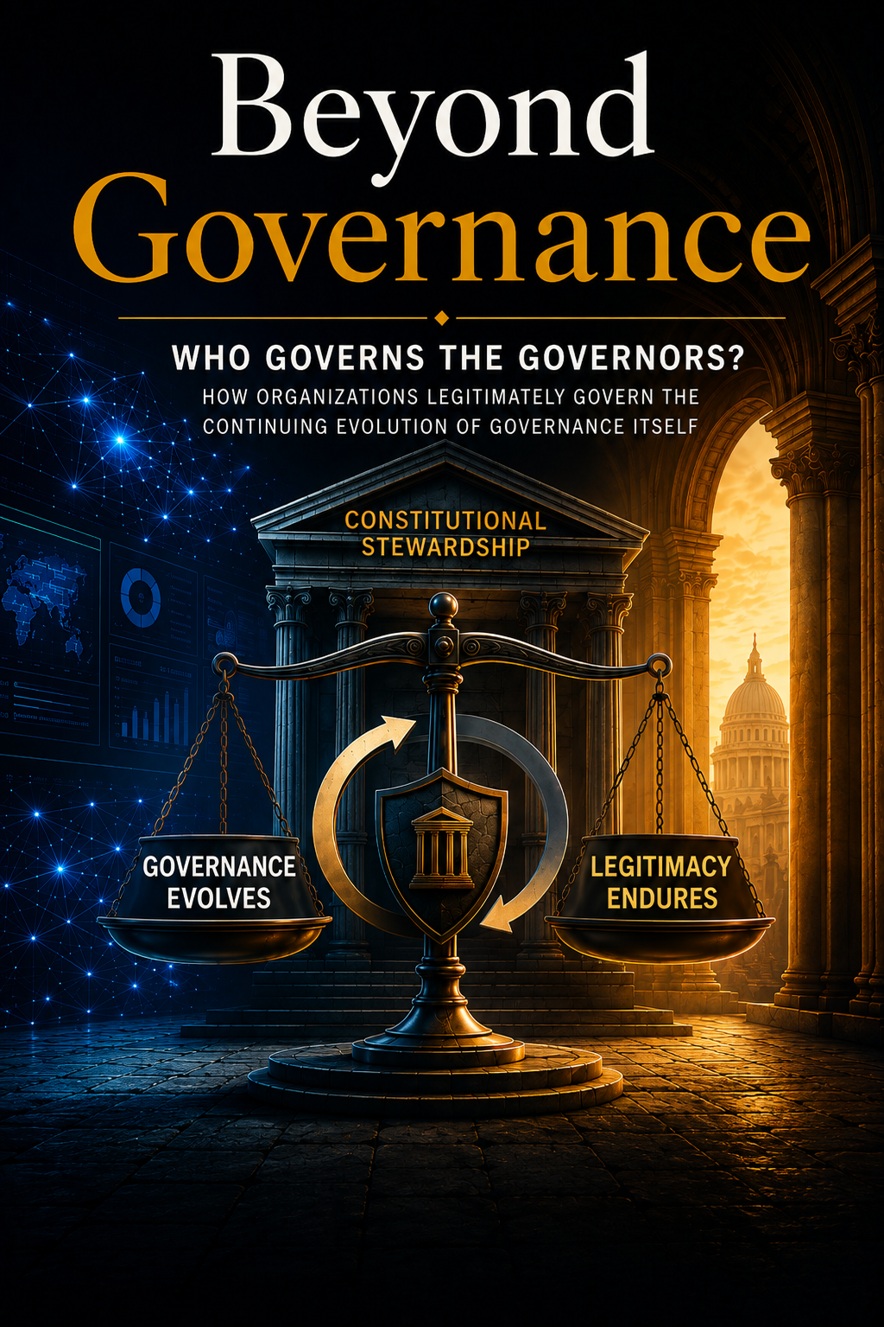
Traditionally, governance has been understood as the organizational capability through which authority establishes direction, decision-making remains subject to accountability, and collective action serves legitimate institutional purposes.
Organizations create governance because collective coordination requires direction, decision rights, responsibility, and constraint.
Where authority is exercised, legitimacy matters.
Legitimate authority requires accountability.
Without these conditions, organizations may retain the capacity to act, but progressively lose the conditions for coherent and legitimate collective action.
This understanding has shaped organizations for generations.
It has also shaped most governance systems.
Governance was largely treated as a relatively stable organizational capability.
Strategies evolved.
Structures changed.
Leaders came and went.
Yet governance itself was generally assumed to provide the enduring institutional framework within which organizational evolution occurred.
The previous articles in this series have progressively shown why that assumption is no longer sufficient.
Human supervision no longer reaches every operational decision.
Artificial intelligence increasingly participates in organizing work.
Governance is increasingly embedded in organizational architecture rather than exercised through continuous intervention.
Constraints increasingly require governed adaptation.
Constitutional commitments require stewardship.
Strategic constraints preserve the organizational conditions through which autonomy, adaptation, and judgment can remain coherent, legitimate, and strategically consequential.
Optimization itself remains subordinate to Protected Institutional Conditions, those conditions within which delegated authority, adaptation, and optimization may operate, but which they cannot independently redefine.
Taken individually, each of these conclusions explains an important organizational transformation.
Taken together, they reveal a deeper constitutional transition.
Governance itself has become part of what organizations must deliberately govern.
But that conclusion creates a harder question than it first appears to answer.
If governance must itself be governed:
Who governs the governors?
The obvious answer would be another governor.
But that merely moves the problem.
Who then governs that governor?
The answer cannot be an infinite hierarchy of authorities supervising authorities.
Nor can governance simply legitimate itself.
The deeper question is therefore not:
Who possesses the final authority over governance?
It is:
Under what conditions can the exercise and continuing evolution of organizational authority remain legitimate?
That distinction changes the problem fundamentally.
Constitutional Coherence Is Not Enough
Governance cannot remain permanently static within organizations that continuously transform.
Yet recognizing this creates an unavoidable dilemma.
If governance never evolves, organizations gradually lose their ability to remain coherent under changing conditions.
If governance can redefine its own foundations without legitimate constraint, governance becomes progressively self-authorizing.
Neither outcome preserves legitimacy.
The challenge is therefore not choosing between stability and change.
It is preserving legitimate continuity throughout institutional evolution.
But even this is not sufficient.
An organization may possess a coherent constitution, clearly defined authority, effective accountability, constitutionally valid procedures for institutional revision, and governance structures that faithfully preserve constitutional continuity.
And still govern illegitimately.
Why?
Because constitutional conformity does not, by itself, establish legitimacy.
A constitution can authorize exploitation.
A procedurally valid process can preserve an illegitimate arrangement.
A properly constituted authority can exercise power in ways that violate rights, dignity, binding obligations, or the justified claims of those materially affected by its actions.
An organization cannot make something legitimate merely by constitutionalizing it.
This creates a distinction that governance must preserve:
Constitutional coherence is necessary, but not sufficient, for legitimate governance.
The organizational constitution can structure authority.
It cannot, by itself, make authority legitimate.
Governance Cannot Be Its Own Source of Legitimacy
Governance does not exist to preserve itself.
It exists to preserve the organization's capacity to pursue legitimate purposes under changing conditions.
Authority is therefore not legitimate merely because governance has authorized it.
Nor is governance legitimate merely because organizational procedures have validated it.
The legitimacy of governance depends upon more than conformity with purposes, principles, authorities, or procedures that the organization itself has the power to define.
This establishes an important boundary.
No organization can be the exclusive source of the conditions that legitimate its own exercise of authority.
Organizations exist within wider normative orders.
These may include law, rights, contractual and fiduciary obligations, professional responsibilities, legitimate stakeholder claims, and ethical obligations that remain relevant even where formal rules are silent.
None of these creates a single superior governor.
Nor does any one of them necessarily provide a complete theory of organizational legitimacy.
Their importance lies elsewhere.
They prevent organizational authority from becoming normatively closed upon itself.
An organization cannot legitimately declare that a right no longer matters merely because recognizing it is inconvenient.
It cannot transform exploitation into legitimacy by incorporating it into policy.
And it cannot eliminate every external basis of contestation simply by redefining its own institutional boundaries.
Legitimate governance therefore requires something stronger than constitutional consistency.
The grounds, limits, and mechanisms of review of organizational authority cannot all remain under the unilateral control of the authority whose legitimacy is at issue.
That is not a demand for universal agreement.
Contestability is not veto.
Justifiability is not consensus.
Reviewability is not permanent indecision.
Organizations must still be capable of deciding and acting.
But authority cannot legitimately monopolize the conditions through which its own legitimacy is established, interpreted, contested, and reassessed.
Formal Independence Is Also Not Enough
Organizations often respond to concentrations of authority by distributing governance responsibilities.
Boards oversee executives.
Audit functions examine controls.
Compliance functions monitor obligations.
Ethics committees examine conduct.
Stakeholder mechanisms provide voice.
Independent review provides recourse.
These mechanisms matter.
But their formal existence does not establish their effectiveness.
A governance architecture may appear distributed while effective power remains concentrated.
An oversight body may be formally independent while depending upon the authority it oversees for appointments, information, resources, access, or institutional survival.
A right to contest may formally exist while the practical cost of exercising it makes contestation ineffective.
A review mechanism may exist while the authority being reviewed controls the evidence upon which review depends.
The architecture remains intact.
Its capacity to constrain power does not.
This reveals two important distinctions:
Formal independence is not effective independence.
Distribution of authority is not necessarily distribution of effective power.
Governance safeguards therefore cannot be evaluated merely by asking whether they exist.
We must ask whether safeguards possess sufficient independence, information, capability, resources, and practical authority to perform their intended function, and whether legitimate challengers have effective standing to use them.
We must also ask whether material concerns can be raised and escalated without the authority under examination controlling the path through which challenge occurs.
A safeguard that lacks these conditions may remain formally present while becoming institutionally incapable of performing its purpose.
Legitimate governance therefore requires not merely institutional safeguards, but effective safeguards against the concentration and capture of the conditions through which authority is constrained.
Independent Institutions Can Still Share the Same Blindness
Yet even effective independence does not solve the entire problem.
Imagine an organization with legitimate purposes, constitutionally bounded authority, genuinely independent oversight, plural sources of information, meaningful stakeholder participation, effective contestability, and robust protections against institutional capture.
No actor is behaving maliciously.
No information is deliberately concealed.
No safeguard has been neutralized.
No rule is being violated.
And still the organization repeatedly produces harmful or illegitimate outcomes.
How?
Because governance can examine only the reality that its architecture enables it to recognize.
Every governance system contains boundaries.
Its architecture shapes who counts as a stakeholder, which consequences and causal relationships enter evaluation, what evidence is considered relevant, which time horizons matter, who has standing, and where organizational accountability begins and ends.
These choices may be explicit.
Often they are not.
Yet they shape the field within which governance sees, evaluates, and decides.
A governance system may therefore possess excellent information about the wrong questions.
It may rigorously evaluate an incorrectly defined problem.
It may provide meaningful contestability to recognized stakeholders while excluding people whom its architecture failed to recognize as stakeholders.
It may optimize responsibly within boundaries that externalize material consequences beyond those boundaries.
The problem is no longer corruption.
It is no longer capture.
It is no longer insufficient accountability.
It is governance blindness.
And governance cannot correct what its architecture systematically renders invisible.
Governance Must Remain Epistemically Open
This creates a further constitutional requirement.
Legitimate governance must preserve the capacity to question not only its decisions, but also the architecture through which those decisions become intelligible.
Its assumptions and boundaries must remain examinable.
Its stakeholder representations and causal models must remain revisable.
Its evidence architecture must remain open to credible counterevidence.
And its categories and time horizons must remain capable of reconsideration when they systematically exclude material realities or consequences.
This does not require omniscience.
No organization can identify every stakeholder, predict every consequence, eliminate every uncertainty, or continuously reconsider every assumption.
Such a requirement would make legitimate action impossible.
The requirement must therefore be proportionate.
Governance must preserve a proportionate and continuing capacity to detect, question, and revise materially consequential assumptions, boundaries, and representations when credible reasons for reconsideration emerge.
This is particularly important in organizations increasingly shaped by artificial intelligence.
AI can expand sensing, analysis, prediction, and optimization.
But it can also make existing categories extraordinarily powerful.
A model may optimize perfectly against the objectives it has been given.
A decision system may apply thresholds consistently.
An agentic workflow may operate exactly within its delegated authority.
Yet none of these capabilities can independently establish whether the categories, objectives, boundaries, thresholds, or representations upon which they operate remain justified and fit for legitimate use.
Computational sophistication does not eliminate the constitutional problem.
It can amplify it.
Optimization therefore remains subordinate to Protected Institutional Conditions.
But those conditions themselves cannot become immune to legitimate examination.
What must be protected from unilateral optimization may still require reconsideration through processes that satisfy the same conditions of legitimacy.
Protection is not immutability.
Continuity is not rigidity.
Adaptation is not arbitrary revision.
The challenge is preserving the legitimacy of the process through which each can occur.
Decision Legitimacy Is Not System Legitimacy
There is another consequence.
Organizations often evaluate governance at the level of individual decisions.
Was the authority legitimate?
Was the process followed?
Was the evidence adequate?
Were relevant stakeholders considered?
Were applicable constraints respected?
These questions matter.
But individually legitimate decisions do not necessarily aggregate into a legitimate organizational system.
A series of decisions may each be reasonable in isolation while producing harmful cumulative consequences.
Actions by different organizational units may each remain within legitimate authority while their interaction generates effects that no single unit owns.
Short-term decisions may satisfy current governance requirements while progressively creating conditions that become unacceptable over longer horizons.
The legitimacy of organizational governance therefore cannot be inferred exclusively from the legitimacy of individual governance acts.
Decision-level legitimacy does not necessarily aggregate into system-level legitimacy.
Governance must consequently remain capable of examining patterns, interactions, cumulative effects, and emergent consequences beyond the individual decisions through which they arise.
This is another reason why governance itself must evolve.
Not because adaptation is intrinsically desirable.
But because the architecture through which legitimate action is preserved can itself become inadequate as organizational reality changes.
Governing the Evolution of Governance
We can now return to the constitutional transition underlying this series.
When conscious supervision became insufficient, governance increasingly required architecture.
When the reach of intervention became limited, organizations required constraints capable of preserving legitimate conditions before intervention became possible.
When those constraints required adaptation, their evolution itself required legitimate processes of revision.
As governance became increasingly embedded in organizational architecture, organizational design became part of governance.
And when optimization reached unprecedented computational capability, organizations discovered that even optimization remains dependent upon conditions that optimization cannot legitimately redefine for itself.
Taken together, these developments reveal a single constitutional reality:
Organizations remain governable only while they preserve the conditions through which governance itself can be legitimately examined, constrained, contested, and revised over time.
Those conditions cannot be reduced to internal constitutional coherence.
They must prevent governance from becoming self-legitimating.
They must preserve effective rather than merely formal independence.
They must protect meaningful contestability.
They must prevent authority from monopolizing the conditions of its own review.
And they must preserve sufficient epistemic openness to recognize when the architecture of governance itself has become inadequate to the reality it governs.
This is not governance beyond governance.
It is governance becoming accountable for the conditions of its own legitimacy.
So Who Governs the Governors?
The answer is not another governor.
No governance system can permanently legitimate itself.
But neither can legitimacy be secured merely by placing another authority above it.
That only recreates the original problem at another level.
The answer lies instead in the conditions under which authority remains legitimately governable.
Governance remains legitimate only when those who exercise authority cannot unilaterally determine all the conditions under which that authority is justified.
Those conditions include the boundaries, constraints, evidence, interpretations, and mechanisms through which authority is exercised, contested, and revised.
Constitutional continuity must not become constitutional closure.
Institutional independence must remain effective rather than ceremonial.
Contestability must remain real without making action impossible.
Materially affected people must have meaningful opportunities to challenge the boundaries through which governance defines its responsibilities, while material consequences and credible evidence must be capable of triggering their reconsideration.
Optimization must remain bounded by conditions it cannot independently redefine.
And governance must remain capable of recognizing when its own architecture requires legitimate revision.
This is why the deepest responsibility of governance is not to preserve governance.
Nor is it simply to preserve institutional stability.
It is to preserve the organization's capacity to exercise authority legitimately while allowing its governance architecture to evolve under changing conditions.
Artificial intelligence has made this challenge more visible by accelerating organizational evolution, expanding delegated action, and increasing both the scale and consequences of architectural choices.
But AI did not create the constitutional problem.
Every organization undergoing significant institutional evolution eventually confronts some version of the same question:
How can governance continue to evolve without allowing those who exercise authority to become the exclusive authors of the conditions that legitimate their authority?
The answer is neither more governance nor less governance.
It is governance whose own authority, architecture, assumptions, boundaries, and evolution remain subject to legitimate constraint, effective contestation, and continuing examination.
This series began by asking whether conscious governance remained sufficient.
It concludes with a deeper constitutional reality.
Governance itself has become part of what organizations must deliberately govern.
But governing governance does not mean creating an endless hierarchy of governors.
It means preserving an architecture in which authority can act without becoming self-authorizing, adapt without becoming arbitrary, remain stable without becoming closed, and evolve without abandoning the conditions that make its exercise legitimate.
That is what lies Beyond Governance.
Not governance beyond organizations.
Not authority beyond constraint.
And not governance legitimating itself.
It is the recognition that organizations can remain legitimately governable through continuous transformation only when governance itself remains accountable to conditions of legitimacy that it cannot unilaterally define, control, or extinguish.
Posted on: August 24, 2026 05:02 AM |
Permalink




