


Categories: Governance, Integration Management, Organizational Project Management, Portfolio Management, Program Management, Strategy
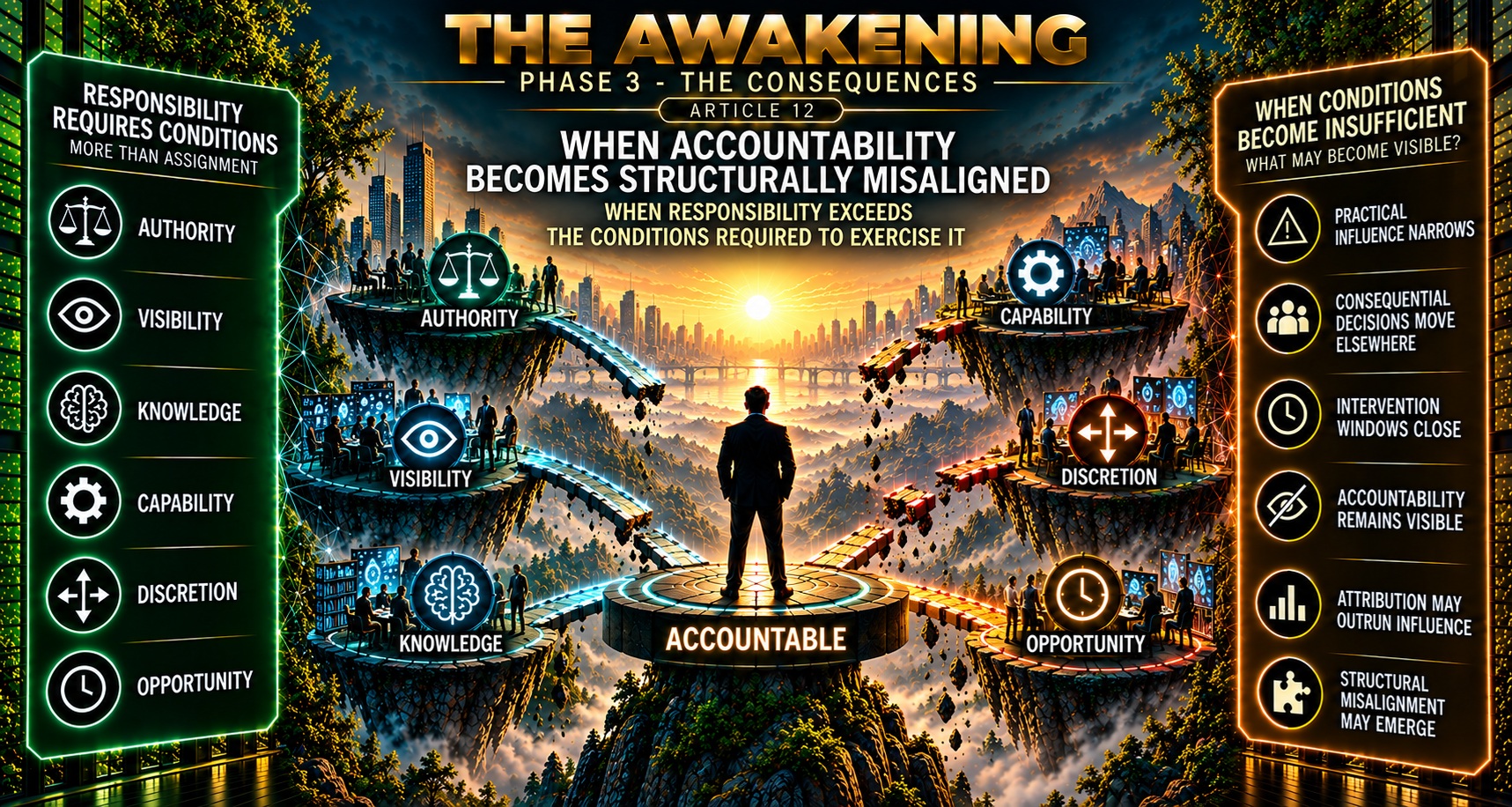
When Responsibility Exceeds the Conditions Required to Exercise It
Someone is still accountable.
The role has not disappeared.
The responsibility has not been removed.
The governance structure still identifies who owns the outcome.
The escalation path still exists.
And when something goes wrong, the organization may still know exactly whose name sits beside the responsibility.
But that does not tell us whether that person still had the conditions required to exercise it.
They may have lacked visibility into a consequential dependency.
The knowledge required to understand the situation may have been distributed elsewhere.
A decision may have been made beyond their authority.
Their discretion may have narrowed.
The opportunity to intervene may have arrived too late.
Or they may have retained formal authority while losing the practical capacity to influence what happened.
Nothing in the responsibility matrix necessarily changes when this occurs.
The accountability remains visible.
The conditions required to exercise it may not.
That creates the central question of this article:
What happens when formal responsibility remains in place while the conditions required to exercise it become insufficient?
Accountability Can Remain After Its Conditions Have Changed
Article 7 of THE AWAKENING asked whether accountability can remain legitimate when authority is distributed.
That inquiry separated several relationships that organizations often compress into a single idea of responsibility.
Responsibility is not authority.
Authority is not knowledge.
Knowledge is not capability.
Capability is not discretion.
Discretion is not causal influence.
And formal accountability does not establish that the actor being held accountable possessed the conditions required to affect the relevant outcome.
Article 7 treated this primarily as a problem of legitimacy and attribution.
Article 12 asks a different question.
What are the consequences when the architecture changes but accountability does not change with it?
Consider a Project Manager who remains accountable for an outcome while consequential decisions increasingly occur within product teams, functional areas, governance bodies, suppliers, automated workflows or other organizational boundaries.
That arrangement is not necessarily defective.
Distributed authority may be entirely appropriate.
Distributed knowledge may improve decision quality.
Local discretion may increase responsiveness.
Specialists may be better positioned to make particular decisions.
Computational systems may recognize relationships that no individual could efficiently process.
The problem does not arise simply because responsibility, knowledge and authority are distributed.
It arises when formal responsibility remains attached to an actor while the conditions required to exercise that responsibility become insufficient for what the actor is still expected to influence.
That is the possibility examined here.
Responsibility Requires More Than Assignment
Organizations are good at assigning responsibility.
They create role descriptions.
RACI matrices.
Governance models.
Delegations of authority.
Approval thresholds.
Escalation paths.
Performance objectives.
Contractual obligations.
And named owners.
These mechanisms matter.
But assignment answers only one question:
Who is expected to be responsible?
It does not answer another:
What must be true for that responsibility to be meaningfully exercised?
At least several conditions may matter.
Authority
Can the actor legitimately make, authorize, challenge or escalate the decisions that materially affect the outcome?
Visibility
Can the actor see the information, dependencies, emerging conditions and consequences relevant to the responsibility?
Knowledge
Can the actor access or mobilize the knowledge required to interpret what is visible?
Capability
Does the actor have the practical capacity to understand, coordinate, decide or intervene as required?
Discretion
Is there meaningful room to act, or has the decision effectively been predetermined by rules, systems, commitments or decisions made elsewhere?
Opportunity
Can intervention occur while meaningful alternatives still exist?
These conditions are not interchangeable.
An actor may have authority without visibility.
Visibility without knowledge.
Knowledge without discretion.
Discretion without capability.
Capability without opportunity.
Or formal responsibility without sufficient combinations of any of them.
That matters because accountability can remain organizationally stable while its enabling conditions move.
The Architecture Can Move While Accountability Stays Still
Project systems rarely change all at once.
Authority may gradually move closer to teams.
Knowledge may become more specialized.
Supplier ecosystems may expand.
Governance may distribute decision rights.
Automation may execute decisions previously made manually.
AI may increasingly analyze, recommend, prioritize or trigger action.
Product structures may change where decisions are made.
Functional boundaries may determine which information is visible.
None of these changes necessarily requires that formal accountability move at the same speed.
The result can be subtle.
The organization still knows who is accountable.
But the system through which that person is expected to exercise responsibility may no longer be the system for which the accountability arrangement was originally designed.
This creates a possible form of structural misalignment:
The architecture of responsibility and the architecture of practical influence begin to diverge.
That divergence does not automatically make accountability illegitimate.
Nor does it prove that the accountable actor lacks agency.
It creates a question that must be investigated:
Has the actor retained sufficient authority, visibility, knowledge, capability, discretion and opportunity relative to the responsibility that remains assigned?
Formal Authority May Not Be Effective Authority
Formal authority matters.
But its existence does not tell us whether it can still produce meaningful influence under the conditions in which it must be exercised.
An escalation right that becomes usable only after a commitment is irreversible may preserve formal authority while providing little effective influence.
An override right may matter little if the person expected to exercise it cannot recognize when intervention is required.
This does not make formal authority meaningless.
It means that formal authority and effective capacity to influence an outcome are not the same thing.
Visibility Is Not the Same as Information
Modern projects may produce enormous amounts of information.
Dashboards.
Reports.
Risk registers.
Logs.
Metrics.
Alerts.
Forecasts.
AI-generated summaries.
Real-time operational data.
That does not necessarily mean that the accountable actor has meaningful visibility.
Visibility requires more than information being technically available.
The relevant relationship must become recognizable.
Its significance must be interpretable.
And it must become visible while action remains possible.
An actor can therefore be surrounded by information and still lack visibility into the consequence for which they will later be held accountable.
This creates an important connection with integrative capacity.
If consequential interdependencies are not recognized and connected across boundaries, an accountable actor may never receive the integrated understanding required to exercise responsibility effectively.
But that connection must not be assumed in every case.
The information may have been available and ignored.
The actor may have misunderstood it.
The signal may have been ambiguous.
The risk may genuinely have been unknowable.
Or the relevant uncertainty may have been irreducible.
Lack of effective visibility is not automatically evidence of insufficient integrative capacity.
Opportunity May Be the Condition We Notice Too Late
Authority, knowledge and capability can all exist and still be insufficient if opportunity disappears.
A decision may remain reversible today and become contractual tomorrow.
A design choice may remain open until procurement commits.
A stakeholder concern may remain manageable until public opposition hardens.
A technical dependency may remain inexpensive to resolve until implementation begins.
A governance intervention may remain useful until the decision path becomes locked.
This makes time part of accountability architecture.
The relevant question is not simply:
Could the actor have intervened?
It is:
Could the actor have intervened while intervention could still materially change the outcome?
That distinction matters.
Because accountability assessed after the event can easily attribute responsibility using information and alternatives that were not available when action was still possible.
The formal responsibility may be unchanged.
The practical opportunity to exercise it may have disappeared much earlier.
The Problem Is Not Always Too Little Authority
There is an obvious response to accountability misalignment:
Give accountable people more authority.
Sometimes that may be appropriate.
But it is not a general solution.
More authority does not create knowledge.
It does not guarantee visibility.
It does not create capability.
It does not recover a lost intervention window.
It does not necessarily improve coordination across interdependent domains.
And concentrating authority may create new information-processing constraints, slower decisions or weaker local responsiveness.
The problem is therefore not:
Accountability is concentrated, so authority should also be concentrated.
Nor is it:
Authority is distributed, so accountability should simply be distributed with it.
The more demanding question is:
What configuration of responsibility, authority, information, knowledge, capability, discretion and intervention opportunity is required for accountability to remain legitimate and practically exercisable under the actual conditions of the project system?
That question cannot be answered through organizational symmetry alone.
When Accountability Becomes Structurally Misaligned
We can now state the hypothesis more precisely.
A single instance of limited authority does not establish structural misalignment.
Neither does one missed signal.
One late escalation.
One poor decision.
One unclear role.
Or one actor failing to use authority that was genuinely available.
Persistence matters.
But persistence alone would not make the misalignment structural.
The mismatch would need to be recurring or embedded in the project configuration rather than merely episodic.
The possibility examined here is that accountability becomes structurally misaligned when formal responsibility remains attached to an actor or role while the project configuration repeatedly or systematically fails to provide sufficient conditions for that responsibility to be exercised in relation to the outcomes for which accountability is retained.
Temporary constraint may be normal.
Incomplete information is unavoidable.
Authority is always bounded.
No actor can control every relevant cause.
And accountability never requires omniscience.
Structural misalignment would therefore need to describe something more systematic than the ordinary limits of responsible action.
It would require a recurring or embedded mismatch between what the system expects an actor to answer for and the conditions the system makes available for influencing it.
That is a hypothesis.
It still has to earn the word structural.
Accountability Misalignment May Remain Invisible
The misalignment may be difficult to see precisely because the formal architecture remains intact.
The responsibility matrix still looks coherent.
The governance model still identifies an owner.
Escalations still occur.
Approvals still have signatures.
Performance objectives still identify responsible individuals.
The organization can therefore retain a clear appearance of accountability.
But clarity of attribution is not the same as legitimacy of attribution.
A name in a box tells us where responsibility was assigned.
It does not tell us whether the conditions required to exercise that responsibility remained available.
This creates a potentially important asymmetry:
Accountability can remain highly visible while the erosion of its enabling conditions remains largely invisible.
That possibility deserves particular attention in distributed project systems.
Human Adaptation May Preserve the Alignment
People may compensate when formal mechanisms do not provide every condition required for responsible action.
Informal relationships may connect knowledge across functions.
People may translate across boundaries.
Experienced actors may recognize dependencies that formal mechanisms miss.
And compensatory coordination may restore visibility or intervention capacity that the formal architecture does not provide reliably.
That may represent resilience, architectural insufficiency, or both.
Informal coordination is not necessarily evidence of structural weakness.
It may itself be a legitimate part of the project's integrative architecture.
The distinction matters.
But the human burden, sustainability and learning consequences of such compensation require a separate inquiry later in this phase.
AI Makes the Question More Difficult
AI does not remove this problem.
It can redistribute it.
A computational system may detect a dependency before a human does.
It may recommend an action.
Prioritize an issue.
Trigger a workflow.
Reject a transaction.
Optimize a schedule.
Or execute within delegated boundaries.
Formal accountability may nevertheless remain human.
That arrangement may be entirely legitimate.
But Article 10 established why human presence or approval alone cannot tell us whether meaningful human agency has been preserved.
If the accountable human cannot understand the relevant context, recognize when intervention is required, access meaningful alternatives, or intervene before action becomes consequential, formal human accountability may remain while effective human influence has narrowed.
The opposite is also possible.
AI may increase visibility.
Expand analytical capacity.
Surface relationships earlier.
Preserve intervention windows.
And make accountability more exercisable rather than less.
Technology therefore does not inherently create accountability misalignment.
The question is whether the resulting human-organizational-computational configuration preserves the conditions required for legitimate and effective responsibility.
Misalignment Does Not Eliminate Responsibility
There is an important danger in this argument.
If accountability requires authority, visibility, knowledge, capability, discretion and opportunity, almost anyone could defend failure by claiming that one of those conditions was incomplete.
That would turn structural explanation into distributed impunity.
That is not the argument.
Actors can fail to exercise authority they genuinely possess.
They can ignore available information.
They can fail to seek relevant knowledge.
They can avoid escalation.
They can exercise poor judgment.
They can fail to act while meaningful opportunity exists.
And they can legitimately be held accountable for those failures.
The existence of structural conditions does not remove individual agency.
The relevant question is therefore not whether the actor faced constraints.
Everyone does.
It is whether the actor had sufficient conditions, relative to the responsibility assigned, to exercise meaningful influence over the outcome being attributed to them.
Accountability requires attribution.
Attribution requires examining both the architecture and the actor's conduct within it.
Neither should substitute for the other.
Alternative Explanations Must Survive
Suppose an accountable actor repeatedly fails to influence outcomes.
Is accountability structurally misaligned?
Perhaps.
But several alternatives remain.
The role may simply have been poorly designed.
Authority may have been available but unused.
Objectives may have been unclear.
Governance may have been weak.
Information may have existed but not been examined.
Political behavior may have obstructed action.
The actor may have lacked capability that the role legitimately required.
A supplier may have created an unforeseeable failure.
The situation may have changed faster than any reasonable configuration could have responded.
Or the outcome may have depended on uncertainty that no actor could meaningfully control.
These alternatives matter.
If accountability misalignment becomes the explanation whenever someone is responsible for an outcome they could not completely control, the concept explains almost every organizational responsibility.
That would make it analytically useless.
The hypothesis therefore needs a discriminating test:
Was there a recurring or embedded mismatch between the responsibility retained and the conditions the project configuration could reasonably be expected to provide for exercising it, or did the actor fail to use conditions that were sufficiently available?
Those are not the same problem.
Accountability Is Not Control
Accountability cannot require complete control.
Projects are interdependent systems in which outcomes emerge from multiple actors, decisions, constraints, uncertainties and external conditions.
No actor controls every causal contributor.
The relevant question is therefore not whether the accountable actor controlled the outcome.
It is whether the responsibility assigned was accompanied by sufficient legitimate influence, information and intervention capacity relative to what the actor was expected to answer for.
That is more demanding than assigning ownership.
But it is much less demanding than requiring control.
What Would Make the Misalignment Structural?
For the term structural misalignment to add explanatory value, several things should be observable.
First, the mismatch should not be merely episodic.
It should recur or be embedded in the project configuration.
Second, the mismatch should concern conditions materially relevant to the assigned responsibility.
Not every informational gap or authority boundary matters.
Third, there should be a plausible mechanism connecting the configuration to the actor's reduced capacity to exercise responsibility.
Fourth, the mismatch should remain distinguishable from individual failure, ordinary uncertainty, poor role design and other credible alternatives.
Fifth, identifying the mismatch should explain something useful that a simpler statement such as “the person lacked authority” does not.
Otherwise, there is no reason to introduce a stronger concept.
The evidence must earn the adjective structural.
What Article 12 Can and Cannot Conclude
Several propositions can now be defended.
1. Formal responsibility does not establish that the conditions required to exercise it remain sufficient.
2. Those conditions can become differently distributed as project architecture changes.
3. Structural misalignment requires more than isolated constraint. It requires a recurring or embedded mismatch between assigned responsibility and the conditions required to exercise it.
4. Such a mismatch does not eliminate individual agency or legitimate accountability.
5. Neither distributed authority nor human or computational participation establishes accountability misalignment by itself.
What cannot yet be concluded is that every persistent separation between responsibility and authority constitutes a distinct phenomenon of structural accountability misalignment.
A stronger hypothesis is worth carrying forward:
Accountability may become structurally misaligned when formal responsibility remains attached to an actor or role while the project configuration repeatedly or systematically fails to provide sufficient authority, visibility, knowledge, capability, discretion or opportunity for that responsibility to be meaningfully exercised in relation to the outcomes for which accountability is retained.
That hypothesis has boundaries.
It has alternative explanations.
It preserves individual agency.
And it can be rejected if the actor possessed sufficient conditions but failed to use them.
That is enough for the investigation to continue.
When Responsibility Stays but the System Moves
Project systems can change while accountability arrangements remain comparatively stable.
Authority can move.
Knowledge can become more distributed.
Decision rights can shift.
Human and computational contributions can change.
And the conditions through which responsibility is exercised can change with them.
None of that eliminates accountability.
Nor does it necessarily weaken it.
Distributed systems may provide better conditions for responsible action.
Technology may increase visibility and intervention capacity.
Informal human adaptation may preserve connections that formal architecture cannot anticipate.
But there may also be a point at which the organization continues to assign responsibility for outcomes while the conditions required to influence those outcomes become insufficient.
When that happens, the problem is no longer simply:
Who is accountable?
The more demanding question becomes:
Accountable with what authority, what visibility, what knowledge, what capability, what discretion, and while what meaningful opportunity to act still remains?
Because responsibility can stay in exactly the same place while the system around it changes.
And when the mismatch between responsibility and the conditions required to exercise it becomes recurring or embedded, accountability may become structurally misaligned.
The next question is what happens when unresolved interdependencies and deferred trade-offs do not disappear, but accumulate over time.
Article 13: The Cost of Deferred Integration.
Posted on: September 28, 2026 10:20 AM |
Permalink



