


Categories: Agile, Governance, Integration Management, Leadership, Organizational Project Management, Portfolio Management, Program Management, Strategy
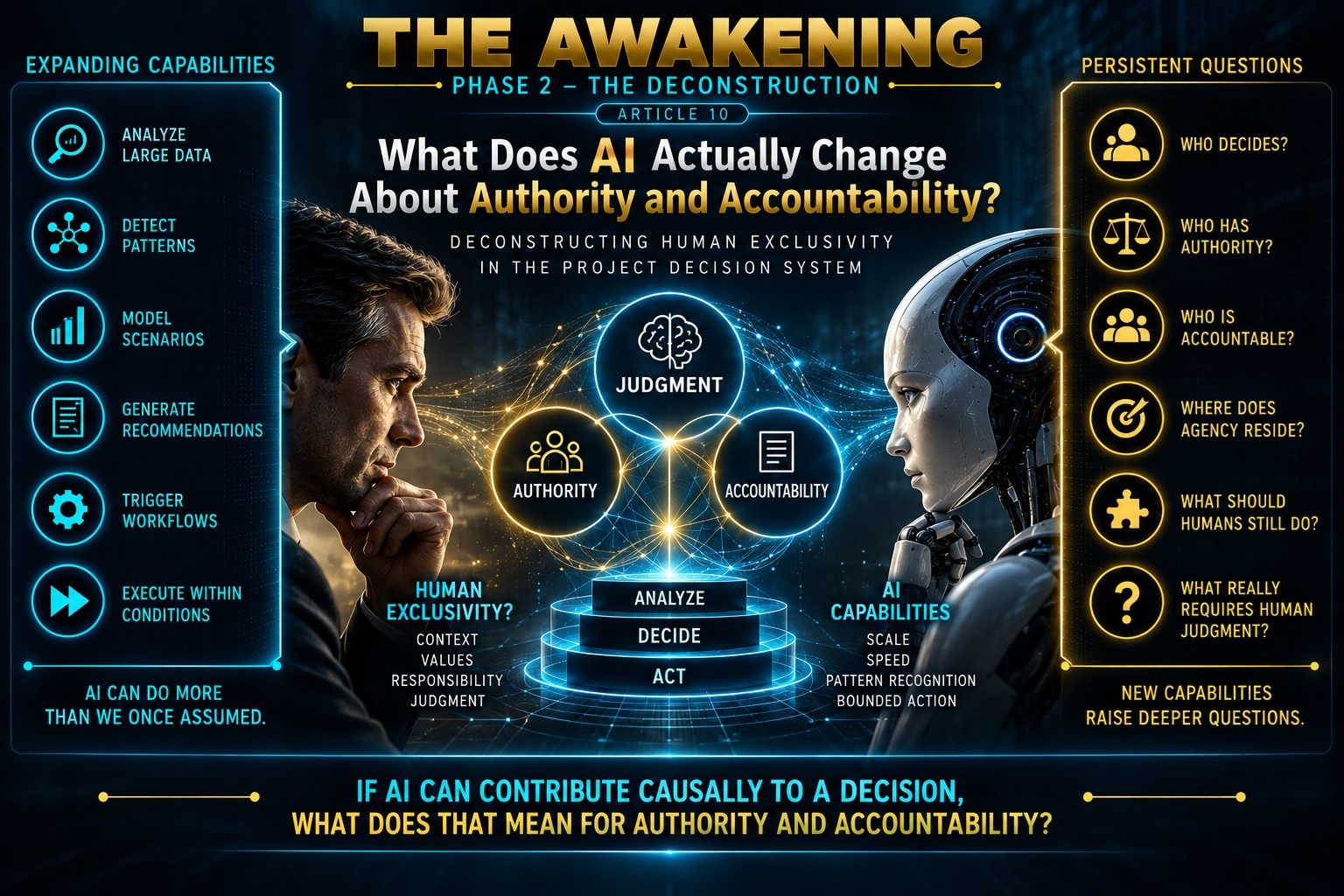
Deconstructing Human Exclusivity in the Project Decision System
Article 6 questioned whether a necessary function must reside in one designated role.
Integration matters.
But the need for integration does not, by itself, prove the need for one integrator.
Article 7 then separated accountability from the assumption that responsibility, authority and causal capacity necessarily reside in the same place.
Article 8 challenged the assumption that control requires centralization, or that greater autonomy necessarily produces greater adaptability.
Article 9 moved the unit of analysis again.
The project system may be the broader unit for analyzing required contribution without making the Project Manager an obsolete unit of professional identity.
Each deconstruction separated relationships that project organizations often treat as if they were inseparable.
Function from role.
Accountability from authority.
Control from centralization.
System contribution from professional identity.
Article 10 reaches a boundary beneath all four.
Historically, project decision systems have been organized primarily around human actors performing analysis, exercising judgment, making decisions, taking action and being held accountable.
Technology could calculate.
Store information.
Automate workflows.
Apply rules.
Generate reports.
Support decisions.
But the project decision system remained fundamentally organized around human agency.
That boundary is becoming less stable.
AI systems can increasingly analyze large bodies of information.
Detect anomalies.
Identify dependencies.
Model scenarios.
Recognize patterns across organizational boundaries.
Generate recommendations.
Prioritize alternatives.
Trigger workflows.
And, within configured conditions, perform actions.
That creates an apparently simple question:
What should humans still do?
But that question may begin too late.
It already assumes that the relevant problem is how work should be divided between humans and AI.
A deeper question comes first:
Which project functions actually depend on human execution, judgment or agency, and which have historically been performed by humans partly because no credible alternative previously existed?
And beneath that lies an even more difficult problem.
If AI can perform a function, does that mean it can legitimately exercise authority over it?
If AI contributes causally to a decision, can it be accountable for that contribution?
If a human formally approves an AI-generated decision without materially shaping it, where does effective agency reside?
And if accountability remains human while consequential decision capacity becomes increasingly computational, what exactly is the human being held accountable for?
That is the final deconstruction of Phase 2.
1. Historical Human Performance Is Not Evidence of Human Necessity
Many project functions have historically been performed by people.
People gather information.
Interpret signals.
Assess risks.
Compare alternatives.
Forecast consequences.
Recommend actions.
Make decisions.
Authorize interventions.
Monitor results.
Escalate exceptions.
And explain what happened.
It is tempting to infer from this history that these are inherently human functions.
But historical concentration does not establish inherent necessity.
The same mistake would be familiar from the earlier articles.
A function performed by one role does not prove that the function requires that role.
Accountability assigned to one actor does not prove that the actor possessed all relevant authority or causal capacity.
A control located centrally does not prove that effective control requires centralization.
And a contribution historically associated with the Project Manager does not prove that the role is the only configuration through which that contribution can be produced.
The same test must now be applied to human agency.
Historical human performance is not evidence of inherent human exclusivity.
Some functions may genuinely require properties that current AI systems do not possess.
Others may not.
The deconstructive task is to distinguish them rather than assume the answer.
2. Capability Does Not Settle Authority
Suppose an AI system can perform a project function more quickly, consistently or accurately than the human actor who previously performed it.
It can detect a schedule anomaly.
Identify a contractual dependency.
Recognize a cross-boundary risk.
Estimate the consequences of a resource decision.
Recommend a corrective action.
Perhaps it can even execute that action within defined limits.
One conclusion follows:
The function is at least partly computationally performable under those conditions.
Another conclusion does not automatically follow:
The AI therefore possesses legitimate authority to decide.
Capability and authority answer different questions.
Capability asks:
Can the function be performed?
Authority asks:
Who or what is legitimately entitled to determine or authorize what happens?
The two are often associated in organizational practice because authority is frequently assigned to actors considered sufficiently capable to exercise it.
But capability alone does not establish legitimate authority.
An analyst may understand a decision better than the executive authorized to make it.
A technical expert may predict the consequence more accurately than the sponsor.
A team may possess the knowledge while a governance body possesses the decision right.
Article 7 already showed why responsibility, authority and causal capacity should not be collapsed.
AI makes that distinction harder to ignore.
An AI system may possess substantial analytical or operational capability without possessing authority.
But the reverse assumption must also be tested.
The fact that authority has historically been exercised by humans does not itself prove that legitimate authority is inherently human.
Perhaps some decision rights can be exercised computationally under delegated conditions.
Perhaps only bounded discretion can.
Perhaps authority remains institutionally attached to human or organizational actors even when execution is computational.
Different forms of authority may require different conditions of delegation and legitimacy.
The answer cannot be derived from capability alone.
But neither can it be derived from tradition.
3. Delegation to AI Is Not One Thing
Organizations already delegate.
They delegate authority to roles.
Decision rights to teams.
Approval limits to managers.
Operational discretion to specialists.
Bounded execution to automated systems.
And execution to suppliers and agents.
AI extends this problem, but it also complicates it.
Consider several different arrangements.
An AI system may analyze information but make no recommendation.
It may recommend but have no authority to act.
It may select among alternatives but require human approval.
It may execute actions after human authorization.
It may act autonomously within predefined thresholds.
It may escalate when those thresholds are exceeded.
Or it may continuously adapt actions within a delegated operating envelope.
These configurations are not equivalent.
Calling all of them “AI decision-making” hides the architecture that matters.
The relevant questions are more precise.
What has been delegated?
Analysis?
Recommendation?
Selection?
Execution?
Discretion?
Authority?
Under what constraints?
With what observability?
With what intervention rights?
And who or what can change those constraints?
The presence of AI therefore tells us less than the architecture of delegation surrounding it.
AI participation in a decision system does not, by itself, tell us where decision authority resides.
4. Recommendation Can Carry More Decision Influence Than Formal Approval Suggests
A familiar governance safeguard is human approval.
AI recommends.
A human decides.
Responsibility therefore remains human.
Sometimes that description may be accurate.
But not always.
Imagine an AI system that processes thousands of variables, identifies the feasible alternatives, ranks them, predicts their consequences and recommends one option.
A human receives the recommendation.
The underlying analysis is too complex to reproduce independently.
The alternatives not surfaced by the system are not visible.
The assumptions shaping the ranking are only partially understood.
Time pressure makes extensive challenge difficult.
The human clicks approve.
Who made the decision?
Formally, perhaps the human.
But the causal contribution to that decision may be more distributed.
The AI shaped the information environment.
It influenced which alternatives became visible.
It structured the comparison.
It affected the perceived significance of consequences.
And it selected the recommendation presented for approval.
The human still performed the formally consequential act of approval.
But formal approval alone does not establish the degree of meaningful human influence that preceded it.
This does not mean the AI “really decided” and the human did not.
That would merely replace one oversimplification with another.
It means:
Decision authority, decision influence and decision causation should not be treated as equivalent merely because one actor performs the final approval.
Human-in-the-loop describes a position in the workflow; whether it constitutes meaningful human oversight depends on the human's actual intervention capacity.
Can the person understand the relevant basis of the recommendation?
Can they challenge it or request alternatives?
And can they intervene while meaningful alternatives remain?
A human approval step without meaningful capacity to shape the decision may preserve a human signature while providing much less human control than the workflow appears to contain.
5. Detection Is Not the Same as Organizational Materiality
AI introduces another distinction.
A system may detect an anomaly.
Identify a dependency.
Predict a consequence.
Recognize a correlation across organizational boundaries.
Estimate probability, magnitude, reversibility or exposure.
These are potentially important capabilities.
But detecting a consequence does not necessarily determine how much that consequence should matter to the organization.
Consider the same predicted consequence in two organizations.
Both AI systems detect it correctly.
Both estimate its probability and magnitude accurately.
But one organization operates under stringent safety obligations.
The other accepts greater exposure in exchange for speed.
The estimated consequence may be the same.
Its organizational significance may not be.
This suggests an important distinction.
Materiality is not necessarily a property of the detected consequence alone. It may depend on the relationship between that consequence and the objectives, values, obligations, thresholds and legitimate interests the project system is expected to protect.
AI may still participate extensively in assessing materiality.
It can apply predefined thresholds.
Model stakeholder effects.
Compare outcomes against objectives.
Identify regulatory constraints.
Represent competing priorities.
Detect inconsistencies.
And calculate whether a consequence satisfies encoded materiality criteria.
But that leaves a deeper question.
If an AI system classifies a consequence as material because it satisfies an organizationally defined threshold, has AI determined materiality?
Or has it operationalized a prior organizational judgment about what should count as material?
The answer may differ by configuration.
And even that distinction may become less clear as AI systems participate in recommending or adapting the criteria themselves.
So the relevant question is not whether AI can calculate significance.
It is:
Can AI determine not only that a consequence exists, but the organizational scope within which that consequence should count as material?
The word “should” matters.
It connects consequence to value, legitimacy, competing objectives, authority and organizational purpose.
But it does not prove that the resulting judgment must remain exclusively human.
That is precisely what must be tested.
6. Judgment Should Not Be Protected by Definition
One easy response to AI is to preserve human exclusivity by redefining whatever AI can do as computation and whatever remains difficult as judgment.
That is circular.
If AI evaluates alternatives, we may say it only analyzes.
If it recommends one, we may say it does not really judge.
If it adapts its recommendation to context, we may say genuine contextual judgment still belongs to humans.
If it explains the trade-off, we may move the boundary again.
Such reasoning makes claims of human-exclusive judgment impossible to falsify.
The deconstruction requires a stronger test.
What do we mean by judgment?
Does it require interpretation under uncertainty?
Context sensitivity?
Comparison of competing objectives or values?
Reasoning where rules are incomplete or exceptions matter?
Awareness of consequences for different stakeholders?
Ability to justify a decision and respond to challenge?
Once the relevant property is specified, we can ask whether it genuinely requires a human actor.
Some forms of judgment may prove computationally reproducible.
Some may be computationally augmented without being fully transferable to AI.
Some may depend on institutional standing rather than cognitive capability.
Some may depend on forms of human experience or moral agency that current AI systems do not possess.
And some things currently called “judgment” may turn out to be sophisticated forms of analysis that were treated as uniquely human only because humans historically performed them.
Human judgment should not be protected from scrutiny by defining it as whatever AI cannot yet do.
7. Authority Is More Than Decision Quality
Suppose an AI system consistently recommends better decisions than the authorized human actor.
Would that justify transferring authority to the AI?
Not necessarily.
Decision quality matters.
But authority is not merely a prize awarded to the most accurate decision-maker.
Organizations allocate authority for multiple reasons.
Expertise.
Representation.
Fiduciary responsibility.
Legal standing.
Protection of rights.
Separation of duties.
Institutional legitimacy.
And sometimes because the decision affects people whose interests require representation rather than merely optimization.
An AI system may outperform a human on prediction without satisfying all of these conditions.
But again, the opposite conclusion should not be assumed.
Not every form of authority requires all of them.
Some decisions are already executed automatically under bounded authority established by human or institutional actors.
AI may expand the range of decisions for which such arrangements are feasible.
The useful distinction may therefore not be:
Human authority versus AI authority.
It may be:
Which forms of decision authority can legitimately be delegated to, or exercised through, computational systems, under which conditions, to what degree, with which constraints and with what retained capacity for intervention?
Authority exercised through a computational system should not automatically be treated as authority held by that system.
That makes authority an architectural and institutional question rather than a label inferred from who or what performs the task.
8. Causal Influence Is Already Distributed
AI complicates another familiar category.
Agency can refer to different things.
The capacity to act.
The capacity to exercise discretion.
Intentional action.
Or the ability to materially shape outcomes.
These should not be assumed to be equivalent.
Project outcomes already emerge from distributed causal systems.
A sponsor sets direction.
A Project Manager integrates.
A team interprets.
A specialist recommends.
A governance body authorizes.
A supplier executes.
An information system constrains available options.
An incentive changes behavior.
A contract limits discretion.
AI can now participate in several of these causal and decision functions.
It may frame alternatives.
Sequence work.
Allocate resources within constraints.
Generate actions.
Trigger interventions.
Adapt recommendations as conditions change.
Or influence human choices without possessing formal authority.
This means that causal influence may become increasingly distributed across humans, organizational structures and computational systems.
But causal contribution is not the same as agency in every meaningful sense.
And agency is not automatically authority.
Nor is either automatically accountability.
These distinctions matter because otherwise organizations may place AI into consequential positions while continuing to describe the decision architecture as if only humans shaped the outcome.
The opposite error is equally possible.
Attributing “agency” to AI too casually may obscure the human and organizational choices that selected the system, defined its objectives, configured its permissions, provided its data, accepted its outputs and determined the conditions of its use.
So the question is not simply:
Did the AI act?
It is:
How were decision capacity and causal influence distributed across the decision system, and which actors or mechanisms materially shaped the resulting action?
9. Accountability Cannot Be Solved by Keeping a Human Name on the Decision
The simplest governance response to AI is often:
A human remains accountable.
That may be necessary.
But it is not sufficient as an explanation.
Article 7 established that legitimate accountability depends on more than formal responsibility.
The accountable actor must be examined in relation to authority, capability, information, opportunity to act, constraints on exercise and causal contribution.
AI makes that architecture even more important.
Suppose a Project Manager remains formally accountable for a decision substantially shaped by an AI system.
What could the Project Manager reasonably know or understand?
Could they challenge or override the recommendation?
Did they choose to use the system, or were they required to use it?
Who selected and configured the system?
Who controlled the relevant thresholds, data and permissions?
And who could intervene when the system's behavior changed?
Simply naming the Project Manager as accountable does not answer these questions.
Nor does blaming the AI.
Accountability should be assessed against how responsibility and authority were allocated, whether the actor was enabled to act, how available discretion was exercised, and what causal contribution can legitimately be attributed, not merely the location of the final human signature.
This does not imply distributed impunity.
Quite the opposite.
The purpose of examining the architecture is to make accountability more defensible.
Different actors may be accountable for different aspects of the same AI-enabled decision system.
Selection.
Configuration.
Authorization.
Use.
Monitoring.
Escalation.
Intervention.
And the exercise or non-exercise of available discretion.
The introduction of AI therefore does not eliminate accountability.
It makes simplistic accountability allocation harder to defend.
10. Can AI Be Accountable?
A harder question remains.
Could AI itself ever be accountable?
Before answering, the term must be clarified.
If accountability means that a system can produce an explanation of its action, preserve an audit trail or be evaluated against performance criteria, AI can participate in accountability mechanisms.
But organizational accountability usually means more.
An accountable actor can be called to account.
Expected to justify conduct.
Evaluated against legitimate obligations.
Subject to consequences.
And situated within an institutional structure of responsibility.
Current AI systems do not independently occupy that kind of organizational standing merely because they can explain an output.
But that observation does not settle every future configuration.
Organizations may create institutional arrangements in which computational agents receive delegated decision rights, operate under explicit obligations and are continuously evaluated against them.
Would that constitute accountability?
Or only accountability of the humans and organizations that created and governed the agent?
The answer depends partly on what accountability is understood to require.
Explanation?
Normative responsibility?
Institutional standing?
Capacity to bear consequences?
Moral agency?
Article 10 should not solve these philosophical and institutional questions by assertion.
For project systems, the more immediate conclusion is narrower.
Computational participation in accountability mechanisms is not yet equivalent to establishing that an AI system can bear organizational accountability in the same sense as a human or institution.
Whether that equivalence could ever become legitimate remains an open question.
11. Human Oversight Must Be More Than Presence
If human accountability is retained, meaningful human oversight becomes important.
But “human oversight” can conceal very different realities.
A human may actively review reasoning and alternatives.
Or merely receive an alert.
A human may have authority to intervene.
Or only authority to escalate.
A human may technically possess an override.
But exercising it may require information they do not have.
Time they are not given.
Expertise they do not possess.
Or organizational conditions that make intervention disproportionately costly.
So the presence of a human in the workflow does not prove the existence of meaningful oversight.
The relevant test is functional.
Can the human recognize when intervention may be necessary?
Can they understand enough of the relevant decision context to challenge the system?
Can they access meaningful alternatives?
Do they possess legitimate authority to intervene?
Can they exercise that authority while intervention can still change the outcome?
And are the organizational conditions compatible with exercising it?
These questions closely resemble the accountability tests from Article 7.
That is not accidental.
AI does not replace the problem of enablement.
It can intensify it.
Human oversight without meaningful intervention capacity may preserve the appearance of human control while weakening its substance.
12. Automation Can Change the Intervention Window
AI can also alter when governance becomes consequential.
In slower human workflows, decision processes may leave visible moments for review.
A recommendation is prepared.
A meeting occurs.
Approval is requested.
Action follows.
AI-enabled systems can compress that sequence.
Detection, interpretation, recommendation and action may occur in seconds.
Or continuously.
By the time a human becomes aware of the consequence, the meaningful intervention window may already have narrowed or closed.
This does not mean faster automation is inherently less governable.
It means governance architecture must account for decision speed.
Some controls may need to move upstream.
Permissions may need to be established before action.
Thresholds before deployment.
Escalation rules before exceptions occur.
Observability before autonomy expands.
Logging before consequential activity begins.
And intervention rights before the system enters operating conditions in which human response would arrive too late.
This produces an important inversion.
I
n some AI-enabled systems, effective governance may depend more heavily on ex ante architecture precisely because ex post human intervention becomes less capable of shaping individual decisions.
That does not eliminate ongoing governance.
Thresholds, permissions, objectives and controls may themselves need to change as conditions change.
But it means that “a human can always intervene” is not a sufficient governance design principle.
The relevant question is whether intervention remains possible while alternatives are still meaningful.
13. The Human May Move From Decision-Maker to Architect of Decision Conditions
If AI increasingly performs analysis, recommendation and bounded action, the human contribution may shift.
Not necessarily disappear.
Shift.
In some configurations, humans may spend less effort producing individual decisions and more effort determining the conditions under which decisions can legitimately be produced.
Which objectives and values matter?
What may be delegated, and what must be escalated?
Which thresholds and evidence requirements apply?
Which stakeholders require protection or representation?
What uncertainty or reversibility is acceptable?
Which decisions require independent review or stop conditions?
And who may change these rules?
This suggests a potentially important movement:
From deciding every action
Toward designing and governing the conditions under which action can occur.
But this should not be universalized.
Some project decisions may continue to require direct human judgment.
Some may be performed predominantly through computational systems.
Others may move dynamically between human and AI contribution as uncertainty, materiality or context changes.
So the proposition is not:
Humans become governance architects and AI becomes decision-maker.
It is narrower:
As computational decision capacity increases, human contribution may increasingly shift from performing individual decision functions toward defining, legitimating and governing the conditions under which those functions are exercised.
Whether even those functions remain exclusively human is still part of the test.
14. What, Then, Remains Distinctively Human?
At this point, it would be tempting to produce a protected list.
Purpose.
Values.
Ethics.
Judgment.
Empathy.
Accountability.
Leadership.
Meaning.
And declare them inherently human.
That would be premature.
Some may prove to depend on human properties that computational systems do not possess.
Some may continue to require human participation because law or institutional legitimacy requires human standing.
Some may be computationally supported while authority remains with human or institutional actors.
Some may be distributed across people and systems.
And some may prove less exclusively human than professional narratives currently assume.
The correct question is therefore not:
What can we reserve for humans?
It is:
Which project functions genuinely require human properties, standing or relationships, and what exactly is the property that makes human participation necessary?
If the answer is empathy, what function requires empathy and why?
If judgment, what kind?
If accountability, what feature of accountability cannot be computationally instantiated?
If legitimacy, whose recognition makes the authority legitimate?
If ethics, which ethical function cannot be performed through computational reasoning and which requires moral agency or institutional standing?
If purpose, who has legitimate standing to define it?
Each claim of human exclusivity must identify its mechanism.
Otherwise “human” becomes another inherited category protected from deconstruction.
15. What Does AI Actually Change About Authority and Accountability?
We can now return to the central question.
Which assumptions about human execution, authority, agency and accountability remain valid when AI becomes capable of analysis, recommendation and bounded action?
The answer is not that AI eliminates human authority.
Nor that accountability can simply be transferred to algorithms.
Nor that humans must retain every consequential decision because humans have historically made them.
AI changes the project decision system by making previously bundled functions increasingly separable.
Analysis can be computational while authority remains human.
Recommendation can be computational while selection is shared.
Execution can be automated while discretion remains bounded by human-defined conditions.
Causal influence can be distributed even when formal approval remains concentrated.
Materiality can be computationally assessed against encoded criteria while the legitimacy of those criteria remains separately contestable.
Oversight can remain human while becoming ineffective if meaningful intervention capacity disappears.
And accountability can remain formally human while becoming less legitimate if the accountable actor lacks the authority, understanding or meaningful capacity to act necessary to discharge it.
So AI does not create one new allocation problem.
It exposes distinctions that were easier to ignore when humans occupied most positions in the decision system.
The relevant design problem becomes:
Which functions can be computationally performed, which forms of discretion can legitimately be delegated, where must authority reside, what intervention capacity must be preserved, and how should accountability be allocated in light of how responsibility and authority are allocated, actors are enabled, discretion is exercised and causal contribution is attributed?
That question must be answered against the actual decision-system configuration.
Not by technological enthusiasm.
Not by protecting inherited professional boundaries.
And not by assuming that historical human performance establishes permanent human necessity.
The Deconstruction
The familiar assumption was:
Project decisions ultimately require human judgment, human authority and human accountability.
That proposition contains several different claims.
They should not be accepted or rejected together.
Some analytical functions may not inherently require human execution.
Some forms of recommendation may not inherently require human generation.
Some bounded actions may be legitimately executable without contemporaneous human approval.
Some forms of discretion may prove legitimately delegable.
Other forms of authority may remain attached to human or institutional standing.
And accountability may depend on properties that computational capability alone does not provide.
The deconstruction therefore does not lead to:
Human → obsolete
Nor to:
AI capability → AI authority
Nor to:
Human signature → legitimate human accountability
It leads to a more disciplined set of distinctions:
Human execution ≠ necessary human exclusivity
Computational capability ≠ legitimate authority
Decision influence ≠ formal decision right
Authority ≠ accountability
Causal contribution ≠ singular responsibility
Human oversight ≠ meaningful intervention capacity
The more rigorous question is:
What exactly must be true for a project function to require human execution, human authority or human accountability?
Each claim must survive separately.
And one proposition survives the deconstruction:
Historical reliance on human actors to perform, authorize or govern a function does not establish that human participation is inherent to that function.
But a second proposition survives with equal force:
The ability of AI to perform or influence a function does not, by itself, establish legitimate authority, accountable standing or the conditions under which that function should be delegated.
That completes the central work of Phase 2.
Across five deconstructions, the question has not been whether familiar project constructs should disappear.
It has been whether the relationships hidden inside them actually hold.
Integration does not automatically imply one integrator.
Accountability does not automatically imply coincident authority and causal capacity.
Control does not automatically imply centralization.
System contribution does not automatically imply role obsolescence.
And human performance does not automatically imply human exclusivity.
What survives is not a roleless, authorityless, control-free or human-free project system.
What survives is a harder requirement:
Project architecture must make explicit which functions are necessary, where capability resides, how discretion and authority are allocated and legitimized, how consequential interdependencies are recognized, how intervention remains possible, and how accountability is assigned to legitimate accountable actors in light of the distribution of responsibility, authority, enablement, exercise and causal contribution across human, organizational and computational participants.
Phase 2 can therefore close without prescribing one universal organizational form.
Its purpose was deconstruction.
It has established the distinctions and tests through which inherited assumptions about role, authority, control, professional identity and human exclusivity can be examined against actual project-system configurations.
The next question is reconstruction.
If these familiar relationships can no longer simply be assumed, how should the project system be designed?
That is where THE AWAKENING goes next.
Posted on: September 21, 2026 02:06 PM |
Permalink



