


Categories: Governance, Integration Management, Organizational Project Management, Portfolio Management, Program Management, Strategy
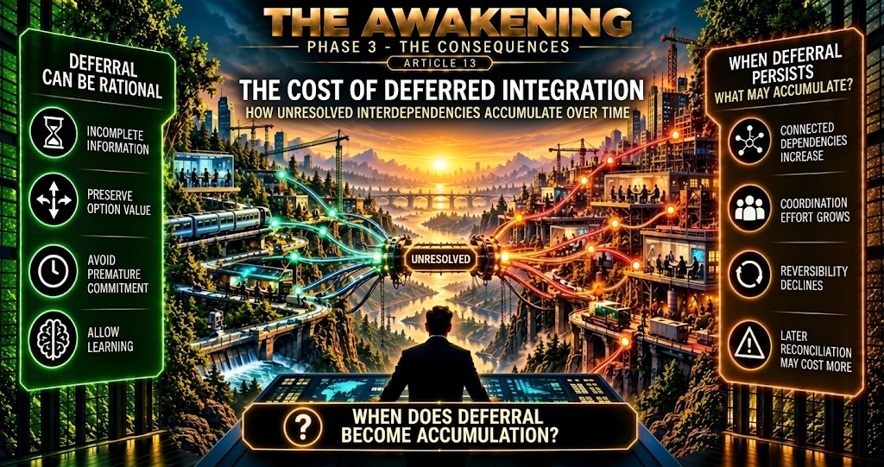
How Unresolved Interdependencies Accumulate Over Time
A dependency is recognized.
But not resolved.
A trade-off is understood.
But the decision is postponed.
A conflict between two legitimate requirements remains open.
An escalation occurs, but no reconciliation follows.
A temporary workaround preserves progress.
A commitment is made while a consequential relationship remains unresolved.
The project continues.
Nothing necessarily fails.
And sometimes nothing more needs to happen.
The dependency may disappear.
New information may make the trade-off irrelevant.
A later decision may resolve the issue at little additional cost.
Deferral may even be the right decision when uncertainty is high and premature commitment would destroy useful flexibility.
But not every unresolved interdependency disappears.
Some remain connected to decisions that continue to be made.
Some become harder to resolve.
Some narrow future alternatives.
Some require additional coordination.
Some change who can still act.
Some move consequences into other parts of the project system.
And some may persist long after the decision that originally deferred them has been forgotten.
That creates the central question of this article:
Do deferred trade-offs, unresolved dependencies and lost intervention windows produce persistent systemic burdens that accumulate over time?
And, if they do:
Is the analogy to debt actually useful?
Deferral Is Not Necessarily a Failure
Projects cannot resolve everything immediately.
Nor should they.
Information is incomplete.
Conditions change.
Some decisions benefit from waiting.
Some dependencies become relevant only under particular scenarios.
Some issues are reversible.
Some uncertainties are better preserved than prematurely eliminated.
And some trade-offs cannot be reconciled until additional evidence becomes available.
Deferral can therefore be rational.
It can preserve option value.
Prevent premature commitment.
Avoid unnecessary coordination.
Allow learning.
And keep the project adaptable.
That distinction is essential.
Deferred integration is not, by itself, evidence of deficient integration.
The relevant question is not whether something was left unresolved.
It is what happens after it is left unresolved.
What Exactly Is Being Deferred?
Integration does not require every difference to disappear.
Nor does it require every dependency to be centrally resolved.
The relevant concern is narrower.
A material interdependency may be recognized but its consequences not yet sufficiently reconciled for the decisions or actions that depend on it.
That may involve a technical choice whose operational implications remain unresolved.
A procurement decision that constrains later implementation alternatives.
A schedule decision that transfers pressure elsewhere.
A commercial commitment made before an interface is settled.
A stakeholder trade-off postponed while other commitments continue.
A governance question escalated but not decided.
Or a temporary workaround that allows work to proceed without resolving the relationship that made the workaround necessary.
In each case, work may continue.
That matters.
Because the consequence of deferral may depend not simply on the unresolved issue itself, but on what the project system does while the issue remains unresolved.
But another possibility must remain separate.
A material interdependency may never have been recognized, even though it could reasonably have been.
That may also create later burden.
But failure to recognize an interdependency is not the same thing as deciding, explicitly or implicitly, to defer its reconciliation after it has become recognizable.
Both may matter to the wider investigation of insufficient integrative capacity.
They should not automatically be treated as the same mechanism.
That distinction becomes especially important if the analogy to debt is later considered.
Time Does Not Automatically Create a Burden
An unresolved issue today is not necessarily more serious tomorrow.
This seems obvious.
But it places an important limit on the hypothesis.
Time alone does not create accumulation.
A dependency may remain unresolved for weeks without becoming more consequential.
A decision may be postponed while the project learns.
An interface may remain open because no downstream commitment yet depends on it.
A stakeholder tension may remain manageable because alternatives are still available.
An unresolved issue may even become irrelevant.
So the relevant mechanism cannot simply be:
Unresolved issue + time = growing burden.
Something else must happen.
The project must continue to make decisions, create commitments, allocate resources, establish expectations, build interfaces or reduce alternatives in ways that interact with what remains unresolved.
The more demanding question is therefore:
Does continued project activity change the consequences of what has been deferred?
Accumulation Requires a Mechanism
If unresolved interdependencies create persistent systemic burdens, there must be a mechanism through which those burdens accumulate.
Several possibilities deserve examination.
A deferred trade-off may become embedded in later decisions.
A temporary workaround may require additional work to remain viable.
A dependency may become connected to more components, teams or commitments.
Later decisions may assume that an unresolved issue has effectively been settled.
Knowledge about why the issue was deferred may become fragmented or disappear.
The people who understood the original trade-off may no longer be available.
Contractual or technical commitments may reduce the available alternatives.
Changing one decision may require reopening several others.
And the cost of reconciliation may increase because the project must now alter relationships that did not exist when the issue first emerged.
None of these mechanisms is inevitable.
But each suggests the same possibility:
The consequences of an unresolved interdependency may change as the system continues to develop around it.
That is more precise than saying that unresolved issues simply “pile up.”
The issue may remain one issue.
What changes may be the number, importance or reversibility of the relationships connected to it.
The Option Space Can Narrow
Article 12 examined whether an accountable actor still has meaningful opportunity to intervene.
That temporal question matters here for another reason.
A decision that can be changed today may be much harder to change after procurement.
A design choice may remain flexible until implementation begins.
A supplier relationship may be renegotiable before contractual commitments deepen.
A stakeholder concern may be manageable before positions harden.
A governance decision may preserve several alternatives before downstream teams organize around one of them.
The unresolved issue has not necessarily become intrinsically more difficult.
The surrounding option space may have narrowed.
This distinction matters.
If later reconciliation becomes more costly, the cause may not be the passage of time.
It may be the commitments made during that time.
So the relevant sequence may be:
Unresolved interdependency → continued decisions and commitments → reduced reversibility or increased connectedness → greater burden of later reconciliation.
That is a mechanism worth testing.
It is not yet evidence of debt.
Local Progress Can Preserve the Unresolved Problem
Projects are often rewarded for continuing to move.
A team can proceed using an assumption.
A supplier can continue against an interim specification.
Operations can prepare around a temporary interpretation.
A schedule can be maintained through resequencing.
A governance question can remain open while lower-level decisions continue.
Each local action may be reasonable.
And each may preserve progress.
But local progress can also change the system around the unresolved relationship.
More work may become dependent on the assumption.
More actors may organize around the temporary solution.
More commitments may become costly to reverse.
The workaround may gradually become the operating condition.
This creates a paradox:
The mechanisms that allow the project to continue may also make the unresolved interdependency more consequential to resolve later.
Not always.
But potentially.
That is one reason schedule or activity progress alone may reveal little about whether unresolved integration is becoming more consequential.
Workarounds Can Be Adaptation, Not Debt
The argument needs an immediate qualification.
Workarounds are not inherently pathological.
A workaround may be an intelligent response to uncertainty.
Temporary coordination may preserve flexibility.
Redundancy may increase resilience.
Teams may deliberately postpone integration because early resolution would impose unnecessary constraints.
An informal arrangement may later become a better permanent solution than the original design.
And adaptive systems often survive precisely because people do not wait for every formal relationship to be resolved before acting.
So repeated workaround activity cannot itself establish accumulated burden.
The relevant question is more demanding:
Does the workaround preserve useful adaptability, or does continued dependence on it progressively increase the effort, constraints or consequences associated with the unresolved interdependency?
Those possibilities must remain separate.
Some Burdens May Be Hidden in Coordination
Not every consequence of deferred integration appears as rework.
Some may appear as additional coordination.
People remember exceptions.
Teams maintain parallel interpretations.
Managers repeatedly reconcile the same boundary.
Specialists translate between incompatible assumptions.
Additional checks are introduced.
Meetings exist because an interface remains unstable.
Escalations recur because the underlying relationship was never resolved.
None of these observations proves that the original deferral was wrong.
Nor does additional coordination automatically represent waste.
But it raises a useful question:
Is the project repeatedly spending attention to preserve coherence around an interdependency that remains unresolved?
If so, part of the cost of deferral may appear not in the issue itself but in the continuing effort required to live with it.
That possibility connects directly with the human burden examined in Article 14.
But the present question is narrower.
Article 13 asks whether the unresolved relationship can create a persistent burden.
Article 14 will ask what happens when people become part of the mechanism through which that burden is absorbed.
The Burden May Move
Another difficulty is attribution.
The consequence of a deferred decision may not appear where the deferral occurred.
A procurement choice may create operational work.
A design shortcut may create maintenance burden.
A schedule decision may transfer pressure to another team.
A commercial commitment may reduce technical flexibility.
A local cost reduction may increase coordination elsewhere.
A postponed governance decision may force lower levels to operate under ambiguity.
This matters because a project can appear to have resolved a problem when it has actually redistributed its consequences.
The original issue may disappear from the risk register.
The meeting may close.
The decision may be marked complete.
But the burden may reappear somewhere else in the project system.
That does not establish accumulation.
It establishes another possibility that must be distinguished from it:
Persistence may occur through transfer, not only through visible continuation of the original issue.
And transfer alone does not establish debt.
When Does Deferral Become Accumulation?
We can now make the hypothesis more demanding.
A deferred interdependency does not become an accumulated burden simply because it remains unresolved.
For accumulation to be a useful description, something must persist or increase as subsequent project activity occurs.
That might include:
- The number of later decisions dependent on the unresolved condition;
- The coordination required to maintain temporary arrangements;
- The number of interfaces affected;
- The difficulty of reversing previous commitments;
- The amount of rework required for later reconciliation;
- The consequences transferred elsewhere in the system;
- The loss of knowledge required to understand why the original trade-off remained unresolved.
They are possible manifestations.
The underlying question is:
Has continued project activity made the unresolved interdependency more consequential, more connected, more costly to reconcile or more dependent on compensatory effort than it was when deferral occurred?
If not, there may be no meaningful accumulation.
Does “Debt” Add Anything?
This brings us to the most tempting term.
Integration debt.
The metaphor is attractive.
A decision is deferred.
The project gains something now.
The unresolved consequence remains.
Future effort is required.
Additional burdens may appear over time.
That sounds like debt.
But resemblance is not enough.
Debt is a strong metaphor because it implies a particular structure.
There is an immediate benefit or avoided cost.
An obligation persists.
Future resources may be required.
The burden may increase.
And the system may eventually have to repay, restructure, absorb or default on what was deferred.
Do unresolved interdependencies actually behave this way?
Sometimes perhaps.
But several problems appear immediately.
Some deferred issues disappear without repayment.
Some become irrelevant.
Some are resolved more cheaply later.
Some create adaptation rather than burden.
Some consequences are irreversible and cannot meaningfully be “repaid.”
Some burdens are transferred to other actors rather than accumulated by the original decision-maker.
And some consequences are not financial or even readily commensurable.
So the analogy must not drive the analysis.
The fact that deferred integration can create future cost does not establish the existence of integration debt.
Nor would every persistent burden created by unresolved integration necessarily constitute integration debt.
If the construct survives at all, it may describe only a narrower subset of cases.
What Would the Debt Analogy Need to Explain?
For integration debt to earn a place, it would need to explain something more specific than:
Unresolved problems can become expensive later.
That observation does not require a new construct.
A useful debt analogy might need to show a recognizable relationship between:
An identifiable decision to defer the reconciliation of a material interdependency,
A benefit, avoided cost or preserved flexibility obtained through that deferral,
A persistent obligation or exposure created by what remains unresolved,
and
Future resources, constraints or consequences associated with maintaining, reconciling or absorbing it.
This would make integration debt, if it exists, narrower than the broader category of persistent burdens associated with unresolved integration.
An interdependency that was never recognized may still create serious consequences.
A burden may persist because consequences were transferred elsewhere.
A workaround may become embedded.
A lost intervention window may create irreversible effects.
Those phenomena matter.
But they would not automatically satisfy the stronger conditions required by the debt analogy.
Even where those conditions are present, we would still need to understand whether there is anything meaningfully analogous to:
principal,
interest,
repayment,
or perhaps default.
Those terms should not be imported mechanically.
If they cannot be defined without stretching the metaphor, that would be evidence against using debt as the construct.
The metaphor must explain the phenomenon.
The phenomenon must not be forced to fit the metaphor.
Deferral May Preserve Value
There is another reason to resist treating debt as inherently negative.
The project may receive genuine value from deferral.
Waiting may preserve flexibility.
A temporary solution may allow learning.
Postponing a decision may avoid locking the project into a poor assumption.
Operating with an unresolved interface may be less costly than resolving it prematurely.
In such cases, future reconciliation cost may be the rational price of preserving options today.
That means even if something analogous to debt exists, its presence would not automatically indicate poor management.
Organizations deliberately use financial debt because present access to resources may justify future obligations.
By analogy, deferred integration might sometimes be a rational intertemporal choice.
The relevant question would then become not:
Does the project have integration debt?
but:
Was the future burden created by deferral understood, proportionate and governable relative to the value preserved or created by deferring?
That is a much harder question.
And a more useful one.
Not Every Future Cost Was Caused by the Deferral
Causal attribution remains difficult.
Suppose a technical interface becomes expensive to change six months after its resolution was deferred.
Was the later cost caused by the deferral?
Perhaps.
But the technology may have changed.
A supplier may have changed.
Regulation may have changed.
The project scope may have expanded.
A new stakeholder may have introduced requirements.
The original information may have been insufficient to support an earlier decision.
Or the later problem may have emerged even if the issue had been resolved immediately.
The counterfactual matters.
What would probably have happened if reconciliation had occurred earlier?
Without that question, almost any later difficulty connected to an earlier unresolved issue can be retrospectively described as the cost of deferral.
That would be too easy.
And analytically weak.
Alternative Explanations Must Survive
Observed accumulation may have other causes.
The project may simply be becoming more complex.
Requirements may be changing.
Scope may be expanding.
Coordination costs may rise because more actors are involved.
Rework may result from uncertainty rather than deferred integration.
Dependencies may emerge that were genuinely unknowable earlier.
A temporary arrangement may persist because it remains the most efficient solution.
Later intervention may become more difficult because of external change rather than previous deferral.
And increasing human effort may reflect legitimate adaptation rather than accumulated burden.
These alternatives matter.
If every increase in coordination, rework or constraint after an unresolved issue is classified as deferred integration cost, the hypothesis becomes unfalsifiable.
The test must be more discriminating:
Can a plausible mechanism connect the earlier deferral to a persistent or increasing later burden, relative to credible alternatives and to what would reasonably have occurred without the deferral?
If not, the later burden should not be attributed to deferred integration.
AI Can Change Both Deferral and Accumulation
Technology can affect both sides of the problem.
AI may identify dependencies earlier.
Preserve knowledge about unresolved trade-offs.
Track assumptions across decisions.
Recognize when later commitments interact with an open issue.
Model the consequences of continued deferral.
And alert decision-makers before option space narrows.
That could reduce some forms of persistent burden.
But computational systems may also accelerate decisions.
Increase the number of interacting actions.
Embed assumptions into workflows.
Propagate recommendations rapidly across connected processes.
And create dependencies that are difficult for human actors to recognize.
A system may therefore become better at detecting unresolved integration while simultaneously becoming faster at creating downstream commitments around it.
Once again, technology does not determine the answer.
The question is:
Does technological augmentation improve the system's ability to recognize, track and reconcile deferred interdependencies faster than it changes the speed and connectedness through which their consequences can propagate?
That relationship cannot be assumed.
What Would Make the Burden Persistent?
A future cost is not enough.
Nor is persistence by itself.
A workaround may remain cheap and effective.
A recurring coordination mechanism may become a legitimate part of the architecture.
An unresolved interface may remain stable indefinitely.
For persistence to matter to this inquiry, the unresolved interdependency must continue to impose some material burden that remains plausibly connected to what was deferred.
The more demanding question is:
Does the unresolved interdependency continue to impose material constraints, resource demands, reduced reversibility or consequential dependencies that would not otherwise be required?
If not, persistence alone tells us little.
And even if such a burden exists, that still does not establish integration debt.
What Article 13 Can and Cannot Conclude
Several propositions can now be defended.
1. Deferring integration is not inherently a failure and may preserve flexibility, learning or option value.
2. Time alone does not cause unresolved interdependencies to accumulate into larger burdens.
3. Accumulation requires a mechanism through which continued project activity changes the consequences of what remains unresolved.
4. Persistent burden may appear through reduced reversibility, additional connectedness, recurring coordination, transferred consequences or increased reconciliation effort.
5. Observed future cost cannot automatically be attributed to earlier deferral. Credible alternatives and the relevant counterfactual must be considered.
A further distinction can now be preserved:
Persistent burden from unresolved integration is a broader possibility than integration debt.
A burden may arise from an interdependency that was never recognized.
It may result from consequences that migrate across the project system.
It may persist through adaptation or compensation.
Those possibilities matter even if the debt analogy ultimately fails.
What cannot yet be concluded is that any subset of these patterns constitutes a distinct phenomenon called integration debt.
A working hypothesis is worth carrying forward:
Deferred integration may create persistent systemic burdens when unresolved material interdependencies remain connected to subsequent decisions, commitments or adaptations in ways that increase the effort, constraints, dependencies or loss of option space associated with later reconciliation.
That hypothesis does not require the debt metaphor.
The metaphor must survive a separate test.
A narrower provisional construct candidate can therefore be stated:
Integration debt may exist where an identifiable decision to defer the reconciliation of a material interdependency provides a present benefit, avoided cost or preserved flexibility while creating a persistent future obligation or exposure that remains connected to that unresolved interdependency and requires additional resources, constrains future action or must later be reconciled, absorbed or otherwise addressed.
That is not a finding.
It is not yet an adopted construct.
And the evidence may show that the debt analogy adds nothing that existing concepts explain more clearly.
The evidence must earn the metaphor.
When the Project Continues but the Unresolved Relationship Remains
Projects must move.
They cannot wait until every uncertainty disappears.
Every interface is settled.
Every trade-off is reconciled.
Every consequence is known.
Deferral is therefore unavoidable.
Sometimes it is intelligent.
Sometimes it is necessary.
Sometimes it preserves exactly the flexibility the project will later need.
But the fact that work can continue does not mean that what remains unresolved has disappeared.
The project may continue to organize itself around it.
Decisions may depend on it.
Commitments may harden around it.
Workarounds may preserve progress.
Coordination may absorb its consequences.
And the people who keep the system coherent may gradually carry more of the burden.
The critical distinction is therefore not between:
Resolved and unresolved.
It is between unresolved relationships whose consequences remain contained and those whose consequences become increasingly embedded in what the project does next.
That is the possibility Article 13 places under investigation.
Whether a narrower subset of those cases deserves to be called integration debt remains open.
Because evidence that deferral has a cost is not enough.
Evidence that the cost persists is not enough.
And even evidence that it accumulates is not enough to justify a new construct.
The debt analogy must explain something that simpler concepts do not.
Until then, integration debt remains a provisional construct candidate.
The next inquiry moves from the accumulated burden to the people who may be carrying part of it.
Article 14: The Human Burden of Integrative Work.
Posted on: September 30, 2026 10:06 AM |
Permalink



