This blog addresses management-related topics and has three areas of focus: 1. Technical skills; 2. Competencies in the field of interpersonal relations and communication (including personal organization and delegation, leadership, teamwork, conflict resolution, conducting meetings, and negotiation); and 3. Strategy (including diagnosis, strategic guidelines, and implementation).4.Technology
Recent Posts
The Same Change Can Succeed and Fail at the Same Time
What Must Exist Even When No Single Role Owns the Whole?
PHASE 4 – THE EMERGENCE
When Structural Drift Becomes Consequential
Implementation Is Not Realization
Categories
Agile,
Career Development,
Career Development,
Career Development,
Career Development,
Career Development,
Career Development,
Career Development,
Career Development,
Career Development,
Career Development,
Career Development,
Career Development,
Career Development,
Career Development,
Career Development,
Career Development,
Career Development,
Career Development,
Career Development,
Career Development,
Career Development,
Career Development,
Career Development,
Career Development,
Career Development,
Career Development,
Career Development,
Career Development,
Career Development,
Career Development,
Career Development,
Career Development,
Career Development,
Career Development,
Career Development,
Career Development,
Career Development,
Career Development,
Career Development,
Career Development,
Career Development,
Career Development,
Career Development,
Career Development,
Career Development,
Career Development,
Career Development,
Career Development,
Career Development,
Career Development,
Career Development,
Career Development,
Career Development,
Career Development,
Career Development,
Career Development,
Career Development,
Career Development,
Career Development,
Career Development,
Career Development,
Career Development,
Career Development,
Career Development,
Career Development,
Career Development,
Career Development,
Career Development,
Career Development,
Career Development,
Career Development,
Career Development,
Career Development,
Career Development,
Career Development,
Career Development,
Career Development,
Career Development,
Career Development,
Career Development,
Career Development,
Career Development,
Career Development,
Career Development,
Career Development,
Career Development,
Career Development,
Career Development,
Career Development,
Career Development,
Career Development,
Career Development,
Career Development,
Career Development,
Career Development,
Career Development,
Career Development,
Career Development,
Career Development,
Career Development,
Career Development,
Career Development,
Career Development,
Career Development,
Career Development,
Career Development,
Career Development,
Career Development,
Career Development,
Career Development,
Career Development,
Career Development,
Career Development,
Career Development,
Career Development,
Career Development,
Career Development,
Career Development,
Career Development,
Career Development,
Career Development,
Career Development,
Education,
Governance,
Governance,
Governance,
Governance,
Governance,
Governance,
Governance,
Governance,
Governance,
Governance,
Governance,
Governance,
Governance,
Governance,
Governance,
Governance,
Governance,
Governance,
Governance,
Governance,
In,
Integration Management,
Interpersonal Skills,
Knowledge Management,
le,
lea,
Leadership,
Leadership,
Leadership,
Leadership,
Leadership,
Leadership,
Leadership,
Leadership,
Leadership,
Leadership,
Leadership,
Leadership,
Leadership,
Leadership,
Leadership,
Leadership,
Leadership,
Leadership,
Leadership,
Leadership,
Leadership,
Leadership,
Leadership,
Leadership,
Leadership,
Leadership,
Leadership,
Leadership,
Leadership,
Leadership,
Leadership,
Leadership,
Leadership,
Leadership,
Leadership,
Leadership,
Leadership,
Leadership,
Leadership,
Leadership,
Leadership,
Leadership,
Leadership,
Leadership,
Leadership,
Leadership,
Leadership,
Leadership,
Leadership,
Leadership,
Leadership,
Leadership,
Leadership,
Leadership,
Leadership,
Leadership,
Leadership,
Leadership,
Leadership,
Leadership,
Leadership,
Leadership,
Leadership,
Leadership,
Leadership,
Leadership,
Leadership,
Leadership,
Leadership,
Leadership,
Leadership,
Leadership,
Leadership,
Leadership,
Leadership,
Leadership,
Leadership,
Leadership,
Leadership,
Leadership,
Leadership,
Leadership,
Leadership,
Leadership,
Leadership,
Leadership,
Leadership,
Leadership,
Leadership,
Leadership,
Leadership,
Leadership,
Leadership,
Leadership,
Leadership,
Leadership,
Leadership,
Leadership,
Leadership,
Leadership,
Leadership,
Leadership,
Leadership,
Leadership,
Leadership,
Leadership,
Leadership,
Leadership,
Leadership,
Leadership,
Leadership,
Leadership,
Leadership,
Leadership,
Leadership,
Leadership,
Leadership,
Leadership,
Leadership,
Leadership,
Leadership,
Leadership,
Leadership,
or,
Organizational Project Management,
Portfolio Management,
Program,
Program Management,
Strategy,
Strategy,
Strategy,
Strategy,
Strategy,
Strategy,
Strategy,
Strategy,
Strategy,
Strategy,
Strategy,
Strategy,
Strategy,
Strategy,
Strategy,
Strategy,
Strategy,
Strategy,
Strategy,
Strategy,
Strategy,
Strategy,
Strategy,
Strategy,
Strategy,
Strategy,
Strategy,
Strategy,
Strategy,
Strategy,
Strategy,
Strategy,
Strategy,
Strategy,
Strategy,
Strategy,
Strategy,
Strategy,
Strategy,
Strategy,
Strategy,
Strategy,
Strategy,
Strategy,
Strategy,
Strategy,
Strategy,
Strategy,
Strategy,
Strategy,
Strategy,
Strategy,
Strategy,
Strategy,
Strategy,
Strategy,
Strategy,
Strategy,
Strategy,
Strategy,
Strategy,
Strategy,
Strategy,
Strategy,
Strategy,
Strategy,
Strategy,
Strategy,
Strategy,
Strategy,
Strategy,
Strategy,
Strategy,
Strategy,
Strategy,
Strategy,
Strategy,
Strategy,
Strategy,
Strategy,
Strategy,
Strategy,
Strategy,
Strategy,
Strategy,
Strategy,
Strategy,
Strategy,
Strategy,
Strategy,
Strategy,
Strategy,
Strategy,
Strategy,
Strategy,
Strategy,
Strategy,
Strategy,
Strategy,
Strategy,
Strategy,
Strategy,
Strategy,
Strategy,
Strategy,
Strategy,
Strategy,
Strategy,
Strategy,
Strategy,
Strategy,
Strategy,
Strategy,
Strategy,
Strategy,
Strategy,
Strategy,
Strategy,
Strategy,
Strategy,
Strategy,
Strategy,
Strategy,
Sustainability,
Talent Management,
Talent Management,
Talent Management,
Talent Management,
Talent Management,
Talent Management,
Talent Management,
Talent Management,
Talent Management,
Talent Management,
Talent Management,
Talent Management,
Talent Management,
Talent Management,
Talent Management,
Talent Management,
Talent Management,
Talent Management,
Talent Management,
Talent Management,
Talent Management,
Talent Management,
Talent Management,
Talent Management,
Talent Management,
Talent Management,
Talent Management,
Talent Management,
Talent Management,
Talent Management,
Talent Management,
Talent Management,
Talent Management,
Talent Management,
Talent Management,
Talent Management,
Talent Management,
Talent Management,
Talent Management,
Talent Management,
Talent Management,
Talent Management,
Talent Management,
Talent Management,
Talent Management,
Talent Management,
Talent Management,
Talent Management,
Talent Management,
Talent Management,
Talent Management,
Talent Management,
Talent Management,
Talent Management,
Talent Management,
Talent Management,
Talent Management,
Talent Management,
Talent Management,
Talent Management,
Talent Management,
Talent Management,
Talent Management,
Talent Management,
Talent Management,
Talent Management,
Talent Management,
Talent Management,
Talent Management,
Talent Management,
Talent Management,
Talent Management,
Talent Management,
Talent Management,
Talent Management,
Talent Management,
Talent Management,
Talent Management,
Talent Management,
Talent Management,
Talent Management,
Talent Management,
Talent Management,
Talent Management,
Talent Management,
Talent Management,
Talent Management,
Talent Management,
Talent Management,
Talent Management,
Talent Management,
Talent Management,
Talent Management,
Talent Management,
Talent Management,
Talent Management,
Talent Management,
Talent Management,
Talent Management,
Talent Management,
Talent Management,
Talent Management,
Talent Management,
Talent Management,
Talent Management,
Talent Management,
Talent Management,
Talent Management,
Talent Management,
Talent Management,
Talent Management,
Talent Management,
Talent Management,
Talent Management,
Talent Management,
Talent Management,
Talent Management,
Talent Management,
Talent Management,
Talent Management,
Talent Management,
Talent Management,
Talent Management
Date
Why transformation outcomes depend on what we examine, at what level, for whom, by which criteria and over what periodOrganizations often ask whether a transformation succeeded.
Did performance improve?
Were costs reduced?
Did teams become more autonomous?
Did the organization become more adaptable?
These are legitimate questions.
But there is a problem hidden inside the question:
What exactly do we mean by success?A transformation can improve performance in one part of the organization while creating difficulties elsewhere.
It can benefit one stakeholder while imposing costs on another.
It can produce immediate gains while weakening capabilities needed later.
It can succeed according to one criterion and fail according to another.
This does not mean that success is arbitrary.
It means that
success is always success with respect to something.So before concluding that a transformation succeeded or failed, we need to make explicit what is being evaluated.
The Same Change Can Produce Different JudgmentsConsider an organization that introduces AI into a workflow.
The technology reduces the time required to complete certain tasks.
Productivity increases.
From an operational efficiency perspective, the change may appear successful.
But suppose the same change also reduces the opportunities through which less experienced professionals learn how to analyse problems, recognize exceptions and develop judgment.
From a capability-development perspective, the picture may be different.
Suppose customers receive faster responses, but employees experience greater monitoring and less discretion.
Again, the evaluation changes.
None of these observations invalidates the original productivity gain.Different judgments do not necessarily mean that one of them is wrong. They may be evaluating different aspects of the same organizational reality.The problem begins when one of those judgments is treated as if it represented the whole transformation.
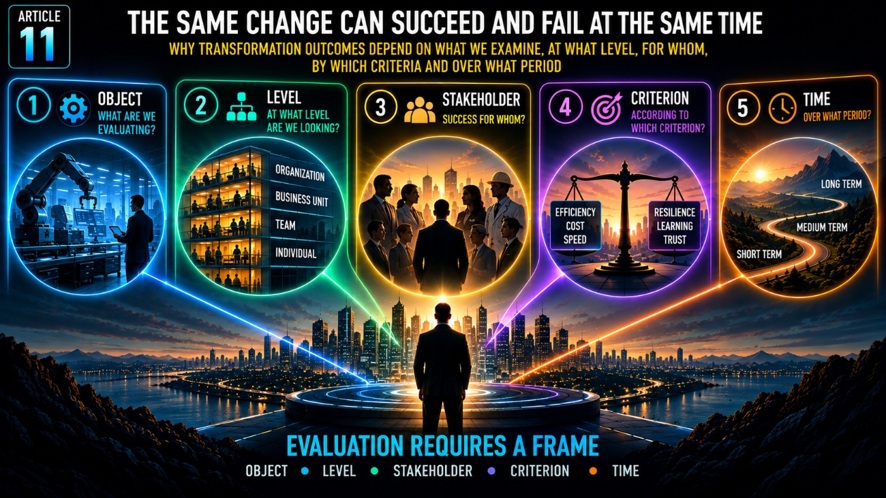
What Are We Evaluating?The first question concerns the
object of evaluation.
A transformation can affect work, authority, capabilities, relationships and organizational performance simultaneously.
Suppose a new operating model reduces cycle time.
If cycle time is the object of evaluation, the evidence may indicate improvement.
But the same operating model may also change how decisions are made, how knowledge circulates or how people develop.
Those are different objects.
Evaluating one does not automatically evaluate the others.
This distinction matters because organizations often move too quickly from:
This indicator improvedto:
The transformation succeeded.The second statement is much broader than the first.
Evidence about one object should not automatically be generalized into a judgment about the whole system.At What Level Are We Looking?The second question concerns the
level of analysis.
A change can improve performance locally while creating problems at another level of the system.
A team may become faster because it receives greater autonomy.
But if several teams optimize their work independently, coordination across the organization may become more difficult.
A business unit may reduce its costs by transferring activities to a shared service.
The unit's financial indicators improve.
But the shared service may become overloaded, increasing delays elsewhere.
Both observations may be accurate. They refer to different levels of the system.Local improvement is not automatically system improvement.And system improvement cannot always be inferred from the performance of its individual parts.
The question is therefore not only whether performance improved.
It is:
At what level did it improve — and what happened at the other levels affected by the change?Success for Whom?A third question concerns the
stakeholder.
Organizational transformations redistribute more than tasks.
They can redistribute benefits, costs, opportunities, authority and risk.
A process that improves convenience for customers may increase workload elsewhere.
Automation may reduce costs while changing developmental opportunities for people entering a profession.
None of this means that different stakeholder interests can always be reconciled.
Nor does it mean that every stakeholder consequence should be given identical weight.
It means that statements about success need to identify
whose experience, interests or outcomes are being considered.Without that clarity, “the transformation succeeded” can conceal an important distributional question:
Successful for whom?According to Which Criterion?Even when we agree on the object, level and stakeholder, evaluation can still change depending on the
criterion being used.
The same intervention may increase efficiency, reduce cost, strengthen resilience, improve customer experience or affect learning and trust.
These criteria are not interchangeable.
And they do not necessarily move in the same direction.
An organization can become more efficient while becoming less resilient.
It can reduce cost while increasing dependency.
It can increase local autonomy while weakening coherence across the system.
The problem is not that organizations use different criteria.
They should.
The problem arises when
one criterion silently becomes a proxy for overall success.A transformation judged only by cost tells us what happened to cost.
It does not, by itself, tell us what happened to the organization as a whole.
Over What Period?There is another dimension that can radically alter the judgment:
Time.A transformation can produce benefits immediately and costs later.
Or it can create short-term disruption while building capabilities that generate value over time.
A new technology may initially reduce productivity while people learn how to use it.
Later, performance may improve substantially.
Another intervention may produce immediate efficiency gains while gradually increasing dependency, reducing redundancy or weakening the development of human capability.
The judgment therefore depends partly on
when we evaluate.
This is particularly important because organizations often evaluate transformation according to reporting cycles that are shorter than some of the consequences they are trying to understand.
What looks successful after three months may look different after three years.
And what appears unsuccessful during transition may eventually prove valuable.
Time does not merely reveal additional outcomes. It can change how earlier evidence should be interpreted.Success and Failure Are Not Always OppositesWe often speak about success and failure as if they occupied opposite ends of a single scale.
But organizational change can produce multiple consequences simultaneously.
A transformation can therefore be successful in one respect and unsuccessful in another without either judgment necessarily being false.
This is not a logical contradiction.
The same realized change is not being judged differently under identical conditions. The judgments refer to different objects, levels, stakeholders, criteria or time horizons.
Success and failure can coexist because they may refer to different dimensions of the same realized change.This does not make evaluation impossible.
It makes evaluation more demanding.
This Does Not Mean That Everything Is RelativeThere is an obvious danger in this argument.
If every transformation can be examined from multiple perspectives, does that mean that any result can be described as either success or failure?
No.
Evidence still matters.
Criteria still matter.
Causal relationships still matter.
Some objectives will have been explicitly established in advance.
Some obligations, constraints and thresholds cannot simply be redefined after the fact.
The purpose of examining transformation across these dimensions is therefore not to make judgment arbitrary.
It is the opposite.
It is to make the basis of judgment
explicit and examinable.
Instead of simply saying:
The transformation succeeded.We need to make explicit what that judgment refers to.
That does not weaken evaluation.
It makes evaluation more rigorous.
Evaluation Requires a FrameA success story can be factually correct and still be incomplete.
So can a failure story.
The question is not whether the story is positive or negative.
The question is
what it leaves outside the frame.
A judgment about transformation requires five questions to be made explicit:
What are we evaluating?At what level?For whom?According to which criterion?Over what period?The judgment may differ depending on any one of these — even when the underlying observations remain the same.This gives us a more precise way to understand transformation evaluation:
Evaluation depends on the object, level, stakeholder, criterion and time horizon through which realized change is examined.This is not a formula for calculating success.
Nor is it a scorecard.
It is a discipline for making explicit
what a claim of success or failure actually refers to.
The Same Change Can Succeed and Fail at the Same TimeThe previous two articles established two distinctions.
Transformation is not a sequence.
It unfolds through interaction, feedback, adaptation and changing conditions.
And implementation is not realization.
What is introduced does not determine the organizational configuration that develops.
Now a third distinction becomes necessary.
Realization is not evaluation.Knowing what changed does not, by itself, tell us what that change means.
Meaning depends on what we examine, at what level, for whom, according to which criterion and over what period.
So the three questions form a progression:
How does change unfold?What does change become?What does change mean?Or, more compactly:
PROCESS → REALITY → EVALUATIONRigorous evaluation depends on understanding what was realized, just as understanding realization benefits from knowing how change unfolded through the system.
A roadmap can guide transformation without fully describing how it unfolds.
An intervention can be implemented without determining what the organization becomes.
And evidence of improvement can be valid without establishing that the transformation succeeded as a whole.
These distinctions do not make planning, implementation or evaluation less important. They make it necessary to understand what each can tell us, and what it cannot.
The challenge is therefore not simply to implement change or demonstrate improvement.
It is to understand how change unfolds, what the organization actually becomes, and how the consequences of that change should be evaluated.
PROCESS → REALITY → EVALUATIONThree distinct questions, connected by the same requirement: to examine the transformation that actually unfolds, rather than assume that what was planned, implemented or measured tells the whole story.
Posted on: October 11, 2026 04:21 AM |
Permalink