

Why might an ethics complaint be rejected or dismissed?


|
Before filing an ethics complaint through pmi.org/ethics, review these requirements. They can help you determine whether your complaint is eligible for consideration and what you will need to support it. Who is the Complainant? The individual, group, organization, or the Institute submits the complaint. A group or organization must designate one individual to represent it and receive correspondence. Who is the Respondent? The Covered Individual whose conduct is the subject of the complaint or investigation. Check out these requirements before submitting your complaint. Is an ethics complaint the right process for your concern?
What questions might arise during an ethics review? 1. Is the complaint against a Covered Individual? The ethics complaint process applies only to:
Complaints cannot be filed against companies or organizations themselves. You must identify the Covered Individual whose conduct is directly at issue. 2. Are you willing to identify yourself? Complaints cannot be submitted anonymously. You may also need to provide additional information. The Respondent will know the details of the complaint filed against them as well as the identity of the Complainant. You may need to participate in a hearing; the Respondent will also attend and answer questions from the hearing panel. 3. Have you identified a mandatory Code provision? A complaint must be based on one or more mandatory provisions of the Code. Aspirational provisions provide important ethical guidance but cannot serve as the basis for a complaint. A complaint alleging only violations of the aspirational provisions can be dismissed. 4. Can you support the complaint with facts? Code section 2.3.4 states: “We file ethics complaints only when they are substantiated by facts.” Describe the relevant facts, identify the mandatory Code provisions you believe may have been violated, and provide supporting evidence. Where appropriate, identify witnesses who can provide relevant information. Note: witnesses should be advised that they are named in the complaint and consent to be contacted should be obtained by the Complainant. 5. Is the matter already being addressed elsewhere? The Institute may delay consideration of, reject, or dismiss a complaint when substantially related civil or criminal litigation or other proceedings are before a court, regulatory agency, or other governmental body.A case may also be rejected or dismissed if the matter is being pursued through another PMI process, including the Chapter Mediation, Dispute, and Grievance Policy. 6. What is considered when deciding whether a complaint should proceed? The review considers whether:
7. Do you need to participate after filing? Yes, the Complainant is expected to cooperate. Failure to cooperate may result in action under the applicable procedures, including termination of the complaint when the Complainant does not cooperate. 8. Can you withdraw a complaint? Yes, a Complainant may withdraw an ethics complaint at any time by providing written notice. In case of any doubts, you may always contact us at [email protected]. We’ll be happy to answer all of your questions. |

Ethics in PMI Certification Part I – The Certification Process and the Code of Ethics
Introduction
Project Management Institute (PMI) certifications such as PMP® (Project Management Professional) are among the most respected credentials in the project management profession. Their value depends on trust; trust that certification holders have met rigorous eligibility requirements and earned their credentials through ethical conduct. However, the drive to obtain these credentials sometimes results in ethical challenges; whether intentional or not, ethical issues can lead to audits, application rejection, or even credential revocation. The Project Management Institute (PMI) Code of Ethics and Professional Conduct (CoEPC) is intended to guide the conduct of PMI members, certification holders, volunteers, and certification candidates throughout the credential lifecycle, including application, examination, certification maintenance, and professional practice. Some of the recurrent issues extracted from the ethics-related feedback received by the Ethics Advisory Team (EAT) are: Some cases stem from misunderstanding rather than intentional misconduct. However, inaccurate applications, unsupported claims, and examination violations can undermine the integrity, credibility, and fairness of the certification process. Left unchecked, these behaviours erode trust in PMI certifications and the profession as a whole. This post examines the alignment between some of the most prevalent ethics issues extracted by the members of the Ethics Advisory Team (EAT) from PMI feedback records and PMI’s Code of Ethics and Professional Conduct values of Responsibility, Respect, Fairness, and Honesty. Experience-Related ViolationsHonesty and Accurate Experience Reporting The PMI value of Honesty requires candidates to provide accurate and complete descriptions of their project management experience. Experience must be truthful, verifiable, and representative of actual project leadership responsibilities. When applicants fail to do so, they create a false representation of their qualifications. Fairness in Meeting Eligibility Requirements Certification eligibility standards exist to ensure all candidates are evaluated consistently. Candidates who embellish experience gain an advantage over honest candidates who invest the time and effort to meet PMI's requirements legitimately. This creates an uneven playing field and diminishes the value of the credential. Therefore, misrepresenting experience violates the PMI value of Fairness because it deprives other applicants of equal treatment under the certification process. Responsibility for Accurate Documentation Failure to properly document project leadership experience or to ensure information is accurate demonstrates a lack of professional accountability. Education and Training MisrepresentationHonest Reporting of Educational Qualifications PMI certifications require candidates to demonstrate specified levels of project management education and training. The PMI Code requires candidates to report educational qualifications accurately. Even if done unintentionally, the result may be certification based on inaccurate information. Because PMI relies heavily on candidate self-reporting, accurate disclosure is essential to maintaining trust in the certification process. Fair Competition Among Candidates Candidates who satisfy education requirements through legitimate coursework should not compete against individuals who inflate training records or count nonqualifying activities. Allowing unsupported educational claims would weaken standards and create unfair advantages. The value of Fairness requires all candidates to meet the same educational thresholds. Respect for Professional Standards Respect extends beyond interpersonal interactions. By honestly meeting education requirements, candidates demonstrate respect for: when they fulfill education requirements honestly. Attempting to bypass educational requirements demonstrates a lack of respect for the rigor and professional significance of PMI credentials. Examination Behaviour and Proctor-Terminated SessionsViolation of Responsibility The PMI Code requires certification candidates to comply with applicable rules and procedures. Leaving the testing area, ignoring instructions, or engaging in prohibited behaviours represents a failure to fulfill these responsibilities. Even when violations are unintentional, candidates remain accountable for understanding the rules governing certification examinations. Violation of Fairness Examination security exists to ensure every candidate competes under identical conditions. Even behaviour that merely creates the appearance of receiving outside assistance can call the fairness of the testing process into question. Consequently, behaviours that lead proctors to terminate sessions directly conflict with PMI's value of Fairness. Violation of Honesty Online certification examinations depend upon self-discipline and ethical conduct. Candidates are expected to honestly demonstrate their own knowledge and abilities. Attempting to circumvent testing rules, receive assistance, or compromise exam security is fundamentally inconsistent with the value of Honesty. Violation of Respect Testing conditions are established to protect all candidates. Failure to comply with proctor directions demonstrates a lack of respect for: Failed Audits and Certification RevocationsViolation of Honesty When auditors cannot verify submitted information, PMI's ability to rely on candidate honesty is compromised. Since certification decisions depend upon the integrity of application information, inaccurate or unverifiable claims undermine the ethical foundation of the program. Violation of Responsibility Candidates are responsible for maintaining records capable of supporting their claims. Failure to provide evidence during an audit may demonstrate inadequate professional responsibility, even when fraud is not present. Violation of Fairness Audits protect candidates who comply honestly with PMI requirements. Without audits, individuals who exaggerate education or experience could obtain certifications improperly. By identifying unsupported claims, audits uphold fairness for all credential holders. Violation of Respect Certification revocation occurs when PMI determines eligibility standards were not satisfied or when integrity concerns arise. Revocations help preserve respect for: Candidates who submit inaccurate applications ultimately devalue the achievement of individuals who earned certification through honest compliance. ConclusionPMI certifications derive their value not only from technical knowledge, but also from the ethical conduct of those who earn and maintain them.Every candidate plays a role in preserving the credibility of the PMI credentials by providing accurate information, following examination rules, maintaining supporting documentation, and acting in accordance with the PMI Code of Ethics and Professional Conduct. When certification holders uphold these standards, they strengthen trust in the profession and reinforce the value of PMI credentials worldwide. Viewed collectively, the education issues, experience misrepresentations, examination misconduct, and failed audits identified in the feedback data all threaten the credibility and integrity of PMI credentials. The audit process, examination security controls, and certification review mechanisms exist to protect the four foundational values of the PMI Code of Ethics and Professional Conduct and preserve public trust in PMI-certified professionals. Additional Resources·https://www.pmi.org/-/media/pmi/documents/public/pdf/ethics/pmi-code-of-ethics.pdf ·https://www.projectmanagement.com/blogs/365304/Ethics-Bistro ·https://www.pmi.org/about/ethics/guidelines ·https://www.pmi.org/certifications
|
Professionalism Under Pressure: Choosing Respect When Conflict Escalates
Categories:
Ethics as a competence,
Behavior,
courage honesty responsibility respect fairness,
code of ethics,
Ethical Leadership,
Decision-making,
Ethics Insight Team,
Ethics Bistro,
Business Ethics,
code of conduct,
Power Skills,
Decision-making,
Business Ethics,
Professionalization,
practitioner,
Ethical Dilemma,
respect,
Professional Responsibility,
Honesty,
Respect,
Responsibility,
Fairness,
Code of Ethics and Professional Conduct,
Human,
fairness,
communication,
honesty,
responsibility,
professonal conduct,
Conflict,
empathy,
EDMF,
Ethics in Communication,
Agile,
Decision Making,
Ethics,
Legal Project Management
Categories: Ethics as a competence, Behavior, courage honesty responsibility respect fairness, code of ethics, Ethical Leadership, Decision-making, Ethics Insight Team, Ethics Bistro, Business Ethics, code of conduct, Power Skills, Decision-making, Business Ethics, Professionalization, practitioner, Ethical Dilemma, respect, Professional Responsibility, Honesty, Respect, Responsibility, Fairness, Code of Ethics and Professional Conduct, Human, fairness, communication, honesty, responsibility, professonal conduct, Conflict, empathy, EDMF, Ethics in Communication, Agile, Decision Making, Ethics, Legal Project Management
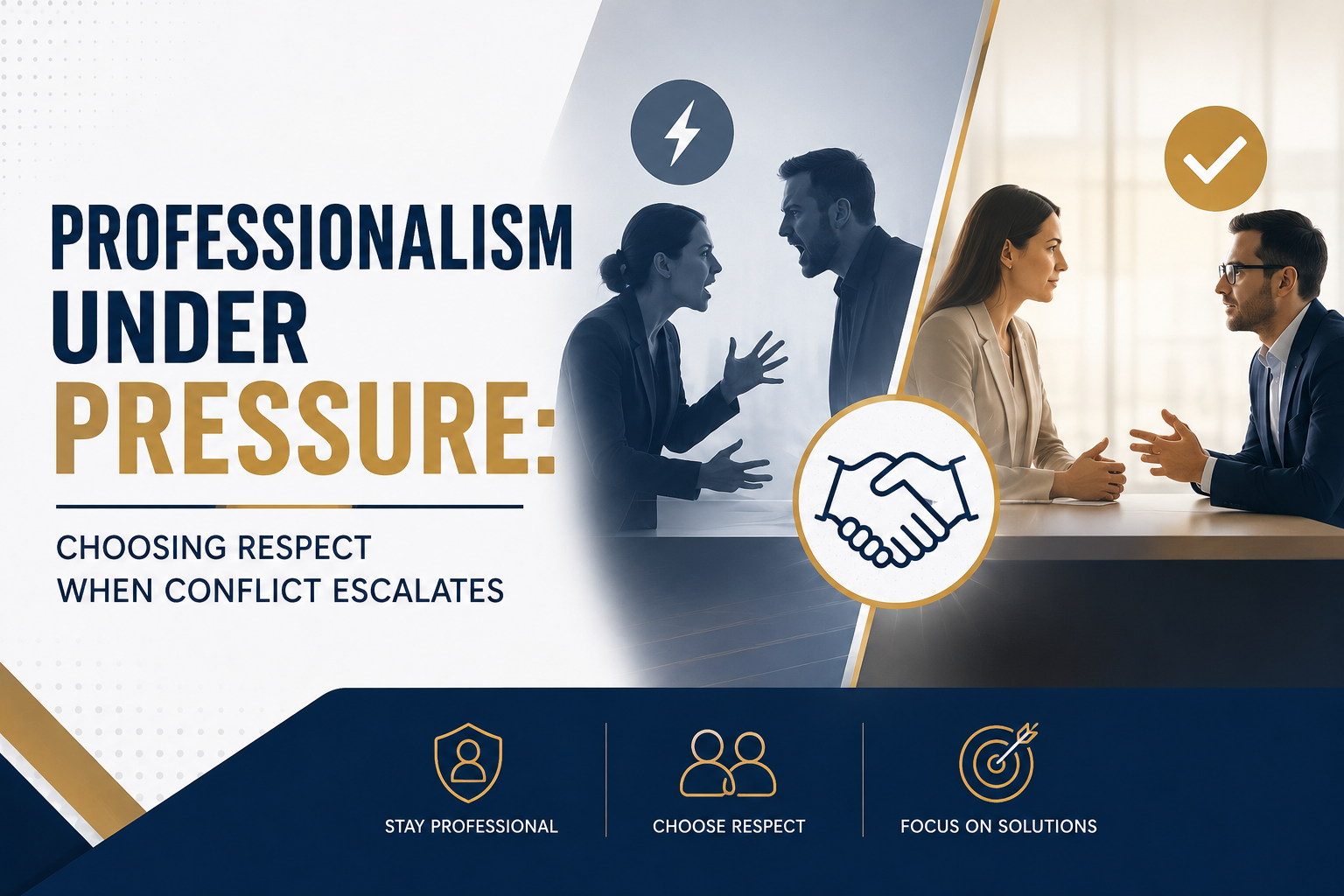 The message arrived at 11:47 p.m. It wasn't long. Just a few lines. But every sentence carried anger. A disagreement over a contract had been going on for weeks. There were questions about payment, responsibilities, and what each side believed had been promised. The conversation had already become uncomfortable. Now, the latest message crossed a different line. There were accusations. Personal insults. A veiled threat about “making sure people know” what had happened. And then came a remark about the other person's background. For a moment, the easiest response seemed obvious: Fight back. After all, they started it. But this is where professionalism is really tested not when everyone is calm and reasonable, but when someone gives us every reason to lose our composure. Conflict is part of professional life. Employment decisions can disappoint people. Contracts can fall apart. Candidates can feel unfairly treated. Managers can become frustrated. Clients and suppliers can disagree about commitments. Sometimes we are genuinely wronged. And sometimes we may be the ones who got something wrong. Either way, disagreement does not give us permission to abandon respect. The PMI Code of Ethics and Professional Conduct places Respect among its four core values. That sounds simple until we find ourselves staring at a message that feels deliberately insulting, threatening, or unfair. Respect is easy when it is reciprocated. It becomes meaningful when it isn't. The person receiving that late-night message eventually did something surprisingly difficult. They didn't respond. Not immediately. They saved the communication, stepped away from the computer, reviewed the facts, and went to bed. The next morning, they wrote back. The response acknowledged the disagreement. It clarified the contractual position. It proposed using the appropriate process to resolve the matter. There were no insults. No threats. No attempt to embarrass the other person. It wasn't weakness. It was professional self-control. Respect doesn't mean tolerating abuse. It doesn't mean remaining silent when discriminatory language is used. It doesn't mean accepting intimidation or allowing retaliation to go unchallenged. And it certainly doesn't mean avoiding difficult conversations. Sometimes respect means setting a boundary. Sometimes it means documenting what happened and involving Human Resources, legal counsel, procurement, recruitment leadership, or another appropriate authority. Sometimes it means saying: “I am willing to discuss the issue, but I will not continue the conversation in this manner.” That is respect too. Because respect isn't only about how we treat people when we agree with them. It is also about recognizing their dignity when we don't. And perhaps that's the uncomfortable part of professional ethics. We cannot control the tone of the message that arrives at 11:47 p.m. We cannot control whether someone tries to intimidate us, insults us, uses discriminatory language, or threatens retaliation. But we can control whether we respond in kind. We can choose to protect our boundaries without attacking someone else's dignity. We can choose accountability without humiliation. We can choose firmness without hostility. We can choose Respect. Not because the other person necessarily deserves our kindness in that moment, but because our professional values should not depend on someone else's behavior. The next time a difficult message lands in your inbox, ask yourself: When someone crosses the line with us, can we hold the line without crossing it ourselves? |
Behind closed doors: When decisions feel already made
|
The decision seemed straightforward, at least on the surface. A leadership role opened after the successful delivery of a project, and several team members demonstrated strong performance, commitment, and clear growth potential. However, when the announcement was made the outcome surprised many. Not because the selected individual lacked capability, mainly because the process lacked clarity. There were no transparent criteria, no visible evaluation process, and no opportunity for others to express interest. What was visible, however, was a prior relationship between the decision-maker and the selected individual. Intentionally or not, the perception of favoritism emerged immediately. This is how favoritism and nepotism tend to show up in project environments, not as obvious violations, but as subtle departures from fairness. Favoritism occurs when personal preferences influence professional decisions. Nepotism goes a step further, granting advantage to family members or close connections. In both cases, the issue is not always about competence, but about whether decisions are made impartially, objectively, and free from competing self-interest. From the perspective of PMI Code of Ethics and Professional Conduct, these situations directly challenge the core values: Responsibility, Respect, Fairness, and Honesty. Here is how each value comes into play: - Responsibility is about ownership, not just of decisions, but of their consequences. Leaders are accountable for how decisions are made and for ensuring they align with the best interests of stakeholders. Avoiding structure or relying solely on personal judgment can unintentionally create ethical gaps. - Respect goes beyond courtesy. It requires creating an environment where individuals feel valued, included, and able to contribute fully. When opportunities are not openly communicated, it limits participation and can undermine a sense of belonging within the team. - Fairness is where the tension becomes most visible. The Code is explicit: decisions must be made impartially, and opportunities should be equally available to qualified individuals. It also clearly states that we must not reward or deny opportunities based on personal considerations such as favoritism or nepotism. Even the appearance of a conflict of interest must be treated with care and transparency. - Honesty is about creating an environment where truth can be spoken and heard. This includes being transparent about how decisions are made and ensuring that information is complete, accurate, and not misleading. The consequences of overlooking these values are not always immediate, but they are real. For example: the high performer who disengages, the colleague who stops applying, the meeting where fewer voices are heard. Trust does not disappear overnight, and it gets slowly replaced by doubt. To be fair, leadership decisions are rarely black and white. Trust, experience, and working relationships matter. But ethical leadership requires more than good intent, it requires intentional processes. This means defining and documenting clear evaluation criteria before decisions are made, ensuring transparency in decision-making, involving multiple perspectives, and openly disclosing potential conflicts of interest when impartiality could reasonably be questioned. Even when decisions are ultimately sound, the absence of visible structure and transparency can weaken trust, create perceptions of bias, and discourage future engagement from team members who feel the process was not equitable. Because ultimately, the question is not just whether the right person was selected. It is whether the process reflects the values we claim to uphold. As the Code reminds us, every choice matters, and collectively, those choices shape the credibility of our profession. Have you ever experienced a situation where a decision felt influenced by favoritism, and how did it change the way you trust leadership? Share your thoughts in the comments and let’s continue the conversation References Link to PMI’s Code of Ethics and Professional Conduct: https://www.pmi.org/about/ethics/guidelines Link to PMI’s Ethical Decision-Making Framework (EDMF): https://www.pmi.org/ethics/ethical-decision-making-framework.pdf Link to PMI’s Blog on Ethics “Ethics Bistro”: https://www.projectmanagement.com/blogs/365304/ethics-bistro |

Cultural Shift: Artificial Intelligence, Machine Learning, and Project Practice
 We are now facing a new wave of transformation like the “webification” era two decades ago. This time, it is artificial intelligence (AI) and machine learning (ML). As project practitioners, we must ask: how do these technologies reshape company culture, and how do we guide organizations through the turbulence? AI is not just another tool—it changes how decisions are made, how work is distributed, and how value is delivered. It can automate repetitive tasks, provide predictive insights, and even challenge traditional hierarchies by empowering data-driven decision-making. However, these benefits come with cultural challenges, including trust, transparency, and ethical responsibility. Cultural change is often the most challenging aspect. With AI, the stakes are higher because people fear being replaced. To make a seamless shift, secure senior management buy-in; without leadership commitment, AI initiatives stall. Start with a pilot project involving a small, willing team that can demonstrate clear benefits, such as faster reporting, reduced errors, or improved forecasting. Use advocates and let these satisfied users share their success stories, which build momentum and reduce resistance. AI adoption should feel like a snowball rolling downhill, gaining speed and enthusiasm as more people recognize its value. Benefits must be crystal clear, where “AI” alone does not mean business value. Identify specific improvements, such as automating workflows to reduce manual errors, enhancing project visibility with predictive analytics, optimizing resource allocation to lower costs, and freeing staff from repetitive tasks so they can focus on creative, strategic work. When AI is introduced only for marketing buzz or compliance optics, resistance will be stronger. On the other hand, the cultural shift becomes smoother as the first AI initiative demonstrates tangible benefits. Information must be meaningful. Too often, AI systems generate dashboards or reports that overwhelm rather than enlighten. If end users cannot quickly find actionable insights, they will revert to old habits. Communication is critical, as it explains what AI will deliver, when, and how it should be used. It also provides training to ensure staff understand the system’s strengths and limitations and utilizes pilots to refine usability before scaling. In short, AI should empower, not confuse. Cultural change is cultural change, whether it is the web or AI. Start with strategy: what outcomes does the company want? Then identify processes that are most critical to achieving those outcomes. Engage the knowledge workers who understand those processes best. Facilitate discussions on how AI can enhance their capabilities. This engagement ensures that AI adoption is not imposed but rather co-created. It keeps the focus on the value delivered, rather than technology for its own sake. Remember: technology is a means, not an end. Bring the human side of the story. Sometimes the simplest benefits win hearts. During the web shift, putting the phone directory online was a breakthrough. For AI, start with something equally obvious, such as AI-driven scheduling that saves hours of manual coordination, smart search that retrieves project documents instantly, and/or automated compliance checks that reduce audit stress. Do not sell paradigm shifts; just sneak them in through everyday wins. From these perspectives, several themes emerge:
As project leaders, we must not only deliver benefits but also safeguard ethical values, as prescribed in the PMI Code of Ethics and Professional Conduct and stipulated in PMI Ethical Decision Making Framework. Here are actionable steps:
In closing, AI and ML are reshaping it today, just as the web transformed project management two decades ago. The challenge is not only technical but cultural. By focusing on strategy, demonstrating clear benefits, and embedding ethics into every initiative, we can deliver projects that are both successful and responsible. Let us commit to being ethical while delivering benefits and consider these questions:
References: Project Management Institute. (2025 November). PMI Code of Ethics and Professional Conduct. pmi.org. https://www.pmi.org/-/media/pmi/documents/public/pdf/ethics/pmi-code-of-ethics.pdf Project Management Institute. (2025 November). PMI Ethical Decision Making Framework. pmi.org. https://www.pmi.org/-/media/pmi/documents/public/pdf/ethics/ethical-decision-making-framework.pdf ==== |


