
Cognitive Sovereignty


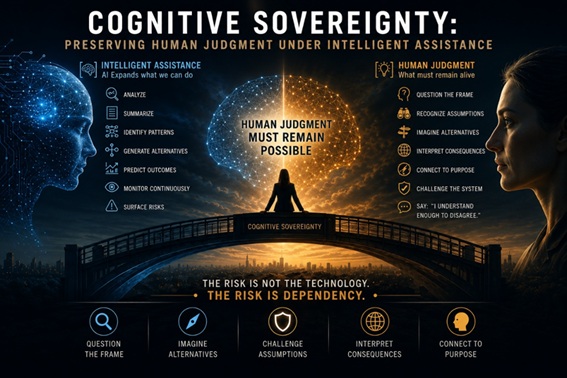 Preserving Human Judgment Under Intelligent Assistance Artificial intelligence is becoming extraordinarily good at helping humans think. It can analyze. Summarize. Compare. Prioritize. Recommend. Challenge. Predict. Generate alternatives. Reveal patterns. And increasingly, it can do these things faster, across more information, than any individual human could realistically process. This is an extraordinary expansion of human capability. But it also creates a question organizations have barely begun to confront. What happens when the intelligence supporting human judgment becomes so capable that humans gradually lose the capacity to judge without it? The question is not whether AI makes humans less intelligent. That would be simplistic. AI may dramatically expand what humans can understand. It may expose blind spots. Reduce cognitive overload. Improve access to knowledge. Challenge weak assumptions. Strengthen analysis. And support better decisions. The problem begins elsewhere. It begins when assistance quietly becomes dependency. A system recommends. The human considers. The recommendation is usually good. Trust grows. The human reviews less deeply. The system improves. The recommendation becomes the expected starting point. Independent analysis begins to appear redundant. Eventually, the human still decides. But increasingly, only after the system has defined what deserves attention. What alternatives appear reasonable. Which risks seem relevant. Which evidence is visible. And how the problem itself is framed. At that point, an uncomfortable question emerges. Is the human still exercising judgment, or merely selecting within a cognitive space already constructed by the system? This is the problem of cognitive sovereignty. Cognitive sovereignty does not mean thinking without artificial intelligence. It does not require rejecting intelligent assistance. It does not mean preserving human cognition in some technologically untouched state. That would be neither realistic nor desirable. Cognitive sovereignty is the capacity to remain meaningfully capable of interpreting, questioning, and judging when intelligence is increasingly mediated by systems. The distinction matters. Access to intelligence is not the same as ownership of judgment. A human may receive extraordinary analysis and still become less capable of challenging its assumptions. A leader may have better recommendations and weaker independent orientation. A team may make faster decisions while progressively losing the ability to recognize when the system has framed the wrong problem. An organization may become more intelligent while becoming increasingly dependent on the infrastructure through which intelligence is delivered. This dependency is difficult to detect. Because it often develops through success. Poor systems are challenged. Unreliable recommendations are questioned. Obvious errors preserve vigilance. Highly capable systems create a different behavioral environment. When recommendations are consistently useful, scrutiny becomes expensive. Independent analysis takes time. Reconstructing context creates friction. Questioning a high-performing system may appear irrational. Why repeat work the system already performs better? Why delay a decision to reconsider an analysis that is almost always correct? Why preserve capabilities that are rarely needed? These questions are reasonable. That is precisely why cognitive dependency can grow unnoticed. The greatest risk may not come from systems humans do not trust. It may come from systems humans have learned to trust almost completely. Trust changes attention. Attention changes practice. Practice changes capability. Capabilities that are rarely exercised weaken. Context that is continuously supplied is less frequently reconstructed. Alternatives that are consistently generated are less often independently imagined. Patterns that are automatically surfaced are less often actively searched for. Over time, the human role may change. From interpreting reality. To reviewing interpretation. From constructing alternatives. To choosing among generated alternatives. From identifying what matters. To validating what has been prioritized. From exercising judgment. To confirming a recommendation. The human remains in the loop. But the cognitive work performed by the human has changed. This is why cognitive sovereignty cannot be reduced to human approval. A person can approve a decision while contributing almost no independent judgment to it. A manager can remain formally responsible while lacking the contextual depth required to challenge the recommendation. A board can review AI-supported analysis while seeing only the reality the analytical architecture has made visible. A human signature proves presence. It does not prove cognitive sovereignty. This becomes particularly important after the accountability gap. If distributed influence makes consequences increasingly difficult to reconstruct, organizations may respond by assigning humans to supervise intelligent systems. But supervision assumes something. The supervisor must retain the capacity to judge the system being supervised. This assumption deserves far more attention. What happens when the system performs most of the analysis? When it maintains more context than the human? When it identifies patterns the human cannot independently perceive? When it generates the alternatives? When it continuously monitors the environment? When it remembers every relevant interaction? When it operates across a scale no individual can reconstruct? The human may retain authority. But authority alone does not guarantee judgment capacity. This creates a new asymmetry. The human may be formally empowered to challenge the system while becoming progressively less capable of knowing when challenge is necessary. That is a deeper problem than automation bias. Automation bias describes a tendency to over-rely on automated recommendations. Cognitive sovereignty concerns the preservation of the underlying capacity required to form, test, and defend judgment when intelligent assistance becomes structurally embedded in how the organization thinks. The difference is significant. Bias may distort a decision. Dependency may alter the decision-maker. A weak recommendation can be rejected. A weakened capacity for independent interpretation is harder to observe. Because the organization may continue performing exceptionally well. Decisions remain fast. Outputs improve. Errors decline. Productivity increases. The system appears successful. Yet beneath performance, something may be changing. The organization may be losing cognitive optionality. Its ability to think through alternative interpretative structures. Its ability to operate when the dominant intelligence infrastructure is unavailable. Its ability to recognize assumptions embedded within the systems it relies upon. Its ability to challenge the categories through which reality is being represented. Its ability to ask a question the system was never designed to prioritize. This is why cognitive sovereignty is not simply an individual skill. It is an organizational capability. Organizations shape how judgment is exercised. They determine which information reaches decision-makers. Which systems frame problems. Which recommendations become defaults. Which metrics receive attention. Which forms of expertise are preserved. Which capabilities are allowed to weaken. And which forms of dissent remain legitimate. An organization can unintentionally design cognitive dependency into its operating model. Not through a single decision. But through accumulated convenience. Analysis is automated. Then prioritization. Then recommendation. Then scenario generation. Then monitoring. Then exception detection. At each stage, human effort is reduced. Performance improves. But a question is rarely asked: What human capability are we no longer exercising because the system now performs it for us? This question should not lead automatically to preservation. Not every human capability must be retained. Organizations do not preserve manual calculation because calculators exist. They do not require humans to memorize information that systems can retrieve more reliably. Technological progress has always changed which capabilities matter. Wisdom is not nostalgia. And cognitive sovereignty is not cognitive conservatism. The relevant question is more precise. Which human capacities must remain sufficiently alive for responsibility to remain meaningfully exercisable? This is the boundary condition. If a capability has no meaningful role in future judgment, allowing it to disappear may be entirely rational. But if its loss makes humans unable to interpret context, question assumptions, recognize abnormality, imagine alternatives, or challenge the systems they govern, then efficiency gains may be purchasing a hidden dependency. This distinction becomes especially important because human judgment is not produced at the moment of approval. Judgment develops through exposure. Interpretation. Comparison. Failure. Reflection. Pattern recognition. Contextual experience. And repeated confrontation with ambiguity. If humans are systematically removed from these cognitive processes, organizations cannot assume that judgment will remain intact and simply become available when an exceptional situation requires it. Judgment cannot be placed on standby indefinitely and expected to remain fully operational. The problem is not only that cognitive work changes. The architecture of exposure changes with it. A leader who sees only escalations may gradually lose contact with normal variation. A reviewer who sees only system-selected exceptions may become dependent on the system's definition of exceptional. A decision-maker who receives pre-structured alternatives may become less practiced at recognizing missing alternatives. A board that sees increasingly optimized abstractions may become more informed and less connected to the conditions from which those abstractions emerge. The paradox is uncomfortable. The better intelligent systems become at supporting judgment, the easier it may become to stop exercising some of the capacities that make meaningful judgment possible. This does not mean organizations should artificially preserve human inefficiency. It means they must become deliberate about cognitive capability. Some judgment capacities may need to be exercised even when the system performs better. Not because humans must outperform AI. But because humans may remain accountable for recognizing when the system's frame, objective, boundary, or consequence requires challenge. This changes the purpose of human involvement. The human should not remain in the loop merely to repeat the machine's analysis. That creates friction without sovereignty. Nor should humans be asked to approve decisions they lack the context to challenge. That creates accountability without meaningful judgment. Human involvement becomes valuable when it preserves capabilities the system cannot legitimately be allowed to make irrelevant to governance. The capacity to question the frame. To recognize when a measured objective has displaced a meaningful purpose. To interpret consequences beyond the optimization domain. To connect present action with organizational identity. To challenge assumptions that have become invisible through repeated system success. To ask whether the decision remains legitimate even when the system is technically correct. These are not arguments for human superiority. AI may challenge frames. Detect objective drift. Model broader consequences. Identify hidden assumptions. And expose contradictions more effectively than humans in many contexts. The issue is not whether AI can participate in these functions. It should. The issue is whether organizations should allow their own capacity to exercise independent judgment to become entirely contingent on the same intelligence infrastructure they are expected to govern. The capacity to challenge a system becomes fragile when the human understanding required to question it depends entirely on the same intelligence infrastructure being challenged. This may become one of the defining tensions of AI-native organizations. The future will not be a choice between human intelligence and artificial intelligence. It will be a question of cognitive architecture. Which forms of intelligence interact? Which forms of judgment remain exercised? Where does interpretation occur? How are assumptions exposed? How can alternative frames emerge? What capabilities must remain independently available? And under what conditions can a human genuinely say: I understand enough to disagree. That may be one of the most important tests of cognitive sovereignty. Not whether humans make every decision. Not whether humans outperform intelligent systems. Not whether every recommendation is independently reproduced. But whether humans remain meaningfully capable of questioning the intelligence on which they increasingly depend. Because assistance can expand capability. Dependence can reduce optionality. And when judgment becomes entirely dependent on the systems it is meant to govern, human authority may remain formally intact while its cognitive foundation quietly erodes. The future of responsible autonomy therefore depends on more than preserving human authority. It depends on preserving the human capacity required to exercise that authority meaningfully. Because accountability without judgment is ceremonial. Authority without comprehension is fragile. And sovereignty without the capacity to disagree may be sovereignty in name only. The next question is therefore no longer whether humans should remain responsible. Nor simply what organizations should refuse to delegate. It is this: How should human-AI decision systems be designed so that autonomy can expand without responsibility becoming merely symbolic? |
Posted on: July 27, 2026 03:25 AM
| Permalink |
Comments (1)


