Support to Develop
by Luis Branco

This blog addresses management-related topics and has three areas of focus: 1. Technical skills; 2. Competencies in the field of interpersonal relations and communication (including personal organization and delegation, leadership, teamwork, conflict resolution, conducting meetings, and negotiation); and 3. Strategy (including diagnosis, strategic guidelines, and implementation).4.Technology
Recent Posts
Who Develops the Capabilities We Still Need?
Is the Project Manager Still the Right Unit of Professional Identity?
When Sponsorship Meets Ownership: Does PMI's Responsible Sponsorship Guide Close the Governance Gap?
When Does Control Preserve Coherence, and When Does It Constrain Adaptability?
Can Accountability Remain Legitimate When Authority Is Distributed?
Categories
Agile,
Career Development,
Career Development,
Career Development,
Career Development,
Career Development,
Career Development,
Career Development,
Career Development,
Career Development,
Career Development,
Career Development,
Career Development,
Career Development,
Career Development,
Career Development,
Career Development,
Career Development,
Career Development,
Career Development,
Career Development,
Career Development,
Career Development,
Career Development,
Career Development,
Career Development,
Career Development,
Career Development,
Career Development,
Career Development,
Career Development,
Career Development,
Career Development,
Career Development,
Career Development,
Career Development,
Career Development,
Career Development,
Career Development,
Career Development,
Career Development,
Career Development,
Career Development,
Career Development,
Career Development,
Career Development,
Career Development,
Career Development,
Career Development,
Career Development,
Career Development,
Career Development,
Career Development,
Career Development,
Career Development,
Career Development,
Career Development,
Career Development,
Career Development,
Career Development,
Career Development,
Career Development,
Career Development,
Career Development,
Career Development,
Career Development,
Career Development,
Career Development,
Career Development,
Career Development,
Career Development,
Career Development,
Career Development,
Career Development,
Career Development,
Career Development,
Career Development,
Career Development,
Career Development,
Career Development,
Career Development,
Career Development,
Career Development,
Career Development,
Career Development,
Career Development,
Career Development,
Career Development,
Career Development,
Career Development,
Career Development,
Career Development,
Career Development,
Career Development,
Career Development,
Career Development,
Career Development,
Career Development,
Career Development,
Career Development,
Career Development,
Career Development,
Career Development,
Career Development,
Career Development,
Career Development,
Career Development,
Career Development,
Career Development,
Career Development,
Career Development,
Career Development,
Career Development,
Career Development,
Career Development,
Career Development,
Career Development,
Career Development,
Career Development,
Career Development,
Career Development,
Career Development,
Career Development,
Education,
Governance,
Governance,
Governance,
Governance,
Governance,
Governance,
Governance,
Governance,
Governance,
In,
Integration Management,
Interpersonal Skills,
Interpersonal Skills,
Interpersonal Skills,
Interpersonal Skills,
Interpersonal Skills,
Interpersonal Skills,
Interpersonal Skills,
Interpersonal Skills,
Interpersonal Skills,
Interpersonal Skills,
Interpersonal Skills,
Interpersonal Skills,
Interpersonal Skills,
Interpersonal Skills,
Interpersonal Skills,
Interpersonal Skills,
Interpersonal Skills,
Interpersonal Skills,
Interpersonal Skills,
Interpersonal Skills,
Interpersonal Skills,
Interpersonal Skills,
Interpersonal Skills,
Interpersonal Skills,
Interpersonal Skills,
Interpersonal Skills,
Interpersonal Skills,
Interpersonal Skills,
Interpersonal Skills,
Interpersonal Skills,
Interpersonal Skills,
Interpersonal Skills,
Interpersonal Skills,
Interpersonal Skills,
Interpersonal Skills,
Interpersonal Skills,
Interpersonal Skills,
Interpersonal Skills,
Interpersonal Skills,
Interpersonal Skills,
Interpersonal Skills,
Interpersonal Skills,
Interpersonal Skills,
Interpersonal Skills,
Interpersonal Skills,
Interpersonal Skills,
Interpersonal Skills,
Interpersonal Skills,
Interpersonal Skills,
Interpersonal Skills,
Interpersonal Skills,
Interpersonal Skills,
Interpersonal Skills,
Interpersonal Skills,
Interpersonal Skills,
Interpersonal Skills,
Interpersonal Skills,
Interpersonal Skills,
Interpersonal Skills,
Interpersonal Skills,
Interpersonal Skills,
Interpersonal Skills,
Interpersonal Skills,
Interpersonal Skills,
Interpersonal Skills,
Interpersonal Skills,
Interpersonal Skills,
Interpersonal Skills,
Interpersonal Skills,
Interpersonal Skills,
Interpersonal Skills,
Interpersonal Skills,
Interpersonal Skills,
Interpersonal Skills,
Interpersonal Skills,
Interpersonal Skills,
Interpersonal Skills,
Interpersonal Skills,
Interpersonal Skills,
Interpersonal Skills,
Interpersonal Skills,
Interpersonal Skills,
Interpersonal Skills,
Interpersonal Skills,
Interpersonal Skills,
Interpersonal Skills,
Interpersonal Skills,
Interpersonal Skills,
Interpersonal Skills,
Interpersonal Skills,
Interpersonal Skills,
Interpersonal Skills,
Interpersonal Skills,
Interpersonal Skills,
Interpersonal Skills,
Interpersonal Skills,
Interpersonal Skills,
Interpersonal Skills,
Interpersonal Skills,
Interpersonal Skills,
Interpersonal Skills,
Interpersonal Skills,
Interpersonal Skills,
Interpersonal Skills,
Interpersonal Skills,
Interpersonal Skills,
Interpersonal Skills,
Interpersonal Skills,
Interpersonal Skills,
Interpersonal Skills,
Interpersonal Skills,
Interpersonal Skills,
Interpersonal Skills,
Interpersonal Skills,
Interpersonal Skills,
Interpersonal Skills,
Interpersonal Skills,
Interpersonal Skills,
Interpersonal Skills,
Interpersonal Skills,
Interpersonal Skills,
Interpersonal Skills,
Knowledge Management,
le,
lea,
Leadership,
Leadership,
Leadership,
Leadership,
Leadership,
Leadership,
Leadership,
Leadership,
Leadership,
Leadership,
Leadership,
Leadership,
Leadership,
Leadership,
Leadership,
Leadership,
Leadership,
Leadership,
Leadership,
Leadership,
Leadership,
Leadership,
Leadership,
Leadership,
Leadership,
Leadership,
Leadership,
Leadership,
Leadership,
Leadership,
Leadership,
Leadership,
Leadership,
Leadership,
Leadership,
Leadership,
Leadership,
Leadership,
Leadership,
Leadership,
Leadership,
Leadership,
Leadership,
Leadership,
Leadership,
Leadership,
Leadership,
Leadership,
Leadership,
Leadership,
Leadership,
Leadership,
Leadership,
Leadership,
Leadership,
Leadership,
Leadership,
Leadership,
Leadership,
Leadership,
Leadership,
Leadership,
Leadership,
Leadership,
Leadership,
Leadership,
Leadership,
Leadership,
Leadership,
Leadership,
Leadership,
Leadership,
Leadership,
Leadership,
Leadership,
Leadership,
Leadership,
Leadership,
Leadership,
Leadership,
Leadership,
Leadership,
Leadership,
Leadership,
Leadership,
Leadership,
Leadership,
Leadership,
Leadership,
Leadership,
Leadership,
Leadership,
Leadership,
Leadership,
Leadership,
Leadership,
Leadership,
Leadership,
Leadership,
Leadership,
Leadership,
Leadership,
Leadership,
Leadership,
Leadership,
Leadership,
Leadership,
Leadership,
Leadership,
Leadership,
Leadership,
Leadership,
Leadership,
Leadership,
Leadership,
Leadership,
Leadership,
Leadership,
Leadership,
Leadership,
Leadership,
Leadership,
Leadership,
or,
Organizational Project Management,
Portfolio Management,
Program,
Program Management,
Strategy,
Strategy,
Strategy,
Strategy,
Strategy,
Strategy,
Strategy,
Strategy,
Strategy,
Strategy,
Strategy,
Strategy,
Strategy,
Strategy,
Strategy,
Strategy,
Strategy,
Strategy,
Strategy,
Strategy,
Strategy,
Strategy,
Strategy,
Strategy,
Strategy,
Strategy,
Strategy,
Strategy,
Strategy,
Strategy,
Strategy,
Strategy,
Strategy,
Strategy,
Strategy,
Strategy,
Strategy,
Strategy,
Strategy,
Strategy,
Strategy,
Strategy,
Strategy,
Strategy,
Strategy,
Strategy,
Strategy,
Strategy,
Strategy,
Strategy,
Strategy,
Strategy,
Strategy,
Strategy,
Strategy,
Strategy,
Strategy,
Strategy,
Strategy,
Strategy,
Strategy,
Strategy,
Strategy,
Strategy,
Strategy,
Strategy,
Strategy,
Strategy,
Strategy,
Strategy,
Strategy,
Strategy,
Strategy,
Strategy,
Strategy,
Strategy,
Strategy,
Strategy,
Strategy,
Strategy,
Strategy,
Strategy,
Strategy,
Strategy,
Strategy,
Strategy,
Strategy,
Strategy,
Strategy,
Strategy,
Strategy,
Strategy,
Strategy,
Strategy,
Strategy,
Strategy,
Strategy,
Strategy,
Strategy,
Strategy,
Strategy,
Strategy,
Strategy,
Strategy,
Strategy,
Strategy,
Strategy,
Strategy,
Strategy,
Strategy,
Strategy,
Strategy,
Strategy,
Strategy,
Strategy,
Strategy,
Strategy,
Strategy,
Strategy,
Strategy,
Strategy,
Strategy,
Strategy,
Sustainability,
Talent Management,
Talent Management,
Talent Management,
Talent Management,
Talent Management,
Talent Management,
Talent Management,
Talent Management,
Talent Management,
Talent Management,
Talent Management,
Talent Management,
Talent Management,
Talent Management,
Talent Management,
Talent Management,
Talent Management,
Talent Management,
Talent Management,
Talent Management,
Talent Management,
Talent Management,
Talent Management,
Talent Management,
Talent Management,
Talent Management,
Talent Management,
Talent Management,
Talent Management,
Talent Management,
Talent Management,
Talent Management,
Talent Management,
Talent Management,
Talent Management,
Talent Management,
Talent Management,
Talent Management,
Talent Management,
Talent Management,
Talent Management,
Talent Management,
Talent Management,
Talent Management,
Talent Management,
Talent Management,
Talent Management,
Talent Management,
Talent Management,
Talent Management,
Talent Management,
Talent Management,
Talent Management,
Talent Management,
Talent Management,
Talent Management,
Talent Management,
Talent Management,
Talent Management,
Talent Management,
Talent Management,
Talent Management,
Talent Management,
Talent Management,
Talent Management,
Talent Management,
Talent Management,
Talent Management,
Talent Management,
Talent Management,
Talent Management,
Talent Management,
Talent Management,
Talent Management,
Talent Management,
Talent Management,
Talent Management,
Talent Management,
Talent Management,
Talent Management,
Talent Management,
Talent Management,
Talent Management,
Talent Management,
Talent Management,
Talent Management,
Talent Management,
Talent Management,
Talent Management,
Talent Management,
Talent Management,
Talent Management,
Talent Management,
Talent Management,
Talent Management,
Talent Management,
Talent Management,
Talent Management,
Talent Management,
Talent Management,
Talent Management,
Talent Management,
Talent Management,
Talent Management,
Talent Management,
Talent Management,
Talent Management,
Talent Management,
Talent Management,
Talent Management,
Talent Management,
Talent Management,
Talent Management,
Talent Management,
Talent Management,
Talent Management,
Talent Management,
Talent Management,
Talent Management,
Talent Management,
Talent Management,
Talent Management,
Talent Management
Date
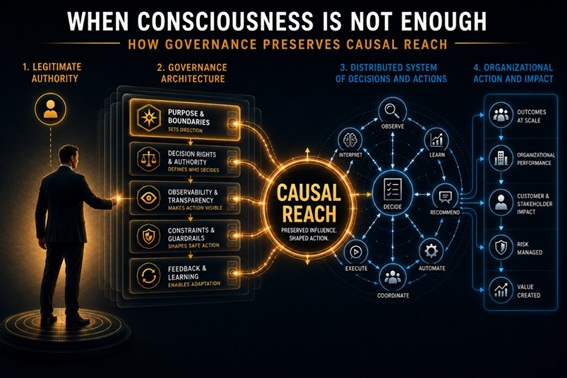
How Governance Preserves Causal Reach
For decades, organizations have relied on a remarkably stable assumption.
Responsible governance begins with conscious human judgment.
Boards establish direction. Executives exercise authority. Managers make decisions. Policies define expectations. Accountability identifies who ultimately answers for organizational outcomes.
This model has endured because authority, judgment and organizational action remained closely connected. Those entrusted with legitimate authority could generally understand how important decisions were formed, intervene before consequences became irreversible and explain why particular choices had been made.
Artificial intelligence does not invalidate that model.
It changes the conditions under which it must operate.
Computational capabilities are no longer confined to automation or decision support. Increasingly, they observe environments, interpret information, generate recommendations, coordinate workflows and, under appropriate governance, execute organizational actions. Organizational action is therefore becoming progressively distributed across human and computational capabilities rather than originating from a single identifiable decision-maker.
This transition creates a governance problem that is fundamentally architectural rather than technological.
Human authority may remain formally intact while progressively losing practical influence over how organizational action is actually produced.
That possibility deserves far more attention than the technology itself.
Conscious Governance Remains Indispensable
Nothing in this transition reduces the importance of human judgment.
Organizations continue to require people capable of interpreting context, weighing competing values, exercising moral and strategic judgment, accepting responsibility and determining what should remain legitimate.
Conscious governance therefore remains indispensable.
It defines purpose.
It establishes legitimacy.
It determines responsibility.
It provides the ethical and institutional foundation upon which governance rests.
Without conscious governance there can be no legitimate governance.
Yet conscious intention alone no longer guarantees that legitimate authority will continue to shape organizational reality.
An organization may sincerely value responsibility while operating processes that gradually separate responsibility from the way organizational action is formed.
It may assign authority to executives who no longer influence the assumptions embedded upstream.
It may preserve human approval while allowing increasingly consequential judgments to emerge long before that approval is exercised.
It may maintain accountability after outcomes while progressively losing influence before those outcomes are created.
None of this necessarily reflects negligence or misconduct.
Every participant may act responsibly.
Every policy may remain formally valid.
Every governance structure may continue to exist.
Yet organizational action may increasingly emerge through interactions that no individual actor fully controls, fully observes or fully understands.
The challenge is therefore not a decline in human responsibility.
It is a decline in governance's ability to remain causally relevant.
From Formal Authority to Causal Reach
Traditional governance asks an important question.
Who possesses legitimate authority?
AI-enabled organizations require a second question.
To what extent does that authority continue to shape how organizational action is actually produced?
These questions are no longer equivalent.
Formal authority identifies who is institutionally empowered to govern.
Governance causal reach describes the extent to which that legitimate authority continues to influence, redirect, interrupt and shape organizational action before its consequences become operationally significant.
Governance does not lose relevance when humans cease to participate.
It loses relevance when legitimate human authority no longer retains sufficient causal reach over the processes through which organizational action is formed.
An executive may retain final approval while exerting little influence over the observations, classifications, recommendations and priorities that have already narrowed the available decision space.
A board may remain ultimately accountable while possessing limited visibility into the organizational architecture through which consequential actions progressively emerge.
Managers may continue to carry responsibility while losing meaningful opportunities to redirect organizational action before its effects propagate.
Authority therefore risks becoming retrospective rather than formative.
It continues to explain outcomes.
It progressively ceases to shape them.
This distinction represents one of the defining governance challenges of AI-enabled organizations.
Governance Must Shape Conditions, Not Merely Decisions
Traditional governance has concentrated primarily on decisions.
Who approved them?
Who owns the outcome?
Who answers for failure?
These questions remain necessary.
They become insufficient when organizational action emerges through distributed observations, interpretations, recommendations, automated processes, human interventions and adaptive workflows.
Under these conditions, governance cannot rely exclusively on assigning accountability after organizational action has already emerged.
It must preserve influence over the conditions through which that action becomes possible.
The objective is not to determine every decision in advance.
Nor is it to eliminate human discretion.
Rather, governance must preserve sufficient causal reach over the architecture within which autonomy is exercised.
This requires attention not only to people, but also to permissions, boundaries, escalation conditions, observability, reversibility, validation mechanisms and other architectural properties that determine how organizational action may emerge.
The question therefore changes.
Governance is no longer concerned only with who decides.
It must also determine the conditions within which decisions are formed.
Constraints Preserve Causal Reach
Architectural constraints become significant within this context.
A constraint is not simply a restriction.
It is an architectural condition that shapes the legitimate space within which autonomy may operate.
Properly designed constraints define the domain of authorized action before organizational consequences emerge.
They may determine:
- Where autonomous action is permitted;
- When human validation becomes necessary;
- Which conditions trigger escalation;
- Which actions remain reversible;
- Which resources may be accessed;
- Which organizational boundaries cannot be crossed;
- Who possesses authority to modify operating conditions.
Their purpose is not to replace judgment.
Their purpose is to preserve governance's causal reach.
They help ensure that legitimate authority continues to influence how organizational action is produced rather than merely assigning responsibility after that action has already occurred.
This distinction is essential.
Constraints do not create legitimacy.
They inherit legitimacy.
An executable rule is not legitimate because software can enforce it.
A constraint may faithfully preserve an obsolete assumption.
It may reinforce historical bias.
It may privilege efficiency while undermining justice.
It may remain technically correct while becoming organizationally inappropriate.
Architectural constraints therefore require continuing legitimacy.
Their validity depends upon the authority from which they derive, the purpose they protect, their proportionality, their transparency, their contestability and their capacity for responsible revision.
Constraint governance should never become governance separated from judgment.
It should become conscious governance expressed architecturally.
Responsible Autonomy Requires Boundaries
Constraints are often portrayed as the opposite of autonomy.
In practice, the relationship is more subtle.
Appropriately designed boundaries frequently make greater autonomy possible.
Teams act with greater confidence when decision rights are clear.
Managers delegate more effectively when authority is explicit.
Organizations scale more safely when local decisions remain connected to legitimate organizational objectives.
Computational systems may operate with greater autonomy when escalation conditions, prohibited states and validation requirements are architecturally defined.
The objective is therefore not greater control.
It is greater responsible autonomy.
Freedom without boundaries frequently transfers uncertainty rather than increasing capability.
Boundaries without judgment produce bureaucracy.
Responsible autonomy requires both.
The challenge is not choosing between autonomy and constraints.
It is designing constraints that preserve freedom while protecting legitimate organizational responsibility.
Governance Always Has a Cost
Architectural governance is neither free nor universally beneficial.
Constraints introduce operational, cognitive and coordination costs.
They require design.
They require monitoring.
They require maintenance.
They require periodic revision.
Poorly designed constraints may reduce adaptability.
Excessive constraints may create organizational rigidity.
Outdated constraints may preserve yesterday's assumptions instead of today's legitimate intentions.
Organizations may eventually comply with their own architecture while that architecture progressively ceases to represent the principles from which it originally derived.
Constraint governance should therefore never be evaluated by the number of controls it introduces.
It should be evaluated by the organizational value it preserves.
Well-designed constraints can reduce systemic risk, enable safer delegation, lower the cost of continuous supervision and increase decision speed within legitimate boundaries.
Poorly designed constraints merely replace human bureaucracy with digital bureaucracy.
Their value is therefore contingent rather than absolute.
Governance Must Remain Adaptable
Neither organizations nor their environments remain static.
Strategies evolve.
Markets evolve.
Technologies evolve.
Institutional expectations evolve.
Constraints that once preserved legitimate authority may gradually cease to do so.
Their continued existence does not guarantee their continued legitimacy.
Preserving governance's causal reach therefore requires more than designing architectural constraints.
It requires preserving the organizational capacity to review, challenge, adapt and, where necessary, retire them without losing the legitimacy from which they originally derived.
Constraint governance is not the replacement of conscious governance.
It is its operational continuation.
Conscious governance determines what should remain legitimate.
Architectural governance determines how that legitimacy acquires organizational influence.
Constraint governance helps preserve that influence as organizational action becomes progressively distributed.
Yet even this introduces a deeper challenge.
What happens when organizational action evolves faster than governance itself can understand whether its own constraints remain appropriate?
That question moves beyond architecture alone.
It becomes a question of time.
It becomes a question of governance at machine speed.
That is where the next article begins. |
Posted on: August 05, 2026 06:46 AM
|
Permalink |
Comments (2)




