
When Time Becomes a Governance Problem


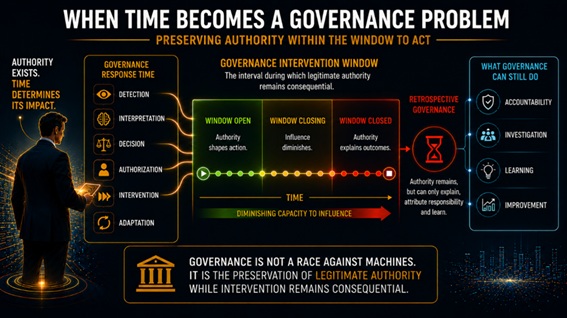 Preserving Authority Within the Window to Act Organizations have always governed under conditions of uncertainty. Markets evolve faster than strategic plans. Operational decisions frequently precede complete information. Crises demand action before every consequence can be understood. Governance has therefore never depended upon eliminating uncertainty or slowing organizational life. It has depended upon preserving the capacity of legitimate authority to influence action before its consequences become unacceptable. Across many conventional organizational settings, governance developed around the assumption that the time required to observe events, interpret their significance, deliberate, authorize a response and intervene would fit within the period during which action remained materially alterable. Governance and organizational action operated within broadly compatible temporal horizons. That compatibility can no longer be assumed. In some organizational contexts, artificial intelligence is transforming the temporal architecture through which action is produced. Computational capabilities participate continuously in observation, interpretation, prioritization, coordination, recommendation and, under defined conditions, autonomous execution. Decisions that previously unfolded over hours may now develop in seconds. Operational states that once changed gradually may shift continuously. Interdependent systems can propagate the consequences of local actions across organizational boundaries before conventional governance processes have completed their own cycles of interpretation and authorization. The challenge is not simply that machines operate faster than humans. Organizations have always combined actors with different speeds and capabilities. The deeper challenge is that governance may no longer operate within the period during which organizational action can still be influenced. Authority may remain formally intact. Boards continue to govern. Executives retain legitimate mandates. Managers carry accountability. Policies define organizational expectations. Yet governance may progressively lose the opportunity to exercise that authority while intervention can still alter the course of action. The previous article argued that governance depends upon preserving causal reach. Legitimate authority must continue to shape how organizational action is formed rather than merely assigning responsibility after outcomes have emerged. This article adds a temporal condition. Causal reach remains effective only while authority can exercise it within consequential time. The central question is therefore not whether humans remain involved in decision-making or whether computational systems become faster. It is whether governance can still make a causally effective difference while intervention remains possible. Time has become an architectural property of governance. Governance Is Not Measured by Speed A common response to increasingly autonomous systems is to assume that governance must simply become faster. If systems execute decisions in milliseconds, governance appears to require comparable speed. But governance is not a race against computation. Its purpose is not to match machine speed. It is to preserve legitimate authority within the period during which that authority can still alter the outcome. Speed alone is therefore an inadequate measure of governability. A highly autonomous system may operate at extraordinary speed while remaining relatively straightforward to govern if its actions are transparent, localized, easily reversible and subject to effective containment. Conversely, a slower organizational process may be difficult to govern if its consequences become irreversible before authority can intervene. The relevant variable is not speed in isolation. It is the remaining opportunity to influence action before important alternatives disappear. This period will be referred to as the governance intervention window. Its significance does not lie in preserving time for its own sake. It lies in preserving the opportunity for governance to remain causally consequential. When that opportunity disappears, governance does not vanish institutionally. Authority may remain present. Accountability may continue to be assigned. Investigations may occur and lessons may be learned. But governance has shifted from shaping the action to explaining it. Authority has become temporally retrospective. To understand how this transition occurs, we must first examine how governance itself consumes time. Governance Response Time Every act of governance unfolds through a sequence of temporal processes. Relevant conditions must become visible. Their significance must be interpreted. Potential consequences must be understood. The organization must determine whether intervention is justified. Legitimate authority must authorize an appropriate response. That response must then alter the course of action. These activities are often treated as one general delay. In reality, they represent distinct forms of latency:
It may understand the risk but lack clarity regarding who has authority to act. Authority may be identified without the technical means to interrupt the process. Intervention may eventually occur, but only after consequences have propagated beyond effective containment. Governance response time reflects the accumulated latency of this sequence, although a single bottleneck may disproportionately determine whether intervention remains viable. This explains why accelerating one component is rarely enough. Real-time dashboards cannot compensate for delayed authorization. Automated alerts cannot replace legitimate judgment. Faster human decisions cannot overcome architectures that provide no mechanisms for interruption, containment or reversal. Governance response time is therefore not merely a technological characteristic. It is an architectural property of the organization. The critical question is not how quickly governance responds in absolute terms. It is whether governance responds before the opportunity to influence the outcome has disappeared. The Governance Intervention Window The governance intervention window is the period during which legitimate authority can still observe, understand, challenge, redirect, suspend or reverse organizational action before its consequences become materially difficult to alter, contain or recover. This window is not always a single or sharply bounded interval. Different forms of influence may disappear at different moments. Prevention may become impossible while containment remains viable. Reversal may cease to be available while compensation, recovery or institutional learning remain possible. Governability may therefore decline progressively rather than disappear at one identifiable point. The duration and shape of the intervention window depend upon the interaction of several properties:
A highly autonomous operational process may require limited direct oversight if its actions remain transparent, localized and inexpensive to reverse. Even limited automation may demand stronger governance where decisions affect fundamental rights, critical infrastructure, financial stability or institutional legitimacy. The intervention window is not a property of the technology alone. It is a relational property connecting action, consequence and the continuing ability of authority to alter both. Temporal governance becomes especially important where actions combine rapid propagation, low reversibility, weak observability and high systemic consequence. Where actions remain localized, transparent and cheaply reversible, retrospective correction may be more proportionate than continuous intervention. Governance succeeds not because it is universally fast. It succeeds because it acts while the relevant action remains governable. Human Oversight Beyond Formal Presence Much contemporary discussion of AI governance emphasizes keeping a human in the decision process. The assumption appears reassuring. If a person approves the recommendation, responsibility seems preserved. If an executive can override the system, authority appears intact. Yet human presence does not necessarily demonstrate meaningful human governance. Oversight possesses organizational value only when it retains genuine capacity to influence action. A manager who receives an approval request seconds before automatic execution may possess formal authority without a realistic opportunity for independent judgment. An executive who remains accountable for outcomes already determined through opaque upstream processes may carry responsibility without sufficient influence. A specialist who can technically interrupt a system only after consequences have propagated possesses an intervention mechanism without effective intervention capacity. Human participation remains visible. Substantive governance does not. The relevant question is no longer merely: Is there a human in the loop? It is: Can authorized human judgment still alter the action before the intervention window closes? This shifts the discussion from structural participation to functional effectiveness. Human oversight should not be evaluated by physical presence, by the number of approval stages or by the quantity of manual review. It should be evaluated by whether human judgment can still produce a causally effective difference. This distinction also exposes a governance paradox. Organizations frequently respond to AI-enabled decision-making by adding more approvals, committees, escalation stages and manual verifications. These measures may increase formal oversight while reducing effective oversight. As approval chains expand, governance response time lengthens. The available intervention window may continue to shrink. The organization can therefore acquire more governance procedures while governing less of the action that matters. Formal control increases. Practical influence declines. The objective should not be to maximize human participation. It should be to preserve human authority where legitimate judgment can still alter consequential outcomes. Observability Is Necessary but Never Sufficient Organizations also respond to increasing autonomy by investing in visibility. They introduce dashboards, continuous monitoring, real-time alerts, operational telemetry, audit trails and explainability tools. These investments are necessary. Governance cannot influence conditions that remain invisible. Without observability, organizations cannot detect emerging risks, understand changing system behaviour or recognize when intervention may be required. But seeing organizational action does not create the ability to govern it. An organization may observe abnormal behaviour immediately while lacking sufficient understanding to determine whether intervention is justified. It may interpret the situation correctly without knowing who has authority to act. It may possess authority without technical mechanisms capable of altering the system. It may intervene successfully but discover that consequences have already propagated beyond containment. Effective governance therefore requires alignment among:
Perfect observability cannot compensate for absent authority. Authority cannot compensate for delayed intervention. Rapid intervention cannot undo consequences that are no longer reversible. Many governance initiatives concentrate on improving what organizations can see. The more difficult challenge is preserving what they can still change. Observability tells governance what is happening. It does not guarantee that governance retains the capacity to influence what happens next. That is the boundary between monitoring organizational action and governing it. Reversibility and the Preservation of Governance Opportunity Reversibility changes the meaning of time. An autonomous system may execute thousands of decisions each second without creating a major governance problem if those decisions remain transparent, localized, reversible and inexpensive to correct. Conversely, one slowly executed decision may demand extensive governance if it creates irreversible commitments, redistributes critical resources, affects fundamental rights or exposes the organization to systemic consequences. Governance should therefore not allocate oversight according to execution speed alone. It should allocate governance according to the relationship among consequence, reversibility and the remaining opportunity for intervention. Where reversibility is high, organizations may legitimately rely on monitoring, correction and continuous learning. As reversibility decreases, governance generally needs to move upstream, unless containment or compensating safeguards preserve other effective means of influence. Intervention after execution becomes less valuable when critical alternatives have already disappeared. In such circumstances, authority is preserved not by supervising every action continuously, but by ensuring that consequential actions remain governable before irreversible commitments are created. Reversibility can extend the period during which governance remains capable of correcting or redirecting action. Its absence narrows the available options. Within this temporal problem, governance must do more than control action. It must preserve legitimate options while intervention remains consequential. Authority remains effective while credible alternatives continue to exist. Once those alternatives disappear, governance may still evaluate consequences, assign responsibility and support learning. It can no longer shape that outcome. Organizations should not attempt to synchronize governance with every computational cycle. Such an ambition would be technically unrealistic and organizationally undesirable. Human judgment derives much of its value from qualities that cannot be compressed indefinitely. Strategic reasoning requires reflection. Ethical judgment requires deliberation. Institutional legitimacy may require dialogue, challenge and contestation. The architectural task is therefore to determine where authority must remain capable of making a consequential difference. Some actions require explicit human judgment before execution. Some may operate within predefined boundaries. Some require continuous observability combined with automated safeguards. Others remain reversible enough to justify correction and retrospective review. The question is not how humans can keep up with machines. It is where legitimate authority must retain an effective option to act. Executive Trade-offs Preserving a viable intervention window creates real costs. Continuous monitoring consumes resources. Escalation mechanisms increase organizational complexity. Redundant safeguards reduce efficiency. Rollback capabilities require technical investment. Human review slows execution. Automatic containment can interrupt legitimate activity. Poorly calibrated thresholds can generate unnecessary interventions. Organizations therefore face an unavoidable dilemma. Insufficient governance allows action to escape meaningful authority. Excessive governance prevents the organization from achieving the speed, experimentation and adaptability that justified automation. Neither extreme is sustainable. The challenge is not to maximize governance or autonomy. It is to allocate governance proportionately to consequence. The cost is not limited to monitoring, controls and technical infrastructure. Governance also creates opportunity cost. Every additional approval stage, precautionary safeguard or conservative threshold may preserve governability while reducing experimentation, slowing innovation and weakening competitive responsiveness. Organizations sacrifice not only money, but also strategic possibility. Conversely, removing safeguards may expose the organization to failures whose consequences exceed the value of the speed gained. The executive question is therefore not: How much governance should we implement? It is: Where does additional governability create more organizational value than the autonomy it constrains? The answer depends upon reversibility, propagation speed, organizational purpose, strategic exposure, regulatory obligations, institutional legitimacy and societal expectations. Temporal governance rejects both bureaucratic uniformity and unrestricted autonomy. It requires differentiated governance architectures whose intensity reflects the significance of the actions being governed. Governing the Mechanisms of Governance Many mechanisms designed to preserve the intervention window increasingly rely upon computational capabilities. Organizations may deploy automated escalation, containment, suspension, rollback, anomaly detection and policy enforcement. These mechanisms can shorten governance response time. They can also create new forms of risk. Poorly calibrated safeguards may trigger unnecessary shutdowns. Defensive automation may amplify disruption across interdependent systems. Thresholds that once reflected organizational priorities may become misaligned with changing conditions. Mechanisms intended to preserve governability may therefore begin producing governance failures. They cannot be trusted merely because they were designed to protect the organization. They must remain observable, challengeable and subject to legitimate revision. The architecture that governs organizational action must preserve the capacity to govern its own mechanisms. This creates the transition to a deeper problem. The challenge is no longer only how to govern autonomous systems. It is how to govern the evolution of the architecture through which governance itself operates. When Governance Becomes Retrospective Organizations do not lose governance merely because computational systems become faster or because humans remain slower. They lose governance over a particular outcome when legitimate authority arrives after the effective opportunity to influence it has disappeared. At that point, governance remains institutionally present through accountability, investigation, learning and policy revision, but it no longer shapes the outcome concerned. Authority has become predominantly retrospective. It explains the outcome more effectively than it shapes it. Retrospective governance remains indispensable. Organizations must learn, assign accountability and improve institutional capability. But retrospective governance should not be mistaken for formative governance. Learning from yesterday cannot substitute for governing today. Responsible organizations require both. One preserves institutional memory and learning. The other preserves organizational direction. Preserving Authority Within the Window to Act The central governance challenge of AI-enabled organizations is preserving legitimate authority while intervention remains consequential. Governance possesses both a causal and a temporal dimension. The previous article argued that authority must retain causal reach. This article has shown that causal reach remains effective only while authority can exercise it within a viable intervention window. Time becomes an architectural property of governance because authority that cannot intervene before consequences become materially difficult to alter risks becoming authority in name rather than authority in practice. The objective is neither continuous human supervision nor unrestricted computational autonomy. It is the deliberate design of organizations in which governance remains proportionate, timely and consequential. That design determines:
Thresholds become obsolete. Escalation paths become inadequate. Safeguards continue to reflect assumptions that no longer correspond to organizational reality. The mechanisms that once preserved authority may gradually weaken it. The next governance problem is therefore evolutionary. If constraints must adapt in order to preserve legitimate authority, who governs the evolution of the rules that govern the system? That is where the next article begins. When Constraints Become Adaptive Who Governs the Evolution of the Rules? |
Posted on: August 07, 2026 05:28 AM
| Permalink |
Comments (0)


