


Categories: Governance, Integration Management, Leadership, Organizational Project Management, Portfolio Management, Program Management, Strategy
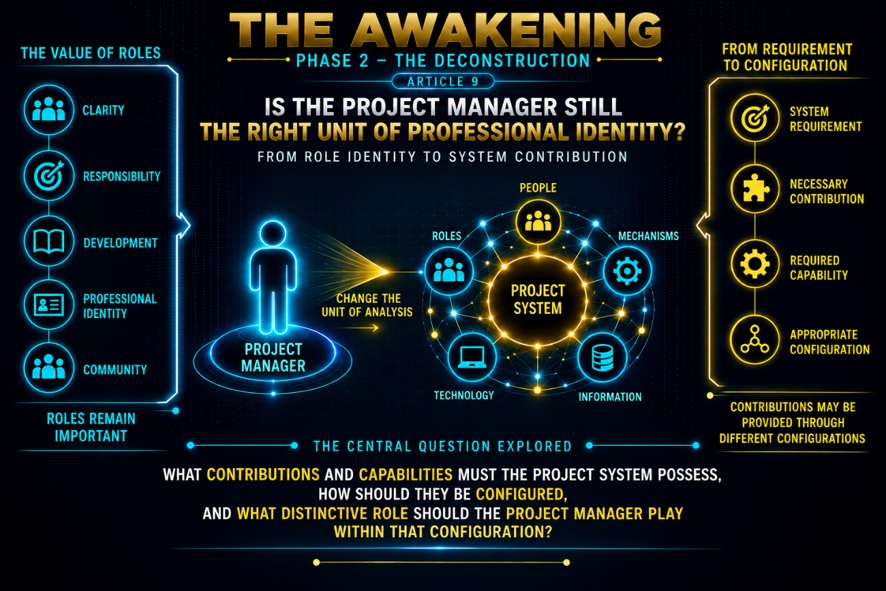
From Role Identity to System Contribution
Article 6 separated a necessary function from the assumption that it must reside in one designated role.
Integration matters.
But the need for integration does not, by itself, prove the need for one integrator.
Article 7 then separated legitimate accountability from the assumption that responsibility, authority and causal
capacity necessarily reside in the same place.
Article 8 challenged another familiar relationship.
Control does not necessarily require centralization.
Autonomy does not automatically produce adaptability.
And effective control must be evaluated by what the project system needs to protect and govern, not merely by the existence of formal controls.
Together, these deconstructions create a more uncomfortable question.
If important project functions can be concentrated, distributed or configured through different combinations of actors and mechanisms, what follows for the professional role around which project management has traditionally organized much of its identity?
The Project Manager remains one of the most recognizable units of professional identity in the field.
People develop qualifications for the role.
Develop careers around it.
Acquire certifications associated with it.
Organizations define responsibilities through it.
Competency models describe what professionals in the role should know and be able to do.
And professional communities often discuss the future of project management by asking what the future Project Manager should become.
That is understandable.
Roles provide clarity.
They concentrate expectations.
They help structure accountability.
They support professional development.
They make capabilities easier to organize, teach, assess and deploy.
But another proposition does not automatically follow:
That the role through which project work has historically been organized must remain the primary unit through which professional contribution is understood.
That is the fourth deconstruction.
Questioning the role as the primary unit for analyzing professional contribution does not yet imply replacing it as a unit of professional identity.
Those are different questions.
And this article must keep them separate.
1. A Role Is Not the Same as a Contribution
A role answers an organizational question.
Who is expected to carry particular responsibilities within a given arrangement?
A contribution answers a different question.
What does an actor, mechanism or technology add to the system's capacity to perform what the project requires?
These questions often overlap.
But they are not equivalent.
A function concerns what must be performed or accomplished.
A capability concerns the capacity required to perform it effectively.
A contribution concerns what a particular actor, role, mechanism or technology provides toward that performance.
And a role is one organizational arrangement through which expectations, responsibilities and often authority are allocated.
These distinctions matter because they prevent different analytical levels from collapsing into one another.
A Project Manager may integrate work.
Facilitate decisions.
Coordinate dependencies.
Protect commitments.
Surface risks.
Connect stakeholders.
Support governance.
Translate information across boundaries.
Preserve context.
Enable adaptation.
And maintain attention on the project as a whole.
Those contributions may be highly valuable.
But their value does not derive solely from the fact that they are performed by someone holding the title Project Manager.
Nor does the fact that other actors can perform some of them prove that the Project Manager role has become obsolete.
The analytical problem is different.
We should not infer the necessity of a contribution from the existence of a role, nor infer the obsolescence of a role merely because its contributions can be distributed.
That distinction matters.
A system may require a contribution without requiring a dedicated role.
It may also require a dedicated role precisely because responsibility for producing that contribution would otherwise remain insufficiently allocated, enabled or exercised.
Different project configurations may therefore produce different answers.
2. Why Professional Identity Forms Around Roles
Before questioning role identity, we should make the strongest case for it.
Roles reduce ambiguity.
They establish expectations.
They help people understand what they are responsible for.
They allow organizations to recruit, develop and assess professionals against recognizable capability profiles.
They provide a language through which authority, accountability and career progression can be structured.
They also provide professional communities with something important:
identity.
Someone can say:
I am a Project Manager.
That statement communicates more than a list of tasks.
It signals a field of practice.
A body of knowledge.
A professional community.
A developmental path.
And a claim about the kinds of problems the person is prepared to address.
Professional identity therefore has value beyond organization design.
It contributes to learning, professional recognition, mobility and community.
So the question is not whether professional roles matter.
They do.
The harder question is:
When does a useful professional identity begin to constrain how we understand the contributions the project system actually requires?
3. Role Boundaries Can Clarify Responsibility
Role boundaries are not inherently restrictive.
They can create necessary clarity.
A Project Manager may be expected to maintain an integrated view of the project and its delivery conditions.
A Product Owner may be responsible for product priorities.
A technical authority may protect architectural integrity.
A sponsor may protect strategic alignment and major commitments.
An operational leader may protect conditions required for sustainable adoption.
These distinctions can make responsibility easier to understand.
They can also reduce duplication.
Clarify decision rights.
Support escalation.
And make accountability more defensible.
A system in which everyone is responsible for everything may become a system in which nobody knows what they are expected to notice, decide or protect.
Role differentiation can therefore support coherence.
But differentiation creates boundaries.
And boundaries influence more than authority.
They can also influence what actors attend to, how they interpret what they see and which consequences they regard as belonging to their field of concern.
This is where the role question becomes more difficult.
4. Does Role Identity Shape What We Notice?
Formal role boundaries and professional role identity are related but not equivalent.
One structures organizational expectations, responsibilities and authority.
The other concerns how actors understand their professional position, responsibilities and field of concern.
Either may influence attention.
They may also reinforce each other.
But their effects should not be assumed to be the same.
Consider two competent professionals observing the same emerging issue.
Both have access to relevant information.
Both understand their own responsibilities.
Both may interpret the facts correctly within their respective domains.
Yet they may not assign the same significance to what they see.
One may interpret the issue primarily as a technical concern.
Another as an operational constraint.
Another as a contractual exposure.
Another as a stakeholder problem.
Another as a project-level threat requiring integration.
The difference may arise from expertise.
From access to information.
From authority.
From incentives.
From experience.
From organizational position.
Or from the boundaries through which each actor understands their own role.
This suggests a question worth testing:
Does professional role identity influence the scope within which actors interpret consequences as materially relevant?
The proposition should not be accepted in advance.
Role identity may sometimes narrow attention.
But it can also sharpen it.
Specialized expertise allows actors to recognize signals that others would miss.
A strong professional identity may strengthen a professional's sense of responsibility rather than restrict it.
And experienced professionals can reason beyond formal role boundaries.
So the issue is not whether roles inevitably produce tunnel vision.
They do not.
The relevant question is whether some configurations make actors' perceived role boundaries too influential in determining the perceived boundary of consequence.
5. The Boundary of the Role Is Not Necessarily the Boundary of the Consequence
Projects divide work because specialization is useful.
But consequences do not necessarily follow the same divisions.
A technical decision may create operational consequences.
A procurement choice may alter implementation options.
A financial decision may transfer cost or effort elsewhere.
A schedule commitment may narrow the choices available to another function.
A product adaptation may alter compliance exposure.
A resource decision may affect system-level viability.
The actor making the decision may be entirely competent within their role.
The problem begins if the organizational or professional boundary through which the decision is interpreted also becomes the perceived boundary of its consequence.
That would create a dangerous equivalence:
My responsibility ends here, therefore the relevant consequence ends here.
But those propositions are not the same.
A role boundary may legitimately help define responsibility or decision authority.
It does not necessarily define where consequences stop.
This distinction is fundamental.
The boundary of legitimate authority and the boundary of material consequence need not coincide.
Once they separate, the project requires some means of recognizing that separation.
That does not necessarily require every actor to see the whole.
But it does require the system to avoid treating local role boundaries as if they were natural boundaries of consequence.
6. From Role Boundary to Perceived Scope of Consequence
This creates a possible relationship worth examining.
Formal role architecture, professional identity and experience may all influence how actors perceive the boundaries of their own field of responsibility or concern.
That perceived boundary can influence attention.
Attention can influence interpretation.
Interpretation can influence the scope within which consequences are perceived as material.
One possible pattern is therefore:
Perceived role boundary
→ Attention
→ Interpretation
→ Perceived scope of consequence
But this should not be treated as a necessary linear sequence.
Several qualifications matter.
Attention may be directed by governance rather than role identity.
Information systems may surface cross-boundary effects.
AI may identify a potentially material relationship before any human actor has framed the issue through a professional role.
Professional experience may cause an actor to look deliberately beyond formal responsibility.
Strong integrative mechanisms may connect partial interpretations before any one actor develops a system-level view.
And the same formal role may produce very different perceived boundaries and patterns of attention in different people and organizational environments.
So the relationship remains a hypothesis to test, not an architecture to assume.
For the present article, its value is narrower.
It helps sharpen the question:
Can a role remain useful as an organizational unit while becoming too narrow as the primary unit through which professional contribution is understood?
7. The Project Manager Is More Than a List of Tasks
A simplistic response would be to decompose the Project Manager role into tasks and distribute them.
Planning goes here.
Risk management there.
Reporting elsewhere.
Scheduling to software.
Analysis to AI.
Facilitation to teams.
Governance responsibilities to formal bodies.
Integration to multiple actors.
Then conclude that little remains.
That reasoning is weak.
A professional role is not simply the arithmetic sum of its visible tasks.
Roles may preserve continuity.
Context.
Judgment.
Relationships.
Professional responsibility.
Cross-domain interpretation.
Project memory.
Attention over time.
And the capacity to recognize relationships that are difficult to allocate as discrete tasks.
The Project Manager can also occupy a structurally valuable position between domains.
That position may allow consequences to be connected that remain fragmented elsewhere.
So distributing tasks does not prove that the role has lost its contribution.
Task decomposability is not evidence of role obsolescence.
Nor does automation prove professional redundancy.
AI may perform analysis.
Generate scenarios.
Detect patterns.
Prepare reports.
Surface dependencies.
Support decisions.
Or execute bounded actions.
But the existence of technological capability does not itself determine where professional judgment, legitimate authority, accountability, contextual interpretation or integrative responsibility should reside.
The role question therefore cannot be answered by a task inventory.
8. Perhaps the Unit of Analysis Is the Problem
Professional debates often begin with the role.
What should the Project Manager do?
Which capabilities should the Project Manager develop?
How should the Project Manager use AI?
Should the role become more strategic, adaptive or business-oriented?
These may all be legitimate questions.
But they already assume that the Project Manager is the primary unit through which the future system should be interpreted.
A different sequence is possible.
What must the project system accomplish?
Which contributions are necessary?
Which capabilities make those contributions possible?
Where must they reside?
Which need continuity?
Which can be distributed?
Which require legitimate authority?
Which depend on proximity to specialized knowledge?
Which require cross-boundary visibility?
Which can be supported or performed computationally?
Which need identifiable accountability?
And only then:
What role architecture best supports those requirements?
As an analytical sequence, instead of:
Role → expected capabilities → system contribution
we can begin with:
System requirement → necessary contribution → required capability → appropriate configuration
The role becomes a possible design consequence rather than the unquestioned analytical starting point.
That does not make the role optional by definition.
It makes its justification contextual and functional.
9. But the System Cannot Become an Excuse for Role Ambiguity
Moving the unit of analysis toward system contribution creates its own danger.
If we say:
The system integrates,
The system governs,
The system learns,
The system decides,
The system adapts,
We may conceal the actual actors and mechanisms through which those functions occur.
System-level language does not itself identify the actors and mechanisms through which responsibility is exercised.
People act.
Governance bodies decide.
Teams interpret.
Algorithms process.
AI systems recommend or execute within configured boundaries.
Actors escalate or fail to escalate.
Organizations allocate resources.
So moving from role identity toward system contribution must not dissolve responsibility into vague systemic language.
A system-level function still requires an explicit configuration of contribution.
Who contributes what?
With what capability?
With what authority?
Under what conditions?
Through which mechanisms?
With what accountability?
And how do those contributions connect?
A broader unit of analysis should make contribution more precise, not responsibility more diffuse.
This is an important safeguard.
10. Contribution Is Not a Substitute for Professional Identity
There is another possible overcorrection.
If roles can be decomposed into contributions, perhaps professional identity should simply disappear into capability portfolios.
People would no longer be Project Managers.
They would merely possess combinations of facilitation, integration, decision, governance, stakeholder, analytical and adaptive capabilities.
That conclusion does not automatically follow.
Professional identity serves purposes that system architecture alone does not replace.
It organizes learning.
Supports communities of practice.
Creates recognizable standards.
Enables career mobility.
Preserves traditions of judgment.
Provides language for competence and experience.
And can create a sense of responsibility that exceeds any one temporary assignment.
The fact that system contribution is a broader analytical unit does not prove that professional roles are obsolete as social, developmental or organizational structures.
This distinction must be preserved:
The appropriate unit for analyzing system contribution need not be the same unit through which professional identity is organized.
That may ultimately be one of the most important conclusions of the deconstruction.
11. When Is the Project Manager Role Particularly Valuable?
If the Project Manager role is not presumed necessary in every configuration, what conditions strengthen the case for it?
One possibility is continuity.
Projects with long temporal horizons may benefit from an actor who preserves context across changing teams, decisions and phases.
Another is interdependence.
Where consequences cross many organizational boundaries, a role with explicit integrative responsibility may reduce ambiguity.
Another is fragmentation of authority.
Where no single domain can resolve significant trade-offs, an actor positioned to connect those domains may support escalation and coherence.
Another is information fragmentation.
Where relevant information remains distributed across actors and domains, a role responsible for connecting partial views may provide value.
Another is governance complexity.
Where contractual, regulatory, stakeholder and organizational arrangements interact, continuity of integrative judgment may matter.
And another is limited distributed integrative capacity.
A system that has not developed reliable distributed integrative mechanisms may depend more heavily on an identifiable role to compensate for architectural gaps.
But these are not universal proofs.
A highly capable distributed system may perform some of the same functions through explicit decision rights, strong interfaces, transparent information, mature governance and effective integration mechanisms.
The relevant test remains functional and counterfactual.
What contribution would be materially weakened if the Project Manager role were absent from this particular configuration, and could that contribution be provided as reliably through another configuration?
If the contribution is distinctive, consequential and difficult to reproduce through plausible alternatives, the role has a strong architectural justification.
If the same contribution is already performed reliably elsewhere, or can be provided through another configuration without creating greater risk, fragmentation or ambiguity, the case deserves closer examination.
12. From Competency Models to System Contribution
Traditional competency models usually ask:
What should a Project Manager know?
What should a Project Manager be able to do?
Those questions remain useful.
But system contribution introduces another layer.
What capabilities must exist somewhere in the project system?
Which must coexist in the same actor?
Which may be distributed?
Which require continuity, legitimate authority or independence?
Which can be augmented computationally?
And which require identifiable responsibility to ensure that they actually exist and are exercised?
This does not eliminate competency models.
It changes their relationship to organization design.
A capability may be essential even when no single role owns it completely.
A role may remain essential because some capabilities may need to remain combined in the same actor or role.
Different actors may provide the same capability at different stages of the project.
And a professional role may increasingly be defined not by exclusive ownership of functions, but by the particular contribution it is expected to make within a wider system configuration.
This suggests a different professional question:
Not only “What must a Project Manager be capable of?” but “What capabilities must the project system possess, and what distinctive contribution should the Project Manager make within that wider configuration of capabilities?”
The difference is subtle.
But consequential.
13. Professional Identity Without Professional Territoriality
Strong professional identity can create expertise, responsibility and community.
But it can also create territoriality.
This is not unique to project management.
Any profession can begin to treat particular activities as belonging to it because they have historically been associated with its role.
When familiar allocations are treated too rigidly, they can begin to sound like this:
Integration belongs to the Project Manager.
Strategy belongs to senior leadership.
Requirements belong to business analysis.
Technical decisions belong to engineering.
Change belongs to change management.
Risk belongs to risk specialists.
Such distinctions can sometimes be useful.
But they can also transform historical allocation into assumed necessity.
The deconstructive question is not:
Who owns this professionally?
It is:
What does the system require, who is best positioned to contribute, and what allocation preserves legitimate responsibility and coherence?
This does not abolish professional boundaries.
It prevents those boundaries from becoming substitutes for architectural reasoning.
Professional identity is most useful when it strengthens contribution.
It becomes more problematic when preserving inherited role boundaries takes precedence over configuring the capabilities the system requires.
14. The Attention Question, Bounded
The earlier attention question can now be bounded more precisely.
Professional role identity and perceived role boundaries may influence the scope within which actors attend to and interpret consequences.
But they are only possible explanations.
Expertise may differ.
Experience may differ.
Incentives may differ.
Information context may differ.
Organizational expectations may differ.
Power and authority may differ.
Actors may also use different thresholds for what they consider material.
So the current hypothesis should remain carefully bounded:
Professional role identity and perceived role boundaries may influence the scope within which actors attend to and interpret consequences, but the strength, direction and independence of those influences require further testing.
We do not need to convert this into a new construct.
Nor should we assume that broadening professional identity automatically broadens attention.
A professional can hold a broad title and still reason locally.
Another can occupy a specialized role and reason systemically.
The challenge is architectural as much as psychological.
The system must make it possible for locally situated expertise to contribute to wider coherence without requiring every actor to become a universal generalist.
15. Is the Project Manager Still the Right Unit of Professional Identity?
We can now return to the central question.
Should professional identity continue to be organized primarily around the Project Manager role, or around the contributions and capabilities required by the project system?
The analysis does not justify replacing one with the other.
It justifies separating the questions.
The Project Manager role remains valuable.
In some configurations, it may be essential.
It can concentrate continuity, integrative responsibility, contextual understanding, facilitation, coordination, governance support and cross-boundary attention in ways that are difficult to reproduce through fragmented contributions.
But the existence and historical importance of the role do not prove that every required project capability must continue to be understood through it.
Nor does the ability to distribute those capabilities prove that the role should disappear.
For analyzing required contribution, the broader project system provides the more defensible starting point.
The role should then be evaluated by the distinctive contribution it provides within that configuration.
This changes how professional identity is situated within the broader project architecture without abolishing it.
The Project Manager can then be understood as one important component within the wider configuration of project contribution rather than the unquestioned unit through which every system requirement must first be interpreted.
The relevant test becomes:
Under what conditions does organizing professional identity around the Project Manager role strengthen the contributions and capabilities the project system requires, and under what conditions does it constrain how they are recognized or configured?
That question cannot be answered by preference alone.
Nor by declaring the role obsolete.
Nor by preserving it simply because it is familiar.
It must be answered against the actual conditions of the project system.
The Deconstruction
The familiar assumption was:
If project work requires a Project Manager, the Project Manager should therefore be the primary unit through which professional contribution is understood.
The first proposition may be true in many configurations.
It does not automatically prove the second.
Roles matter.
Professional identity matters.
Specialization matters.
Continuity matters.
Accountability matters.
But functions, contributions and consequences do not always remain inside the professional boundaries through which organizations have historically arranged them.
So the deconstruction does not lead to:
Role → obsolescence
It leads to a more disciplined distinction:
Professional role ≠ system contribution
The two can reinforce each other.
But they should not be treated as equivalent.
The more rigorous design question is:
What contributions and capabilities must the project system possess, how should they be configured, and what distinctive role should the Project Manager play within that configuration?
That preserves the profession without making the profession the unit through which every system requirement must first be interpreted.
And one proposition survives the deconstruction:
The project system may be the broader unit for analyzing required contribution without making the Project Manager an obsolete unit of professional identity.
The future of the role should therefore not be decided by asking whether its traditional tasks can be redistributed.
It should be decided by asking whether the role continues to provide a distinctive, legitimate and materially valuable contribution relative to plausible alternative configurations.
That leaves the final assumption of Phase 2.
Project systems have historically been designed around human analysis, judgment, authority, action and accountability.
But those relationships are beginning to change.
If AI can increasingly analyze information, recognize patterns, recommend decisions and perform bounded actions, which parts of the project decision system still require human exclusivity?
That is where THE AWAKENING goes next.
Article 10
What Happens When AI Becomes Part of the Project Decision System?
Questioning Human Exclusivity in Analysis, Agency and Accountability
Posted on: September 18, 2026 01:51 PM |
Permalink


