
When Constraints Become Adaptive


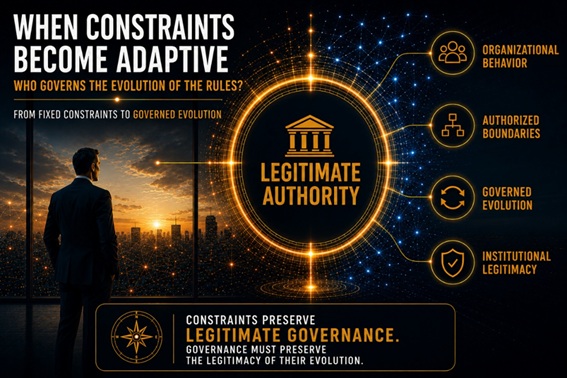 Who Governs the Evolution of the Rules? Introduction Governance has traditionally rested on a simple organizational premise. Legitimate authority intervenes when consequential decisions must be made. Once those decisions are authorized, the organization executes them until governance is again required. For decades this architecture proved both effective and sufficient. It aligned authority with accountability, enabled delegation and allowed organizations to balance strategic direction with operational autonomy. That premise is becoming progressively less adequate. Increasingly, organizational behaviour is no longer produced primarily through successive episodes of human decision-making. It emerges continuously through the interaction of people, computational capabilities, delegated authority, organizational processes and dynamically changing operating conditions. This transformation is frequently described as technological. Its deeper significance, however, is architectural. The central challenge is no longer whether organizations will adopt increasingly capable computational systems. It is whether governance can continue exercising meaningful influence when organizational behaviour increasingly develops between formal moments of executive intervention. The previous articles argued that legitimate authority must preserve Governance Causal Reach and that such influence remains effective only while organizations retain a viable Governance Intervention Window. Those conditions remain indispensable. They are no longer sufficient. Even where authority possesses both causal reach and sufficient opportunity to intervene, organizations increasingly operate at a scale, speed and continuity that make permanent human supervision neither feasible nor desirable. Governance therefore confronts a fundamentally different question. Not simply how important decisions should be made. But how the conditions through which organizational behaviour continuously emerges should themselves be governed. This article argues that the answer lies not in expanding supervision but in governing architecture. Legitimate authority does not remain effective because it continuously intervenes. It remains effective because it continuously shapes the conditions within which organizational behaviour becomes possible. From Episodic Governance to Continuous Governance Traditional governance is fundamentally episodic. It concentrates legitimate authority around identifiable moments of institutional judgment. Boards establish strategic direction. Executives authorize investment. Managers allocate resources. Policies articulate institutional intent. Governance intervenes when authority is required and withdraws once execution begins. This architecture reflects an organizational reality in which authority and action are separated by relatively stable periods of implementation. Governance determines direction. Operations execute it. The relationship is essentially sequential. Across many organizational environments this model continues to perform effectively. Its limitations emerge when organizational behaviour no longer develops primarily through discrete episodes of conscious human judgment. Today, organizational action increasingly emerges through continuously interacting human and computational capabilities. Information is interpreted dynamically. Recommendations evolve as new evidence becomes available. Resources may be reallocated automatically within previously authorized boundaries. Operational priorities adjust in response to changing conditions. The organization increasingly adapts without waiting for a new episode of executive intervention. The significance of this transition is often misunderstood. It does not imply that artificial intelligence replaces leadership. Nor does it imply that organizations become autonomous in any absolute sense. The more profound transformation concerns the relationship between authority and organizational action. Authority increasingly influences the organization not only through individual decisions, but through the architectural conditions that continue shaping organizational behaviour long after those decisions have been made. This distinction is fundamental. No Board of Directors can supervise every operational adjustment. No executive team can continuously evaluate every recommendation generated across an interconnected enterprise. No governance committee can deliberate upon every interaction through which organizational behaviour progressively develops. At organizational scale, the limitation is not managerial. It is architectural. Attempting to preserve governance by multiplying approvals, reviews or supervisory mechanisms would eventually undermine the very adaptability organizations seek to preserve. Governance would progressively become operational administration. Delegation would deteriorate into procedural dependence. Organizational responsiveness would increasingly be exchanged for additional oversight without necessarily strengthening legitimacy. The objective therefore cannot be continuous intervention. Nor can it be accepting that organizational behaviour develops beyond meaningful human influence. Neither alternative preserves effective governance. The challenge is preserving the continuing influence of legitimate authority without requiring authority to participate directly in every consequential organizational action. This represents a fundamental transition. Governance progressively becomes less concerned with supervising individual decisions and more concerned with shaping the architectural conditions through which those decisions continuously emerge. Organizations are therefore no longer governed primarily through isolated episodes of authority. They increasingly become governed through persistent architectural conditions established by authority. Why Constraints Become Necessary If governance cannot remain effective through continuous intervention alone, an immediate question follows. How can legitimate authority continue influencing organizational behaviour between formal moments of executive judgment? The answer cannot simply be more governance. Organizations have never lacked procedures, approval mechanisms or formal controls. Adding additional layers of supervision rarely resolves architectural limitations. More often, it amplifies them. The organizational requirement is different. Governance requires a mechanism capable of extending the influence of legitimately authorized decisions beyond the moment at which those decisions were originally made. That mechanism is the constraint. Within this article, a constraint is not understood primarily as a restriction. It is an architectural condition. Its purpose is not to prescribe every organizational action. Its purpose is to shape the authorized space within which organizational behaviour may legitimately emerge. This distinction fundamentally changes the role of governance. Traditional governance primarily evaluates actions. Architectural governance increasingly governs the conditions from which those actions arise. Governance does not remain effective by supervising every action. It remains effective by governing the conditions through which organizational action is allowed to emerge. This proposition represents the central argument of the article. As organizational autonomy expands, governance increasingly depends upon its ability to establish architectural conditions capable of preserving legitimate authority between episodes of conscious intervention. Within appropriately designed constraints, people, computational capabilities and hybrid organizational arrangements may continue exercising delegated autonomy without requiring continuous escalation. Governance deliberately re-enters the process only where organizational behaviour approaches boundaries carrying greater institutional consequence. Properly designed constraints therefore do not reduce organizational freedom. They make responsible organizational freedom governable. Equally important, constraints should never be confused with legitimacy itself. They do not create legitimacy. They carry legitimately authorized intent into the architecture of organizational action. Their authority therefore derives not from their existence, but from the legitimacy of the institutions, purposes and decision processes through which they are established, maintained and periodically reviewed. Architecture does not replace judgment. It preserves the conditions under which judgment remains consequential. This observation transforms the object of governance. If organizational behaviour increasingly emerges through architectural conditions rather than isolated decisions alone, governance can no longer concern itself exclusively with organizational action. It must also determine whether the architectural conditions shaping that action remain appropriate as organizations, technologies and institutional environments continue to evolve. That question leads directly to the next stage of the argument. If constraints increasingly preserve the continuing influence of legitimate authority, what makes a constraint itself capable of remaining legitimate as the organization changes? What Is an Adaptive Constraint? The previous section argued that governance remains effective not by supervising every organizational action, but by governing the conditions through which organizational action is allowed to emerge. That conclusion immediately raises a more fundamental question. What exactly is a constraint? The answer matters because the term is frequently used without architectural precision. Within organizations, constraints are often treated as synonymous with policies, procedures, rules or controls. Although these mechanisms frequently interact, they perform different organizational functions. Policies express institutional intent. Procedures describe expected ways of working. Rules prescribe or prohibit specific behaviours. Controls monitor, detect, prevent or correct deviations from intended conditions. A constraint occupies a different architectural position. It is defined not by its documentary form, nor by its technical implementation, but by the function it performs within the governance architecture. A constraint is a persistent, or conditionally activated, architectural condition that shapes the authorized space within which organizational behaviour may emerge. Rather than determining individual decisions, it governs the conditions under which legitimate decisions become possible. The distinction is therefore functional rather than categorical. A policy, rule or control may itself operate as a constraint whenever it materially shapes the authorized space available for organizational action. What matters is not what the mechanism is called. What matters is the architectural role it performs. Properly understood, constraints neither replace judgment nor diminish autonomy. They make autonomy governable. Their purpose is to preserve the continuing influence of legitimately authorized decisions long after those decisions have been made. Constraints are therefore not mechanisms of restriction. They are mechanisms of continuity. They allow legitimate authority to remain consequential between formal episodes of governance. Their authority, however, should never be confused with legitimacy itself. Constraints do not create legitimacy. They carry legitimately authorized intent into the architecture of organizational action. Their authority derives from the legitimacy of the institutions, purposes and decision processes through which they are established, maintained and periodically reviewed. Within an effective governance architecture, constraints perform three complementary functions. First, they enable delegated autonomy. By defining authorized operating boundaries, they allow organizational actors to continue exercising judgment without requiring continuous escalation. Second, they preserve systemic coherence. They reduce the probability that localized optimization progressively diverges from organizational purpose, delegated authority or institutional priorities. Third, they preserve governability. As organizational behaviour approaches boundaries carrying greater institutional significance, constraints identify where governance must deliberately re-enter the process. The significance of constraints therefore lies not in limiting organizational freedom. It lies in making responsible organizational freedom sustainable at organizational scale. Yet this immediately introduces a further challenge. If constraints preserve the continuing influence of legitimate authority, how should governance preserve the continuing suitability of the constraints themselves? Governing the Evolution of Constraints No governance architecture operates within a static environment. Organizations evolve. Strategies change. Technologies mature. Business models develop. Regulatory expectations shift. Institutional learning accumulates. Stakeholder priorities evolve. Architectural conditions that once faithfully extended the influence of legitimate authority may progressively become less appropriate as the organization itself changes. Governance therefore acquires a second responsibility. It must govern not only organizational behaviour but also the continuing suitability of the architectural conditions through which that behaviour emerges. This does not imply that constraints should change continuously. Nor does it suggest that adaptive organizations should constantly redesign their governance architecture. Institutional continuity remains a strategic capability. Predictability supports coordination. Consistency strengthens trust. Stability protects organizational identity. The objective is therefore not maximizing adaptation. It is preserving appropriate adaptation. This distinction defines the concept of an adaptive constraint. An adaptive constraint is not one that modifies itself automatically. Nor is it one that continuously optimizes its own behaviour. Its defining characteristic is different. An adaptive constraint is one whose evolution remains subject to legitimate governance as the organizational conditions it was designed to support progressively evolve. Its evolution therefore remains governed. Legitimate authority determines not only the constraint itself, but also the institutional processes through which that constraint may subsequently be reviewed, strengthened, relaxed, retired or replaced. Those processes should themselves remain transparent, evidence-based and contestable. In many organizations they may also require multiple legitimate authorities. Revising a constraint frequently redistributes authority, accountability, discretion, organizational risk or institutional responsibility. Such decisions cannot always be reduced to a single executive judgement. Equally important, adaptation should never be triggered merely because organizational conditions have changed. Organizations change continuously. Governance should intervene only when credible evidence demonstrates that an existing constraint no longer adequately supports the organizational purpose, accountability relationship or risk boundary it was originally intended to preserve. This principle protects organizations from two symmetrical failures. One is institutional rigidity. Constraints remain unchanged while organizational reality progressively moves beyond the assumptions embedded within them. The other is institutional volatility. Constraints are revised so frequently that governance gradually loses continuity, predictability and strategic coherence. Neither extreme preserves responsible governance. Adaptive constraints therefore occupy a deliberate middle position. They preserve continuity while remaining legitimately revisable. They enable institutional learning without allowing adaptation itself to become architecturally uncontrolled. Governance therefore evolves. It no longer governs only organizational behaviour. It increasingly governs the legitimate evolution of the architectural conditions through which organizational behaviour continuously emerges. Constraint Drift and Governance Debt Every governance architecture embodies assumptions about the organization it seeks to govern. Those assumptions rarely become incorrect suddenly. Far more often, they progressively lose correspondence with organizational reality. Strategies evolve. Business models transform. Technologies introduce new capabilities. Risk environments change. Institutional priorities develop. Over time, the architectural assumptions embodied within existing constraints may no longer adequately represent the organizational conditions they were originally designed to support. This phenomenon may be understood as Constraint Drift. Constraint Drift is the progressive divergence between a constraint as designed, interpreted or enacted and the organizational purpose, accountability relationship or risk environment it is intended to support. A drifting constraint may continue operating exactly as designed. Its implementation may remain technically correct. The problem is not technical. It is architectural. The organization has evolved while the assumptions embodied within the constraint have not. Initially, this divergence may produce little observable consequence. Organizations frequently identify and correct minor forms of drift before they generate significant organizational effects. The greater risk emerges when architectural divergence remains unresolved. Exceptions gradually become routine. Temporary workarounds become institutional practice. Compensating controls accumulate. Additional approvals proliferate. Governance progressively becomes more complex without becoming more effective. This accumulated burden should not be confused with Constraint Drift itself. It represents a different organizational phenomenon. It may be understood as Governance Debt. Governance Debt is the accumulated organizational burden created when necessary architectural evolution is repeatedly postponed while temporary compensations progressively replace structural adaptation. Unlike technical debt, governance debt cannot be understood solely through technical complexity. Its consequences appear organizationally. Decision latency increases. Coordination costs expand. Executive attention becomes progressively absorbed by exceptions rather than strategic priorities. Trust in governance gradually weakens as organizational actors increasingly learn to navigate around the architecture instead of through it. Governance Debt becomes visible when organizations spend more effort compensating for outdated constraints than resolving the architectural misalignment that created those compensations. Constraint Drift is an important source of Governance Debt. It is not its only source. Governance Debt may also arise from other forms of unresolved architectural misalignment, including fragmented authority, overlapping governance structures or persistent institutional inconsistency. The distinction is therefore essential. Constraint Drift describes progressive architectural divergence. Governance Debt describes the accumulated organizational burden created when that divergence, or other architectural misalignments, remain unresolved. This distinction changes how governance quality should be evaluated. The existence of constraints is no longer sufficient evidence of effective governance. The more important question is whether organizations possess legitimate, evidence-based and institutionally accountable mechanisms capable of determining when constraints should remain stable, when they should evolve and when they should deliberately be retired. Governance therefore acquires a broader architectural responsibility. It must preserve not only effective organizational behaviour but also the continuing suitability of the architectural conditions through which that behaviour continuously becomes possible. This conclusion completes the second stage of the argument. Once governance becomes responsible for the continuing evolution of constraints, the next question is no longer how constraints should change. It becomes more fundamental. How should governance design the architecture within which constraints themselves are created, related, justified and legitimately evolved? Executive Trade-offs No governance architecture is without cost. Every mechanism designed to preserve the continuing influence of legitimate authority introduces organizational effort, coordination demands and strategic trade-offs. Adaptive constraints are no exception. Designing them requires institutional judgment. Maintaining them requires observation, evidence gathering and disciplined review. Revising them requires executive attention, organizational coordination and implementation capability. Adaptive governance is therefore neither administratively neutral nor economically free. These costs should not be underestimated. Architectural reviews consume leadership capacity. Governance assurance requires expertise. Institutional learning requires disciplined reflection. Updating governance boundaries may temporarily disrupt established ways of working while new conditions are understood and adopted. The alternative, however, is rarely less expensive. When architectural constraints progressively lose alignment with organizational reality, organizations increasingly compensate through exceptions, manual interventions, overlapping controls and additional approval mechanisms. Governance gradually becomes heavier while becoming progressively less effective. Managerial effort shifts from governing the organization to managing the consequences of architectural misalignment. The strategic decision is therefore not whether governance should evolve. It is determining when architectural adaptation preserves more organizational value than maintaining the existing architecture. That balance depends upon context. Organizations responsible for public safety, critical infrastructure or financial stability may legitimately privilege continuity. Organizations competing through rapid innovation may legitimately require greater architectural adaptability. Neither position is universally superior. Each reflects a different balance between resilience, adaptability, legitimacy and operational performance. Adaptive constraints therefore do not diminish executive judgment. They relocate it. Leadership progressively spends less effort supervising individual operational decisions and more effort determining when the governance architecture itself should evolve. This also redistributes organizational power. Revising a constraint may expand discretion, redistribute authority, alter accountability relationships or transfer organizational risk. Constraint evolution is therefore never merely technical. It is an institutional decision with strategic consequences. A practical executive principle follows. Architectural revision becomes justified when the recurring organizational cost of exceptions, delays, workarounds, compensating controls and unmanaged risk exceeds the expected organizational cost and disruption of revising the governance architecture. The objective of mature governance is therefore not increasing managerial intervention. It is progressively reducing the amount of intervention required to preserve responsible organizational behaviour. Boundary Conditions The argument developed throughout this article is intentionally bounded. Adaptive constraints should not be interpreted as a universal governance solution. Their value depends upon the characteristics of the organizational environment they govern. Where organizational conditions remain relatively stable, operational consequences remain localized and governance intervention remains consistently feasible, traditional governance mechanisms may continue to perform effectively. Organizations do not require adaptive constraints merely because computational capabilities become more sophisticated. Nor should every governance architecture become continuously adaptive. Excessive adaptation may itself become a source of instability. Organizations that continually redefine their operating boundaries risk weakening institutional consistency, organizational trust and strategic coherence. Predictability is itself a governance capability. Certain institutional commitments derive their legitimacy precisely from remaining intentionally resistant to frequent revision. Adaptive constraints therefore require constitutional limits. This does not imply an infinite hierarchy of rules governing other rules. Rather, every governance architecture requires a bounded constitutional layer that determines:
It is the institutional level at which the authority to revise ordinary constraints is itself assigned, bounded and made accountable. Equally important, constraints rarely operate independently. Revising one architectural boundary may unintentionally alter authority relationships, redistribute operational risk or weaken protections established elsewhere within the governance architecture. Constraint evolution must therefore be evaluated systemically rather than locally. The argument also does not imply that computational systems should determine how governance evolves. Computational capabilities may provide analysis, prediction, simulation and decision support. They cannot independently determine institutional legitimacy or the acceptable distribution of authority, accountability and responsibility. Finally, adaptive constraints do not replace leadership. They preserve the continuing influence of legitimate leadership between episodes of conscious organizational judgment. Their purpose is not replacing governance. It is preserving governance under conditions where organizational behaviour increasingly develops continuously rather than episodically. From Adaptive Constraints to Architectural Governance Across the first three articles of this series, a coherent architectural argument has progressively emerged. The first demonstrated that legitimate authority must preserve Governance Causal Reach. Authority that cannot influence how organizational behaviour is formed progressively loses practical significance. The second demonstrated that causal reach possesses a temporal condition. Authority remains effective only while organizations retain a meaningful Governance Intervention Window. This article introduces a third condition. Even where authority possesses both causal reach and sufficient opportunity to intervene, organizations cannot realistically depend upon continuous supervision as organizational behaviour increasingly emerges through continuously interacting human and computational capabilities. Governance must therefore preserve the continuing influence of legitimate authority by governing the architectural conditions through which organizational behaviour becomes possible. This represents a fundamental change in the object of governance. Governance progressively moves from supervising individual organizational actions toward governing the architecture through which those actions continuously emerge. Human judgment therefore becomes more rather than less significant. Its role progressively shifts from supervising operational activity toward determining organizational purpose, legitimate authority, acceptable boundaries and the legitimate evolution of those boundaries. Adaptive constraints explain how legitimately authorized intent continues influencing organizational behaviour after individual decisions have been made. They do not yet explain how governance should determine which architectural conditions ought to exist in the first place. That is the problem of Architectural Governance. Conclusion Organizations have always depended upon human judgment. That remains unchanged. What is changing is not the necessity of judgment, but the mechanism through which its influence is preserved. As organizational behaviour increasingly emerges through continuously interacting human and computational capabilities, governance can no longer depend exclusively upon episodic intervention. It must also preserve the architectural conditions through which legitimately authorized intent continues shaping organizational behaviour between formal episodes of executive judgment. Adaptive constraints provide that capability. Not because they replace judgment. Not because they automate legitimacy. But because they carry legitimately authorized intent into the architecture through which responsible organizational behaviour continuously emerges. Governance therefore does not remain effective by supervising every action. It remains effective by governing the conditions through which organizational action is allowed to emerge. Architecture does not replace judgment. It preserves the conditions under which judgment remains consequential. Yet governing constraints is only one stage of a broader architectural transition. Organizations must also determine the principles through which those constraints are created, related, justified and legitimately evolved. Governance has traditionally sought to improve organizational decisions. The next challenge is more fundamental. It is designing architectures through which responsible decisions emerge because the architecture itself continuously preserves the conditions that make them possible. That is the challenge of Architectural Governance. Next Article Architectural Governance Designing Boundaries Before Decisions Happen |
Posted on: August 10, 2026 04:58 AM
| Permalink |
Comments (0)


