
Transformation Is Not a Sequence


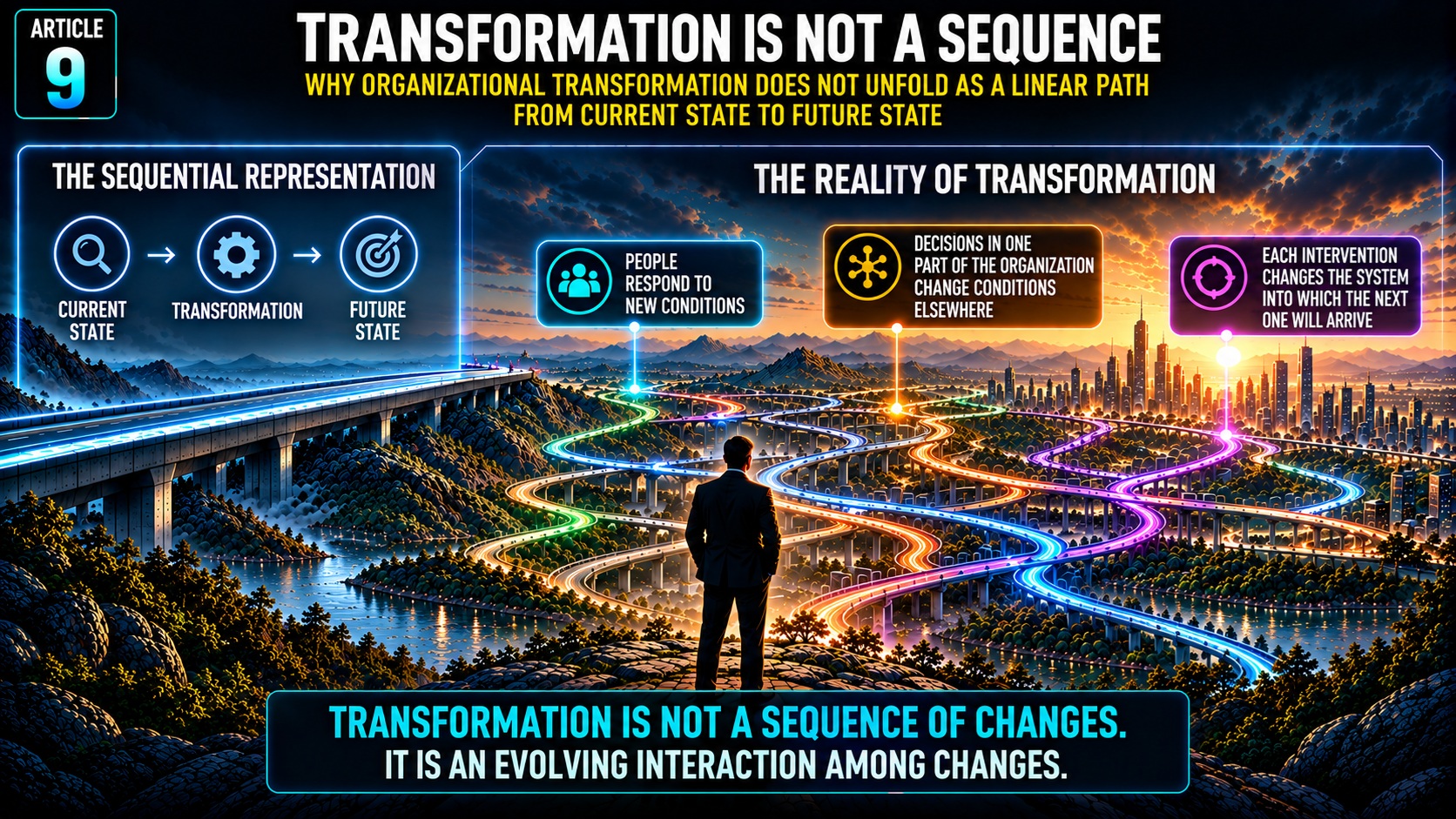 Why organizational transformation does not unfold as a linear path from current state to future state Transformation is often represented as a journey. There is a current state. There is a desired future state. Between them sits a transformation program designed to move the organization from one to the other. The logic is familiar: Current State → Transformation → Future State It is useful. It is also potentially misleading. Because organizations do not stop changing while transformation is taking place. People respond to new conditions. Technologies create possibilities that did not exist when the transformation was designed. Decisions made in one part of the organization alter conditions elsewhere. New capabilities emerge. Existing ones may become less relevant. Customers change their behavior. Competitors respond. Regulations evolve. Assumptions become obsolete. And every intervention changes the system into which the next intervention will arrive. Transformation is not a sequence of changes. It is an evolving interaction among changes. That distinction matters. The Comfort of the Sequence There are good reasons why we think about transformation sequentially. Sequences make complexity manageable. We diagnose the current situation, define a target state, identify gaps, design initiatives, establish milestones, assign responsibilities, implement changes and measure progress. There is nothing inherently wrong with doing this. Organizations need direction. Transformation requires coordination. Investments require decisions. Dependencies need to be understood. People need some visibility into where the organization is trying to go. The problem begins when a useful planning representation becomes a theory of how transformation actually happens. A roadmap can easily create the impression that organizational change behaves like the roadmap itself. First A. Then B. Then C. Finally D. But while A is being implemented, people respond to it. Those responses may change B. The consequences of B may reveal that C is no longer appropriate. Something happening outside the organization may make D less desirable than it appeared when the transformation began. And something learned along the way may make possible an outcome that nobody could have specified at the beginning. The roadmap has remained sequential. The organization has not. Organizations Are Systems, Not Sequences Systems thinking has challenged this way of understanding organizations for decades. Russell Ackoff emphasized a fundamental property of systems: the behavior of the whole depends not only on its parts, but on how those parts interact. That distinction changes how we think about transformation. If an organization is treated as a collection of components, transformation can appear to be a series of interventions: change the technology, redesign the process, restructure the roles. But changing a component also changes some of its relationships with other components. And those relationships matter. Consider the introduction of AI into a workflow to improve productivity. The initial intervention may appear straightforward: automate or augment part of the work. But once that happens, the nature of the remaining human work may change. If AI performs more of the initial analysis, professionals may spend more time reviewing, interpreting or handling exceptions. That can change roles, coordination and what managers need to do. It may affect decision rights or escalation paths, alter which capabilities people need, and change the work through which some of those capabilities develop. Eventually, new human and computational capabilities may make another redistribution of work possible. What began as a technological intervention has become an organizational process. Not because somebody necessarily designed every consequence. But because changes interact. The same principle applies beyond AI. A new governance mechanism can change decision behavior. Greater team autonomy can change coordination requirements. The intervention enters an existing system of relationships. The system responds. And that response becomes part of the context for what happens next. Cause and Effect Do Not Disappear To say that transformation is not sequential is not to say that it is random. Nor does systems thinking eliminate causality. It asks us to understand causality differently. Peter Senge distinguished detail complexity — situations involving many variables — from dynamic complexity, where cause and effect may be separated in time and space and where apparently obvious interventions can produce non-obvious consequences. That distinction is particularly important in organizational transformation. An intervention can produce direct effects. Those effects can generate second-order consequences. Those consequences can feed back into the conditions that produced them. Several changes can reinforce one another. Others can counteract one another. Some effects appear quickly. Others become visible only after months or years. An organization may decentralize operational decisions while centralizing data. It may remove hierarchical layers while increasing digital monitoring. It may improve current productivity while changing the experiences through which future capabilities develop. These developments are not necessarily contradictory. They appear contradictory only when transformation is imagined as movement along a single axis. Organizations change across multiple, interacting dimensions. And those dimensions do not necessarily move together. Feedback Changes What Happens Next Donella Meadows placed feedback at the center of understanding system behavior. An intervention produces consequences. Information about those consequences returns to actors in the system. They respond. Their response changes subsequent conditions. That is fundamentally different from imagining transformation as a chain of independent steps. Feedback may confirm that an intervention is working as intended. It may expose unintended consequences, challenge assumptions or reveal dependencies that were previously invisible. But feedback does more than tell us whether implementation is progressing. It can change the transformation itself. What the organization discovers becomes part of the information available for subsequent decisions. Learning is therefore not something that happens after transformation. It is part of how transformation unfolds. Different Parts of the Organization Move at Different Speeds Feedback is also rarely instantaneous. Donella Meadows drew particular attention to delays and to their relationship with the rate at which a system is changing. Delays matter because a system may continue responding to conditions that have already changed, or act before the consequences of previous interventions have become visible. Organizations contain many such timescales. Technology can change rapidly. Processes may take longer. Roles may take longer still. Decision rights may remain largely untouched. Governance may react only after new risks become visible. Culture can continue carrying assumptions inherited from an organizational architecture that formally no longer exists. Capability development operates on another timescale again. The consequence is important: An organization can simultaneously contain elements of its past, its present and its possible future. A team may already be working differently while its performance system still rewards old behavior. Professionals may receive broader responsibility while decision authority remains elsewhere. A structure may become flatter while escalation practices continue to reproduce the previous hierarchy. This is more than a difference in implementation speed. Different rates of change and different feedback delays can create temporary — and sometimes persistent — misalignments across the organizational system. The organization is therefore not simply “before” or “after” transformation. Nor is it necessarily somewhere along a single path between the two. Different parts of the system may be following different trajectories. Some Changes Advance. Others Stop. Some Reverse. Sequential representations also encourage another assumption: directionality. Once an organization becomes more automated, more decentralized, more agile or more digitally enabled, the next stage is easily imagined as involving more of the same. But adaptation does not require movement in only one direction. An organization may delegate work and later restore human intervention. A team may receive greater autonomy and subsequently encounter new governance constraints. A process may be automated and later redesigned because consequences appear that were not visible initially. A structural layer may disappear while some of its functions reappear elsewhere. None of this necessarily means that transformation has failed. It may mean that the system has generated information that changes what the organization should do next. Adaptation can therefore include continuation, acceleration, redirection, stabilization or reversal. The capacity to change direction in response to evidence may itself reflect adaptation rather than transformation failure. A Snapshot Is Not a Trajectory This creates a particular problem when we observe organizations in transformation. We often describe what we see as though it were the new organizational model. But the configuration we observe today may simply be the current position of an unfinished process. A professional who once executed a task may now review work produced by AI. That division of work may stabilize. Or the boundary may move again as capabilities, evidence, risks and confidence change. Human intervention may decrease, remain essential or even be reintroduced after consequences emerge. The present configuration alone cannot tell us which trajectory will prevail. A snapshot of transformation is not the same thing as its trajectory. And trajectory is not the same thing as destination. Transformation Can Change the Problem Itself There is another reason transformation cannot be reduced to sequence. Organizations do not merely respond mechanically to interventions. People interpret what is happening. Different groups can understand the same situation differently. Experience can change those interpretations. Peter Checkland's work on Soft Systems Methodology emerged from the difficulty of treating complex human situations as though there were always a clearly defined problem waiting for an optimal solution. In such situations, inquiry and action can change how participants understand both the problem and what would count as improvement. The organization halfway through a transformation may not simply know more about the original problem. It may understand the problem differently. New evidence can challenge the original diagnosis. Stakeholder experience can reveal consequences that were previously invisible. Capabilities that did not exist when the transformation began can create possibilities that could not previously have been considered. Even the meaning of a desirable future state can evolve. Transformation therefore changes not only possible solutions. It can change the organization's understanding of what it is trying to solve. Transformation Changes the Conditions of Transformation This leads to the deeper implication. Traditional transformation thinking can implicitly treat the organization as the object of change. But organizations do not merely receive interventions. Through feedback, learning and adaptation, they change while being changed. The organization making decisions halfway through a transformation may therefore operate with different knowledge, capabilities, relationships and constraints from those that existed at the beginning. So transformation does something more profound than move an organization toward a target state. Transformation changes the organization, but it also changes the conditions under which the organization continues to transform. This does not mean that everything is unpredictable or that transformation cannot be designed. Some relationships are sufficiently understood to be planned. Dependencies can be managed. Direction can be intentional. Principles, boundaries and governance can be designed. But the more transformation involves complex human interaction, reciprocal adaptation and changing contexts, the less reliably its complete trajectory can be specified in advance. Dave Snowden's work on complexity makes this distinction particularly important. In complex contexts, relationships between cause and effect cannot always be determined reliably in advance. This shifts emphasis toward intervention, observation and learning rather than assuming that the full causal path can be known beforehand. Planning therefore remains necessary. Prediction has limits. The Roadmap Is Not the Transformation None of this makes transformation roadmaps obsolete. A roadmap can coordinate intended change, establish dependencies, responsibilities and milestones, and make direction visible. But a roadmap describes what we intend to change. It cannot, by itself, tell us everything those changes are changing. This requires another practice alongside implementation planning: continuously examining what previous interventions have changed elsewhere in the system, which assumptions still hold, which consequences are emerging and what those signals imply for subsequent decisions. The question is no longer only: What should happen next? It must also be: What is happening because of what we have already changed? That second question changes how transformation is governed. It turns feedback from a mechanism for checking progress into a source of learning about the transformation itself. And it prevents us from confusing fidelity to the plan with fidelity to the purpose. Purpose Is Not Destination If the organization changes while transformation unfolds, and its environment changes at the same time, then even the desired future state cannot always remain fixed. This does not mean abandoning purpose. Quite the opposite. The more uncertain the path becomes, the more important it is to distinguish purpose from destination. A predefined organizational configuration can become obsolete while the purpose that justified the transformation remains valid. The organization may preserve what it is trying to achieve while changing how that achievement should be organized. Transformation is therefore better understood through interacting processes of purpose, intervention, response, feedback, learning and adaptation. Plans, milestones and target states can still exist. But they exist inside a system capable of changing them. Transformation Is Not a Sequence The mistake is not representing transformation sequentially. Sometimes we must. The mistake is confusing the representation with the phenomenon. A sequence can help us coordinate interventions. It does not mean that the organization itself will transform sequentially. So a critical question during transformation is not only: Did we implement what we planned? It is also: What are the changes we have already made changing elsewhere in the system — and how should that change what happens next? Because transformation is not a sequence of interventions leading predictably toward a predefined destination. It is an evolving systemic process in which interventions interact, feedback reshapes subsequent decisions, learning changes understanding, and the organization progressively alters the conditions of its own transformation. And that creates another problem. If transformation does not unfold exactly as designed, completing the planned interventions cannot tell us what the organization has actually become. Implementation tells us what we introduced. It does not necessarily tell us what the system realized. That is where we go next. Article 10 — Implementation Is Not Realization |
Posted on: September 27, 2026 05:34 AM
| Permalink |
Comments (0)


