
Who Develops the Capabilities We Still Need?


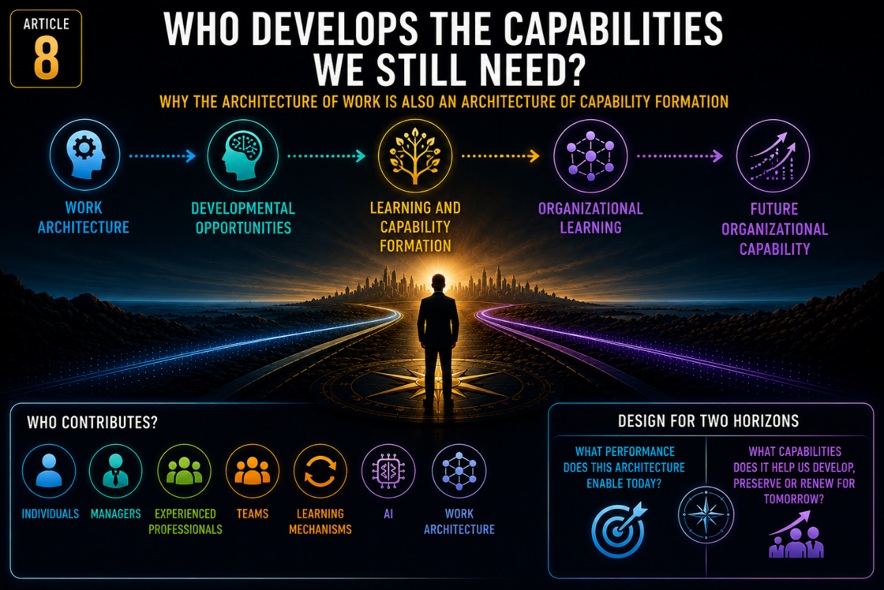 Why the Architecture of Work Is Also an Architecture of Capability Formation Over the previous articles in this series, I have explored a recurring idea. The new ways of working in projects are not simply about adopting agile practices, introducing new technologies, changing methodologies or giving teams greater autonomy. They reflect a deeper transformation in the organizational conditions through which projects operate. Purpose, authority, decision-making, governance, resources, human and computational capabilities, organizational boundaries and learning increasingly need to be connected differently if projects, understood as temporary organizations, are to remain adaptive without losing coherence, accountability or the capacity to create value. That transformation raises another question. What happens to capability formation when the architecture of work itself changes? This question becomes particularly important as artificial intelligence assumes a growing share of activities previously performed by people, including planning, analysis, monitoring, reporting, documentation, information consolidation and decision preparation. Much of the immediate discussion focuses on productivity, roles and employment. But there is another consequence. Some of this work did more than produce an output. It also exposed people to problems from which they could learn. If new ways of working change how work, authority, decisions and human-computational capabilities are distributed, they may also change who encounters problems, who investigates them, who makes judgments, who receives feedback, who experiences consequences and who gets the opportunity to try again. When we redesign the architecture of work, we also redesign the distribution of developmental opportunities. And that matters because an organization cannot simply declare the capabilities it will need in the future. Those capabilities have to develop somewhere. The Capabilities Required by New Ways of Working Earlier in this series, I argued that the evolution of project work is changing the contribution expected from the Project Manager. As AI becomes increasingly capable of supporting planning, analysis, monitoring, documentation and decision preparation, the value of the role cannot be understood primarily through those activities. The distinctive contribution increasingly lies elsewhere. Connecting strategy with execution. Integrating capabilities distributed across the organization. Working across functional and organizational boundaries. Preserving context. Facilitating decisions. Detecting emerging dependencies and inconsistencies. Helping temporary organizations remain coherent while adapting. Combining human and computational capabilities without obscuring decision authority or accountability. These are not merely additional tasks. They require judgment, contextual understanding, pattern recognition, relational capability and the ability to operate across boundaries that no single function fully controls. But identifying the capabilities required is only part of the problem. How do people actually develop them? That question becomes increasingly important when the architecture of work that historically provided some of those experiences is itself being redesigned. Work Has an Operational and a Developmental Consequence Organizations normally design work around the result that needs to be produced. A schedule must be developed. A risk must be analysed. A dependency must be managed. A decision must be prepared. The operational output is visible. The developmental consequence is less so. Someone developing a schedule may gradually learn how dependencies interact, where uncertainty enters the plan, why estimates fail and how apparently local changes propagate across a project. Someone supporting a difficult stakeholder discussion may learn how interests, authority and organizational context shape what can legitimately be decided. The task produces an operational result. The experience may also create a developmental opportunity. This does not mean that work automatically produces capability. Capability development also depends on individual effort, reflection, feedback, mentoring, social interaction, prior knowledge and the quality of the experience itself. But work architecture still matters because it distributes access to information, proximity to problems, participation in decisions, responsibility, feedback, consequences and opportunities for practice. The architecture of work is therefore not the same thing as capability formation, but it creates part of the developmental architecture within which capability can emerge. This becomes particularly significant when work is redistributed between humans and AI. The usual questions remain essential. What should be automated or augmented? Where must human judgment remain decisive? Who validates, challenges and decides? Who remains accountable? But another question should now accompany them: What happens to the developmental function of the work when its allocation changes? If AI produces the initial analysis, where does a less experienced professional learn to construct one? If AI identifies dependencies, how do people develop the ability to recognize dependencies the system misses? If AI continuously monitors signals and anomalies, how do people develop the sensing capability required to recognize when the system itself may be wrong? These questions do not demonstrate that automation is undesirable. They demonstrate that automation can have consequences beyond the allocation of tasks. AI Can Reduce Learning. It Can Also Increase It. It would be a mistake to assume that AI necessarily makes people less capable. The same technology can support very different forms of human engagement. One professional may use AI in ways that reduce their own cognitive engagement. Another may use it to examine assumptions, generate counterarguments, explore scenarios, compare interpretations and challenge their own reasoning. One delegates the problem. The other uses AI to engage more deeply with it. Individual agency, effort, curiosity and the willingness to question apparently convincing answers all matter. But architecture matters too. Consider two organizations using essentially the same AI capability. In one, professionals receive AI-generated recommendations and are expected mainly to confirm that the result appears reasonable. In another, professionals are expected to formulate the problem, make assumptions explicit, compare their reasoning with the AI, investigate disagreements, justify decisions and subsequently examine outcomes. Both organizations use AI. Both may improve productivity. But they have not created the same developmental conditions. The relevant question is therefore not whether AI is good or bad for learning. It is: What kind of human engagement does the architecture of human-computational collaboration make more or less likely? Do Not Preserve the Task. Preserve or Redesign the Developmental Function. There is an obvious danger in this argument. If people historically developed capabilities while performing certain tasks, organizations might conclude that those tasks should remain human. That would be the wrong lesson. Many inherited activities exist because information was once difficult to obtain, calculations were expensive, systems were poorly integrated or coordination required manual intervention. Some work is repetitive. Some provides little meaningful development. Some should disappear. An adaptive organization should not preserve an obsolete mechanism simply because it once served a legitimate purpose. The same principle applies here. Historical developmental value does not justify permanent task preservation. The relevant question is not whether the old task should survive. It is whether it performed a developmental function that remains necessary. A report may disappear. The ability to distinguish signal from noise may remain important. Manual schedule updating may disappear. Understanding dependencies and the consequences of change may still matter. The task can disappear while the capability remains necessary. The challenge is therefore to identify the developmental function and decide whether it should be preserved, replaced or redesigned. From Accidental Learning to Deliberate Capability Formation Historically, much professional development occurred as a by-product of work. People learned because they were exposed to problems, observed more experienced colleagues, received feedback, made decisions of increasing significance and encountered situations that did not fit what they had previously learned. Over time, some of those experiences contributed to professional judgment. But this mechanism was never perfect. Experience does not automatically produce learning. Repetition can reinforce poor practice. Consequences can be misunderstood. Years of experience do not necessarily produce years of development. The emergence of AI therefore gives organizations an opportunity not merely to protect old learning pathways, but to examine whether those pathways were ever sufficiently deliberate. If an activity can be automated, the organization can ask: What did people actually learn through this activity? Is that learning still necessary? Was the activity an effective way of developing it? If not, what would be better? The answer may involve progressive exposure to increasingly complex problems, mentoring, simulation, deliberate challenge of AI-generated outputs or post-decision reviews that examine why expectations differed from outcomes. The specific mechanism will vary. The architectural principle is more important: Developmental functions that remain necessary should not be left unaddressed merely because the tasks through which they were historically performed have been automated. From Individual Learning to Organizational Capability This extends an argument developed earlier in this series. Project work generates experience, tests assumptions, reveals limitations and creates opportunities for new knowledge to emerge. But adaptive organizations need more than local learning. They need mechanisms through which temporary experience can contribute to more permanent organizational capability. There is now an earlier question in that chain. What experiences is the architecture of work creating in the first place? Organizational learning depends partly on what individuals and teams have had the opportunity to observe, practise, question and understand. If the architecture changes those opportunities, it also changes some of the raw material from which future organizational capability can emerge. The relationship can therefore be understood as a longer sequence: Architecture of work → Distribution of developmental opportunities → Human engagement and experience → Learning and capability formation → Organizational learning → Future organizational capability → Capacity to adapt and create value. None of these transitions is automatic. But ignoring the earlier links does not make them disappear. This is why capability formation cannot be treated only as an individual career issue or as the responsibility of Learning and Development. It is also shaped by organizational design. Who Develops the Capabilities We Still Need? There is no single answer. Individuals remain responsible for their own development, and organizations cannot learn on their behalf. But managers influence which problems people encounter and how responsibility develops. Experienced professionals provide context, challenge and feedback. Teams shape whether assumptions are questioned and knowledge is shared. Learning mechanisms create opportunities for structured practice. AI can automate, augment, explain, simulate, challenge and provide access to knowledge at a scale previously unavailable. And the architecture of work shapes how these elements are connected. Within the context of work, capability formation therefore emerges from the interaction between individual agency and organizational conditions. Neither should be used to excuse the other. An organization cannot systematically remove meaningful developmental opportunities and then treat every future capability deficit as an individual failure. But individuals cannot expect architecture alone to create capability without effort, curiosity, reflection and engagement. The organization creates conditions. People act within them. Capability develops through the interaction. The Intertemporal Consequence of Work Design This introduces a dimension that can easily remain invisible in transformation decisions. Organizations often evaluate a new way of working primarily through present performance. Does it reduce cost? Increase speed? Improve quality? Reduce risk? Improve coordination or decision support? Those questions remain necessary. But they are not always sufficient. A work architecture can improve performance today while weakening some of the conditions through which capabilities needed tomorrow would otherwise develop. Another architecture may achieve similar performance improvements while deliberately creating new developmental mechanisms. The difference may not appear immediately. It may become visible years later when the organization needs people capable of integrating conflicting perspectives, challenging automated recommendations, exercising judgment under uncertainty, operating across organizational boundaries or recognizing signals that existing systems have not been designed to detect. What later appears as a capability shortage may therefore sometimes have an earlier architectural origin. Today's allocation of work helps shape tomorrow's distribution of capability. This does not mean organizations must develop every capability internally. They can recruit, contract, partner or access expertise through broader ecosystems. But external access does not eliminate the systemic question. If organizations broadly remove the pathways through which particular forms of expertise develop without creating alternatives, recruiting capability from elsewhere merely relocates the problem. Capability formation therefore introduces an intertemporal consequence into the architecture of new ways of working. Designing for Present Performance and Future Capability Throughout this series, I have argued that new ways of working in projects concern more than methodology, technology or isolated changes in team practices. They concern the organizational conditions through which projects remain capable of adapting while preserving direction, legitimate authority, accountability and the capacity to create sustainable value. Capability formation adds another requirement. An adaptive organization must consider not only whether its architecture enables people to act effectively today, but whether it continues to create the conditions through which the capabilities required for adaptation can develop tomorrow. AI makes this issue particularly visible because it allows organizations to redistribute work at unprecedented speed and scale. But the principle is broader than AI. Every significant redesign of work changes, to some degree, the distribution of participation, decision-making, practice, feedback and exposure to consequences. Those changes can influence what the organization becomes capable of doing later. This is why the architecture of work is also, in an important but non-deterministic sense, an architecture of capability formation. Not because work automatically produces capability. Not because historical tasks should be protected. But because work architecture distributes developmental opportunities from which future human and organizational capability can emerge. New ways of working should therefore be evaluated across two horizons: What performance does this architecture enable today? And: What capabilities does it help us develop, preserve or renew for tomorrow? The future of project work will not depend only on what humans and artificial intelligence become capable of doing separately. It will also depend on whether the architectures through which they work together continue to support the development of the human capabilities on which adaptation, judgment, accountability and sustainable value creation still depend. |
Posted on: September 20, 2026 03:48 AM
| Permalink |
Comments (0)


