


In the previous articles,
I sought to demonstrate that Project Management has evolved far beyond the discussion of methodologies.
The discipline has progressively shifted from a dominant concern with planning and control to an increasing attention toward adaptation, outcomes, products, and context.
We also saw that the capacity for change does not depend solely on teams, but on the organizational conditions that connect purpose, authority, resources, trust, and execution.
This evolution leads to an inevitable question:
If organizations are striving to become more adaptive and artificial intelligence is beginning to
assume a growing share of the work traditionally associated with projects, is a Project Manager still necessary?
Artificial intelligence systems can already support numerous activities in planning, analysis, documentation, monitoring, and decision preparation.
Simultaneously, many organizations seek to distribute authority, increase team autonomy, reduce hierarchical dependencies, and accelerate response to change.
Faced with this reality, it might appear that the profession risks losing relevance.
That conclusion, however, confuses the tasks performed with the organizational function that gives them
meaning.
Producing schedules, organizing meetings, tracking activities, or consolidating information has never, in itself, constituted the reason for the Project Manager’s existence.
Those activities are instruments.
The decisive question is different:
What organizational problem continues to exist even when a growing share of these activities can be
automated?
The organizational problem that justifies the profession
One of the most relevant contributions of Project Management research has been to stop interpreting the
project merely as a coordinated set of activities and to begin understanding it as a temporary organization.
This conceptual shift helps distinguish the function of Project Management from other management
functions.
Organizations develop relatively permanent capabilities:
- Operations
- Finance
- Technology
- Human Resources
- Marketing
- Production
- Legal
criteria.
However, many strategic and cross-cutting changes do not belong exclusively to a single organizational
unit.
Developing a new product, executing a digital transformation, implementing artificial intelligence, building infrastructure, or adapting to a regulatory change typically requires the temporary orchestration of capabilities distributed across multiple areas and, frequently, external organizations.
It is precisely to address this problem that the project emerges.
The project does not necessarily replace the permanent organization, nor does it permanently reorganize all the capabilities upon which it depends.
It creates a temporary collaborative configuration designed to combine knowledge, resources, decisions, and responsibilities around a specific change.
This distinction remains relevant in functional, matrix, project-oriented, product-oriented, or network-organized structures.
What varies is:
The authority assigned to the project;
The stability of the team;
The availability of resources;
The relationship with permanent units;
How decisions are governed.
The organizational problem, however, remains.
It is necessary to transform distributed capabilities into temporarily coherent action, directed toward an outcome that no single unit fully controls.
The distinctive function of Project Management resides in this space.
Not all initiatives necessarily require a formal Project Manager role. In some contexts, these responsibilities may be distributed across a team, assumed by a product lead, a program manager, or another temporary leadership figure.
This does not, however, eliminate the organizational function.
It merely means that it can be exercised through different configurations.
Whenever a change requires integrating distributed capabilities, managing temporary interdependencies, and preserving coherence across multiple units, that function must continue to be assured explicitly and legitimately.
When a Project Manager is formally designated, they do not necessarily possess hierarchical authority
over all people or resources involved.
Nor do they replace the sponsor, governance bodies, functional managers, or product owners.
They do, however, occupy a central, though shared, role in helping create and preserve the conditions necessary for the viability of the temporary organization.
This means contributing so that:
- The necessary capabilities are able to collaborate;
- Dependencies are recognized and addressed;
- Decisions find appropriate levels of authority;
- Work maintains its connection to purpose;
- Conflicts do not fragment the initiative;
Project Management remains necessary, therefore, not because specific instruments must continue to
be operated manually, but because the problem of temporary cross-functional collaboration has not disappeared.
The object of Project Management has also changed
Recognizing the project as a temporary organization remains fundamental, but it is no longer sufficient to understand all contemporary forms of project work.
Not all projects have become highly fluid or permanently reconfigurable systems.
There are regulated, infrastructural, repetitive, or high-criticality initiatives that require relatively stable structures, requirements, and processes.
However, in many contemporary contexts, the temporary organization can no longer be treated as a configuration fully defined at the outset and preserved without significant alterations until closure.
Projects increasingly coexist with:
- Continuously evolving products;
- Distributed teams;
- Partners entering and leaving throughout the initiative;
- Frequent shifts in priorities;
- Interdependent technological ecosystems;
- New regulatory demands.
The challenge ceases to consist merely in managing changes to the plan.
It comes to include ensuring that the collaboration configuration itself can change without fragmenting.
Relationships can be revised.
Roles can evolve.
Boundaries between project, product, and operations can blur.
Human and computational capabilities can be redistributed.
New stakeholders can acquire influence over decisions initially assigned to others.
For this reason, the object of Project Management has become more demanding.
The Project Manager does not merely manage a temporary sequence of activities.
They contribute to keeping a temporary organization viable - one that can learn, adapt, and reconfigure itself while seeking to materialize change.
From execution management to preserving adaptive viability
For decades, the Project Manager was associated primarily with execution management:
- Planning
- Coordination
- Control
- Risk management
- Schedule
- Cost
- Quality
There is no sustainable adaptability without execution discipline.
The evolution of the profession does not require abandoning these foundations. It requires recognizing that they no longer describe its full contribution.
As the temporary organization becomes more distributed, interdependent, and adaptive, the challenge expands from execution management to preserving its adaptive viability.
By adaptive viability, I mean the capacity of the temporary organization to remain coherent and executable - preserving decision rights, responsibilities, and legitimate conditions for action - while adjusting relationships, capabilities, and forms of collaboration in response to relevant changes.
Preserving that viability does not mean assuming all decision rights or replacing governance bodies.
The sponsor remains responsible for executive support and the strategic legitimacy of the initiative.
Governance bodies remain responsible for decisions that exceed the authority granted to the project.
Functional managers remain responsible for permanent capabilities, resources, and a significant portion of specialized knowledge.
The Project Manager operates at the intersection of these responsibilities.
They help make it visible when:
- Assigned authority is insufficient;
- A dependency blocks flow;
- Priorities cease to be compatible;
- A local decision produces systemic consequences;
- Organizational conditions no longer support the required outcomes.
They contribute to making its governance operationally possible.
This distinction avoids turning the Project Manager into an abstractly responsible entity for all change, while simultaneously recognizing the specificity of their position.
It is at this point that I propose an integrative interpretation of the contemporary role of the Project
Manager:
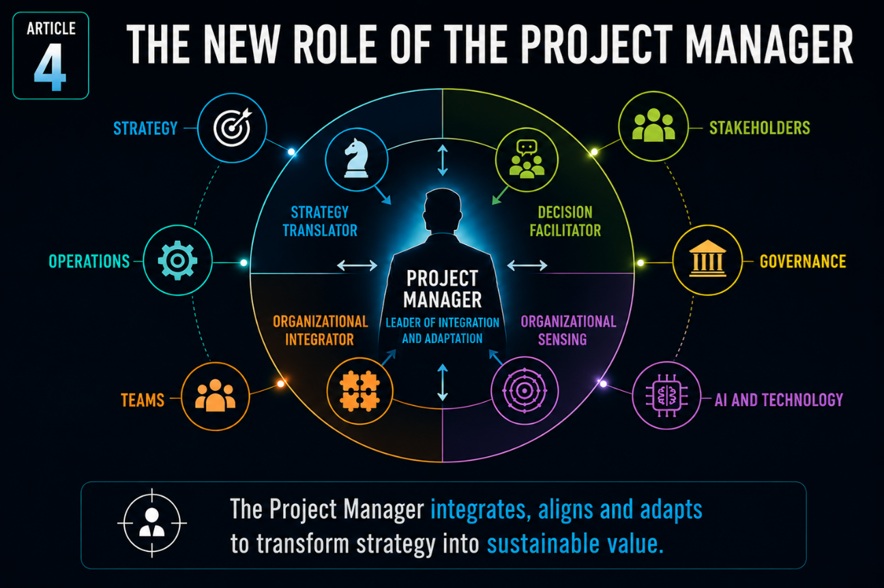
- In adaptive organizations, the Project Manager contributes to preserving the adaptive viability of the temporary organization by helping create and preserve conditions that allow work, knowledge, decisions, and learning to traverse the human, functional, organizational, and computational boundaries that characterize the initiative, while accountability remains clear and traceable.
1. The adaptability of temporary organizations;
2. Boundary-spanning work;
3. Human-computational collaboration;
4. Organizational sensing.
This is not to suggest that these responsibilities belong exclusively to the Project Manager.
It is to recognize that, due to the cross-cutting nature of their function, they occupy a particularly
relevant position to articulate them within the temporary initiative.
Translating strategy to preserve context
One of the most important manifestations of this contribution lies in the relationship between strategy
and execution.
As seen in the previous article, strategic intention can lose meaning as it cascades through the organization.
Strategy transforms into objectives.
Objectives transform into metrics.
Metrics transform into tasks.
Work continues to be executed, but the context that gave it meaning can degrade.
This loss becomes especially problematic in adaptive environments.
The greater the autonomy granted to teams, the greater the need for them to understand the intention that should guide their decisions.
Autonomy without context does not necessarily produce coherent adaptation. It can produce locally
rational decisions that are incompatible with the overall purpose of the initiative.
Translating strategy is not an exclusive function of the Project Manager. Sponsors, functional leaders, product owners, and other stakeholders also participate in this translation.
The specific contribution of the Project Manager stems from the continuity with which they accompany the
transformation of that intention into cross-functional work.
Whenever they relate an operational decision to a strategic outcome;
Whenever they clarify the impact of a priority shift;
Whenever they make explicit the assumptions supporting a choice;
Whenever they identify a divergence between what is being executed and what the organization intends to
achieve;
They are contributing to preventing context from being lost as it crosses boundaries.
Preserving context does not mean preventing the project from changing.
It means ensuring that change remains understandable, justifiable, and tied to purpose.
True strategy translation does not consist, therefore, in repeating plans or objectives.
It consists in keeping available the meaning necessary for the temporary organization to adapt without
losing direction.
Facilitating decisions in an adaptive organization
As the temporary organization evolves, decision complexity increases as well.
For many years, the Project Manager was primarily associated with preparing information to support decisions made by sponsors, functional managers, or governance bodies.
That responsibility remains relevant.
The context, however, has altered.
Today, a growing portion of the information required for decisions can be generated by intelligent systems capable of analyzing risks, simulating scenarios, identifying patterns, and formulating recommendations within seconds.
Paradoxically, this evolution does not reduce the importance of human decision-making.
It makes it more demanding.
The greater the capacity to produce information, the greater the need to understand the assumptions embedded within it, recognize its limitations, and decide when it should or should not be followed.
In this context, the Project Manager's contribution ceases to reside primarily in generating information.
It comes to reside in the quality of the decision process.
This does not mean replacing those with decision-making authority.
It means contributing to ensuring that decisions occur under appropriate conditions:
- That assumptions are explicit;
- That dependencies are identified;
- That different perspectives can be considered;
- That risks are understood;
- That context remains accessible throughout the process.
However, speed without context merely increases the rate at which incoherent decisions propagate.
True agility results from the ability to combine speed, understanding, and accountability.
Preserving flow across boundaries
One of the most relevant developments in recent research is the growing attention dedicated to boundary
spanning.
Projects are no longer understood merely as coordination mechanisms.
They are recognized today as spaces where different organizational boundaries are continuously crossed:
- Boundaries between functions
- Between organizations
- Between disciplines
- Between technologies
- Between decision levels
- And, increasingly, between human and computational capabilities
It consists in contributing so that work, knowledge, decisions, and learning can flow across those boundaries without losing coherence, while accountability remains clear and traceable.
When this flow is interrupted, loss of context, delays, conflicts, duplication of effort, inconsistent decisions, and the degradation of collective learning frequently emerge.
Naturally, this work does not belong exclusively to the Project Manager.
Specialists, functional leaders, sponsors, architects, product owners, and other stakeholders also perform liaison functions between different parts of the organization.
However, due to the cross-cutting position they occupy throughout the initiative, the Project Manager is often in a privileged position to identify discontinuities, make dependencies visible, and facilitate the restoration of that flow.
It is precisely at this point that preserving adaptive viability ceases to be merely an operational concern and comes to represent a critical organizational capability.
Artificial intelligence and human-computational collaboration
Much of the current discussion around artificial intelligence remains focused on task automation:
- Planning
- Estimating
- Risk analysis
- Documentation
- Monitoring
- Reporting
Yet this reading remains incomplete.
Artificial intelligence does not merely alter the tools of Project Management.
It alters the temporary organization itself.
As people and intelligent systems collaborate more closely, new boundaries emerge:
- Who validates a recommendation produced by artificial intelligence?
- Who accounts for the consequences of that decision?
- How is transparency ensured?
- How is context preserved?
- How should decision rights, delegated execution, validation, and human override be legitimately structured across human and computational capabilities?
They are organizational.
The true impact of artificial intelligence does not consist merely in automating activities.
It consists in increasing the need for coordination between human and computational capabilities within
the temporary organization.
The future of the profession will depend less on the direct execution of analytical tasks and more on the capability to contribute to a responsible, transparent, and coherent collaboration between people and intelligent systems.
The Project Manager as part of the organizational sensing system
There is a less obvious consequence of this evolution.
Throughout a project, the Project Manager continuously tracks interactions among different areas, specialists, partners, customers, governance bodies, and, progressively, intelligent systems.
This position affords them a particularly rich perspective on the dynamics of the temporary organization.
Long before specific problems show up in formal metrics, small signals can become visible:
- A growing dependency;
- A contradictory priority;
- A repeatedly postponed decision;
- A loss of alignment among teams;
- An AI-generated recommendation that conflicts with relevant contextual knowledge.
Together, they can reveal important shifts in the adaptive capacity of the initiative.
It is in this sense that I propose understanding the Project Manager as part of the organization's organizational
sensing system.
Not because they concentrate all information, nor because they hold exclusive responsibility for organizational adaptation, but because their cross-cutting position allows them to observe relationships, dependencies, and
inconsistencies that would hardly be perceived from within a single permanent function.
This capacity does not replace formal monitoring mechanisms.
It complements them.
And it can significantly improve the quality of organizational adaptation.
A new way to exercise leadership
All these transformations inevitably lead to an evolution in project leadership.
For many years, leading a project meant primarily coordinating teams, tracking progress, resolving conflicts, and ensuring execution.
These responsibilities remain present.
However, they no longer fully describe the leadership required in adaptive organizations.
Leading a temporary organization means creating conditions for distributed capabilities to collaborate despite differences in knowledge, language, objectives, authority, and technology.
It means:
- Facilitating learning;
- Building trust;
- Preserving context;
- Promoting coherent decisions;
- Contributing to keeping permeable the boundaries through which work, knowledge, and learning flow, while accountability remains clear and traceable.
of a system in permanent adaptation.
Conclusion
Throughout this article, I sought to answer a simple question:
Why does an adaptive organization still need a Project Manager?
The answer does not lie in the tasks traditionally associated with the profession.
Those will continue to evolve, and many will be increasingly supported by artificial intelligence.
The organizational problem that historically justified Project Management, however, remains.
Organizations continue to require temporary configurations capable of integrating distributed capabilities to realize changes that no permanent unit can achieve in isolation.
In some contexts, this function may be performed without a formal Project Manager title.
What is essential, however, is not the job title.
It is that the function of preserving the conditions for adaptive viability is explicitly assured, with responsibilities assigned according to legitimate authority, capability, and opportunity to act.
When a Project Manager is formally entrusted with a central role in assuring this function, their distinctive contribution ceases to depend primarily on producing plans or controlling execution.
It comes to depend on their capability to help create and preserve the conditions that allow context to be maintained, decisions to be facilitated, collaboration to be fostered, and work, knowledge, and learning to continue crossing organizational boundaries while accountability remains clear and traceable.
The interpretation proposed in this article seeks to integrate recent contributions from research on temporary organizations, boundary spanning, and artificial intelligence applied to Project Management into a coherent understanding of the profession's evolution.
If this interpretation is correct, the greatest transformation of the Project Manager does not lie in adopting new tools.
It lies in how the Project Manager's contribution evolves as the organizational function itself becomes more demanding.
And this conclusion naturally leads to the final article of this series:
If the temporary organization itself must increasingly be capable of adaptation, how must project ways of working evolve with it?
Posted on: August 23, 2026 04:15 AM |
Permalink




