
Viewing Posts by Shenila Shahabuddin

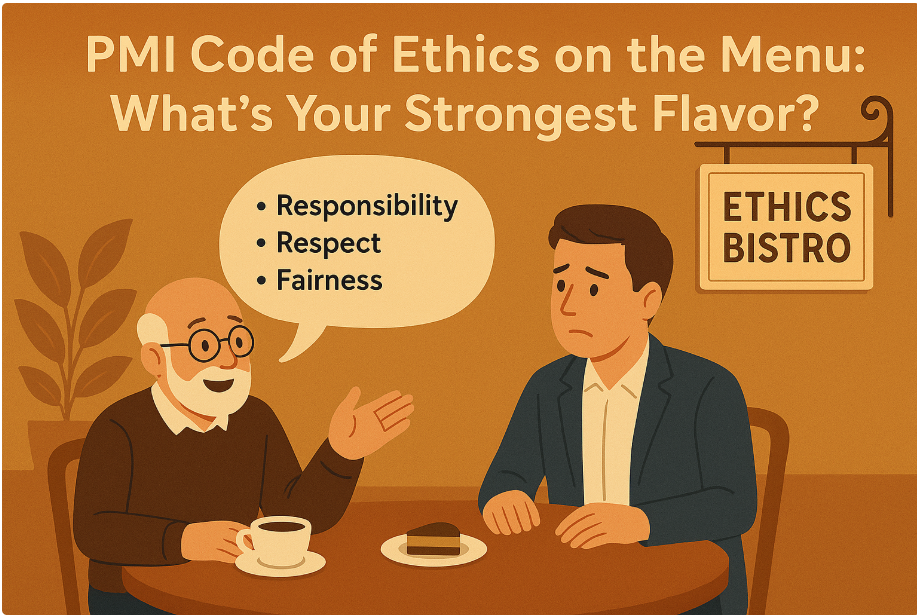
PMI Code of Ethics on the Menu: What’s Your Strongest Flavor?


| Imagine walking into a cozy little café called The Ethics Bistro. The air smells of freshly brewed coffee, and the tables are filled with people quietly reflecting on their day. At one corner table sits a project manager named David, looking worried.
The owner of the bistro, a wise old mentor, notices David’s frown and walks over. “Why so serious, David?” the mentor asks. David sighs. “I am leading a project team, but I am struggling to make the right calls. Deadlines, clients, budgets it feels like I am being pulled in every direction. How do I know if I am being fair?” The mentor smiles and says, “Ah, then you need to taste the four-course meal we serve here every day. It is called the PMI Code of Ethics.” First Course: Responsibility “Responsibility is like the soup,” the mentor explains. “It warms the soul. As project managers, we are responsible for our decisions, both good and bad. If something goes wrong, we take responsibility instead of placing blame. Taking responsibility keeps the project honest and the team confident.” Second Course: Respect Next comes the main dish. “Respect is the heart of the meal. Just as food is seasoned with care, respect seasons every conversation. Whether it is a client, team member, or vendor, every person deserves to be valued. Respect builds trust, and trust keeps the project alive.” Third Course: Fairness Then arrives a plate of perfectly balanced flavors. “Fairness means treating everyone equally. No hidden favoritism, no secret deals. Like sharing bread at the table, fairness ensures everyone gets their piece. When the team feels fairness, they give their best.” Final Course: Honesty Finally, dessert is served sweet but powerful. “Honesty,” says the mentor, “is the sugar of relationships. Speak the truth, even when it is uncomfortable. A project can survive a missed deadline, but it cannot survive broken trust.” David listens carefully, sipping coffee. “So, the PMI Code of Ethics is like this meal responsibility, respect, fairness, and honesty. If I serve these values to my team, they will follow me with trust.” The mentor nods. “Exactly. Projects come and go, but the taste of integrity stays forever.” As David leaves the Ethics Bistro that night, the burden feels lighter. He knows that no matter how tough the project becomes, the recipe for ethical leadership will guide him. If you were serving your project team at the Ethics Bistro, which course responsibility, respect, fairness, or honesty would they say is your strongest flavor? Share your answer in the comments. Reference: |
Trust the Data - but Not Blindly: An Ethics Bistro on AI
|
It was a rainy Tuesday when the red flag popped up. The AI tool, designed to optimize resource allocation across our project portfolio, had flagged three critical projects for delay. The model’s recommendation? Shift half the team from Project Titan to Project Eclipse to balance out workloads. At first glance, it seemed logical. The resource allocation maps, and velocity graphs supported the reallocation. But something did not sit right. I had collaborated closely with Titan’s team leads for months. They were on the verge of a breakthrough with a critical client deliverable. Moving people now, even with Eclipse falling behind, could cause a domino effect across our most valuable account. I called a huddle. “Why did the model deprioritize Titan?” I asked the AI SME. “It is based on risk scoring from delivery variance, budget utilization, and resource burn. Titan looked stable, so it pulled from there.” “But it does not know the client conversation we had last week. Titan’s ‘stability’ is built on momentum we cannot afford to interrupt.” That was it. The AI had the data but not the context. We chose not to follow the recommendation. Instead, we manually adjusted scope and brought in temporary support for Eclipse. It was a tough call, but three months later, Titan delivered on time and exceeded client expectations. Eclipse caught up too—without derailing the portfolio. That experience taught me something: AI is brilliant at pattern recognition, but it does not see what you know. It does not read nuance. And it does not carry responsibility. So, when should project managers trust AI—and when should we intervene? Trust AI when:
But intervene when:
AI is like a junior analyst with infinite memory and no emotional baggage. But it lacks judgment, and judgment is where leadership lives. As project managers, we are not just responsible for outcomes; we are stewards of values. According to the PMI Code of Ethics, we are bound to act with responsibility, respect, fairness, and honesty. Blindly following AI no matter how accurate without human oversight may compromise all four. Use AI like a compass not a map. Let it guide your thinking, but do not let it override your wisdom. Because when things go south, the algorithm will not be in the room explaining the outcome you will. So next time your AI flags a decision, pause. Ask: Does this align with what I know, what I have seen, and what matters most? If the answer is no, trust yourself and intervene. Reference: Webinar: Ethical Project Leadership in the digital age Webinar: When to Trust AI and When to Intervene
|

Ethical Leadership in the Digital Age
|
The rapid pace of technological innovation has transformed industries, workplaces, and the way we live. While these advancements have brought remarkable benefits, they also present unique challenges for leaders, particularly in maintaining ethical standards. Ethical leadership in the digital age is not just about making decisions that comply with laws and regulations but also ensuring those decisions align with core values and principles. Navigating Complex Ethical Landscapes Digital technologies often blur the lines between right and wrong, especially when decisions involve data privacy, artificial intelligence, or automation. Leaders must grapple with questions like: How much data collection is too much? Is it ethical to replace human jobs with AI? These dilemmas require a framework for thoughtful decision-making. The Project Management Institute (PMI) provides a valuable Ethical Decision-Making Framework (EDMF) that can guide leaders through these complex scenarios. The EDMF encourages:
Building Trust Through Transparency In a digital-first world, trust is a cornerstone of ethical leadership. Leaders must prioritize transparency in their decision-making processes, particularly when handling sensitive issues like data breaches or AI bias. Communicating openly about challenges and the steps being taken to address them fosters trust among employees, customers, and stakeholders. Fostering an Ethical Culture Ethical leadership also involves creating a culture where ethical behavior is encouraged and rewarded. This means setting clear expectations, providing training on ethical practices, and leading by example. When employees see their leaders making ethical choices, even when it's difficult, they are more likely to follow suit. The Role of Continuous Learning The digital age evolves rapidly, and so do its ethical challenges. Leaders must commit to continuous learning to stay informed about emerging technologies and their potential implications. This includes engaging with diverse perspectives to better understand the societal impact of their decisions. Conclusion Ethical leadership in the digital age is about more than avoiding scandals or staying compliant. It's about making principled decisions that benefit not just the organization but society as a whole. By leveraging frameworks like PMI’s EDMF, fostering transparency, and committing to continuous learning, leaders can navigate the ethical complexities of the digital world. What’s your take? How do you think leaders can better prepare themselves for the ethical challenges posed by digital transformation? Share your thoughts in the comments below! Reference: |

Navigating Ethical Crossroads: A Human-Centered Approach for Project Managers
|
In project management, while we focus heavily on timelines, budgets, and deliverables, there’s another vital factor that often goes unnoticed: ethics. Making ethical decisions isn’t always straightforward, particularly when faced with real-world pressures. The Project Management Institute’s (PMI) Ethical Decision-Making Framework (EDMF) is a tool designed to assist project managers in tackling these dilemmas, offering a structured path through the complexities of professional life. Yet, beyond the framework and guidelines, ethical decisions are rooted in something far more personal: our values, emotions, and relationships. The PMI’s EDMF provides five core steps to navigate ethical challenges: Assess, Consider, Analyze, Apply, and Evaluate. While these offer a clear process, the real strength of the framework comes to life when combined with the human touch. Let’s delve into what this looks like in practice. Ethical Decisions Are Deeply Personal Consider a situation where you’re managing a project under intense pressure to meet a looming deadline. A senior manager suggests cutting a few quality checks to save time. On an ethical level, you recognize that this isn’t the right course of action, but rejecting the suggestion could lead to strained relationships and project delays. Here, human emotions—like the fear of conflict or the desire to avoid disappointing others—can cloud judgment. This is where the PMI framework proves its value. It prompts you to pause, reflect, and assess the situation more objectively. By doing so, you can recognize the long-term implications of compromising on quality. Ethical decision-making in this scenario isn’t merely about adhering to rules; it’s about maintaining integrity and trust, both now and in the future. Empathy Plays a Vital Role in Ethics As project managers, we’re not just responsible for tasks but for leading people. Many ethical dilemmas don’t simply arise from rule-breaking but from human conflict. Take the example of a team member who is repeatedly missing deadlines due to personal struggles. A straightforward response might be to reprimand them, but empathy encourages a deeper understanding of their situation. The PMI framework urges you to analyze the situation not only from the perspective of the project’s needs but also with consideration for the individual. Balancing professional standards with empathy isn’t about lowering expectations—it’s about ensuring that both the team’s success and the individual’s well-being are taken into account. Ethical Leadership Demands Courage It often takes courage to stand firm in the face of ethical challenges. Making the right decision doesn’t always align with what’s easiest. For example, imagine you’re asked to approve a vendor who doesn’t meet ethical standards simply because they offer the lowest price. Refusing to comply could upset higher-ups, but proceeding would compromise the integrity of the project. The PMI framework supports ethical courage, encouraging project managers to take action with integrity, even when it feels risky. Upholding ethical standards might not always be popular, but it’s essential for long-term success and trust. Reflecting on Decisions with a Human Lens Finally, the framework’s evaluation phase encourages reflection on both the immediate and long-term effects of your decisions. It’s not just about refining your processes; it’s about personal growth and the impact on the people you lead. How did your decisions shape the team’s dynamic? Did they reinforce a culture of integrity? In the end, PMI’s Ethical Decision-Making Framework is more than just a procedural tool—it’s a guide that, when combined with empathy, courage, and integrity, helps us navigate the complex, human side of project management. Have you faced any ethical dilemmas in your project management career? How did you navigate the decision-making process? Let’s discuss it here at Ethics Bistro! Reference: |

Navigating AI-Enhanced Project Management through the PMI Ethical Decision-Making Framework
|
Once upon a time in the dynamic realm of project management, where the hum of algorithms met the cadence of human decisions, ethical considerations took center stage. Project managers found themselves at a crossroads, facing dilemmas influenced by the advent of Artificial Intelligence (AI). Our story unfolds within the context of the Project Management Institute's (PMI) Ethical Decision-Making Framework, a guiding compass in the unfolding ethical odyssey of AI-enhanced project management. In the heart of project management, the integration of AI introduced both opportunities and challenges. Project managers grappled with ethical dilemmas as algorithms influenced decisions that shaped project destinies. The PMI Ethical Decision-Making Framework emerged as a beacon, illuminating the path to navigate these ethical nuances. Our protagonist, the conscientious project manager, embarked on a journey guided by the PMI framework. The first step was to define the ethical dilemma at hand, unraveling the intricacies of AI-driven decision-making. Real-world scenarios became the canvas on which the project manager painted the ethical landscape. Armed with knowledge, our protagonist delved into the second stage – gathering information. Transparency became a key quest, as the project manager sought to understand the inner workings of AI algorithms. The goal was to make informed decisions while ensuring clarity and explainability. As the story unfolded, the importance of stakeholders came into focus. The project manager recognized the diverse cast involved – from team members to end-users. The ethical responsibility extended beyond immediate concerns, considering the far-reaching impact on all stakeholders. A myriad of options lay on the ethical table, each with its consequences and implications. Our project manager evaluated each option against the ethical principles embedded in the PMI framework – responsibility, respect, fairness, and honesty. At the decision-making crossroads, the project manager made choices that aligned not only with the immediate ethical concern but also contributed to the project's long-term ethical culture. The PMI's Code of Ethics and Professional Conduct served as the guiding script. With the decision made, the project manager moved into the implementation phase. Practical considerations, communication, and transparency took center stage. The ethical resolution wasn’t just a decision but a commitment to ethical culture throughout the project. The story ends with a promise to navigate the ethical journey of AI-enhanced project management, guided by the PMI Ethical Decision-Making Framework. As we think back on this adventure, we invite you to share your thoughts on how AI ethics will shape the future of project management. What problems and opportunities do you see, and how can the collective wisdom of the project management community contribute to an ethical and creative landscape? We value your insights, so please share your thoughts in the comments section below. Let's keep exploring the connection between ethics and innovation in the dynamic world of project management together! Reference: |



