
We all tackle ethical dilemmas. Wrong decisions can break careers. Which are the key challenges faced? What are some likely solutions? Where can we find effective tools? Who can apply these and why? Dry, theoretical discussions don't help. Join us for lively, light conversations to learn, share and grow!
View Posts By:
Tara Leparulo
Shenila Shahabuddin
Juan Posada Toro
Albert Agbemenu
Ming Yeung
Kannan Ganesan
Yannick Arekion
Witold Hendrysiak
Stelian ROMAN
Laszlo J. Kremmer MBA, CSPO®, CSM®, PMP®
Past Contributors:
Dr. Deepa Bhide
Lily Murariu
Alankar Karpe
Bryan Shelby
Amany Nuseibeh
Mohamed Hassan
Fabio Rigamonti
Simona Bonghez
John Watson
Lissa Muncer
Valerie Denney
Majeed Hosseiney
Gretta Kelzi
Enrique Cappella
Rocio Briceno
Karthik Ramamurthy
Recent Posts
Professionalism Under Pressure: Choosing Respect When Conflict Escalates
The Credential Is a Promise: What Do Three Letters Really Say?
When the schedule slipped, so did accountability: Ethical reflections from an early ERP project - Part 2
When the schedule slipped, so did accountability: Ethical reflections from an early ERP project - Part 1
Do You Like to Pick and Choose Your Projects?
Categories
Aerospace and Defense,
Agile,
AI,
Ambassadors,
Artificial Intelligence,
Ask the Experts,
Behavior,
bottom line,
Business Acumen,
Business Ethics,
Business Ethics,
CEO,
CFO,
Change Management,
Chapters,
CIO,
code of conduct,
code of ethics,
Code of Ethics and Professional Conduct,
communication,
Conflict,
Construction,
courage honesty responsibility respect fairness,
Cultural Diversity,
Culture,
CxO,
Decision Making,
Decision-making,
Decision-making,
Digital Project Management,
Digital Transformation,
Diversity,
Do the right thing,
dugutalization project manager professionalism social media,
economy,
EDMF,
EMAG,
empathy,
Ethical Dilemma,
Ethical Leadership,
Ethics,
Ethics,
Ethics,
Ethics,
Ethics,
Ethics,
Ethics,
Ethics as a competence,
Ethics Bistro,
Ethics in Communication,
Ethics Insight Team,
Fairness,
fairness,
Governance,
Honesty,
honesty,
Human,
Information Technology,
Leadership,
Legal Project Management,
Legilsation,
Lessons Learned,
Negotiation,
Nexus,
Organizational Culture,
Organizational Project Management,
PMI Program Management,
PMI Talent Triangle,
PMIAA,
Portfolio Management,
Power Skills,
practitioner,
Product Management,
Professional Conduct,
professional conduct,
Professional Responsibility,
Professionalization,
professonal conduct,
Program Management,
Project,
Project Management,
project manager,
Regulatory,
research,
Respect,
respect,
Responsibility,
responsibility,
Risk Management,
Stakeholder Management,
Strategy,
Sustainability,
Team Assessment,
Teams,
Thought leadership,
tools,
Trust,
trust,
Values,
Values,
values,
Virtual Experience Series,
volunteers,
Ways of Working
Date
Imagine walking into a cozy little café called The Ethics Bistro. The air smells of freshly brewed coffee, and the tables are filled with people quietly reflecting on their day. At one corner table sits a project manager named David, looking worried.
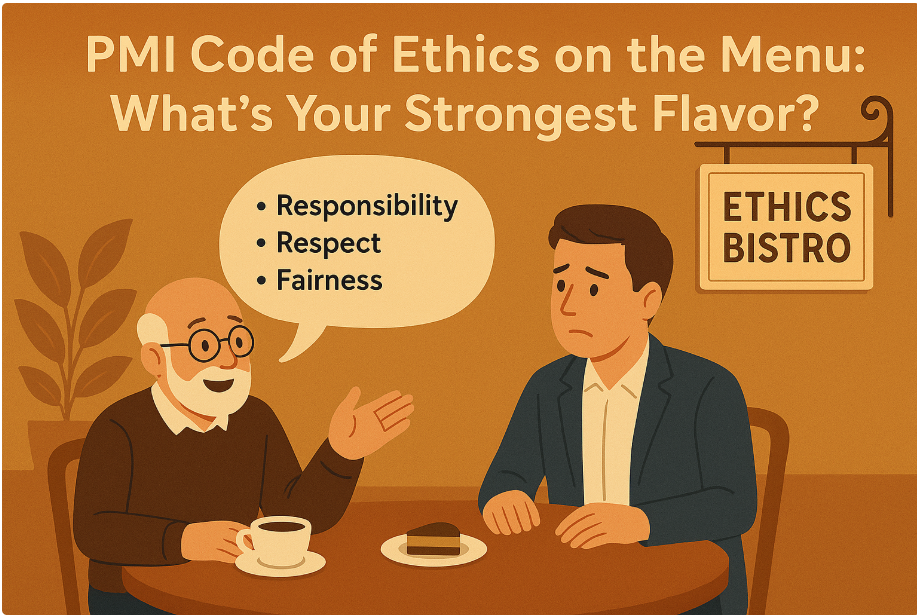
The owner of the bistro, a wise old mentor, notices David’s frown and walks over.
“Why so serious, David?” the mentor asks.
David sighs. “I am leading a project team, but I am struggling to make the right calls. Deadlines, clients, budgets it feels like I am being pulled in every direction. How do I know if I am being fair?”
The mentor smiles and says, “Ah, then you need to taste the four-course meal we serve here every day. It is called the PMI Code of Ethics.”
First Course: Responsibility
“Responsibility is like the soup,” the mentor explains. “It warms the soul. As project managers, we are responsible for our decisions, both good and bad. If something goes wrong, we take responsibility instead of placing blame. Taking responsibility keeps the project honest and the team confident.”
Second Course: Respect
Next comes the main dish. “Respect is the heart of the meal. Just as food is seasoned with care, respect seasons every conversation. Whether it is a client, team member, or vendor, every person deserves to be valued. Respect builds trust, and trust keeps the project alive.”
Third Course: Fairness
Then arrives a plate of perfectly balanced flavors. “Fairness means treating everyone equally. No hidden favoritism, no secret deals. Like sharing bread at the table, fairness ensures everyone gets their piece. When the team feels fairness, they give their best.”
Final Course: Honesty
Finally, dessert is served sweet but powerful. “Honesty,” says the mentor, “is the sugar of relationships. Speak the truth, even when it is uncomfortable. A project can survive a missed deadline, but it cannot survive broken trust.”
David listens carefully, sipping coffee. “So, the PMI Code of Ethics is like this meal responsibility, respect, fairness, and honesty. If I serve these values to my team, they will follow me with trust.”
The mentor nods. “Exactly. Projects come and go, but the taste of integrity stays forever.”
As David leaves the Ethics Bistro that night, the burden feels lighter. He knows that no matter how tough the project becomes, the recipe for ethical leadership will guide him.
If you were serving your project team at the Ethics Bistro, which course responsibility, respect, fairness, or honesty would they say is your strongest flavor?
Share your answer in the comments.
Reference:
PMI Code of Ethics & Professional Conduct
Posted
by
Shenila Shahabuddin
on: October 04, 2025 01:39 AM |
Permalink




