Do You Like to Pick and Choose Your Projects?
From the Ethics Bistro Blog
by Tara Leparulo,
Shenila Shahabuddin, Juan Posada Toro, Albert Agbemenu, Ming Yeung, Kannan Ganesan, Yannick Arekion, Witold Hendrysiak, Stelian ROMAN, Laszlo J. Kremmer MBA, CSPO®, CSM®, PMP®

We all tackle ethical dilemmas. Wrong decisions can break careers. Which are the key challenges faced? What are some likely solutions? Where can we find effective tools? Who can apply these and why? Dry, theoretical discussions don't help. Join us for lively, light conversations to learn, share and grow!
View Posts By:
Tara Leparulo
Shenila Shahabuddin
Juan Posada Toro
Albert Agbemenu
Ming Yeung
Kannan Ganesan
Yannick Arekion
Witold Hendrysiak
Stelian ROMAN
Laszlo J. Kremmer MBA, CSPO®, CSM®, PMP®
Past Contributors:
Dr. Deepa Bhide
Lily Murariu
Alankar Karpe
Bryan Shelby
Amany Nuseibeh
Mohamed Hassan
Fabio Rigamonti
Simona Bonghez
John Watson
Lissa Muncer
Valerie Denney
Majeed Hosseiney
Gretta Kelzi
Enrique Cappella
Rocio Briceno
Karthik Ramamurthy
Recent Posts
Professionalism Under Pressure: Choosing Respect When Conflict Escalates
The Credential Is a Promise: What Do Three Letters Really Say?
When the schedule slipped, so did accountability: Ethical reflections from an early ERP project - Part 2
When the schedule slipped, so did accountability: Ethical reflections from an early ERP project - Part 1
Do You Like to Pick and Choose Your Projects?
Categories
Aerospace and Defense,
Agile,
AI,
Ambassadors,
Artificial Intelligence,
Ask the Experts,
Behavior,
bottom line,
Business Acumen,
Business Ethics,
Business Ethics,
CEO,
CFO,
Change Management,
Chapters,
CIO,
code of conduct,
code of ethics,
Code of Ethics and Professional Conduct,
communication,
Conflict,
Construction,
courage honesty responsibility respect fairness,
Cultural Diversity,
Culture,
CxO,
Decision Making,
Decision-making,
Decision-making,
Digital Project Management,
Digital Transformation,
Diversity,
Do the right thing,
dugutalization project manager professionalism social media,
economy,
EDMF,
EMAG,
empathy,
Ethical Dilemma,
Ethical Leadership,
Ethics,
Ethics,
Ethics,
Ethics,
Ethics,
Ethics,
Ethics,
Ethics as a competence,
Ethics Bistro,
Ethics in Communication,
Ethics Insight Team,
Fairness,
fairness,
Governance,
Honesty,
honesty,
Human,
Information Technology,
Leadership,
Legal Project Management,
Legilsation,
Lessons Learned,
Negotiation,
Nexus,
Organizational Culture,
Organizational Project Management,
PMI Program Management,
PMI Talent Triangle,
PMIAA,
Portfolio Management,
Power Skills,
practitioner,
Product Management,
Professional Conduct,
professional conduct,
Professional Responsibility,
Professionalization,
professonal conduct,
Program Management,
Project,
Project Management,
project manager,
Regulatory,
research,
Respect,
respect,
Responsibility,
responsibility,
Risk Management,
Stakeholder Management,
Strategy,
Sustainability,
Team Assessment,
Teams,
Thought leadership,
tools,
Trust,
trust,
Values,
Values,
values,
Virtual Experience Series,
volunteers,
Ways of Working
Date
Do You Like to Pick and Choose Your Projects?
What the PMI Code of Ethics Says May Surprise You
As a Project Manager, you know the feeling. A new project lands in your lap which is either a cutting-edge AI technology implementation, a shiny digital transformation or something that will look brilliant on your CV and that you know you can deliver. You're energised. You're in. Then there's the other kind. The project that is deep in the red, the one nobody else wanted, the rescue mission with a sponsor who is already frustrated, a team that is burnt out, and a timeline that was never realistic to begin with. Suddenly your diary looks very full.
We have all been there and tempted to lean toward the good ones and push back on the hard ones. It's human nature. But before you do, let's talk about what the PMI Code of Ethics and Professional Conduct actually says because most practitioners have never taken notice to that relevant section.
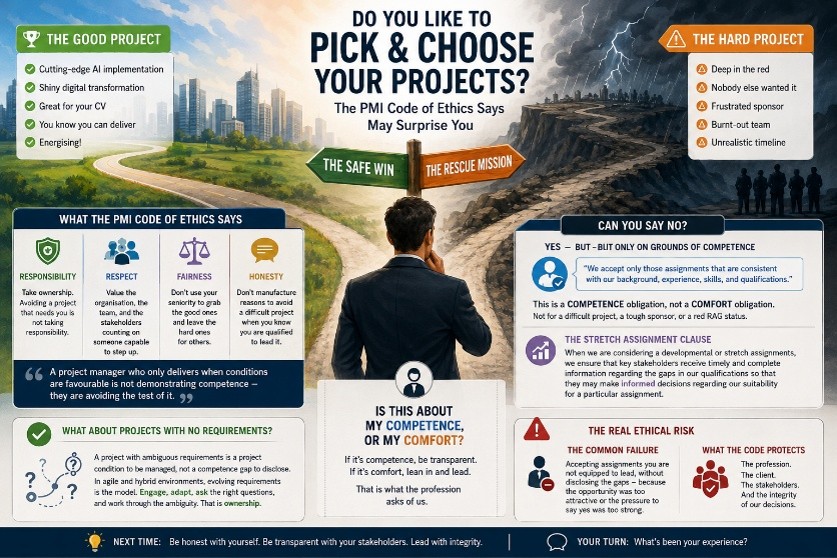 So if you had to choose between the good project and the hard one, which one should you take?
The answer that the Code points to is the one that we are qualified for which may be the hard one. And here's why.
The Code of Ethics does not give you the right to cherry-pick assignments based on what looks good for your career or what feels manageable for your stress levels. Think about what the four pillars actually demand in this situation.
Responsibility means taking ownership including the decision to avoid a project that genuinely needs you.
Respect means valuing the organisation, the team stuck on that struggling project, and the stakeholders counting on someone capable to step up.
Fairness means not using your seniority or positioning to grab the good ones and leave the hard ones for others.
Honesty means not manufacturing reasons to avoid a difficult project when you know full well you are qualified and competent to lead it.
The uncomfortable truth that the Code asks us to sit with is this: “
a project manager who only delivers when conditions are favourable is not demonstrating competence they are avoiding the test of it”.
But there is a provision that lets you say no but it's not what you think.
Now here is where it gets interesting, because the Code does provide a legitimate basis to decline an assignment. It sits in the Responsibility chapter of the updated 2025 PMI Code of Ethics and Professional Conduct (version 8, effective November 2025), in Section 2.2.3 it reads:
"
We accept only those assignments that are consistent with our background, experience, skills, and qualifications."Most practitioners who know this line assume it covers situations like the ones above the difficult project, the unwanted rescue, the high-pressure delivery. It doesn't.
This is a competence obligation, not a comfort obligation.
The Code is protecting the profession and the client from a Project Manager who takes on work they are genuinely not equipped to lead. Taking on a highly specialised regulatory compliance program, a complex sovereign cloud migration, or a safety-critical infrastructure project when that domain expertise is genuinely beyond their capability without telling anyone is an ethical problem the Code is addressing. Not a project with a difficult sponsor or a red RAG status.
Also the clause most practitioners have never read that makes this provision even richer is the commentary that follows it, which the vast majority of PMPs have never encountered:
"When we are considering a developmental or stretch assignments, we ensure that key stakeholders receive timely and complete information regarding the gaps in our qualifications so that they may make informed decisions regarding our suitability for a particular assignment."
This is the stretch assignment clause. The Code explicitly contemplates that you will sometimes be asked to lead work at the edge of your capability and the ethical response is not automatic refusal. It is transparency. Be upfront about where the gaps are, what support you will need, and let your stakeholders make an informed call. That is Honesty and Responsibility working exactly as the Code intends.
What about the project with no requirements?This is where even experienced practitioners get caught out, and it comes up regularly during the PMP training exam simulators for good reason. If you are assigned a project with poorly defined or missing requirements, is that grounds to refuse the project?
The answer is No. A project with ambiguous requirements is a project condition to be managed, not a competence gap to disclose.
So next time you feel the pull toward the safe win, or the resistance to the rescue project, ask yourself one honest question: Is this about my competence, or my comfort? If it is competence speak up, be transparent, and let your stakeholders decide with the full picture. If it is comfort take a breath, lean in, and lead. That is what the profession asks of us.
Have you ever said no to a project that you were fully qualified to lead and if so, was it really about competence, or were you protecting yourself? Have you ever watched a colleague grab the good projects and leave the hard ones for others and said nothing? Now that you are aware of what the PMI Code of Ethics actually says does it change how you see those moments?
Please share your thoughts below.
More information please refer to the PMI Code of Ethics and Professional Conduct https://www.pmi.org/-/media/pmi/documents/public/pdf/ethics/pmi-code-of-ethics.pdf?rev=e7713058411741c78fe3c4f77040895c
Posted
by
Yannick Arekion
on: June 09, 2026 02:37 AM |
Permalink
Comments (6)
Please login or join to subscribe to this item

Ming Yeung
Professor (adjunct part time)| George Brown Polytechnic/Fanshawe College/Humber Polytechnic
Toronto, Ontario, Canada
Yannick, your reflection cuts to the heart of a truth many project managers quietly recognise: the temptation to choose the “good” projects and sidestep the difficult ones is real where the PMI Code of Ethics and Professional Conduct (Code) asks more of us.
At its core, the Code’s four values, namely Responsibility, Respect, Fairness, and Honesty, challenge us to look beyond comfort and toward professional duty. Responsibility reminds us that avoiding a project that genuinely needs our capability is still a choice with consequences. Respect calls us to acknowledge the people already struggling within that troubled initiative. Fairness demands that we not leverage influence to secure only favourable assignments. Honesty requires transparency about our motives and our true level of competence.
The PMI Ethical Decision‑Making Framework (EDMF) reinforces this mindset by urging practitioners to pause, assess context, identify stakeholders, examine options, and test decisions against ethical principles before acting. It is a discipline of vigilance which separates perceived dilemmas from actual ethical breaches.
Looking back on my own experiences, the most competent project managers I have known were not the ones who chased prestige but those who stepped into complexity with integrity, disclosed their limitations openly, and upheld the profession through their conduct. Ethical practice is rarely glamorous, but it is always defining.
You remind us that we must stay alert not only to the ethical dilemmas we imagine, but to the real breaches that occur when comfort overrides duty.
Let us remain vigilant, reflective, and courageous in the choices that shape our profession.
Excellent post, Yannick. I really like how clearly you distinguish between a true competence gap and simple discomfort with a difficult assignment. The “competence vs. comfort” framing is practical, memorable, and a strong reminder that ethical project leadership is often tested most when the project is messy, pressured, or unpopular. A valuable reflection for every project manager.
In my former company, PMs were nominated to projects by the line manager, so we didn't really chose our project. You can of course accept or reject the manager decision to a certain limit, as the boss has the last call.
The problem I faced, as an experienced PM and a woman (I think being a woman is one of the key point in the situation I faced), was that I was given the projects that were complicated and that nobody else wanted but also not in the top company projects. According to the work ethic explained in this paper, as I had the experience and skills to manage them, I accepted, meaning that I was managing difficult projects with no visibility from the company top managers that were focused on other projects, meaning no possibility to capitalize on it for my career progress.
When I have understood that the situation will continue forever, as despite regular conversation with managers nobody wanted to change anything to that situation that was confortable for them, I left the company.
Project selection is a privilege that comes with experience. Early in your career you take what is available, but as you grow, aligning projects with your strengths and interests makes you more effective.

Juan Posada Toro
Customer Success Manager| Rockwell Automation
Envigado, Antioquia, Colombia
Great post Yannick and thanks for sharing. It offers a valuable perspective by challenging us to distinguish between competence and comfort. I especially appreciated how you grounded the discussion in specific sections of the PMI Code rather than personal opinion.
The point about stretch assignments was particularly insightful, it reinforces that ethical leadership is not about having all the answers, but about being transparent regarding our capabilities and support needs. I would say it is a reminder that the toughest ethical decisions often begin with honest self-reflection before they become project decisions.
Thank you for this post Yannick. A thought-provoking perspective, especially the distinction between competence and comfort. I agree that difficult conditions alone should not be confused with a lack of qualification. One point I would add is that ethical responsibility also includes recognising when personal capacity has become a risk. A PM may be qualified on paper but still need to raise concerns if workload, authority, resources, or organisational support make responsible delivery unrealistic.
The stretch-assignment principle is particularly valuable: know your gaps, disclose them, seek the right support, and allow stakeholders to make an informed decision. That turns “leaning in” from simply accepting a difficult project into a genuinely ethical leadership decision.
Please Login/Register to leave a comment.
|
I can't go to a bad movie by myself. What, am I gonna make sarcastic remarks to strangers?
- Jerry Seinfeld
|







