
Professionalism Under Pressure: Choosing Respect When Conflict Escalates
Categories:
Ethics as a competence,
Behavior,
courage honesty responsibility respect fairness,
code of ethics,
Ethical Leadership,
Decision-making,
Ethics Insight Team,
Ethics Bistro,
Business Ethics,
code of conduct,
Power Skills,
Decision-making,
Business Ethics,
Professionalization,
practitioner,
Ethical Dilemma,
respect,
Professional Responsibility,
Honesty,
Respect,
Responsibility,
Fairness,
Code of Ethics and Professional Conduct,
Human,
fairness,
communication,
honesty,
responsibility,
professonal conduct,
Conflict,
empathy,
EDMF,
Ethics in Communication,
Agile,
Decision Making,
Ethics,
Legal Project Management
Categories: Ethics as a competence, Behavior, courage honesty responsibility respect fairness, code of ethics, Ethical Leadership, Decision-making, Ethics Insight Team, Ethics Bistro, Business Ethics, code of conduct, Power Skills, Decision-making, Business Ethics, Professionalization, practitioner, Ethical Dilemma, respect, Professional Responsibility, Honesty, Respect, Responsibility, Fairness, Code of Ethics and Professional Conduct, Human, fairness, communication, honesty, responsibility, professonal conduct, Conflict, empathy, EDMF, Ethics in Communication, Agile, Decision Making, Ethics, Legal Project Management


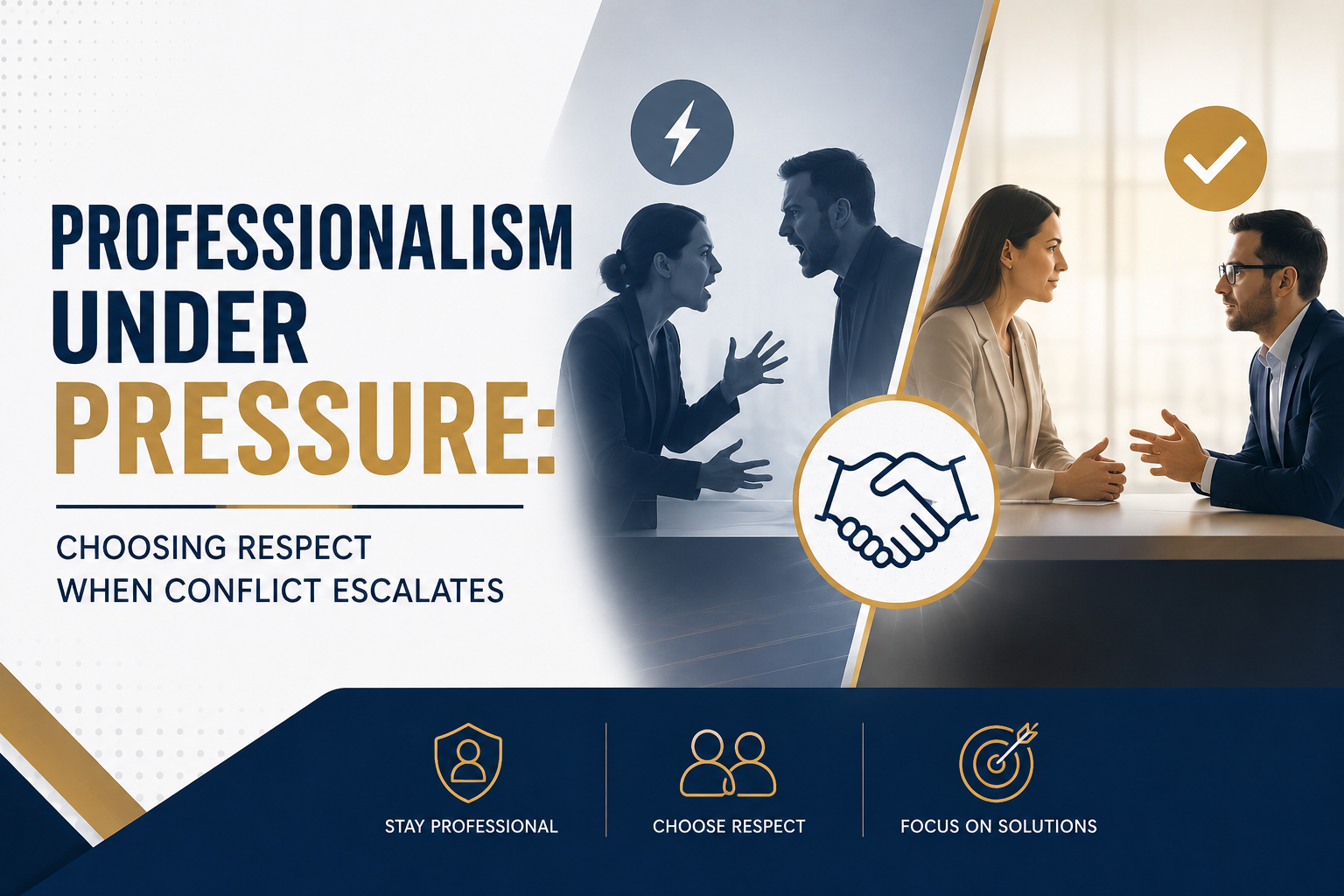 The message arrived at 11:47 p.m. It wasn't long. Just a few lines. But every sentence carried anger. A disagreement over a contract had been going on for weeks. There were questions about payment, responsibilities, and what each side believed had been promised. The conversation had already become uncomfortable. Now, the latest message crossed a different line. There were accusations. Personal insults. A veiled threat about “making sure people know” what had happened. And then came a remark about the other person's background. For a moment, the easiest response seemed obvious: Fight back. After all, they started it. But this is where professionalism is really tested not when everyone is calm and reasonable, but when someone gives us every reason to lose our composure. Conflict is part of professional life. Employment decisions can disappoint people. Contracts can fall apart. Candidates can feel unfairly treated. Managers can become frustrated. Clients and suppliers can disagree about commitments. Sometimes we are genuinely wronged. And sometimes we may be the ones who got something wrong. Either way, disagreement does not give us permission to abandon respect. The PMI Code of Ethics and Professional Conduct places Respect among its four core values. That sounds simple until we find ourselves staring at a message that feels deliberately insulting, threatening, or unfair. Respect is easy when it is reciprocated. It becomes meaningful when it isn't. The person receiving that late-night message eventually did something surprisingly difficult. They didn't respond. Not immediately. They saved the communication, stepped away from the computer, reviewed the facts, and went to bed. The next morning, they wrote back. The response acknowledged the disagreement. It clarified the contractual position. It proposed using the appropriate process to resolve the matter. There were no insults. No threats. No attempt to embarrass the other person. It wasn't weakness. It was professional self-control. Respect doesn't mean tolerating abuse. It doesn't mean remaining silent when discriminatory language is used. It doesn't mean accepting intimidation or allowing retaliation to go unchallenged. And it certainly doesn't mean avoiding difficult conversations. Sometimes respect means setting a boundary. Sometimes it means documenting what happened and involving Human Resources, legal counsel, procurement, recruitment leadership, or another appropriate authority. Sometimes it means saying: “I am willing to discuss the issue, but I will not continue the conversation in this manner.” That is respect too. Because respect isn't only about how we treat people when we agree with them. It is also about recognizing their dignity when we don't. And perhaps that's the uncomfortable part of professional ethics. We cannot control the tone of the message that arrives at 11:47 p.m. We cannot control whether someone tries to intimidate us, insults us, uses discriminatory language, or threatens retaliation. But we can control whether we respond in kind. We can choose to protect our boundaries without attacking someone else's dignity. We can choose accountability without humiliation. We can choose firmness without hostility. We can choose Respect. Not because the other person necessarily deserves our kindness in that moment, but because our professional values should not depend on someone else's behavior. The next time a difficult message lands in your inbox, ask yourself: When someone crosses the line with us, can we hold the line without crossing it ourselves? |
Project Management Palate: Crafting a Lasting Legacy through Righteous Choices
|
In the world of project management, the final phases often serve as the grand finale, leaving an impression on team members and stakeholders. Similarly, within the ethical realm of project management, the decisions we make can be likened to the sweet treats that define our professional legacy.
Just like a perfectly executed project, ethical decisions in project management are built on a foundation of trust. When project managers consistently make choices guided by integrity and transparency, they establish a reputation for reliability. Trust, much like the sweetness in a well-executed project, becomes the signature flavor that lingers and attracts collaboration. Consider the case of a project manager who prioritizes honesty and fairness in their dealings. Over time, this project manager builds trust not only within the team but also with clients, stakeholders, and the wider project community. The sweetness of trust becomes the defining note in the professional legacy they leave behind.
Ethical choices are the ingredients that nourish collaborative relationships, creating a harmonious blend of respect, empathy, and understanding. Just as a well-executed project brings together different components, ethical decisions in project management foster connections and collaborations. In a project team setting, a project manager who values inclusivity and treats team members with fairness cultivates a positive work environment. This ethical approach becomes the secret recipe for a cohesive and motivated team, leaving a lasting impact on both the individuals involved and the success of the project.
Ethical decisions in project management, like the sweet ripples from a successful project, have a far-reaching impact. When project managers prioritize doing what is right, they inspire those around them to follow suit. This creates a ripple effect of project success that extends beyond immediate project boundaries. Consider a project manager who makes a commitment to sustainable and ethical project practices. The positive impact is not confined to the project itself but resonates throughout the organization, influencing other projects, team dynamics, and even project stakeholders. Ethical decisions, like a sweet ripple, have the power to shape the broader project landscape.
Just as a celebrated chef leaves a legacy through their timeless recipes, project managers can build a legacy of professional integrity through consistent ethical choices. This legacy becomes a guiding light for future project managers, setting a standard for moral conduct in project management. A project manager who stands firm in their ethical convictions, even in the face of project challenges, becomes a beacon of inspiration. Their legacy is one of unwavering principles, leaving a blueprint for others to follow. Likewise, organizations that prioritize ethical project practices become trailblazers, demonstrating that project success can be achieved with a commitment to doing what is right. Conclusion: As we savor the rich flavors of the "Project Management Palate," let us appreciate that ethical decisions are not merely individual acts but the essential ingredients shaping a profound professional legacy. Much like the lingering sweetness of a successfully executed project, ethical choices leave an indelible mark on individuals and projects alike. So, as you navigate the diverse menu of project management decisions, relish the unique sweetness that ethical choices bring. Choose the ingredients of trust, foster collaborative relationships, initiate positive ripples of project success, and construct a legacy steeped in professional integrity. In this grand banquet of project management considerations, let your choices be the dessert that leaves everyone yearning for more – a legacy of sweetness that extends beyond project timelines. We invite you to share your thoughts and opinions on ethical decision-making in project management. How do you prioritize ethics in your projects, and what strategies do you employ to ensure lasting impact? |
Be Original - An Ethical Dilemma!
Categories:
respect,
fairness,
communication,
honesty,
responsibility,
professonal conduct,
research,
Leadership,
Ethics,
Organizational Culture
Categories: respect, fairness, communication, honesty, responsibility, professonal conduct, research, Leadership, Ethics, Organizational Culture
| “Hey Peter, here’s my submission. Apologies for the delay but had to do some research to get the algorithms working the right way”. Maya rushed into Peter’s cabin. “Thanks. What took you so long?” Peter wanted to know.
“Oh! I needed time to check on the output. That took some time. The logic behind these algorithms was present on a website and I used that material” Maya continued. Peter was a new project manager to the organization and had been recently deputed to a project related to Innovation in the information technology domain. He was a product of an elite business school and was chosen for this project for his innovative ideation and a drive to succeed. Peter knew this work wasn’t Maya’s original work and it needed to be called out by providing an appropriate citation. However Peter also knew if she did that, his project would not be considered for Innovation and that he and his team would lose out on the award. “Well we need to make the appropriate attributions to the original document that had the logic. That would be an appropriate next step” Maya wanted to check with Peter. “I guess so but the process of deriving output is your work and so I don’t think we need to call an attribution separately. I have noted that the so called “original” works that are out there are actually ideas from other sources. I guess it is fine to be “inspired” by such ideas as there is always someone who would have said it before you do. I would focus on our part of the work and in this case our original work is in processing the output or the effort that has gone in deriving the research outcome. Your part of the activity is quite complex and important for the eventual objective of our project” – Peter. “Well I don’t agree with you. After all the output is the function of the original algorithms and those are not my original scripts” Maya continued to debate. “Well, I guess I differ with your thought. Also remember that if we do so we are likely to be disqualified and will probably be out of the Innovation contest. Do you really believe that all original work out there is truly "original"? Well we are inspired by someone's ideas and that fuels the creativity in us. Well, give it a thought and let me know what you think” – Peter seemed disappointed. Given the easy availability of information on internet for most of the research papers today, these instances are not uncommon. This dilemma cuts across domains. It’s a belief that the scope for original thinking has reduced and that most of the works are a “copy-paste” or a derivation of someone’s original work. Blatant copying of original works and passing it off without an appropriate attribution is a common complaint. Resorting to these tricks is perceived as means for a quick success. The publishing community is quite aware of this and has set appropriate check points (created software applications for plagiarism check) to flag such instances. What can be done in such situations? How do we drive inspiration to write original articles? How can project managers work towards an appropriate balance of creativity and derivation? Applying originality of thoughts with the right attributions builds on the credibility of the author and ensures their authenticity and appropriate processing of guidelines. Your thoughts on this ethical dilemma are welcome…. Disclaimer: all characters, names and incidents in this story are fictional. Any resemblance to actual persons, living or dead, or actual events is purely coincidental.
|

A differing view- Of what we see and hear
Categories:
respect,
fairness,
communication,
honesty,
responsibility,
professonal conduct,
Leadership,
Ethics,
Organizational Culture
Categories: respect, fairness, communication, honesty, responsibility, professonal conduct, Leadership, Ethics, Organizational Culture
| Have you ever had an ah-ha moment because of something that just happens to you? As I sat at my desk preparing for a Skype call with a colleague from across the globe, I watched the sun rise as it kissed and glistened the morning dew. While sitting in front of a pair of windows, I noticed the one on my right had taken on cloudiness in the glass, and the window on the left is perfectly clear. And yes, the azaleas are still blooming, and the mock cherry is starting to light up! Since I sit right in the middle, and with a slight turn of my head I could go from a crispy clear view to a not so clear view.
As the phone rang, a multitude of thoughts were racing through my head, including several quotes, “if you change the way you look at things the things you look at change!” – Wayne Dyer. “Good leadership requires the ability to imagine life through another’s eyes”- Seth Godin. And then I checked on a definition of Empathy- “Being able to appreciate and experience emotion from another person’s perspective.” This led me to think about the many ways we view the world, and how often we have differing interpretations or views of the same idea or situation, whether it be a problem, an opportunity or a solution. We tend to view the world and our impact through our own lenses. I wondered how much we could benefit and learn from other perspectives and how my friend was seeing the world today. So, I asked…., and here is a small portion of our conversation. Although we did not achieve the intended purpose of our call, what we did accomplish by better understanding each other and growing our relationship was much more valuable. While this happened by accident, we imagined how many of our relationships that would benefit from having more of these types of conversations, intentionally! We discussed the critical importance of clarity. What is crystal clear to one person may not be so clear to the next person. And within that difference, with its presence or absence, therein lies the opportunity for conflict, creativity, and growth. And among other things, also the breakdown or building of Trust! What is the difference between those two outcomes? If we can so easily become vulnerable to see things differently, how often do we understand the things we hear differently from intended? Or how often do two or more of us hear the same things, and walk away with a different understanding of what was said? How often do we take the time to look at things through the other person’s lenses, and make a sincere effort to try and understand what, why or how they see things? Empathy is a leadership competency. Practice putting yourself in the other persons shoes, see it and hear it from where they stand, and see if you can find a common ground to build on. Discovering clarity on our different perspectives increases our understanding, capacity and ability to find the best solutions and outcomes for whatever we are trying to do. If you think that is important, how might we make achieving clarity a shared responsibility? Please join our conversation, we welcome your perspective. Where do you stand on this?
|

Is speaking up your responsibility?
Categories:
respect,
fairness,
communication,
honesty,
responsibility,
professonal conduct,
Leadership,
Ethics,
Organizational Culture
Categories: respect, fairness, communication, honesty, responsibility, professonal conduct, Leadership, Ethics, Organizational Culture
| If yes, then what other values or attributes should we include when exercising this responsibility?
|


