Support to Develop
by Luis Branco

This blog addresses management-related topics and has three areas of focus: 1. Technical skills; 2. Competencies in the field of interpersonal relations and communication (including personal organization and delegation, leadership, teamwork, conflict resolution, conducting meetings, and negotiation); and 3. Strategy (including diagnosis, strategic guidelines, and implementation).4.Technology
Recent Posts
Delegation with Purpose: Building Autonomy and Developing Capability
RCPCV™: A Method for Decision-Making and Continuous Improvement
The Same Change Can Succeed and Fail at the Same Time
What Must Exist Even When No Single Role Owns the Whole?
PHASE 4 – THE EMERGENCE
Categories
Agile,
Career Development,
Career Development,
Career Development,
Career Development,
Career Development,
Career Development,
Career Development,
Career Development,
Career Development,
Career Development,
Career Development,
Career Development,
Career Development,
Career Development,
Career Development,
Career Development,
Career Development,
Career Development,
Career Development,
Career Development,
Career Development,
Career Development,
Career Development,
Career Development,
Career Development,
Career Development,
Career Development,
Career Development,
Career Development,
Career Development,
Career Development,
Career Development,
Career Development,
Career Development,
Career Development,
Career Development,
Career Development,
Career Development,
Career Development,
Career Development,
Career Development,
Career Development,
Career Development,
Career Development,
Career Development,
Career Development,
Career Development,
Career Development,
Career Development,
Career Development,
Career Development,
Career Development,
Career Development,
Career Development,
Career Development,
Career Development,
Career Development,
Career Development,
Career Development,
Career Development,
Career Development,
Career Development,
Career Development,
Career Development,
Career Development,
Career Development,
Career Development,
Career Development,
Career Development,
Career Development,
Career Development,
Career Development,
Career Development,
Career Development,
Career Development,
Career Development,
Career Development,
Career Development,
Career Development,
Career Development,
Career Development,
Career Development,
Career Development,
Career Development,
Career Development,
Career Development,
Career Development,
Career Development,
Career Development,
Career Development,
Career Development,
Career Development,
Career Development,
Career Development,
Career Development,
Career Development,
Career Development,
Career Development,
Career Development,
Career Development,
Career Development,
Career Development,
Career Development,
Career Development,
Career Development,
Career Development,
Career Development,
Career Development,
Career Development,
Career Development,
Career Development,
Career Development,
Career Development,
Career Development,
Career Development,
Career Development,
Career Development,
Career Development,
Career Development,
Career Development,
Career Development,
Career Development,
Education,
Governance,
Governance,
Governance,
Governance,
Governance,
Governance,
Governance,
Governance,
Governance,
Governance,
Governance,
Governance,
Governance,
Governance,
Governance,
Governance,
Governance,
Governance,
Governance,
Governance,
Governance,
Governance,
In,
Integration Management,
Interpersonal Skills,
Interpersonal Skills,
Interpersonal Skills,
Interpersonal Skills,
Interpersonal Skills,
Interpersonal Skills,
Interpersonal Skills,
Interpersonal Skills,
Interpersonal Skills,
Interpersonal Skills,
Interpersonal Skills,
Interpersonal Skills,
Interpersonal Skills,
Interpersonal Skills,
Interpersonal Skills,
Interpersonal Skills,
Interpersonal Skills,
Interpersonal Skills,
Interpersonal Skills,
Interpersonal Skills,
Interpersonal Skills,
Interpersonal Skills,
Interpersonal Skills,
Interpersonal Skills,
Interpersonal Skills,
Interpersonal Skills,
Interpersonal Skills,
Interpersonal Skills,
Interpersonal Skills,
Interpersonal Skills,
Interpersonal Skills,
Interpersonal Skills,
Interpersonal Skills,
Interpersonal Skills,
Interpersonal Skills,
Interpersonal Skills,
Interpersonal Skills,
Interpersonal Skills,
Interpersonal Skills,
Interpersonal Skills,
Interpersonal Skills,
Interpersonal Skills,
Interpersonal Skills,
Interpersonal Skills,
Interpersonal Skills,
Interpersonal Skills,
Interpersonal Skills,
Interpersonal Skills,
Interpersonal Skills,
Interpersonal Skills,
Interpersonal Skills,
Interpersonal Skills,
Interpersonal Skills,
Interpersonal Skills,
Interpersonal Skills,
Interpersonal Skills,
Interpersonal Skills,
Interpersonal Skills,
Interpersonal Skills,
Interpersonal Skills,
Interpersonal Skills,
Interpersonal Skills,
Interpersonal Skills,
Interpersonal Skills,
Interpersonal Skills,
Interpersonal Skills,
Interpersonal Skills,
Interpersonal Skills,
Interpersonal Skills,
Interpersonal Skills,
Interpersonal Skills,
Interpersonal Skills,
Interpersonal Skills,
Interpersonal Skills,
Interpersonal Skills,
Interpersonal Skills,
Interpersonal Skills,
Interpersonal Skills,
Interpersonal Skills,
Interpersonal Skills,
Interpersonal Skills,
Interpersonal Skills,
Interpersonal Skills,
Interpersonal Skills,
Interpersonal Skills,
Interpersonal Skills,
Interpersonal Skills,
Interpersonal Skills,
Interpersonal Skills,
Interpersonal Skills,
Interpersonal Skills,
Interpersonal Skills,
Interpersonal Skills,
Interpersonal Skills,
Interpersonal Skills,
Interpersonal Skills,
Interpersonal Skills,
Interpersonal Skills,
Interpersonal Skills,
Interpersonal Skills,
Interpersonal Skills,
Interpersonal Skills,
Interpersonal Skills,
Interpersonal Skills,
Interpersonal Skills,
Interpersonal Skills,
Interpersonal Skills,
Interpersonal Skills,
Interpersonal Skills,
Interpersonal Skills,
Interpersonal Skills,
Interpersonal Skills,
Interpersonal Skills,
Interpersonal Skills,
Interpersonal Skills,
Interpersonal Skills,
Interpersonal Skills,
Interpersonal Skills,
Interpersonal Skills,
Interpersonal Skills,
Interpersonal Skills,
Interpersonal Skills,
Knowledge Management,
le,
lea,
Leadership,
Leadership,
Leadership,
Leadership,
Leadership,
Leadership,
Leadership,
Leadership,
Leadership,
Leadership,
Leadership,
Leadership,
Leadership,
Leadership,
Leadership,
Leadership,
Leadership,
Leadership,
Leadership,
Leadership,
Leadership,
Leadership,
Leadership,
Leadership,
Leadership,
Leadership,
Leadership,
Leadership,
Leadership,
Leadership,
Leadership,
Leadership,
Leadership,
Leadership,
Leadership,
Leadership,
Leadership,
Leadership,
Leadership,
Leadership,
Leadership,
Leadership,
Leadership,
Leadership,
Leadership,
Leadership,
Leadership,
Leadership,
Leadership,
Leadership,
Leadership,
Leadership,
Leadership,
Leadership,
Leadership,
Leadership,
Leadership,
Leadership,
Leadership,
Leadership,
Leadership,
Leadership,
Leadership,
Leadership,
Leadership,
Leadership,
Leadership,
Leadership,
Leadership,
Leadership,
Leadership,
Leadership,
Leadership,
Leadership,
Leadership,
Leadership,
Leadership,
Leadership,
Leadership,
Leadership,
Leadership,
Leadership,
Leadership,
Leadership,
Leadership,
Leadership,
Leadership,
Leadership,
Leadership,
Leadership,
Leadership,
Leadership,
Leadership,
Leadership,
Leadership,
Leadership,
Leadership,
Leadership,
Leadership,
Leadership,
Leadership,
Leadership,
Leadership,
Leadership,
Leadership,
Leadership,
Leadership,
Leadership,
Leadership,
Leadership,
Leadership,
Leadership,
Leadership,
Leadership,
Leadership,
Leadership,
Leadership,
Leadership,
Leadership,
Leadership,
Leadership,
Leadership,
Leadership,
or,
Organizational Project Management,
Portfolio Management,
Program,
Program Management,
Strategy,
Strategy,
Strategy,
Strategy,
Strategy,
Strategy,
Strategy,
Strategy,
Strategy,
Strategy,
Strategy,
Strategy,
Strategy,
Strategy,
Strategy,
Strategy,
Strategy,
Strategy,
Strategy,
Strategy,
Strategy,
Strategy,
Strategy,
Strategy,
Strategy,
Strategy,
Strategy,
Strategy,
Strategy,
Strategy,
Strategy,
Strategy,
Strategy,
Strategy,
Strategy,
Strategy,
Strategy,
Strategy,
Strategy,
Strategy,
Strategy,
Strategy,
Strategy,
Strategy,
Strategy,
Strategy,
Strategy,
Strategy,
Strategy,
Strategy,
Strategy,
Strategy,
Strategy,
Strategy,
Strategy,
Strategy,
Strategy,
Strategy,
Strategy,
Strategy,
Strategy,
Strategy,
Strategy,
Strategy,
Strategy,
Strategy,
Strategy,
Strategy,
Strategy,
Strategy,
Strategy,
Strategy,
Strategy,
Strategy,
Strategy,
Strategy,
Strategy,
Strategy,
Strategy,
Strategy,
Strategy,
Strategy,
Strategy,
Strategy,
Strategy,
Strategy,
Strategy,
Strategy,
Strategy,
Strategy,
Strategy,
Strategy,
Strategy,
Strategy,
Strategy,
Strategy,
Strategy,
Strategy,
Strategy,
Strategy,
Strategy,
Strategy,
Strategy,
Strategy,
Strategy,
Strategy,
Strategy,
Strategy,
Strategy,
Strategy,
Strategy,
Strategy,
Strategy,
Strategy,
Strategy,
Strategy,
Strategy,
Strategy,
Strategy,
Strategy,
Strategy,
Strategy,
Strategy,
Sustainability,
Talent Management,
Talent Management,
Talent Management,
Talent Management,
Talent Management,
Talent Management,
Talent Management,
Talent Management,
Talent Management,
Talent Management,
Talent Management,
Talent Management,
Talent Management,
Talent Management,
Talent Management,
Talent Management,
Talent Management,
Talent Management,
Talent Management,
Talent Management,
Talent Management,
Talent Management,
Talent Management,
Talent Management,
Talent Management,
Talent Management,
Talent Management,
Talent Management,
Talent Management,
Talent Management,
Talent Management,
Talent Management,
Talent Management,
Talent Management,
Talent Management,
Talent Management,
Talent Management,
Talent Management,
Talent Management,
Talent Management,
Talent Management,
Talent Management,
Talent Management,
Talent Management,
Talent Management,
Talent Management,
Talent Management,
Talent Management,
Talent Management,
Talent Management,
Talent Management,
Talent Management,
Talent Management,
Talent Management,
Talent Management,
Talent Management,
Talent Management,
Talent Management,
Talent Management,
Talent Management,
Talent Management,
Talent Management,
Talent Management,
Talent Management,
Talent Management,
Talent Management,
Talent Management,
Talent Management,
Talent Management,
Talent Management,
Talent Management,
Talent Management,
Talent Management,
Talent Management,
Talent Management,
Talent Management,
Talent Management,
Talent Management,
Talent Management,
Talent Management,
Talent Management,
Talent Management,
Talent Management,
Talent Management,
Talent Management,
Talent Management,
Talent Management,
Talent Management,
Talent Management,
Talent Management,
Talent Management,
Talent Management,
Talent Management,
Talent Management,
Talent Management,
Talent Management,
Talent Management,
Talent Management,
Talent Management,
Talent Management,
Talent Management,
Talent Management,
Talent Management,
Talent Management,
Talent Management,
Talent Management,
Talent Management,
Talent Management,
Talent Management,
Talent Management,
Talent Management,
Talent Management,
Talent Management,
Talent Management,
Talent Management,
Talent Management,
Talent Management,
Talent Management,
Talent Management,
Talent Management,
Talent Management,
Talent Management,
Talent Management
Date
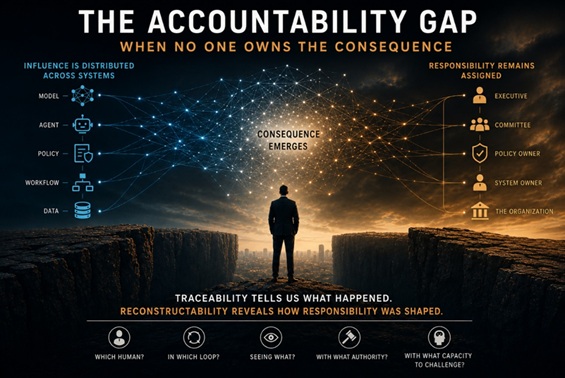
When No One Owns the Consequence
Organizations have always struggled with accountability.
Projects fail.
Strategies collapse.
Risks materialize.
Customers are harmed.
Opportunities disappear.
And sooner or later, someone asks:
Who was responsible?
For most of organizational history, this question was difficult for human reasons.
Authority was unclear.
Roles overlapped.
Committees diluted ownership.
Leaders avoided responsibility.
Decisions disappeared into bureaucracy.
The problem was familiar.
Someone had decided.
But no one wanted to own the consequence.
AI-native organizations are creating a different problem.
Increasingly, the difficulty may not be that someone refuses to own the decision.
It may be that no single actor meaningfully contains the decision at all.
A model detects a pattern.
An agent generates an option.
Another system ranks it.
A policy defines a threshold.
A workflow triggers an action.
A human reviews an exception.
A feedback loop changes future behavior.
The system adapts.
A consequence emerges.
Who decided?
The model?
The agent?
The team that designed the objective?
The person who configured the threshold?
The executive who approved deployment?
The human who did not intervene?
The organization itself?
Each may have influenced the outcome.
Yet none may fully contain the decision that produced it.
This is where the accountability gap begins.
Distributed decision-making can distribute influence more easily than organizations can preserve meaningful ownership of consequence.
The distinction matters.
Because influence is not the same as authority.
Authority is not the same as execution.
Execution is not the same as judgment.
And causal participation is not automatically the same as responsibility.
Yet organizational accountability systems often behave as if these categories remain neatly aligned.
A role is assigned.
An owner is named.
A governance body is identified.
A policy defines responsibility.
The organization can point to someone.
Formally, accountability exists.
But formal accountability does not necessarily mean that responsibility remains substantively exercisable.
A person may be accountable for a system they did not design.
A team may oversee models whose interactions they cannot fully reconstruct.
A leader may approve a domain of autonomy without seeing every adaptation that follows.
A human reviewer may validate only the exceptions the system chooses to surface.
A board may remain responsible for consequences generated through thousands of distributed decisions operating continuously across the organization.
The name remains.
The accountability remains.
But the capacity to meaningfully own the consequence may already be weakening.
This creates an uncomfortable possibility.
The accountability gap does not begin only when no one is formally responsible. It may begin when responsibility remains assigned, but meaningful ownership of consequence can no longer be reconstructed across distributed influence.
Consider a customer denied access to a service.
No single model made the entire decision.
One system classified risk.
Another adjusted priority.
A policy established eligibility.
Historical data shaped the model.
A workflow applied the threshold.
An agent selected the response.
No exception reached a human reviewer.
The outcome is clear.
The customer was denied.
But where exactly does responsibility reside?
The technical answer may be traceable.
Logs may identify each event.
The sequence may be recorded.
Every system action may carry a timestamp.
Yet this reveals another important distinction.
Traceability tells us what happened. Responsibility requires understanding how authority, influence, and judgment shaped what happened.
An audit trail can reconstruct sequence.
It does not automatically reconstruct meaning.
It may show that a threshold changed.
But why was that threshold legitimate?
It may show that an agent selected an action.
But which objective shaped the selection?
It may show that no human intervened.
But was intervention realistically possible?
It may show that the system operated as designed.
But who determined that the design remained acceptable after the system adapted?
These are not questions of data availability alone.
They are questions of responsibility architecture.
And they become harder as influence becomes distributed.
One team builds the model.
Another supplies the data.
Another defines the policy.
Another configures the workflow.
Another monitors performance.
Another manages exceptions.
Leadership approves the system.
Governance reviews aggregate risk.
The system operates.
Each participant sees a fragment.
Each fragment may appear reasonable.
Yet the consequence emerges from the interaction of the whole.
Influence may be distributed. Accountability may become fragmented. But consequences still arrive whole.
The customer experiences one denial.
The employee experiences one exclusion.
The community experiences one harm.
The organization inherits one reputational consequence.
The regulator sees one accountable entity.
Reality does not fragment consequence simply because the architecture of decision-making has fragmented influence.
This asymmetry is becoming increasingly important.
Organizations are becoming extraordinarily capable of distributing intelligence.
They can distribute analysis across models.
Execution across agents.
Authority across workflows.
Monitoring across systems.
Judgment across human-machine interactions.
But their accountability structures often remain attached to static roles, committees, policies, and reporting lines.
The architecture of influence evolves.
The architecture of accountability remains comparatively stable.
And the distance between them grows.
This is the accountability gap.
Not merely the absence of ownership.
But the growing misalignment between how consequences are produced and how responsibility is assigned.
This explains why adding more human approvals may not solve the problem.
A human can approve a recommendation without understanding the full system that shaped it.
A committee can validate a process while each member sees only part of the architecture.
A leader can remain accountable while depending entirely on the system for the information required to challenge the system.
A human signature may create formal ownership.
It does not automatically create meaningful responsibility.
This is why the familiar idea of keeping a human in the loop deserves greater scrutiny.
Which human?
In which loop?
Seeing what?
With what authority?
With what capacity to challenge the system?
And with what understanding of the distributed influences that produced the decision?
Human presence matters.
But presence alone does not close the accountability gap.
The deeper requirement may be reconstructability.
When influence is distributed across agents, models, workflows, thresholds, incentives, and human interventions, meaningful accountability increasingly depends on the ability to reconstruct the relevant structure of consequence.
Not every technical event.
Not every line of code.
Not every internal state.
But the relevant relationships through which authority was granted, influence was exercised, judgment was displaced or preserved, and consequence became possible.
This is more demanding than explainability.
A model may explain why it produced an output.
But the model may represent only one part of the decision.
An agent may reveal its reasoning.
But the objective it pursued may have been shaped elsewhere.
A workflow may be perfectly auditable.
But the threshold embedded within it may reflect an assumption no one has revisited for years.
Explaining components is not the same as reconstructing responsibility across the system.
This is where distributed intelligence creates a structural problem.
The more decision influence is distributed, the less realistic it becomes to assume that one individual can intuitively reconstruct the whole.
A highly competent leader may still see only fragments.
A responsible human may still lack relevant context.
An attentive board may still receive abstractions.
A skilled reviewer may still encounter a consequence after the decisive influences have already interacted elsewhere.
The problem is no longer simply machine capacity versus human cognitive capacity.
It is increasingly:
Distributed influence versus attributable, meaningful, and substantively exercisable responsibility.
This distinction matters because organizations may otherwise respond to the accountability gap symbolically.
Assign an owner.
Create a committee.
Require an approval.
Add a dashboard.
Produce an audit report.
Keep a human in the loop.
Each may be useful.
None is sufficient if the person or body made accountable cannot meaningfully understand, challenge, or reconstruct the relevant architecture of influence.
Accountability then becomes ceremonial.
The organization can identify who is responsible.
But the responsible person cannot fully exercise responsibility.
This is not an argument for eliminating human accountability.
Quite the opposite.
If responsibility for consequence cannot simply disappear into intelligent systems, organizations must become more rigorous about the conditions that make human accountability meaningful.
Authority must be visible.
Delegation must be intelligible.
Boundaries must be identifiable.
Relevant influence must be reconstructable.
Judgment must remain possible.
Challenge must remain legitimate.
Intervention must remain real.
Otherwise, organizations risk creating a dangerous asymmetry.
Humans remain accountable for consequences produced by architectures they can no longer meaningfully reconstruct.
That may become one of the defining governance problems of AI-native organizations.
Because formal accountability can survive long after substantive responsibility capacity has begun to erode.
The title remains.
The role remains.
The signature remains.
The legal responsibility may remain.
But the actual ability to understand, challenge, and answer for consequence may be progressively exceeded by the rate, scale, and distribution of agentic execution.
At that point, asking who is accountable is no longer enough.
The deeper question becomes:
Who is still capable of exercising accountability meaningfully?
The future of responsible AI-native organizations will depend on more than assigning responsibility after consequences emerge.
It will depend on preserving the conditions under which responsibility can still be exercised before, during, and after autonomous action.
Because influence can be distributed.
Decision-making can be distributed.
Execution can be distributed.
But if responsibility is fragmented beyond meaningful reconstruction, accountability becomes little more than a name attached to a consequence.
And this leads to an even more uncomfortable question.
What happens when the humans expected to challenge intelligent systems gradually lose the capacity to judge without them? |
Posted on: July 24, 2026 04:15 AM
|
Permalink |
Comments (1)
|
"I like Wagner's music better than anybody's; it is so loud, one can talk the whole time without other people hearing what you say."
- Oscar Wilde
|




