
Constraint as a Strategic Capability


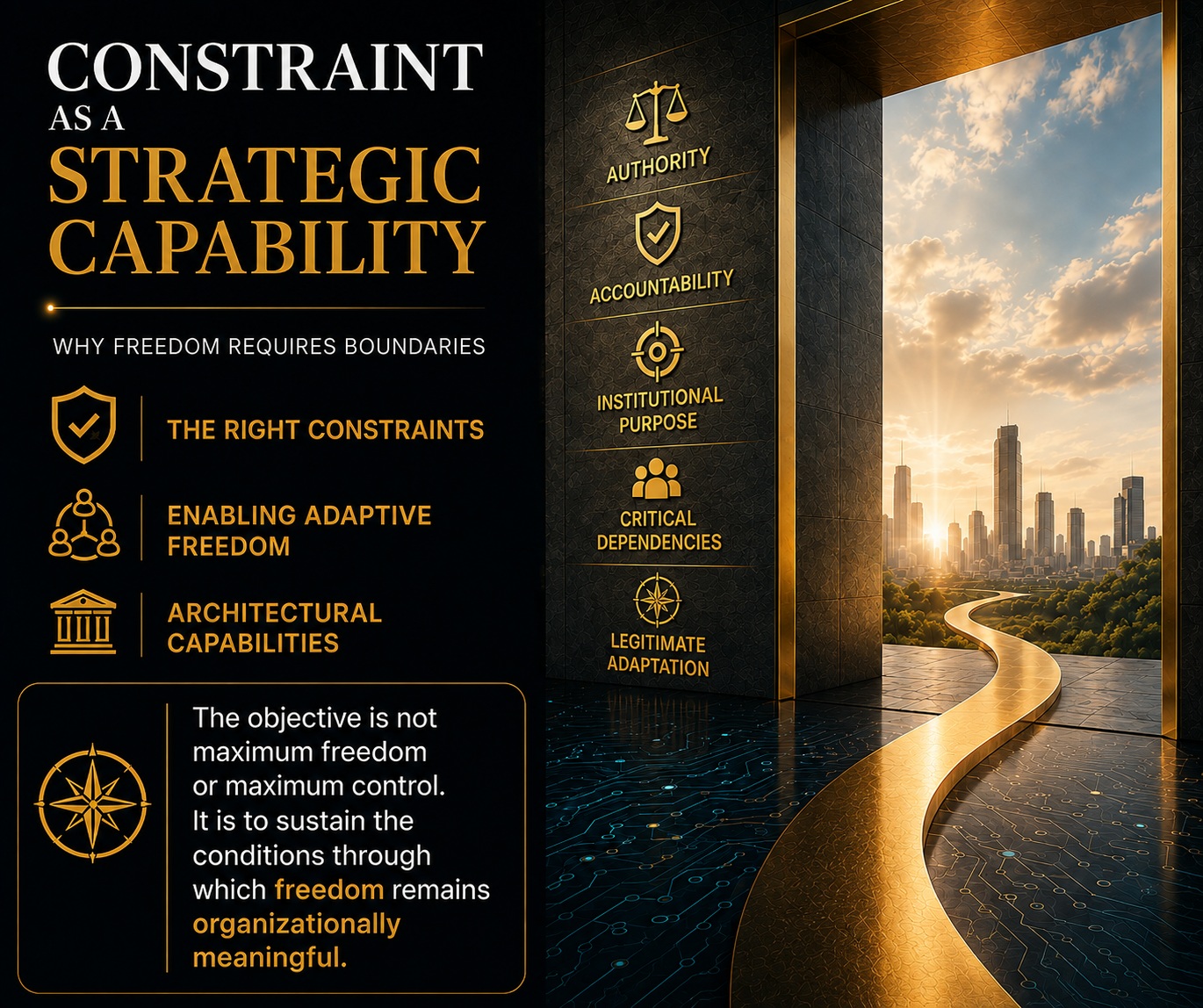 Why Freedom Requires Boundaries For decades, organizations have pursued a remarkably consistent objective. Greater flexibility. Greater autonomy. Greater empowerment. The underlying assumption has been equally straightforward. The fewer the constraints, the greater the organization's ability to adapt. This intuition is partly correct. Organizations burdened by unnecessary bureaucracy become slower, less innovative and less responsive. Removing obsolete constraints can therefore create genuine value. But removing constraints does not automatically create adaptability. Organizations become adaptive not because constraints disappear, but because the right constraints remain. Every organization depends upon boundaries. Authority must be distributed. Responsibilities must be assigned. Decision rights must be defined. Some actions may be delegated. Others require authorization. Certain commitments must remain protected from ordinary operational discretion. Without these conditions, freedom does not become autonomy. It becomes ambiguity. Coordination weakens. Responsibility becomes difficult to attribute. Local decisions gradually diverge from collective purpose. The strategic question is therefore not whether constraints should exist, but whether they preserve or undermine the organizational capabilities required for coherent adaptation. That question becomes increasingly important as organizations become more deeply AI-enabled. Organizational action no longer develops exclusively through individual human decisions. It increasingly emerges through continuous interactions between people, teams and computational capabilities. Under these conditions, organizations cannot rely on continuous executive supervision to maintain direction. Nor can they approve every operational decision without weakening the adaptability they seek to create. Legitimately authorized institutional intent must therefore be translated into the organizational architecture within which action occurs. That is where constraints acquire strategic significance. Within many organizations, constraints are still understood primarily as mechanisms of control. They define what people cannot do. Their value is measured largely by the behaviour they prevent. That understanding is becoming increasingly incomplete. A poorly designed constraint limits capability. A well-designed constraint preserves it. The difference lies not in whether a boundary exists, but in what that boundary protects. A constraint designed merely to reduce discretion can become an obstacle to judgment and adaptation. A constraint designed to protect legitimate authority, institutional purpose, accountability and critical dependencies can increase organizational autonomy because it reduces uncertainty without prescribing every decision. The objective is therefore neither maximum freedom nor maximum control. It is to sustain the conditions through which freedom remains organizationally meaningful. Seen from this perspective, constraints are no longer merely mechanisms of compliance. They can become architectural capabilities. A strategic constraint is an architectural capability because it preserves the organizational conditions through which autonomy, adaptation and judgment remain coherent, legitimate and strategically consequential across continuous organizational evolution. This definition changes how strategic constraints should be evaluated. Their value does not depend primarily on the behaviour they restrict. It depends on the organizational capability they sustain. A strategic constraint does not prescribe every choice. It establishes the conditions within which many different choices can remain legitimate. Rather than concentrating intelligence, it allows intelligence to become distributed without fragmenting purpose. Teams can adapt to local realities. Managers can exercise delegated authority. Computational capabilities can recommend, coordinate and execute actions within legitimate architectural boundaries. Governance does not need to intervene in every action because legitimately authorized institutional intent has already been translated into the conditions through which organizational action emerges. This explains why better boundaries often create greater autonomy. When authority is clear, fewer decisions require escalation. When critical outcomes are explicit, teams can experiment with greater confidence. When unacceptable states are architecturally defined, computational capabilities can operate with greater independence. When the conditions for intervention are protected, human judgment can be concentrated where interpretation, conflicting values and institutional responsibility create the greatest organizational value. Strategic constraints therefore do not diminish judgment. They protect the organizational space in which judgment remains necessary and consequential. This reveals a form of capability that is often overlooked. Capabilities are usually understood as resources, technologies, skills or processes that enable organizations to perform activities. Strategic constraints represent something fundamentally different. This is not primarily a capability to perform more activity. It is a capability to maintain organizational integrity while activity evolves. That capability becomes increasingly valuable as complexity grows. Different teams pursue different objectives. Different technologies operate at different speeds. Different stakeholders hold different expectations. Computational capabilities continually create new opportunities for optimization and adaptation. Each local decision may appear entirely reasonable within its own context. Collectively, however, those same decisions can gradually weaken the organization if nothing maintains their relationship with institutional purpose. Strategic constraints do not resolve this tension by eliminating diversity or imposing uniformity. They resolve it by defining what must remain coherent while allowing everything else to adapt. Purpose. Legitimate authority. Critical dependencies. Risk boundaries. Accountability relationships. Constitutional commitments. Within those conditions, considerable diversity remains possible. Different teams may solve problems differently. Different business units may pursue different operating models. Different computational capabilities may optimize different processes. Adaptation can therefore become distributed without becoming fragmented. This is freedom within coherence, not freedom from coherence. Its strategic significance extends well beyond governance. It enables organizations to delegate authority without dissolving responsibility. To decentralize decisions without fragmenting direction. To automate operational activity without abandoning accountability. To innovate and adapt without making every institutional commitment provisional or repeatedly reconstructing the foundations of legitimate action. The capability does not lie in possessing more constraints. Every organization already operates within numerous formal, technological, economic and cultural conditions. At the organizational level, the capability is expressed through the ability to distinguish between constraints that preserve organizational capacity and those that merely preserve the past. Some should remain stable because trust, predictability and institutional continuity depend upon them. Others should evolve because strategy, technologies and operating conditions change. Still others should disappear because the assumptions that originally justified them no longer exist. Organizations that cannot make these distinctions often oscillate between two equally damaging extremes. One is rigidity. Constraints remain long after they have ceased to protect anything of strategic value. The other is volatility. Boundaries change so frequently that authority, accountability and organizational expectations gradually lose coherence. Strategic capability lies between these extremes. It protects continuity without defending obsolescence. It enables evolution without allowing adaptation itself to become institutionally arbitrary. Artificial intelligence makes the significance of this capability especially visible. Computational capabilities increasingly observe, recommend, coordinate and execute organizational activity at a scale and speed that human supervision alone cannot match. They can analyse alternatives. Simulate consequences. Identify patterns. Support learning. Improve efficiency. But they cannot independently determine which institutional commitments should remain protected, which distributions of authority remain legitimate or which organizational values should never become variables for optimization. Those remain institutional determinations. Technology may support them. It cannot legitimately replace them. Strategic constraints allow computational capabilities to exercise increasing autonomy without separating organizational action from organizational purpose. The advantage therefore does not arise because an organization possesses fewer constraints than others. It arises because the organization can intentionally design, preserve and legitimately evolve better ones. That capability influences how effectively strategy is translated into distributed organizational action and how confidently authority can be delegated. It also affects how safely computational capabilities can be integrated and how rapidly adaptation can occur without weakening organizational integrity. Strategy is concerned not only with where an organization intends to compete or what value it seeks to create. It must also address the architectural conditions through which people and computational capabilities can continue pursuing that strategy coherently as the organization evolves. Strategic constraints belong to strategy because they preserve the organizational capability through which strategy remains executable under conditions of continuous adaptation. Organizations do not become strategically adaptive by eliminating boundaries. They become strategically adaptive by preserving the boundaries that allow autonomy, adaptation and judgment to remain coherent, legitimate and strategically consequential. Freedom, therefore, is not created by the absence of constraints. It is sustained by the presence of the right ones. Yet this conclusion leads naturally to another question. If strategic constraints protect the conditions that make coherent organizational action possible, what happens when organizations begin optimizing everything that can be measured, accelerated or improved? Optimization always requires an objective. But not everything an organization must preserve can safely be reduced to an optimization objective. Some institutional conditions derive their value precisely from remaining protected from optimization itself. That is where the next article begins. The Limits of Optimization What Architecture Must Protect |
Posted on: August 19, 2026 07:45 AM
| Permalink |
Comments (0)


