
The Human Burden of Integrative Work


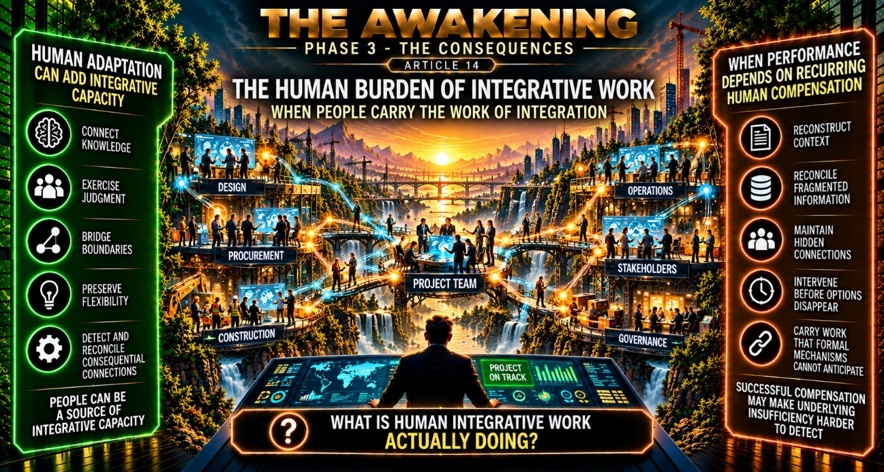 When People Carry the Work of Integration The project is still moving. Dependencies are being connected. Trade-offs are being reconciled. Information reaches the people who need it. Problems are noticed before they become failures. Teams coordinate across boundaries. Decisions that could have conflicted are somehow brought together. The system appears to be working. But perhaps the formal mechanisms are not doing all of that. Perhaps people are carrying part of the integrative work themselves. Someone remembers that two decisions made in different meetings are connected. Someone calls another team before approving a change. Someone translates between technical and operational language. Someone notices that the dashboard does not show the consequence that matters. Someone keeps track of an exception that exists nowhere in the formal process. Someone knows whom to contact when the escalation path is too slow. Someone repeatedly brings together information that the system keeps apart. None of this is necessarily a problem. It may be exactly what capable people in adaptive organizations should do. But it creates a difficult question: When does human adaptation strengthen the project system's integrative capacity, and when does it compensate for integrative capacity that has become insufficient? And another follows immediately: Can successful human compensation make architectural insufficiency harder to detect? People Are Part of the Architecture There is an immediate danger in framing the problem as: Architecture versus people. Organizations do not integrate themselves independently of human action. People interpret information. Build relationships. Exercise judgment. Notice weak signals. Translate across domains. Challenge assumptions. Escalate concerns. Resolve ambiguity. Connect knowledge that formal structures cannot completely anticipate. Informal coordination is therefore not automatically evidence that formal mechanisms have failed. It may be part of the architecture through which the project system actually works. That distinction matters. If every informal conversation, discretionary intervention or act of human judgment is treated as compensation for architectural weakness, then almost every functioning project could be diagnosed as architecturally deficient. That would make the hypothesis useless. The relevant question is not: Are people doing integrative work? Of course they are. The more demanding question is: What kind of integrative work are people doing, under what conditions, and what would happen if they stopped doing it? Human Adaptation Can Be Integrative Capacity Article 11 asked whether effective integrative capacity can become insufficient relative to material interdependence. But effective integrative capacity does not reside only in formal governance mechanisms. It may also exist in relationships, experience, judgment, routines, informal networks and the ability of people to recognize and reconcile consequential connections. A project manager who notices an interaction that no dashboard captured may be adding integrative capacity. A specialist who translates between two domains may be adding integrative capacity. A team that develops an informal coordination routine because formal processes cannot anticipate every interaction may be adding integrative capacity. A leader who recognizes that an escalation is formally unnecessary but systemically important may be adding integrative capacity. These actions should not automatically be interpreted as evidence that something is wrong. They may demonstrate that the system is adaptive. Indeed, a project configuration that attempted to specify every interaction in advance might become slower, more rigid and more expensive than the uncertainty it was designed to manage. So: Human adaptation can be part of effective integrative capacity rather than compensation for its absence. That proposition must be preserved throughout the inquiry. But Adaptation Can Also Become Compensation The same observable behaviours can have another explanation. People may be connecting information because formal interfaces repeatedly fail to do so. They may be translating because responsibilities and knowledge have become separated in ways that repeatedly make translation necessary. They may be attending additional meetings because consequential dependencies are otherwise missed. They may be maintaining private notes because organizational memory does not preserve the context required for later decisions. They may be checking work manually because automated or formal mechanisms cannot reliably identify the relevant relationships. They may be using personal networks because official escalation paths repeatedly arrive too late. They may be protecting downstream teams from consequences that the project configuration continues to generate upstream. From the outside, the project may still appear integrated. But part of that integration may now depend on recurring human effort required to compensate for limitations that the project configuration repeatedly reproduces. That creates a possible distinction: Human adaptation may add integrative capacity, or it may compensate for insufficient integrative capacity. And in practice, it may do both. The Same Behaviour Can Mean Different Things This is what makes the problem difficult. Consider two project managers who regularly speak with people outside formal meetings. One may be using professional judgment to enrich an already effective configuration. The other may be preventing repeated failures because existing mechanisms cannot connect the necessary information in time. The observable behaviour is similar. The systemic meaning is different. Consider two teams maintaining an informal cross-functional channel. For one, the channel may be a low-cost adaptation that improves responsiveness. For the other, it may be the only mechanism preventing incompatible decisions from propagating across the project. Again, the behaviour looks similar. The configuration underneath it may not be. So the presence of informal coordination cannot distinguish resilience from insufficiency. Nor can the amount of visible human effort by itself. The relevant question must reach beneath the behaviour: What function is the human effort performing, why is that effort necessary, and what happens to system performance when it is absent? A Counterfactual Becomes Important One way to examine that distinction is through a counterfactual. What would happen if that human integrative effort disappeared? Suppose the experienced project manager who routinely connects two functions leaves. Suppose the specialist who understands both the technical and operational implications is unavailable. Suppose the informal cross-functional meeting stops. Suppose people no longer maintain the unofficial spreadsheet that reconciles information from incompatible systems. Suppose the manager who repeatedly catches exceptions stops checking manually. Would the project system continue to recognize and reconcile the relevant material interdependencies with sufficient quality, reliability and timeliness? If yes, the human activity may have been supplementary. If performance deteriorates materially, the activity may have been carrying more of the system's effective integrative capacity than its formal mechanisms revealed. But even that does not establish architectural insufficiency. A resilient project configuration may deliberately rely on human discretion. Expertise may be intentionally embedded in roles. Informal coordination may be an efficient design choice. Redundancy may be deliberate. The counterfactual therefore identifies dependency. It does not by itself tell us whether that dependency is problematic. The Question Is Not Whether the Architecture Depends on People Every project system depends on people in some way. The stronger test is whether the dependency is: Recognized, Sustainable, Reproducible where necessary, Proportionate to the integrative requirement, and Supported by the authority, information, capability and opportunity required to perform the work. A system may legitimately rely on experienced judgment. But if only one person knows how several critical decisions connect, the issue is not that human judgment exists. It is that effective integrative capacity may depend on a fragile concentration of knowledge. A system may legitimately rely on informal coordination. But if people must continuously reconstruct information that formal mechanisms repeatedly fragment, the question becomes whether the coordination remains proportionate. A system may legitimately rely on discretionary intervention. But if successful outcomes require repeated exceptional intervention simply to preserve ordinary coherence, the meaning of “exceptional” becomes questionable. The relevant distinction is therefore not: Formal architecture versus informal human work. It is: Human work as a legitimate component of effective integrative capacity versus human work required to compensate for limitations that the project configuration repeatedly reproduces. Compensation Can Preserve Performance Suppose people compensate successfully. Dependencies are recognized. Trade-offs are reconciled. Customers receive the intended outcome. Milestones are achieved. Problems are contained. Performance indicators remain acceptable. From the perspective of observed outcomes, the system may appear healthy. And yet those outcomes may increasingly depend on additional human integrative work that is not visible in the formal mechanisms through which project performance is observed. This leads to the first working hypothesis of this article: Successful human compensation may preserve project performance while making an underlying insufficiency in effective integrative capacity harder to detect. The hypothesis is deliberately conditional. Successful compensation does not prove that such insufficiency exists. But if it does, successful compensation may make it harder to observe. That possibility matters because organizations often learn from visible deviations. Success Can Weaken the Signal If compensation prevents a deviation from becoming visible, the signal available for architectural learning may weaken. This creates a paradox. The more successfully people compensate, the less visible the underlying problem may become. A dependency is caught before it causes delay. The dashboard remains green. A conflict is resolved before escalation. The governance mechanism appears adequate. A workaround prevents rework. The process appears effective. A person absorbs additional coordination. The project appears efficient. Successful intervention may therefore remove the evidence that intervention was necessary. If this occurs repeatedly, the organization may observe: Acceptable performance without observing: The additional human effort required to produce it. That does not mean the architecture is necessarily weak. But it means observed performance alone may be insufficient evidence that the project's effective integrative capacity is sustainably supported. This is a potentially important learning problem. The better the compensation works, the weaker the signal that something in the system may need to change. Hidden Work Can Become a System Dependency Human integrative work may also become normalized. The extra call becomes routine. The unofficial spreadsheet becomes indispensable. The experienced manager is always copied. The specialist is invited to every decision because “she knows how everything fits together.” The team maintains a parallel process because the official one cannot capture what they need. None of these developments necessarily indicates dysfunction. Some may be efficient adaptations. But normalization can change visibility. What began as an exception may no longer be perceived as additional work. What began as temporary compensation may become an expected part of the role. What began as individual initiative may become a hidden dependency of the system. This creates another question: When does adaptive human effort become a condition on which acceptable system performance depends? That dependency may matter even when performance remains strong. The Burden Is Not Only Coordination Article 13 identified the possibility that unresolved integration may create persistent burden. When people absorb part of that burden, coordination effort is only one possible manifestation. There may also be cognitive burden. People must remember relationships that the system does not preserve. Maintain multiple mental models. Track exceptions. Reconstruct context. Anticipate downstream consequences. Distinguish important signals from noise. Switch repeatedly between domains. Carry unresolved questions across decision cycles. And remember not only what was decided, but why something remained unresolved. There may be attentional burden. What requires monitoring? What changed? Which interface is becoming consequential? Which assumption is no longer safe? Which decision needs to be revisited? There may be interpretive burden. What does this information mean elsewhere in the system? Who else needs to know? Does a local change alter a system-level trade-off? There may be relational burden. Who must be contacted? Which boundary needs to be crossed? Whose trust is required to surface a concern? Who can influence a decision when formal authority sits elsewhere? And there may be temporal burden. People must intervene while intervention can still matter. These are overlapping manifestations, not an exhaustive taxonomy. The burden is therefore not simply: More meetings. It may be the continuing human work required to preserve consequential connections across a distributed project system. But More Human Effort Is Not Necessarily Excessive Burden Again, the hypothesis needs a boundary. Complex projects require cognitive effort. Leadership requires attention. Integration requires communication. Professional judgment requires interpretation. Collaboration requires relationships. None of this becomes an architectural problem merely because it consumes human capacity. The relevant question is not: Are people working hard to integrate the project? It is: Is the human effort required to preserve coherence proportionate, sustainable and intentionally supported by the project configuration, or is acceptable performance increasingly dependent on compensatory effort that the configuration neither makes visible nor reliably sustains? That distinction protects the argument from turning ordinary professional work into evidence of systemic deficiency. Compensation May Create Fragility A project may perform well because particular people are unusually capable. They know the history. They understand several domains. They recognize weak signals. They have trusted relationships. They know which formal rule can be interpreted flexibly and which cannot. They know whom to call. That can be an enormous source of resilience. But it can also create concentration risk. If integrative performance depends disproportionately on a small number of people, the project may become vulnerable to: absence, turnover, overload, competing priorities, loss of attention, or changes in context that exceed those individuals' capacity. Again, the existence of key people is not evidence of poor architecture. Expertise is naturally unevenly distributed. The stronger question is: Would the project system retain sufficient integrative capacity if those individuals were temporarily unavailable or replaced by equally competent people who did not possess the same accumulated relationships and contextual knowledge? That is a test of system dependence, not a criticism of expertise. Compensation Can Consume the Capacity Needed Elsewhere Human attention is finite. Time spent reconstructing fragmented context cannot simultaneously be used elsewhere. Attention devoted to repeated reconciliation is unavailable for other forms of judgment. Experienced people repeatedly bridging interfaces may have less capacity for strategic interpretation, learning, stakeholder engagement, innovation or anticipation. This does not mean every coordination activity creates an opportunity cost worth eliminating. But if compensatory integrative work expands, another consequence becomes possible: The system may preserve visible coherence by consuming human capacity that would otherwise be available for other valuable work. The cost of insufficient integrative capacity may therefore appear not only in additional effort. It may appear in what capable people no longer have sufficient capacity to do. That is a different form of burden. And potentially a less visible one. Compensation Can Also Build Capability The argument must now turn against itself. Human adaptation is not merely a cost. People learn by resolving ambiguity. They develop judgment by encountering trade-offs. They build relationships through cross-boundary work. They acquire system understanding by connecting consequences. They become better at recognizing patterns because they have repeatedly had to interpret them. The same integrative work that consumes capacity may also develop capability. That creates another tension. Removing human integrative work because it appears inefficient could eliminate opportunities through which people develop the judgment the system later needs. Conversely, preserving unnecessary manual work merely because it provides learning would also be difficult to justify. So the question cannot be reduced to: How much human effort can we eliminate? It must also ask: What capabilities are being exercised or developed through that effort, and what happens to those capabilities if the work is redesigned, automated or removed? This connects the human burden question to a broader issue: the project system must not only perform today. It may also need to preserve or regenerate the capabilities required to govern tomorrow. AI Can Reduce the Burden and Change It AI may reduce some forms of human integrative work. It may identify dependencies. Retrieve relevant context. Connect information across systems. Track assumptions. Detect inconsistencies. Summarize changes. Surface anomalies. Maintain organizational memory. Model downstream consequences. And reduce the need for people to manually search, remember and reconcile information. That may genuinely increase integrative capacity while reducing unnecessary human burden. But the burden may also change rather than disappear. People may need to determine whether the relationships identified by AI are materially relevant. Challenge recommendations. Interpret ambiguous contexts. Resolve competing values. Decide when automated reconciliation should be overridden. Monitor dependencies created by the AI-enabled workflow itself. And recognize situations the system was not designed to detect. There is therefore no general reason to assume: Automation of integrative work = reduction of human integrative burden. Nor should the opposite be assumed. The relevant question is: Which integrative functions are being reduced, which are being transformed, which are being transferred, and which new forms of human judgment or oversight are being created? Human Presence Is Not the Same as Human Capacity Article 10 distinguished human presence in a decision system from meaningful human intervention capacity. The same distinction matters here. A project may formally retain human review. But if people are overloaded by coordination work, fragmented information and repeated exception handling, their ability to exercise judgment may weaken. They remain present. They remain accountable. They may retain formal authority. But the human capacity required to recognize, question or intervene may become constrained. This creates a connection between the consequences examined across this phase. Insufficient integrative capacity may generate compensatory human work. Compensatory work may consume attention. Reduced attention may weaken the conditions under which other responsibilities can be meaningfully exercised. That is a possible mechanism. It is not yet a demonstrated causal chain. Each relationship must survive separately. Adaptation or Compensation? We can now return to the central distinction. Human adaptation may strengthen integrative capacity when it: Responds flexibly to conditions formal mechanisms cannot reasonably anticipate; Connects knowledge efficiently; Uses judgment where codification would be disproportionate; Creates learning; Builds relationships; Preserves useful flexibility; And remains sustainable and reproducible enough for the system's needs. Human adaptation may instead be compensating for insufficient integrative capacity when acceptable performance increasingly depends on recurring human effort required to overcome limitations that the project configuration repeatedly reproduces. Possible signals might include: Repeated reconstruction of the same context; Persistent dependence on particular individuals; Recurring manual reconciliation of fragmented information; Informal mechanisms becoming indispensable without being recognized as such; Increasing coordination effort merely to preserve existing performance; Intervention repeatedly occurring near the point at which options disappear; Or important work remaining invisible to formal measures of project effort. These are not diagnostic criteria. They are possible observations. The distinction cannot be made from any one of them alone. Alternative Explanations Must Survive Observed human burden may have many causes. The project may simply be complex. The work may require expert judgment. A temporary crisis may justify exceptional coordination. A new team may still be learning. Formal processes may intentionally leave discretion to experienced people. The project may be undergoing legitimate adaptation. External volatility may create additional cognitive demand. People may be compensating for individual performance problems rather than limitations in the project configuration. A particular individual may choose to over-coordinate even when the system does not require it. Or additional effort may produce benefits greater than its cost. These alternatives matter. If every instance of high coordination effort, informal work or human intervention is interpreted as compensation for insufficient integrative capacity, the hypothesis becomes unfalsifiable. The discriminating question is therefore: Can the recurring human effort be plausibly connected to a limitation in the project's effective integrative capacity, rather than to complexity, deliberate design, temporary adaptation, individual behaviour or another credible explanation? If not, the burden should not be attributed to insufficient integrative capacity. What Would Make the Burden Architectural? The word architectural must also earn its place. A person working late once is not architectural evidence. An exceptional escalation is not architectural evidence. A difficult stakeholder conversation is not architectural evidence. A temporary workaround is not architectural evidence. Even repeated effort is not enough by itself. For the burden to support an architectural interpretation, the need for compensatory work would have to be meaningfully connected to how the project system distributes, connects or enables the integrative work required for coherence. The pattern would need to be more than episodic. The relevant work would need to matter to material interdependencies. A plausible mechanism would need to connect the project configuration to the recurring burden. Credible alternatives would need to be considered. And the interpretation would need to explain something more than: People are working hard on a complex project. Otherwise, simpler explanations should be preferred. What Article 14 Can and Cannot Conclude Several propositions can now be defended. 1. Human integrative work is not, by itself, evidence of insufficient integrative capacity. It may constitute part of the project's effective integrative capacity. 2. Similar observable behaviours may represent resilience, legitimate adaptation or compensation for insufficient integrative capacity under different conditions. 3. Successful human compensation may preserve observable project performance and therefore make an underlying insufficiency in effective integrative capacity harder to detect, if such insufficiency exists. 4. Human integrative burden may appear through coordination, attention, memory, interpretation, relationship management, temporal intervention and opportunity cost, not only through visible workload. 5. Dependence on human expertise is not inherently problematic, but concentrated dependence may make integrative performance fragile when the required capability is not sufficiently reproducible or supported. 6. Compensatory work may consume human capacity, but integrative work may also develop judgment, relationships and system understanding. Burden and capability development therefore cannot be treated as simple opposites. 7. AI may reduce, redistribute or transform human integrative work. Its presence does not establish either lower burden or greater effective integrative capacity. What cannot yet be concluded is that recurring human integrative effort is evidence of an architectural gap. Nor can we conclude that formalizing or automating such work would necessarily improve the system. The first working hypothesis is: Successful human compensation may preserve project performance while making an underlying insufficiency in effective integrative capacity harder to detect. A second hypothesis reaches further: Human adaptation may strengthen effective integrative capacity when it extends the project's ability to recognize and reconcile material interdependencies, but may function as compensation when acceptable performance increasingly depends on recurring human effort required to overcome limitations that the project configuration repeatedly reproduces. These hypotheses need evidence. They need boundary conditions. They need alternative explanations. And they must remain rejectable. When People Keep the System Working Some of the most important work in a project may never appear in the project plan. Someone notices. Someone remembers. Someone connects. Someone translates. Someone calls. Someone challenges. Someone reconciles. Someone intervenes before the option disappears. Sometimes that is simply what capable professionals do. Sometimes it is precisely what makes an adaptive project system resilient. But sometimes the same people may be carrying work that the project configuration has quietly come to depend on. And if they carry it successfully, the project may continue to look healthy. That is what makes the problem difficult. Human adaptation can contribute to resilience. Human adaptation can be part of integrative capacity. Human adaptation can also compensate for insufficient integrative capacity. And the observable behaviour may look remarkably similar in all three cases. The real question is therefore not whether people are compensating. It is whether the system can distinguish adaptation that renews its integrative capacity from adaptation on which acceptable performance increasingly depends because the project configuration does not sufficiently support the integrative work required. Because the people who keep a project coherent may also make weaknesses in its integrative architecture harder to see. And if those weaknesses persist, the next question is what happens when their consequences can no longer be absorbed. Article 15: When Structural Drift Becomes Consequential. |
Posted on: October 02, 2026 05:16 AM
| Permalink |
Comments (0)


