
When Structural Drift Becomes Consequential


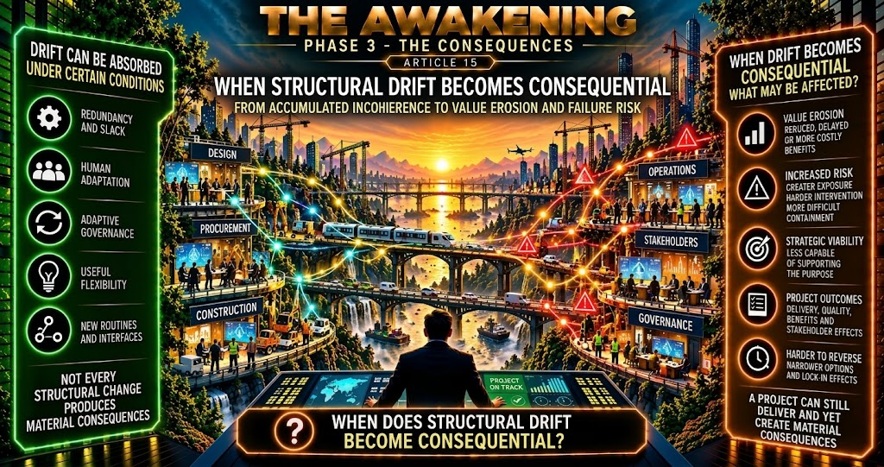 From Accumulated Incoherence to Value Erosion and Failure Risk The project is still delivering. Milestones are still being reached. Problems are still being solved. People are still carrying integrative work. Trade-offs are still being managed. Exceptions are still being absorbed. The project may even appear successful. And yet something may have changed. Decisions that once preserved flexibility now constrain what can happen next. Dependencies that once required coordination now determine which options remain possible. Workarounds that once solved local problems have become conditions on which other parts of the project depend. Responsibilities remain formally clear, but the conditions required to exercise them have changed. People continue to preserve coherence, but doing so requires increasing attention, coordination or intervention. None of these conditions necessarily means that the project is failing. But they create the final question of this phase: When does structural drift become consequential? More precisely: Under what conditions does accumulated systemic incoherence begin to affect value, risk, strategic viability or project outcomes? Drift Is Not Failure Article 11 introduced structural drift as a hypothesis. It asked whether a project system can gradually change as effective integrative capacity becomes insufficient relative to the volume, velocity or complexity of its material interdependencies. But drift is not failure. A project can change structurally and continue to perform. It can develop new routines. Redistribute coordination. Create informal interfaces. Rely more heavily on particular people. Accept temporary inconsistencies. Defer reconciliation. Adapt governance mechanisms. Change how authority is exercised. Some of those changes may increase resilience. Some may preserve useful flexibility. Some may be efficient responses to uncertainty. Others may create burdens or dependencies that matter later. The existence of drift therefore tells us very little by itself. The relevant question is not: Has the project changed? It is: What consequences, if any, are being created by the way the project system has changed? Consequence Requires a Mechanism It is tempting to construct a simple sequence: insufficient integrative capacity → structural drift → incoherence → failure But that sequence would assume precisely what this phase has been trying to investigate. Each relationship requires its own mechanism. Insufficient integrative capacity may contribute to structural friction without producing structural drift. Structural drift may occur without producing material incoherence. Incoherence may exist without affecting value. A project may absorb substantial incoherence through redundancy, adaptation, human judgment or available slack. And poor outcomes may occur for reasons unrelated to integrative capacity. So Article 15 cannot ask merely whether a project with structural drift later performed poorly. It must ask: What changed in the system, how did that change alter consequential relationships, and through what plausible mechanism did those altered relationships affect value, risk, viability or outcomes? Without that mechanism, temporal sequence is not causal explanation. What Does “Consequential” Mean? Not every consequence matters equally. A new meeting is a consequence. Additional coordination is a consequence. A delayed decision is a consequence. A workaround is a consequence. Additional cognitive effort is a consequence. But Article 15 is concerned with a stronger threshold. When does what has been happening inside the project begin to affect something materially important? That may include: Value because expected benefits are reduced, delayed, transferred or made more costly to realize; Risk because exposure increases, intervention becomes harder, or consequences become more difficult to contain; Strategic viability because the project becomes less capable of supporting the purpose or strategic conditions that justified it; or Project outcomes because delivery, quality, benefits, stakeholder effects or other material results are affected. These categories may overlap. They are not offered as an exhaustive taxonomy. They identify different ways in which internal systemic conditions may become consequential beyond the friction through which they first appeared. Value Erosion Is Not the Same as Project Failure A project does not need to fail before structural incoherence matters. It may deliver what was specified while producing less value than expected. It may reach a milestone while narrowing the benefits that remain achievable. It may remain within budget while transferring cost elsewhere. It may satisfy one stakeholder while creating consequences for another. It may meet scope while weakening operational usability. It may deliver an output while making the intended outcome more difficult to achieve. This distinction matters because traditional project signals may remain acceptable while the value relationship is deteriorating. So the relevant question is not simply: Did the project succeed or fail? It is: Did the evolving project system alter the conditions under which intended value could be created, preserved or realized? That is a different test. Local Success Can Coexist With Systemic Loss This returns us to one of the earliest tensions in THE AWAKENING. A local decision can be legitimate. A team can meet its objective. A supplier can satisfy its contract. A workstream can deliver its output. A manager can act within authority. And yet the combined consequences can still be unfavorable for the project system. This is not because local success is irrelevant. It is because local success and system-level value are different units of evaluation. Consider a technical optimization that improves performance but increases operational complexity. A procurement decision that reduces acquisition cost but limits future adaptability. A schedule recovery action that preserves a milestone but reduces testing opportunity. A governance decision that accelerates approval but reduces the time available to surface consequential interdependencies. Each decision may be defensible within its own frame. The systemic question is whether their combined consequences remain coherent with what the project is trying to achieve. Structural drift becomes relevant when the relationships among such decisions change in ways that materially alter that coherence. Accumulated Incoherence Does Not Mean Accumulated Error The phrase accumulated systemic incoherence needs care. It does not mean that the project has accumulated a growing list of mistakes. Nor does it require individual decisions to have been wrong. Article 5 already established the possibility that locally legitimate decisions can become globally incoherent. Article 13 added a temporal dimension: unresolved material interdependencies may remain connected to later decisions and commitments. Article 14 added another possibility: people may preserve observable coherence through integrative effort that is not fully visible in formal mechanisms. Accumulated incoherence therefore refers to something narrower than accumulated error. It concerns the possibility that relationships among decisions, dependencies, responsibilities, commitments and adaptations become progressively less compatible with one another or with the conditions required to preserve project-level coherence. That possibility still requires evidence. The number of decisions is not evidence of accumulation. Complexity is not evidence of incoherence. Change is not evidence of drift. And drift is not evidence of damage. The Threshold May Depend on the Remaining Capacity to Absorb Projects can absorb a great deal. People resolve conflicts. Teams adapt. Managers intervene. Buffers absorb variability. Contingency absorbs uncertainty. Governance mechanisms escalate exceptions. Stakeholders renegotiate expectations. Technical architectures accommodate change. Informal relationships bridge gaps. This capacity to absorb disturbance may explain why structural friction does not immediately become visible as poor performance. But absorption is not necessarily unlimited. The relevant question may therefore be: When does the project system lose sufficient capacity to absorb, reconcile or redirect the consequences of its own internal incoherence? That threshold could arise for different reasons. The volume of consequential interdependencies may increase. Available attention may decrease. Options may narrow. Reversibility may decline. Slack may be consumed. Key people may become overloaded or unavailable. Commitments may become harder to change. External conditions may shift. Or several of these may interact. None should be assumed to be necessary. But they suggest that consequence may depend not only on the existence of incoherence, but also on the remaining capacity of the system to absorb it. Option Space Matters Article 13 asked whether deferred integration can become more consequential as subsequent decisions and commitments reduce reversibility or increase connectedness. That question becomes particularly important here. A project may tolerate an unresolved interdependency while several alternatives remain available. The same unresolved relationship may become much more consequential after contracts are signed, interfaces are fixed, systems deployed, stakeholders committed or operational dependencies established. The underlying issue may not have changed. The available response may have. This suggests a possible mechanism: Systemic incoherence → continued commitments → narrowing option space → reduced ability to reconcile consequences → greater material exposure But this sequence is only a hypothesis. Narrower option space is not automatically harmful. Commitment is necessary for projects to progress. Irreversibility is not inherently poor design. And preserving options indefinitely may itself destroy value. The relevant question is whether the remaining option space is sufficient for the consequences the system may still need to reconcile. Risk Can Increase Before Failure Appears Failure is an outcome. Risk concerns exposure before the outcome is known. That distinction matters. Structural drift may become consequential by changing exposure even when no adverse outcome has yet occurred. A project may become more dependent on one person. More sensitive to one interface. More difficult to reverse. More reliant on an assumption. More vulnerable to delayed information. More dependent on successful human compensation. More exposed to a decision whose consequences propagate across multiple parts of the system. None of these conditions proves that failure will occur. But they may change the distribution or materiality of possible consequences. The relevant question is therefore not: Has something already gone wrong? It is: Has the evolving configuration materially changed what the project is exposed to, how consequences could propagate, or how effectively the system could respond if they did? That is a risk question rather than a failure claim. Strategic Viability Can Change While Delivery Continues Projects do not operate in a frozen strategic environment. Markets change. Technology changes. Regulation changes. Stakeholder expectations change. Organizational priorities change. New information changes what is valuable. A project configuration that remains internally capable of delivering may nevertheless become less aligned with the conditions that justified the project. This creates a difficult attribution problem. If strategic viability deteriorates, is that because the project system drifted? Or because the external environment changed? Or because strategy itself changed? Or because the project failed to detect and integrate those changes quickly enough? These are different explanations. Structural drift should not become a convenient label for every case in which a project becomes strategically questionable. The stronger question is: Did the way the project system evolved materially reduce its ability to recognize, interpret or respond to changes that were relevant to continued strategic viability? Only then does integrative capacity become a plausible part of the explanation. Consequences Can Be Transferred Article 13 established that burden may persist through transfer rather than through visible continuation of the original issue. The same principle applies to consequences. A project may preserve schedule by transferring effort to operations. Preserve budget by reducing maintainability. Preserve local performance by increasing coordination elsewhere. Preserve delivery by accepting future remediation. Preserve one stakeholder's value while reducing another's. Preserve current flexibility by increasing future exposure. The project itself may therefore continue to look successful while consequences appear somewhere else. This creates an attribution challenge. Where should we look for the consequence? If evaluation stops at the project boundary, transferred consequences may disappear analytically even though they remain real organizational consequences. But widening the boundary indefinitely creates the opposite problem. Almost every project can be connected to distant consequences. So the relevant boundary must remain tied to material causal relationships and legitimate project objectives, obligations and affected interests. System thinking requires broader boundaries. It does not justify unlimited attribution. Failure Is Not a Single Event Even the word failure requires care. A project can fail to meet a milestone. Fail to deliver an output. Fail to realize intended benefits. Fail to remain strategically viable. Fail to protect a stakeholder interest. Fail to adapt when assumptions change. Or deliver successfully while producing consequences that undermine the value it was intended to create. These are not equivalent. Article 15 therefore should not treat project failure as a single binary endpoint. Nor should it redefine every value shortfall as failure. The relevant analytical question is: Which material outcome was affected, relative to what objective, obligation or legitimate expectation, and through what mechanism? Without that specificity, “failure” explains very little. The Project May Still Look Healthy One of the most difficult possibilities is that consequence and visibility may not occur at the same time. The system may continue to produce acceptable indicators while dependencies deepen. Human intervention may continue to resolve emerging conflicts. Workarounds may continue to function. Buffers may still exist. Options may still be sufficient. The consequences may therefore remain contained. This does not establish that deterioration is occurring beneath the surface. Nor does it establish that successful compensation necessarily delays observable consequences. Those possibilities require evidence. But it does mean that: Absence of visible failure is not, by itself, evidence that the relationships supporting project performance remain unchanged. This is as far as Article 15 should go without stronger evidence. Whether successful compensation can systematically increase the interval between the emergence of systemic deterioration and observable consequence remains an open hypothesis. It should not be assumed. Consequence May Be Nonlinear Another possibility must remain open. The relationship between incoherence and consequence may not be proportional. A project may absorb several unresolved tensions with little observable effect. Then one additional commitment, dependency or external change may alter the consequences substantially. That does not necessarily mean a hidden threshold exists. Nor does it justify describing every late-stage problem as a tipping point. But linear reasoning may be insufficient. The effect of an unresolved interdependency may depend on what else has happened around it. The consequence of losing a key person may depend on how concentrated contextual knowledge has become. The consequence of a delayed decision may depend on how much option space remains. The consequence of one local optimization may depend on other optimizations already embedded elsewhere. The relevant question is therefore: Do consequences arise from individual conditions independently, or from interactions among conditions that have become mutually reinforcing or increasingly difficult to reconcile? That distinction matters for both explanation and intervention. Early Friction May Be a Signal, but Not a Diagnosis The working hypothesis for this phase was: Insufficient integrative capacity may become visible first through structural friction, deferred trade-offs, accountability misalignment and narrowing option space rather than immediate project failure. The previous articles examined parts of that possibility. Article 11 examined structural drift. Article 12 examined accountability misalignment. Article 13 examined deferred integration and persistent burden. Article 14 examined human integrative work and compensation. Article 15 can now ask what evidentiary value these conditions may have. But the answer cannot simply be yes. Structural friction may arise from legitimate adaptation. Deferred trade-offs may preserve option value. Accountability tension may reflect temporary transition. Narrowing option space may represent necessary commitment. Human compensation may be effective integrative capacity. None is a failure signal by definition. Their significance depends on mechanism, persistence, materiality, interaction and context. So the phase hypothesis survives only in a bounded form: These conditions may provide earlier evidence of changing systemic relationships, but none can independently establish insufficient integrative capacity or predict project failure. That is a much more defensible proposition. The Counterfactual Still Matters Suppose a project experiences value erosion. How do we know that structural drift contributed? We need to ask: What would reasonably have happened if the relevant integrative relationships had been recognized and reconciled differently? Would value still have declined? Would the same exposure have existed? Would strategic viability still have changed? Would the same outcome have occurred because of external conditions, technical uncertainty, market change, execution failure or another cause? This is difficult. Projects do not provide experimental controls. But without some counterfactual reasoning, attribution becomes retrospective storytelling. A bad outcome followed structural drift. Therefore structural drift caused the bad outcome. That inference is not sufficient. The mechanism and credible alternatives must survive. Alternative Explanations Must Survive Poor project outcomes may result from many causes. Technical failure. Unrealistic objectives. Resource constraints. External shocks. Market change. Regulatory intervention. Supplier failure. Poor execution. Weak leadership. Inadequate expertise. Strategic error. Stakeholder conflict. Simple uncertainty. Bad luck. And combinations of these. Some of these may themselves interact with integrative capacity. But they should not be relabelled as integration problems merely because integration is the focus of this series. That would make the theory absorb every failure and therefore explain none of them well. The discriminating question is: Can a plausible mechanism connect insufficient integrative capacity, through identifiable changes in project relationships or response capacity, to the material consequence being examined, relative to credible alternative explanations? If not, the consequence should not be attributed to insufficient integrative capacity. Structural Drift Is Not Necessarily the Cause There is another possibility. Structural drift may be a response to deteriorating conditions rather than their cause. Teams may create informal coordination because uncertainty increased. Authority may redistribute because the environment became more volatile. Workarounds may proliferate because external change invalidated the original design. People may carry more integrative work because the project entered a difficult transition. In such cases, drift and poor outcomes may share a common cause. Or drift may actually reduce the severity of those outcomes. This is an important adversarial test. Observed sequence is not enough. Even when structural drift precedes an adverse consequence, we must still ask whether it: Contributed to the consequence, Mitigated it, Merely accompanied it, or Was itself produced by the same underlying conditions. Without that distinction, causal attribution remains weak. When Does Drift Become Consequential? We can now formulate the question more precisely. Structural drift becomes consequential not merely when the project system changes, nor when friction appears, nor when people work harder. It becomes consequential when changes in the relationships through which the project operates can be plausibly connected to material effects on value, exposure, strategic viability or outcomes. That may occur when: material interdependencies are no longer recognized or reconciled with sufficient quality, reliability or timeliness; subsequent commitments make unresolved relationships harder to reconcile; responsibility remains while the conditions required for meaningful exercise weaken; human compensation becomes increasingly necessary to preserve acceptable performance; available capacity to absorb or redirect consequences declines; or combinations of these conditions materially change what the project can still achieve or withstand. These are not diagnostic criteria. They are possible mechanisms. No single condition is sufficient. And their presence does not establish causality. What Phase 3 Can and Cannot Conclude Phase 3 began with a question: What consequences may emerge when integrative capacity becomes insufficient relative to material interdependence? The investigation now supports several bounded propositions. 1. Insufficient integrative capacity need not become visible first as project failure. It may become visible through changing relationships, recurring friction, unresolved interdependencies, accountability misalignment, narrowing option space or increasing human integrative effort. But none of these conditions independently proves insufficiency. 2. Structural drift is not inherently dysfunctional. It may represent adaptation, resilience, redistribution or legitimate response to changing conditions. Its significance depends on what relationships change and what consequences follow. 3. Deferred integration can create persistent burden under some conditions, but persistence, accumulation and debt are not equivalent. A mechanism must connect deferral to later burden. 4. Formal responsibility can remain while the conditions required for meaningful exercise become insufficient. But responsibility-capability mismatch must be distinguished from ordinary difficulty, temporary constraint and other explanations. 5. Human integrative work can be part of effective integrative capacity or compensation for its insufficiency. Observable behaviour alone may not distinguish the two. 6. Successful compensation may preserve performance while making underlying insufficiency harder to detect. This remains a working hypothesis, not an established general relationship. 7. Internal systemic conditions become consequential only when a plausible mechanism connects them to material effects on value, exposure, strategic viability or project outcomes. Temporal sequence or correlation is not enough. 8. Poor outcomes cannot be attributed to insufficient integrative capacity without credible alternative explanations and counterfactual reasoning. Integration must not become a universal explanation for project difficulty. What Phase 3 Cannot Establish Phase 3 does not establish that: distributed project systems necessarily lose coherence; structural drift necessarily follows distributed leadership; informal coordination indicates weak architecture; deferred integration is inherently undesirable; human compensation is evidence of dysfunction; narrowing option space is necessarily harmful; AI necessarily increases or reduces integrative capacity; structural drift predicts project failure; or insufficient integrative capacity is the primary explanation for poor project outcomes. Those claims would exceed what the inquiry can support. Phase 3 has instead established the analytical conditions under which the hypothesis can be investigated more rigorously. The Consequence Is Not the Starting Point It is easy to begin with failure. A project missed its objective. Value declined. Risk materialized. A strategy became unviable. Then we work backwards looking for explanations. But THE AWAKENING has taken the opposite route. It began with distribution. Then integration. Then local legitimacy and systemic coherence. Then the assumptions connecting roles, authority, accountability, control and human agency. Only after those relationships were separated did Phase 3 ask what their consequences might be. That sequence matters. Because failure does not tell us which architecture would have prevented it. And success does not tell us that the architecture was adequate. A project can succeed because its architecture was effective. It can succeed because people compensated. It can succeed because conditions were forgiving. It can fail despite strong integrative capacity. And it can fail partly because consequential relationships were not recognized or reconciled while meaningful intervention remained possible. The outcome alone cannot tell us which explanation is true. The End of Phase 3 The question that opened this phase was not: Does insufficient integrative capacity cause project failure? It was: What consequences may emerge when integrative capacity becomes insufficient relative to material interdependence? The answer is necessarily conditional. Consequences may emerge through changing dependencies, deferred reconciliation, accountability misalignment, reduced option space, human compensatory burden, changing exposure and declining capacity to absorb incoherence. But those mechanisms are neither universal nor independently diagnostic. They require evidence. They require boundary conditions. They require alternative explanations. They require counterfactual reasoning. And they require us to distinguish what the system contains from what it transfers, what it absorbs from what it resolves, and what merely changes from what becomes materially consequential. The working hypothesis can therefore be reformulated in a more disciplined form: Insufficient integrative capacity may become visible through structural friction, deferred trade-offs, accountability misalignment, narrowing option space and increasing dependence on human integrative effort before material effects appear in conventional project outcomes. That is not a prediction. It is not a universal sequence. And it does not establish that any one of those conditions indicates failure. It identifies where evidence may need to be sought before the final consequence becomes the only thing we can see. Because by the time incoherence becomes visible as failure, the most important question may no longer be why the project failed. It may be: What changed earlier in the system, while different outcomes were still possible? |
Posted on: October 05, 2026 05:02 AM
| Permalink |
Comments (1)


