Caustic Comment Causes Cultural Crisis
From the Ethics Bistro Blog
by Tara Leparulo,
Shenila Shahabuddin, Juan Posada Toro, Albert Agbemenu, Ming Yeung, Kannan Ganesan, Yannick Arekion, Witold Hendrysiak, Stelian ROMAN, Laszlo J. Kremmer MBA, CSPO®, CSM®, PMP®

We all tackle ethical dilemmas. Wrong decisions can break careers. Which are the key challenges faced? What are some likely solutions? Where can we find effective tools? Who can apply these and why? Dry, theoretical discussions don't help. Join us for lively, light conversations to learn, share and grow!
View Posts By:
Tara Leparulo
Shenila Shahabuddin
Juan Posada Toro
Albert Agbemenu
Ming Yeung
Kannan Ganesan
Yannick Arekion
Witold Hendrysiak
Stelian ROMAN
Laszlo J. Kremmer MBA, CSPO®, CSM®, PMP®
Past Contributors:
Dr. Deepa Bhide
Lily Murariu
Alankar Karpe
Bryan Shelby
Amany Nuseibeh
Mohamed Hassan
Fabio Rigamonti
Simona Bonghez
John Watson
Lissa Muncer
Valerie Denney
Majeed Hosseiney
Gretta Kelzi
Enrique Cappella
Rocio Briceno
Karthik Ramamurthy
Recent Posts
Professionalism Under Pressure: Choosing Respect When Conflict Escalates
The Credential Is a Promise: What Do Three Letters Really Say?
When the schedule slipped, so did accountability: Ethical reflections from an early ERP project - Part 2
When the schedule slipped, so did accountability: Ethical reflections from an early ERP project - Part 1
Do You Like to Pick and Choose Your Projects?
Categories
Aerospace and Defense,
Agile,
AI,
Ambassadors,
Artificial Intelligence,
Ask the Experts,
Behavior,
bottom line,
Business Acumen,
Business Ethics,
Business Ethics,
CEO,
CFO,
Change Management,
Chapters,
CIO,
code of conduct,
code of ethics,
Code of Ethics and Professional Conduct,
communication,
Conflict,
Construction,
courage honesty responsibility respect fairness,
Cultural Diversity,
Culture,
CxO,
Decision Making,
Decision-making,
Decision-making,
Digital Project Management,
Digital Transformation,
Diversity,
Do the right thing,
dugutalization project manager professionalism social media,
economy,
EDMF,
EMAG,
empathy,
Ethical Dilemma,
Ethical Leadership,
Ethics,
Ethics,
Ethics,
Ethics,
Ethics,
Ethics,
Ethics,
Ethics as a competence,
Ethics Bistro,
Ethics in Communication,
Ethics Insight Team,
Fairness,
fairness,
Governance,
Honesty,
honesty,
Human,
Information Technology,
Leadership,
Legal Project Management,
Legilsation,
Lessons Learned,
Negotiation,
Nexus,
Organizational Culture,
Organizational Project Management,
PMI Program Management,
PMI Talent Triangle,
PMIAA,
Portfolio Management,
Power Skills,
practitioner,
Product Management,
Professional Conduct,
professional conduct,
Professional Responsibility,
Professionalization,
professonal conduct,
Program Management,
Project,
Project Management,
project manager,
Regulatory,
research,
Respect,
respect,
Responsibility,
responsibility,
Risk Management,
Stakeholder Management,
Strategy,
Sustainability,
Team Assessment,
Teams,
Thought leadership,
tools,
Trust,
trust,
Values,
Values,
values,
Virtual Experience Series,
volunteers,
Ways of Working
Date
Guru was happy that the weekly project status call was conflict-free. His feel-good was shattered by a sudden jolt. Nathan, a system architect, seemed to be in a foul mood. He was almost screaming. “Ananya: This is the worst documentation I’ve ever seen. You also delivered this trash several days late. I don’t want to work with you anymore!”

Ananya, a fresh college graduate and new recruit to the team, was shell-shocked. Her silence further angered Nathan, who demanded, “Is there a reply coming?”
Guru was also shocked by Nathan’s outburst. With Ananya staying silent, he moved through the remaining agenda items and ended the call.
Still dazed, Ananya headed straight to the cafeteria. Feeling for her, Guru wanted to immediately tackle the issue with sensitivity. Reaching out to her, he said, “What Nathan did was inexcusable. I apologize on his behalf. Why was he so upset with your work?”
She replied, “My colleague Jahangir was supposed to peer-review my manual on Wednesday. He fell sick. Since we were already late, I emailed it immediately. I agree that there were some quality issues. But that’s no reason for Nathan to humiliate me!”
Guru soothed the youngster. “I agree. Nathan shouldn’t have been so harsh. Maybe he was just being brutally frank. I too have faced the music from several people who are brutally honest with their views. But that’s no excuse for disrespect. I’ll certainly talk to him.”
He connected with Nathan for a brief discussion explaining the serious impact of the harsh words and unwarranted outburst. Nathan understood. He promised to immediately call Ananya and apologize.
Guru’s project was staffed by a virtual team with contributors from the US, UK, Brazil, India, and Japan. There had been several past conflicts based on cultural issues. However, severe time constraints had not allowed him to deal with these challenges.
At the PMI EMEA Congress that weekend, Guru attended the session, “Respect Culture or Face Failure: Leadership Lessons from the world over.”
Katherine, the speaker, started with the impactful words, “Does your project team gel well? If not, success will certainly elude you! If you, as PM, ignore this, you invite disaster.”
The presenter listed many factors that could adversely impact virtual teams: Age, Geography, Language, Attitudes towards Ethics, Religion, etc. Quoting NASA’s Dr. Stephen Johnson, she said, “The root causes of project failure are often cultural, not technical.”
She said that her experience as a global cultural consultant showed that such situations could be reversed. Proactive leaders could leverage positive cultural traits for the good of the project.
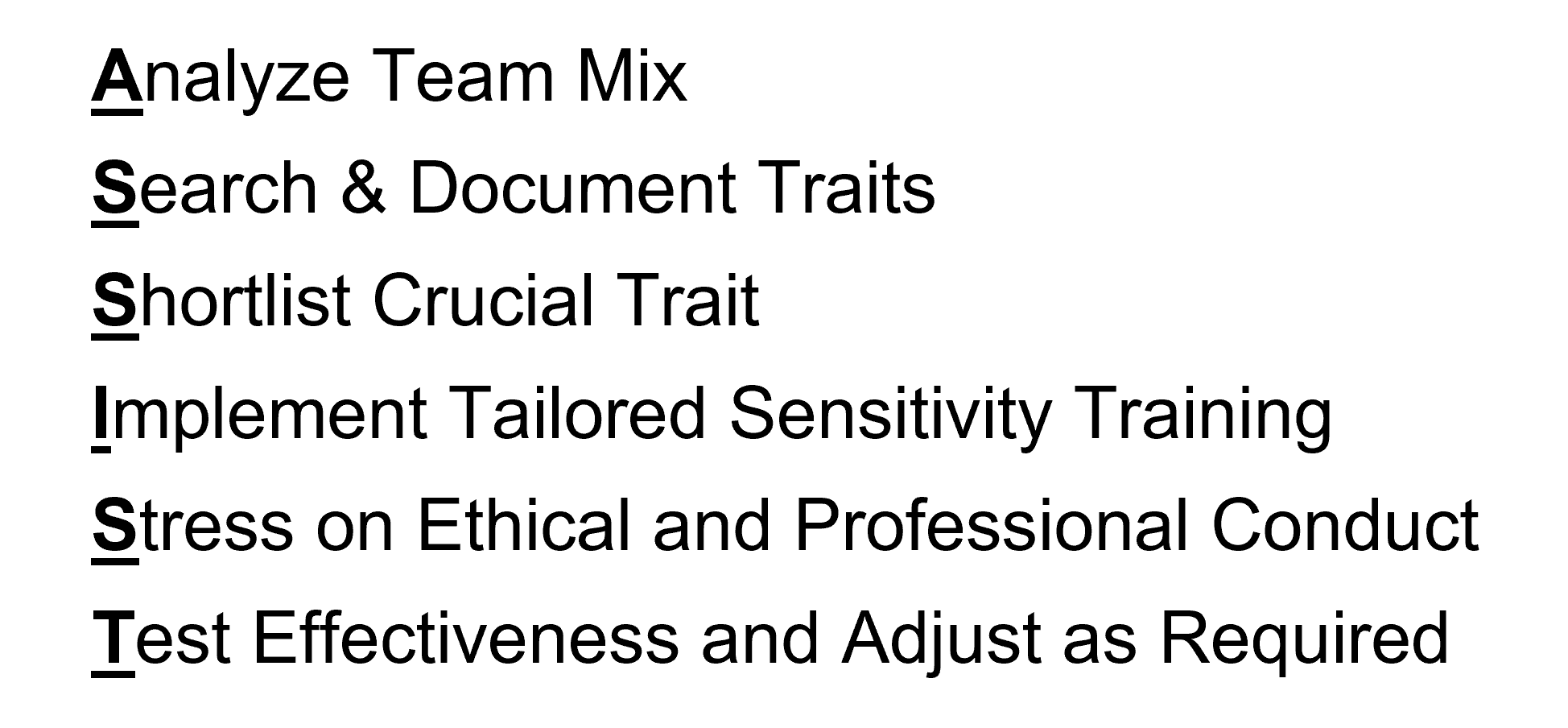
Katherine proposed a six-step process named “ASSIST” to manage cultural differences effectively:
When Katherine asked attendees to share their experiences, Guru narrated the recent project issue and actions he had taken. He asked, “What would you recommend?”
She replied that Guru’s actions were excellent responses. However, to prevent more such dangerous conflicts, the team would need to take a proactive stance on cultural differences.
At the tea break, Guru requested Katherine’s professional assistance in turning around the difficult situation. She readily agreed to help.
She began with an analysis of the team’s cultural mix and various traits that needed careful handling. Using customized team activities such as quizzes and role-plays, she sensitized the team on cultural differences.

Katherine’s interventions worked like a charm as conflicts significantly dropped.
As he approved a final payment, Guru thanked the consultant for her inputs. He told her that she had made a huge difference to his team’s chemistry and resolved to apply the six-step ASSIST process on every project.

Please comment on these factors to benefit our dynamic community here on projectmanagement.com:
- Have you faced similar issues with cultural diversity in your teams?
- What were the negative effects of these issues?
- What did you do to handle the problems?
Posted
by
Karthik Ramamurthy
on: May 31, 2019 01:36 PM |
Permalink
Comments (23)
Page: 1 2 next>
Please login or join to subscribe to this item

Zahara Khan
Program Lead, SEDP| Silver Jubilee Development Agency
Karachi, Sindh, Pakistan
Love the case. I have attended many international meetings where a lack of understanding of cultural norms & nuances resulted in conflicts. My current team has people from 6 local regions, speaking 9 languages, and widely differing professional backgrounds. Our organization has Diversity, Respect, Humility, and Fairness as some of its Core Values. These Values are included in the Job Description for every position in the organization and act as a compass for us when dealing with each other, partner institutions, and our targeted beneficiaries. This approach has helped us tremendously in leveraging our team's cultural diversity instead of letting it cause conflicts.

Drew Craig
Sr. Agile & Product Coach| Vanguard
Philadelphia, Pa, United States
Thank you, for the great perspectives.

Karthik Ramamurthy
Author, Say YES to Project Success| Founder KeyResultz
Chennai, Tamilnadu, Tamilnadu, India
@Zahara: Thanks a million for sharing your rich experiences with cultural diversity in your teams. It is interesting to see that two of the Core Values of your team -- Respect and Fairness -- are two of the four pillars of PMI's Code of Ethics and Professional Responsibility.
I hope you will continue to contribute your knowledge and skills for the benefit of our vibrant community here.
Karthik Ramamurthy
Author, Say YES to Project Success| Founder KeyResultz
Chennai, Tamilnadu, Tamilnadu, India
@Andrew Craig: Thanks a million for your kind words. They really made my day!

Alok Priyadarshi
Project Manager| Tata Consulting Engineers Limited
Jamshedpur, Jharkhand, India
Very interesting article. Thanks a lot Karthik!!
Alok Priyadarshi
Project Manager| Tata Consulting Engineers Limited
Jamshedpur, Jharkhand, India
Very interesting article. Thanks a lot Karthik!!
Karthik Ramamurthy
Author, Say YES to Project Success| Founder KeyResultz
Chennai, Tamilnadu, Tamilnadu, India
@Alok Priyadarshi: Thanks a million for your kind words. They really made my day!

Lily Murariu
Speaker, Author, Researcher| Public Service Canada
Cantley, Quebec, Canada
@Karthik, you brought up a good topic, that has an evergreen nature, and remains more and more relevant mainly in times where globalization and virtual work are so often discussed.
For more than a decade I managed and lead diverse teams; it is easy to draw some insights that age, cultural background, education, professional background they all have an impact on the dynamic of the team, actively engaging their leaders (project/program/portfolio management), and impacting the deliverable of the projects at any given time.
There is no simple formula but there are numerous approaches that can be considered towards alleviating a situation like the one you exemplified here, Karthik, that can commplement the ASSIST model you have shared:
-Start with embedding the values of the PMI Code of Ethics (https://www.pmi.org/-/media/pmi/documents/public/pdf/ethics/pmi-code-of-ethics.pdf), as respect, fairness, responsibility are values to be promoted throughout the daily work of each time.
-Address and treat situations like this one immediately and follow up on their dynamic; take the necessary decisions
-Consider cultural training and emerge cultural sensitivity practices in the daily activity.
-Train the trainer, in this case the leader. There is never enough awareness, training and education that leaders can be exposed to in order to make them and their teams successful
-Talk about harassment and bullying as cultural aspects can bring various perspectives on these two negative behavior which have a long standing impact on the teams if not addressed
-Performance manage the team and ensure that the code of ethics and healthy practices can be addressed
-Promote a healthy work environment
-Promote wellness in the work place and reward positive practices of the team members
Management of projects while leading diverse teams becomes an art and we are all called to become better and better at doing this.
Thanks,
Hi Karthik, only hope there is a Guru in every company.
Karthik Ramamurthy
Author, Say YES to Project Success| Founder KeyResultz
Chennai, Tamilnadu, Tamilnadu, India
Great storytelling Karthik. I am able to relate to a similar situation in my project too!
Thank you for the wonderful insight
Thanks so much Karthik. What an amazing and contemporary case! Yes, I have seen cultural differences to be a major cause of project failures. These triggers, when seen in the project environment need to be controlled on time.
While project managers may be the fire fighters and take on a lot of stress, some of these outbursts are unwarranted and damage the project team morale.
The steps that you have elaborated will surely help in managing such situations.
Thank you for bringing forth the case.

Rami Kaibni
 Community Champion
Senior Projects Manager | Field & Marten Associates
New Westminster, British Columbia, Canada
Great post Karthik, as usual.
Karthik Ramamurthy
Author, Say YES to Project Success| Founder KeyResultz
Chennai, Tamilnadu, Tamilnadu, India
@Lily Murariu: Thanks a million for your detailed comment which leverages your experience and adds great insights to this discussion.
The seven points you mentioned to strengthen the ASSIST model are certainly practical.
I'm sure you will continue adding value to our vibrant community here!
Karthik Ramamurthy
Author, Say YES to Project Success| Founder KeyResultz
Chennai, Tamilnadu, Tamilnadu, India
@Sripriya Narayanasamy: Thanks a ton for your kind words.
Do continue contributing your insights for the benefit of the project management community here!
Karthik Ramamurthy
Author, Say YES to Project Success| Founder KeyResultz
Chennai, Tamilnadu, Tamilnadu, India
@Rami Kaibni: Thank you very much for your kind words.
I'm very sure you will continue contributing your insights for the benefit of our dynamic community here!
Karthik Ramamurthy
Author, Say YES to Project Success| Founder KeyResultz
Chennai, Tamilnadu, Tamilnadu, India
@Deepa Bhide: Thanks a million for your insightful comment, and your kind words of appreciation.
Keeping cool in the face of crisis, as you mentioned firefighters do, certainly adds to effectiveness!
Do keep leveraging your experience and knowledge for the benefit of our valuable commuity here on projectmanagement.com

Alankar Karpe
Project and program management, Speaker and mentor | Wipro
Bangalore, India
Thanks for sharing this, Karthik! I have faced situations where cultural diversity caused problems such as low morale, damp team spirits. Since project timelines and deliverables creates a lot of pressure on team members, plus people are at multi location make these things worst. I found the way out is clear and direct communication so that understanding between the team members should increase.
Karthik Ramamurthy
Author, Say YES to Project Success| Founder KeyResultz
Chennai, Tamilnadu, Tamilnadu, India
@Alankar Karpe: Thanks a million for your detailed comment which leverages your experience and adds great insights to this discussion.
The point you mentioned about clear and direct communication improving understanding is certainly a great way to improve cultural sensitivities and improve chances of project success.
I'm sure you will continue adding value to our vibrant community here!

Amany Nuseibeh
Speaker, Global Leader | Optimal Consulting
Sydney, Nsw, Australia
What a great blog Karthik! Thank you for sharing, and thanks to Zahara, Lily, Deepa and Alankar for sharing their insight and experience. The soft skills of understanding and managing cultural differences are becoming more critical every day. Dealing with multicultural virtual teams adds another dimension to the complexity of communications and the challenges that every leader needs to overcome to foster a safe environment that is more conducive of success. Having said that, we are all humans at the end of the day, we share common ethical values "Respect, Responsibility, Fairness and Honesty". Empathy and ethics would be a strong foundation to kick start a high performing team.
Page:
1 2 next>
Please Login/Register to leave a comment.
|
"Truth comes out of error more readily than out of confusion."
- Francis Bacon
|




