Navigating AI in Project Management: A Comparison with Racing Co-Pilots and Driverless Cars
From the Ethics Bistro Blog
by Tara Leparulo,
Shenila Shahabuddin, Juan Posada Toro, Albert Agbemenu, Ming Yeung, Kannan Ganesan, Yannick Arekion, Witold Hendrysiak, Stelian ROMAN, Laszlo J. Kremmer MBA, CSPO®, CSM®, PMP®

We all tackle ethical dilemmas. Wrong decisions can break careers. Which are the key challenges faced? What are some likely solutions? Where can we find effective tools? Who can apply these and why? Dry, theoretical discussions don't help. Join us for lively, light conversations to learn, share and grow!
View Posts By:
Tara Leparulo
Shenila Shahabuddin
Juan Posada Toro
Albert Agbemenu
Ming Yeung
Kannan Ganesan
Yannick Arekion
Witold Hendrysiak
Stelian ROMAN
Laszlo J. Kremmer MBA, CSPO®, CSM®, PMP®
Past Contributors:
Dr. Deepa Bhide
Lily Murariu
Alankar Karpe
Bryan Shelby
Amany Nuseibeh
Mohamed Hassan
Fabio Rigamonti
Simona Bonghez
John Watson
Lissa Muncer
Valerie Denney
Majeed Hosseiney
Gretta Kelzi
Enrique Cappella
Rocio Briceno
Karthik Ramamurthy
Recent Posts
Professionalism Under Pressure: Choosing Respect When Conflict Escalates
The Credential Is a Promise: What Do Three Letters Really Say?
When the schedule slipped, so did accountability: Ethical reflections from an early ERP project - Part 2
When the schedule slipped, so did accountability: Ethical reflections from an early ERP project - Part 1
Do You Like to Pick and Choose Your Projects?
Categories
Aerospace and Defense,
Agile,
AI,
Ambassadors,
Artificial Intelligence,
Ask the Experts,
Behavior,
bottom line,
Business Acumen,
Business Ethics,
Business Ethics,
CEO,
CFO,
Change Management,
Chapters,
CIO,
code of conduct,
code of ethics,
Code of Ethics and Professional Conduct,
communication,
Conflict,
Construction,
courage honesty responsibility respect fairness,
Cultural Diversity,
Culture,
CxO,
Decision Making,
Decision-making,
Decision-making,
Digital Project Management,
Digital Transformation,
Diversity,
Do the right thing,
dugutalization project manager professionalism social media,
economy,
EDMF,
EMAG,
empathy,
Ethical Dilemma,
Ethical Leadership,
Ethics,
Ethics,
Ethics,
Ethics,
Ethics,
Ethics,
Ethics,
Ethics as a competence,
Ethics Bistro,
Ethics in Communication,
Ethics Insight Team,
Fairness,
fairness,
Governance,
Honesty,
honesty,
Human,
Information Technology,
Leadership,
Legal Project Management,
Legilsation,
Lessons Learned,
Negotiation,
Nexus,
Organizational Culture,
Organizational Project Management,
PMI Program Management,
PMI Talent Triangle,
PMIAA,
Portfolio Management,
Power Skills,
practitioner,
Product Management,
Professional Conduct,
professional conduct,
Professional Responsibility,
Professionalization,
professonal conduct,
Program Management,
Project,
Project Management,
project manager,
Regulatory,
research,
Respect,
respect,
Responsibility,
responsibility,
Risk Management,
Stakeholder Management,
Strategy,
Sustainability,
Team Assessment,
Teams,
Thought leadership,
tools,
Trust,
trust,
Values,
Values,
values,
Virtual Experience Series,
volunteers,
Ways of Working
Date
Categories:
AI,
Decision Making,
Decision-making,
Decision-making,
Do the right thing,
empathy,
Ethical Dilemma,
Ethical Leadership,
Ethics,
Ethics as a competence,
Ethics Bistro,
Ethics in Communication,
Ethics Insight Team,
Honesty,
honesty,
Leadership,
Professional Conduct,
professional conduct,
professonal conduct,
Respect,
respect,
Responsibility,
responsibility,
Trust,
trust,
Values,
Values,
values,
Ways of Working
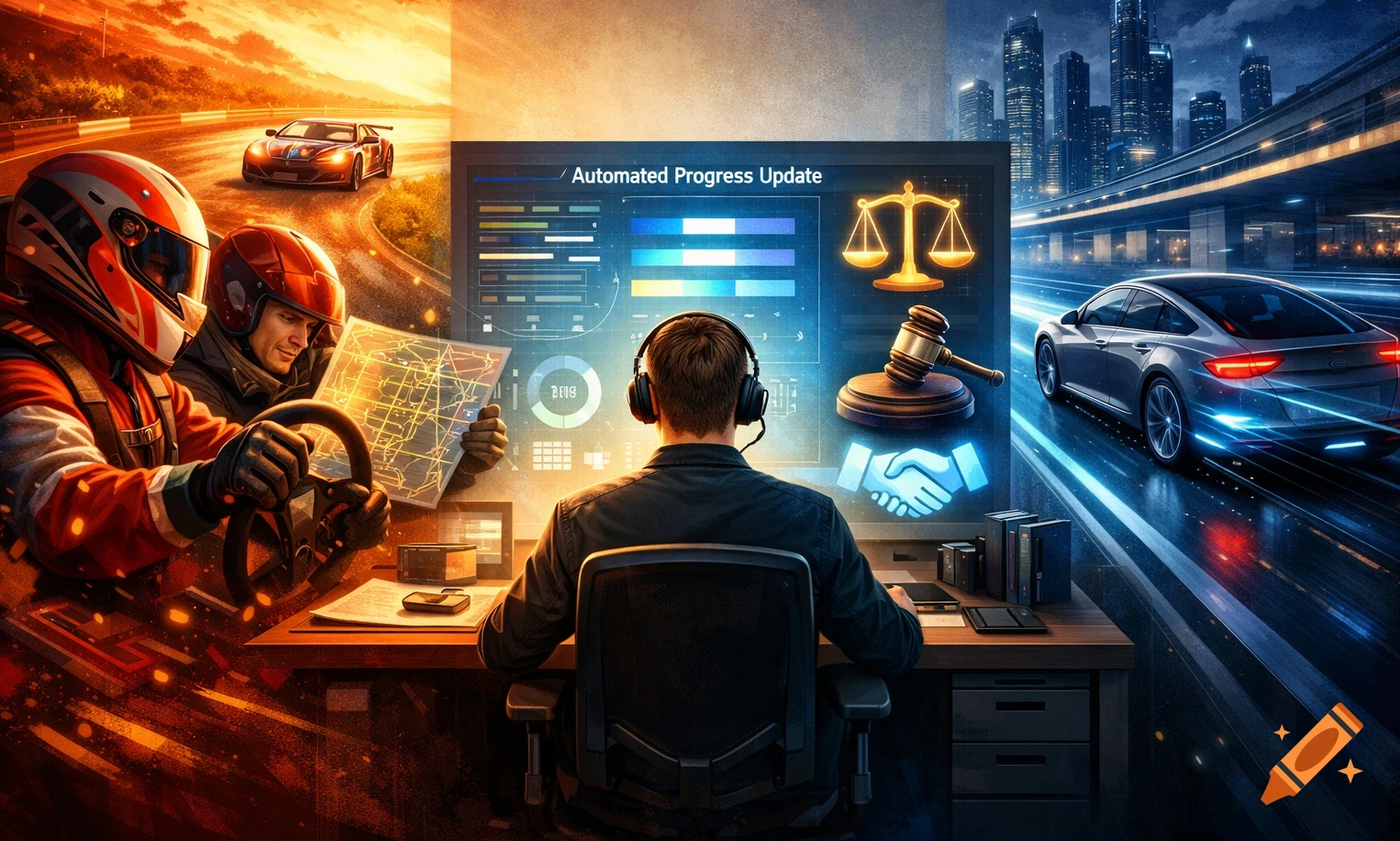 Artificial Intelligence (AI) is revolutionizing industries, and project management is no exception. With advanced tools supporting decision-making, risk mitigation, and efficiency, the project management landscape is increasingly intertwined with AI technologies. However, this evolution raises questions about human responsibility, autonomy, and ethics—questions like those faced in the realms of racing co-pilots and driverless cars. This blog explores the pros and cons of using AI in project management and compares these dynamics with racing environments and autonomous vehicle scenarios, focusing on the balance between human involvement and ethical considerations.
  The Role of AI in Project Management AI-driven tools, such as virtual assistants and machine learning algorithms, are increasingly used to streamline project management processes. From schedule optimization and predictive analytics to stakeholder communication and resource allocation, AI empowers project managers to make well-informed and efficient decisions. The Racing Co-Pilot Analogy: Shared Responsibility, Enhanced Performance In professional racing environments, a co-pilot performs critical tasks: navigating the course, analysing conditions, and advising the driver. This relationship mirrors the human-machine collaboration often seen in project management. Here, AI acts as a "co-pilot," assisting project managers while leaving primary control in human hands. Let us examine this analogy: Pros of AI as a Co-Pilot in Project Management:
 - Enhanced Decision-Making: AI algorithms analyse massive datasets to predict outcomes and recommend actions, akin to a co-pilot guiding navigational decisions during a race.
- Efficiency Gains: AI automates repetitive tasks and improves processes, freeing project managers to focus on strategy—like how co-pilots manage tactical information during high-speed races.
- Risk Reduction: By identifying potential issues in advance, AI serves as an advisor, much like a racing co-pilot warning about challenging road conditions, enabling initiative-taking corrections.
Cons of AI as a Co-Pilot: - Over-Reliance on AI: Just as a driver must remain vigilant and not entirely dependent on the co-pilot, project managers risk deferring critical decisions to AI tools, potentially leading to a lack of accountability.
- Ethical Blind Spots: Racing ethics demand fair play and adherence to rules; similarly, ethical AI use in project management calls for attention to bias, transparency, and fairness. Overlooking these aspects can harm stakeholders or perpetuate inequitable practices.
In this analogy, collaborative relationships thrive when the human retains ultimate responsibility while leveraging AI as a supporting entity. The Driverless Car Comparison: Autonomous AI in Project Management Shifting perspective, consider driverless cars: vehicles fully controlled by AI, requiring minimal human intervention. Some envision project management systems that resemble a driverless car—autonomous AI overseeing the project's execution from start to finish. While promising, this model has risks and challenges to consider. Pros of Autonomous AI in Project Management: - Unparalleled Precision: Autonomous AI can minimize human errors, akin to driverless cars maintaining perfect lane control or braking at precisely calculated intervals.
- Scalability: AI can manage complex, multi-layered projects beyond human capacity, like its role in optimizing traffic flows with autonomous vehicle networks.
Cons of Autonomous AI: - Loss of Human Judgment: Driverless cars highlight the drawback of removing human intuition, empathy, and situational awareness—a challenge mirrored in project management where human leadership and creativity are essential.
- Accountability Gaps: In a driverless car accident, responsibility is ambiguous. Similarly, with autonomous AI, project managers may struggle to allocate accountability for errors, raising ethical dilemmas.
- Ethical Concerns: Driverless cars must navigate moral conflicts (e.g., protecting passengers versus pedestrians). In project management, fully autonomous systems must grapple with potentially biased decisions affecting stakeholders, raising questions of fairness and inclusivity.
Ethical Considerations: Responsibility and Integrity Both racing co-pilots and driverless cars illustrate contrasting extremes in human-machine collaboration. A key differentiator in these scenarios is ethical responsibility: - In shared responsibility (co-pilot), humans are ethically required to oversee and correct AI outputs, ensuring alignment with organizational values and stakeholder trust. Like racing, project managers retain control while benefiting from AI's support.
- In autonomous systems (driverless cars), ethical concerns magnify as AI takes over critical decisions. Issues of fairness, inclusivity, and transparency emerge, demanding rigorous bias checks, accountability frameworks, and adherence to PMI’s Code of Ethics principles.
Driving AI responsibly in projects calls for a careful balance. Project managers must evaluate how AI’s involvement impacts stakeholder trust, transparency, and ethical integrity. Conclusion: The Road Ahead for AI in Project Management The racing co-pilot and driverless car analogies shed light on the pivotal balance required in leveraging AI for project management. While AI offers immense benefits—such as efficiency, precision, and scalability—it also raises concerns about accountability, ethical responsibility, and judgment. As the PMI Code of Ethics underscores values like fairness, honesty, and responsibility, project managers must ensure AI tools serve as partners rather than replacements, fostering trust and inclusivity. By choosing the right path—whether enhanced collaboration or selective autonomy—project managers can steer their projects responsibly toward success while maintaining the ethical values essential to effective leadership. Related discussion topic: Can project management run on AI autopilot?
https://tinyurl.com/mr497je7
Posted
by
Stelian ROMAN
on: March 04, 2026 03:42 AM |
Permalink
Comments (8)
Please login or join to subscribe to this item
AI is transforming project management, from co-pilot support to autonomous execution. But projects are human systems ethics, judgment, and stakeholder trust can’t be automated. The key is collaboration: let AI optimize and inform, while humans steer strategy, accountability, and ethical decisions. Autopilot can assist, but humans remain essential.

Ming Yeung
Professor (adjunct part time)| George Brown Polytechnic/Fanshawe College/Humber Polytechnic
Toronto, Ontario, Canada
Roman, your blog offers a thoughtful and engaging exploration of how AI is reshaping project management, and the analogies to racing co‑pilots and driverless cars are especially effective in illustrating the spectrum of human–machine collaboration.
By comparing AI‑assisted project management to a racing co‑pilot, the authors highlight the value of shared responsibility where AI enhances decision‑making, efficiency, and risk mitigation while the human project manager retains control and ethical accountability.
This framing is compelling because it reinforces the idea that AI should augment, not replace, human judgment.
The shift to the driverless car analogy is equally insightful, emphasizing the risks of over‑automation. The discussion around loss of human intuition, accountability gaps, and ethical dilemmas mirrors real concerns in project environments where AI may make decisions that affect stakeholders without transparent reasoning.
Your blog’s emphasis on fairness, inclusivity, and alignment with PMI’s Code of Ethics strengthens its relevance for practitioners navigating emerging technologies.
What stands out most is the balanced tone: you neither glorify AI nor dismiss its potential. Instead, they encourage project managers to adopt AI responsibly, maintaining oversight while leveraging its strengths.
This aligns well with contemporary expectations for ethical leadership, especially in environments where trust and transparency are essential.
Thank you for sharing your for professional deliberation and reflection.
Ming Yeung
Professor (adjunct part time)| George Brown Polytechnic/Fanshawe College/Humber Polytechnic
Toronto, Ontario, Canada
Reflection: Choosing Ethics When Pressures Rise
Reading the discussion on balancing stakeholder interests reminds me how often project professionals stand at the crossroads between ethical responsibility and organizational pressure. The scenario is not theoretical; it mirrors real dilemmas many of us have faced. When timelines tighten, budgets shrink, and expectations escalate, the temptation to soften the truth or delay difficult conversations can be strong. Yet these are precisely the moments when our ethical compass must remain steady.
Throughout my career, across financial services, fintech leadership, and now as part of the PMI Ethics Advisory Team, I have learned that ethical clarity is not an abstract ideal but a daily discipline. It requires mindfulness, courage, and a willingness to speak truth even when it is inconvenient. Transparency, fairness, and respect are not optional values; they are the foundation of trust. And trust, once compromised, is nearly impossible to rebuild.
Ethical dilemmas rarely announce themselves. They emerge quietly: a request to “reframe” a risk, pressure to accelerate work at the expense of team well‑being, or subtle encouragement to prioritize optics over honesty. Our responsibility is to notice these moments, pause, and choose integrity.
Here is a call to action to my fellow practitioners: immerse yourselves in ethics. Stay vigilant. Question assumptions. Speak up when something feels misaligned. Celebrate ethical behaviour in others and hold yourselves accountable to the standards you expect from your teams. Ethical leadership is not a role; it is a practice. And our profession is stronger when each of us commits to it fully.

Amari Zivai
Sales Representative| Total Life Changes
Michigan, United States

Noha Fadel
Infrastructure team leader/ Project Manager| Saudi Consulting Services - SAUD CONSULT
Cairo, C, Egypt

Juan Posada Toro
Customer Success Manager| Rockwell Automation
Envigado, Antioquia, Colombia
Thanks for sharing my dear Dan.
I really like the co-pilot analogy, especially because it keeps human responsibility at the center. For me, the real ethical risk is not AI making a wrong recommendation, but humans accepting it without questioning it. AI can support our judgment, but it cannot take responsibility for the consequences of our decisions.
The more autonomous AI becomes, the more important it is to be clear about who remains accountable. That distinction will become increasingly critical in project management.

Stelian ROMAN
Project Manager| MicroSafety
Carlingford, New South Wales, Australia
@Juan, like in racing, the only driver is the one holding the steering wheel and with the foot on the brake. Assuming that AI can make decisions is dangerous. In manufacturing, robots took the jobs that humans couldn't do (toxic environment, hard labour) or repetitive tasks. AI can augment human intelligence, but we are far from being ready to let it think for us.
From an ethics perspective, I would've liked to extend the 4 laws proposed for physical robots:
- A robot may not injure a human being or, through inaction, allow a human being to come to harm.
- A robot must obey the orders given it by human beings except where such orders would conflict with the First Law.
- A robot must protect its own existence as long as such protection does not conflict with the First or Second Law.
- A robot may not harm humanity, or, by inaction, allow humanity to come to harm.
Juan Posada Toro
Customer Success Manager| Rockwell Automation
Envigado, Antioquia, Colombia
Hi Dan.
I like the “driver holding the steering wheel” analogy.
For me, the key ethical question is not only what AI can decide, but what decisions we should never delegate to AI, regardless of how capable it becomes.
Please Login/Register to leave a comment.
|
The rumors of my death have been greatly exaggerated.
- Mark Twain
|




