Support to Develop
by Luis Branco

This blog addresses management-related topics and has three areas of focus: 1. Technical skills; 2. Competencies in the field of interpersonal relations and communication (including personal organization and delegation, leadership, teamwork, conflict resolution, conducting meetings, and negotiation); and 3. Strategy (including diagnosis, strategic guidelines, and implementation).4.Technology
Recent Posts
Delegation with Purpose: Building Autonomy and Developing Capability
RCPCV™: A Method for Decision-Making and Continuous Improvement
The Same Change Can Succeed and Fail at the Same Time
What Must Exist Even When No Single Role Owns the Whole?
PHASE 4 – THE EMERGENCE
Categories
Agile,
Career Development,
Career Development,
Career Development,
Career Development,
Career Development,
Career Development,
Career Development,
Career Development,
Career Development,
Career Development,
Career Development,
Career Development,
Career Development,
Career Development,
Career Development,
Career Development,
Career Development,
Career Development,
Career Development,
Career Development,
Career Development,
Career Development,
Career Development,
Career Development,
Career Development,
Career Development,
Career Development,
Career Development,
Career Development,
Career Development,
Career Development,
Career Development,
Career Development,
Career Development,
Career Development,
Career Development,
Career Development,
Career Development,
Career Development,
Career Development,
Career Development,
Career Development,
Career Development,
Career Development,
Career Development,
Career Development,
Career Development,
Career Development,
Career Development,
Career Development,
Career Development,
Career Development,
Career Development,
Career Development,
Career Development,
Career Development,
Career Development,
Career Development,
Career Development,
Career Development,
Career Development,
Career Development,
Career Development,
Career Development,
Career Development,
Career Development,
Career Development,
Career Development,
Career Development,
Career Development,
Career Development,
Career Development,
Career Development,
Career Development,
Career Development,
Career Development,
Career Development,
Career Development,
Career Development,
Career Development,
Career Development,
Career Development,
Career Development,
Career Development,
Career Development,
Career Development,
Career Development,
Career Development,
Career Development,
Career Development,
Career Development,
Career Development,
Career Development,
Career Development,
Career Development,
Career Development,
Career Development,
Career Development,
Career Development,
Career Development,
Career Development,
Career Development,
Career Development,
Career Development,
Career Development,
Career Development,
Career Development,
Career Development,
Career Development,
Career Development,
Career Development,
Career Development,
Career Development,
Career Development,
Career Development,
Career Development,
Career Development,
Career Development,
Career Development,
Career Development,
Career Development,
Career Development,
Education,
Governance,
Governance,
Governance,
Governance,
Governance,
Governance,
Governance,
Governance,
Governance,
Governance,
Governance,
Governance,
Governance,
Governance,
Governance,
Governance,
Governance,
Governance,
Governance,
Governance,
Governance,
Governance,
In,
Integration Management,
Interpersonal Skills,
Interpersonal Skills,
Interpersonal Skills,
Interpersonal Skills,
Interpersonal Skills,
Interpersonal Skills,
Interpersonal Skills,
Interpersonal Skills,
Interpersonal Skills,
Interpersonal Skills,
Interpersonal Skills,
Interpersonal Skills,
Interpersonal Skills,
Interpersonal Skills,
Interpersonal Skills,
Interpersonal Skills,
Interpersonal Skills,
Interpersonal Skills,
Interpersonal Skills,
Interpersonal Skills,
Interpersonal Skills,
Interpersonal Skills,
Interpersonal Skills,
Interpersonal Skills,
Interpersonal Skills,
Interpersonal Skills,
Interpersonal Skills,
Interpersonal Skills,
Interpersonal Skills,
Interpersonal Skills,
Interpersonal Skills,
Interpersonal Skills,
Interpersonal Skills,
Interpersonal Skills,
Interpersonal Skills,
Interpersonal Skills,
Interpersonal Skills,
Interpersonal Skills,
Interpersonal Skills,
Interpersonal Skills,
Interpersonal Skills,
Interpersonal Skills,
Interpersonal Skills,
Interpersonal Skills,
Interpersonal Skills,
Interpersonal Skills,
Interpersonal Skills,
Interpersonal Skills,
Interpersonal Skills,
Interpersonal Skills,
Interpersonal Skills,
Interpersonal Skills,
Interpersonal Skills,
Interpersonal Skills,
Interpersonal Skills,
Interpersonal Skills,
Interpersonal Skills,
Interpersonal Skills,
Interpersonal Skills,
Interpersonal Skills,
Interpersonal Skills,
Interpersonal Skills,
Interpersonal Skills,
Interpersonal Skills,
Interpersonal Skills,
Interpersonal Skills,
Interpersonal Skills,
Interpersonal Skills,
Interpersonal Skills,
Interpersonal Skills,
Interpersonal Skills,
Interpersonal Skills,
Interpersonal Skills,
Interpersonal Skills,
Interpersonal Skills,
Interpersonal Skills,
Interpersonal Skills,
Interpersonal Skills,
Interpersonal Skills,
Interpersonal Skills,
Interpersonal Skills,
Interpersonal Skills,
Interpersonal Skills,
Interpersonal Skills,
Interpersonal Skills,
Interpersonal Skills,
Interpersonal Skills,
Interpersonal Skills,
Interpersonal Skills,
Interpersonal Skills,
Interpersonal Skills,
Interpersonal Skills,
Interpersonal Skills,
Interpersonal Skills,
Interpersonal Skills,
Interpersonal Skills,
Interpersonal Skills,
Interpersonal Skills,
Interpersonal Skills,
Interpersonal Skills,
Interpersonal Skills,
Interpersonal Skills,
Interpersonal Skills,
Interpersonal Skills,
Interpersonal Skills,
Interpersonal Skills,
Interpersonal Skills,
Interpersonal Skills,
Interpersonal Skills,
Interpersonal Skills,
Interpersonal Skills,
Interpersonal Skills,
Interpersonal Skills,
Interpersonal Skills,
Interpersonal Skills,
Interpersonal Skills,
Interpersonal Skills,
Interpersonal Skills,
Interpersonal Skills,
Interpersonal Skills,
Interpersonal Skills,
Interpersonal Skills,
Knowledge Management,
le,
lea,
Leadership,
Leadership,
Leadership,
Leadership,
Leadership,
Leadership,
Leadership,
Leadership,
Leadership,
Leadership,
Leadership,
Leadership,
Leadership,
Leadership,
Leadership,
Leadership,
Leadership,
Leadership,
Leadership,
Leadership,
Leadership,
Leadership,
Leadership,
Leadership,
Leadership,
Leadership,
Leadership,
Leadership,
Leadership,
Leadership,
Leadership,
Leadership,
Leadership,
Leadership,
Leadership,
Leadership,
Leadership,
Leadership,
Leadership,
Leadership,
Leadership,
Leadership,
Leadership,
Leadership,
Leadership,
Leadership,
Leadership,
Leadership,
Leadership,
Leadership,
Leadership,
Leadership,
Leadership,
Leadership,
Leadership,
Leadership,
Leadership,
Leadership,
Leadership,
Leadership,
Leadership,
Leadership,
Leadership,
Leadership,
Leadership,
Leadership,
Leadership,
Leadership,
Leadership,
Leadership,
Leadership,
Leadership,
Leadership,
Leadership,
Leadership,
Leadership,
Leadership,
Leadership,
Leadership,
Leadership,
Leadership,
Leadership,
Leadership,
Leadership,
Leadership,
Leadership,
Leadership,
Leadership,
Leadership,
Leadership,
Leadership,
Leadership,
Leadership,
Leadership,
Leadership,
Leadership,
Leadership,
Leadership,
Leadership,
Leadership,
Leadership,
Leadership,
Leadership,
Leadership,
Leadership,
Leadership,
Leadership,
Leadership,
Leadership,
Leadership,
Leadership,
Leadership,
Leadership,
Leadership,
Leadership,
Leadership,
Leadership,
Leadership,
Leadership,
Leadership,
Leadership,
Leadership,
Leadership,
or,
Organizational Project Management,
Portfolio Management,
Program,
Program Management,
Strategy,
Strategy,
Strategy,
Strategy,
Strategy,
Strategy,
Strategy,
Strategy,
Strategy,
Strategy,
Strategy,
Strategy,
Strategy,
Strategy,
Strategy,
Strategy,
Strategy,
Strategy,
Strategy,
Strategy,
Strategy,
Strategy,
Strategy,
Strategy,
Strategy,
Strategy,
Strategy,
Strategy,
Strategy,
Strategy,
Strategy,
Strategy,
Strategy,
Strategy,
Strategy,
Strategy,
Strategy,
Strategy,
Strategy,
Strategy,
Strategy,
Strategy,
Strategy,
Strategy,
Strategy,
Strategy,
Strategy,
Strategy,
Strategy,
Strategy,
Strategy,
Strategy,
Strategy,
Strategy,
Strategy,
Strategy,
Strategy,
Strategy,
Strategy,
Strategy,
Strategy,
Strategy,
Strategy,
Strategy,
Strategy,
Strategy,
Strategy,
Strategy,
Strategy,
Strategy,
Strategy,
Strategy,
Strategy,
Strategy,
Strategy,
Strategy,
Strategy,
Strategy,
Strategy,
Strategy,
Strategy,
Strategy,
Strategy,
Strategy,
Strategy,
Strategy,
Strategy,
Strategy,
Strategy,
Strategy,
Strategy,
Strategy,
Strategy,
Strategy,
Strategy,
Strategy,
Strategy,
Strategy,
Strategy,
Strategy,
Strategy,
Strategy,
Strategy,
Strategy,
Strategy,
Strategy,
Strategy,
Strategy,
Strategy,
Strategy,
Strategy,
Strategy,
Strategy,
Strategy,
Strategy,
Strategy,
Strategy,
Strategy,
Strategy,
Strategy,
Strategy,
Strategy,
Strategy,
Sustainability,
Talent Management,
Talent Management,
Talent Management,
Talent Management,
Talent Management,
Talent Management,
Talent Management,
Talent Management,
Talent Management,
Talent Management,
Talent Management,
Talent Management,
Talent Management,
Talent Management,
Talent Management,
Talent Management,
Talent Management,
Talent Management,
Talent Management,
Talent Management,
Talent Management,
Talent Management,
Talent Management,
Talent Management,
Talent Management,
Talent Management,
Talent Management,
Talent Management,
Talent Management,
Talent Management,
Talent Management,
Talent Management,
Talent Management,
Talent Management,
Talent Management,
Talent Management,
Talent Management,
Talent Management,
Talent Management,
Talent Management,
Talent Management,
Talent Management,
Talent Management,
Talent Management,
Talent Management,
Talent Management,
Talent Management,
Talent Management,
Talent Management,
Talent Management,
Talent Management,
Talent Management,
Talent Management,
Talent Management,
Talent Management,
Talent Management,
Talent Management,
Talent Management,
Talent Management,
Talent Management,
Talent Management,
Talent Management,
Talent Management,
Talent Management,
Talent Management,
Talent Management,
Talent Management,
Talent Management,
Talent Management,
Talent Management,
Talent Management,
Talent Management,
Talent Management,
Talent Management,
Talent Management,
Talent Management,
Talent Management,
Talent Management,
Talent Management,
Talent Management,
Talent Management,
Talent Management,
Talent Management,
Talent Management,
Talent Management,
Talent Management,
Talent Management,
Talent Management,
Talent Management,
Talent Management,
Talent Management,
Talent Management,
Talent Management,
Talent Management,
Talent Management,
Talent Management,
Talent Management,
Talent Management,
Talent Management,
Talent Management,
Talent Management,
Talent Management,
Talent Management,
Talent Management,
Talent Management,
Talent Management,
Talent Management,
Talent Management,
Talent Management,
Talent Management,
Talent Management,
Talent Management,
Talent Management,
Talent Management,
Talent Management,
Talent Management,
Talent Management,
Talent Management,
Talent Management,
Talent Management,
Talent Management,
Talent Management,
Talent Management
Date
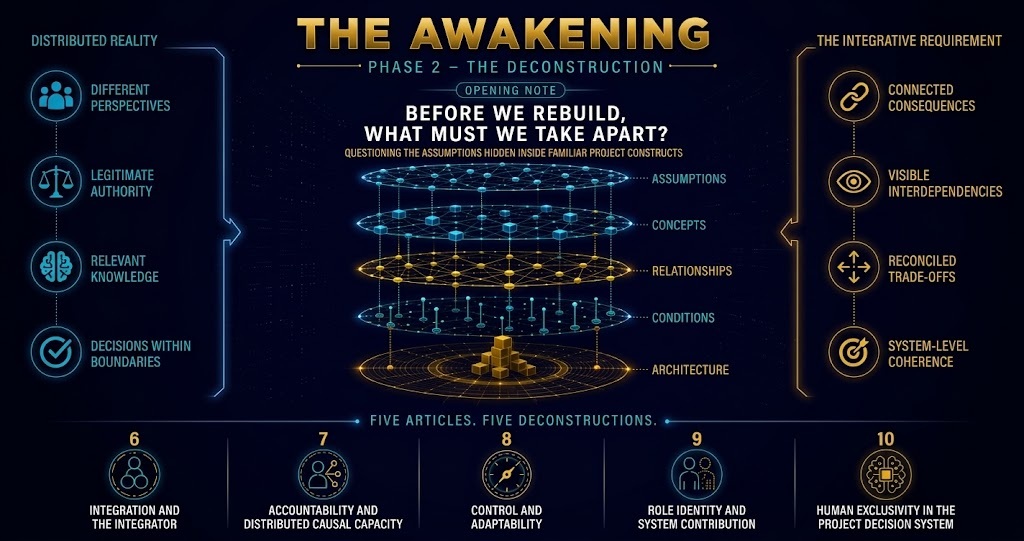
Questioning the assumptions hidden inside familiar project constructs
The first phase of THE AWAKENING began with a question.
What changes when project leadership becomes increasingly distributed?
Five reflections later, the answer became more precise.
Leadership has not disappeared.
Integration has not been forgotten.
Agility is not inherently the problem.
The Project Manager has not simply stopped integrating.
And distributed leadership does not, by itself, create an integration gap.
What has changed is the architecture within which these functions are exercised.
Leadership, authority, knowledge, adaptation and management responsibilities can increasingly reside in different places.
Responsibility for integrative work can also be distributed.
But the interdependencies among those distributions do not disappear.
Phase 1 therefore ended with a more precise conclusion:
The challenge is not that leadership has disappeared. Nor that integration has been forgotten. It is that as leadership, authority and management responsibilities become increasingly distributable, the architecture of integration must remain sufficiently explicit and capable relative to the material interdependencies created by that distribution. Otherwise, locally legitimate decisions can become globally incoherent.
That was The Revealing.
But revealing the problem is not the same as understanding the assumptions through which we interpret it.
That is where Phase 2 begins.
From Revealing to Deconstructing
Project management has developed around concepts that are both useful and familiar.
Leadership.
Authority.
Responsibility.
Accountability.
Control.
Autonomy.
Governance.
Coordination.
Integration.
Alignment.
Roles.
These concepts help us organize action.
But familiarity can also make relationships between them appear necessary before that necessity has been tested.
If there is integration, we may look for an integrator.
If someone is accountable, we may assume that person must also possess authority.
If control decreases, we may assume autonomy increases.
If information is visible, we may assume that what matters will be recognized.
If responsibilities are clearly allocated, we may assume consequential relationships among them will also be recognized.
If everyone is aligned, we may assume the system will remain coherent.
If governance exists, we may assume integration follows.
None of these relationships should be rejected in advance.
But neither should they be accepted merely because they are familiar.
Phase 2 will test them.
Deconstruction Is Not Rejection
The purpose of deconstruction is not to declare established project structures obsolete.
Nor is it to replace Project Managers, governance, accountability, control or established management practices with a new vocabulary.
It is something more disciplined.
To separate what has been treated as inseparable, so that we can test what is essential, what is contingent, and what actually follows under different organizational conditions.
That distinction matters.
An integrator may be highly valuable.
The question is whether integration inherently requires one.
Control may preserve coherence.
The question is which forms of control do so, under what conditions, and when they begin to constrain useful adaptation.
Accountability is often associated with authority and causal capacity.
The question is whether accountability can remain legitimate when the conditions required to influence outcomes reside in different places or become materially constrained.
Roles can concentrate functions, capabilities and professional identity.
The question is whether those functions necessarily depend on the role boundaries through which they have traditionally been organized.
Project decision systems have historically been designed around human analysis, judgment, authority and accountability.
The question is which of those relationships remain necessary when AI becomes capable of analysis, recommendation and bounded action.
Deconstruction therefore begins neither with acceptance nor rejection.
It begins with a more demanding question:
What exactly must be true for the relationship we have assumed to hold?
The Unit of Analysis Must Also Be Questioned
Phase 1 already exposed one reason this matters.
A project can contain competent people, legitimate authority, clear responsibilities, sound decisions, effective teams and appropriate governance mechanisms, yet still produce consequences that cannot be adequately understood by examining any one decision in isolation.
Decisions interact.
Responsibilities intersect.
Authority boundaries meet.
Consequences can propagate across boundaries.
And some risks become visible only at the level of those relationships.
Deconstruction therefore cannot focus only on roles.
It must also examine the relationships among:
Functions, actors, decisions, authority, information, incentives, boundaries, interdependencies and consequences.
The question is no longer simply:
Who does what?
It also becomes:
Which relationships, if any, must exist among differentiated responsibilities for the system to remain governable and sufficiently coherent?
Phase 1 Had Already Begun the Deconstruction
Some of this work has already started.
Phase 1 separated integration from governance, coordination and alignment.
It also distinguished local validity from systemic coherence.
These were not semantic exercises.
They changed what we learned to look for.
A governance structure can establish legitimate authority, decision rights, accountability and oversight without ensuring that every material interdependency is recognized and reconciled.
Activities can be coordinated while consequential trade-offs remain unresolved.
People can remain aligned around strategic intent while changing conditions create new incompatibilities.
And decisions can be rational, evidence-informed, legitimately authorized and defensible within their own contexts while their combined consequences become systemically incoherent.
The implication is important.
Concepts that interact should not automatically be treated as equivalent, and functions that have historically resided together should not automatically be assumed to be inseparable.
Phase 2 makes that principle explicit.
What Happens When the Conditions Separate?
Consider a familiar expectation.
Someone is responsible for integration.
But what if that person can see a material interdependency and lacks the legitimate authority to address it?
What if they possess authority but lack relevant knowledge?
What if they possess authority and knowledge but become involved only after meaningful alternatives have disappeared?
What if the formal conditions to act exist, but exercising responsibility requires challenging a previous decision, established position or material interest?
These are not necessarily the same problem.
Nor should they automatically receive the same explanation.
Treating them as one can hide the architecture through which responsibility, authority, knowledge, capability, discretion and opportunity to act are actually connected.
Phase 2 will therefore repeatedly separate constructs that are often compressed together.
Not to fragment understanding.
But to make their relationships more precise.
The Method of Phase 2
Each reflection will begin with a relationship that appears intuitively plausible.
Then it will subject that relationship to adversarial testing.
What happens if one element exists without the other?
Under which conditions does the relationship hold?
Under which conditions does it fail?
What mechanism actually connects the two?
At what level of analysis does that mechanism operate?
Who or what must possess the relevant capacity?
What evidence would allow us to distinguish a necessary relationship from one that is merely conventional?
And, importantly:
What would falsify the proposition?
The objective is not to protect the argument developed in Phase 1.
It is to expose it to stronger tests.
If a proposition survives, it should survive because meaningful alternatives and counterconditions were seriously examined.
If it does not, THE AWAKENING should change with the evidence.
A defined sequence of inquiry does not predetermine its conclusions.
What Phase 2 Will Deconstruct
Five questions will structure this phase.
Integration and the Integrator
Does system-level integration inherently require a designated integrator, or can integrative capacity be produced through alternative architectures?
Accountability and Distributed Causal Capacity
Under what conditions can accountability remain legitimate when authority, knowledge, capability and discretion reside in different places?
Control and Adaptability
Which forms of control remain necessary for coherence, and under what conditions do they begin to weaken useful autonomy and adaptation?
Role Identity and System Contribution
Should professional identity continue to be organized primarily around the Project Manager role, or around the contributions and capabilities required by the project system?
Human Exclusivity in the Project Decision System
Which assumptions about human execution, authority, agency and accountability remain valid when AI becomes capable of analysis, recommendation and bounded action?
These questions structure the inquiry. They do not prescribe its answers.
Some inherited relationships may survive scrutiny.
Some may need to be qualified.
Some may prove contingent on particular organizational conditions.
And some apparent dichotomies may become less useful once the underlying architecture is examined more closely.
That uncertainty is not a weakness of the inquiry.
It is the reason for conducting it.
Before We Rebuild
There is a temptation, once a structural problem becomes visible, to design the solution immediately.
A new role.
A new governance mechanism.
A new accountability model.
A new framework.
A new layer of control.
But premature reconstruction carries its own risk.
We may try to solve the problem using assumptions that have not themselves been tested.
So Phase 2 will resist that temptation.
Before asking what the future architecture of project leadership should become, we need to establish which parts of our inherited conceptual architecture are genuinely necessary, which are contingent, and which relationships survive adversarial testing.
Only then does reconstruction become meaningful.
Phase 1 revealed an architectural problem.
Phase 2 will question the assumptions through which that problem is normally understood.
And it begins with perhaps the most obvious assumption of all.
Integration matters.
Phase 1 gave us strong reasons to retain that conclusion.
But another proposition does not automatically follow from it:
That integration requires an integrator.
So the first question of THE DECONSTRUCTION is deceptively simple:
Does Integration Need an Integrator?
That is where Phase 2 begins |
Posted on: September 09, 2026 04:53 AM
|
Permalink |
Comments (11)
|
"When I examine myself and my methods of thought, I come to the conclusion that the gift of fantasy has meant more to me than my talent for absorbing positive knowledge."
- Albert Einstein
|




